
Once you’ve got Japanese verbs down in their basic masu / masen form, the next big step is learning how to point at things and talk about them — and how to connect ideas in the same sentence. That’s exactly what this lesson covers.
We’re looking at Dialogue 2 from Lesson 1 of a real Japanese course — a short shopping conversation between Ms. Honda and Mr. Smith. From this one dialogue we get four really important grammar points that you’ll use constantly in everyday Japanese: the ko-so-a-do series (kore, sore, are, dore), the contrast particle wa, the addition particle mo, and the connective kedo (but).
Kore Sore Are in Japanese Explained – Ko-So-A-Do, Particles Wa and Mo, and Kedo for Beginners
If you haven’t read the previous grammar lesson yet, go through how Japanese verbs work (masu and masen) first — this lesson builds directly on that. And if your still working on pronunciation, my post on Japanese long vowels and pitch accent covers the sounds you’ll need for all the vocabulary here.
📌 How to use this lesson: Read through the dialogue and grammar notes, then work through each drill out loud. The speaking drills at the end are where the real learning happens — don’t just read the answers, say them.
Dialogue 2 – In a Store
Ms. Honda and Mr. Smith are shopping together. This is a very natural, realistic conversation — the kind of thing you’d hear between colleagues or friends looking at products in a Japanese store or online.
Honda: あれ、買いますか。
Are, kaimasu ka. — Will you buy that (over there)?
Smith: ええ、買いますけど…
Ee, kaimasu kedo… — Yes, I will, but…
Honda: これは?
Kore wa? — How about this?
Smith: ああ、それもちょっといりますね。
Aa, sore mo chotto irimasu ne. — Oh, we need a few of those, too, don’t we?
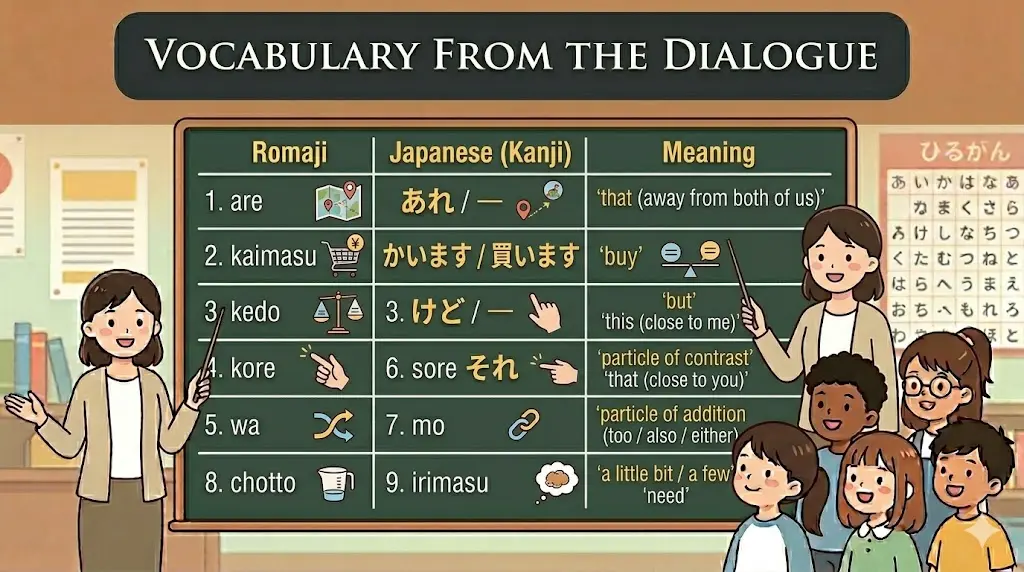
Vocabulary from the Dialogue
| Romaji | Japanese | Kanji | Meaning |
|---|---|---|---|
| are | あれ | — | that (away from both of us) |
| kaimasu | かいます | 買います | buy |
| kedo | けど | — | but |
| kore | これ | — | this (close to me) |
| wa | は | — | particle of contrast |
| sore | それ | — | that (close to you) |
| mo | も | — | particle of addition (too / also / either) |
| chotto | ちょっと | — | a little bit / a few |
| irimasu | いります | — | need |
Additional Vocabulary
| Romaji | Japanese | Kanji | Meaning |
|---|---|---|---|
| ga | が | — | but (more formal than kedo) |
| takusan | たくさん | — | a lot |
| mimasu | みます | 見ます | look / watch |
| tsukaimasu | つかいます | 使います | use |
| kikimasu | ききます | 聞きます | listen / ask |
| yomimasu | よみます | 読みます | read |
| kakimasu | かきます | 書きます | write / draw |
| hanashimasu | はなします | 話します | talk / speak |
1-2-1 Noun + Verb – Japanese Word Order and Context
As we saw in the previous grammar lesson, Japanese doesn’t require a subject or object if its already clear from the context. But when you do need to specify them — for example, when pointing at something specific — you place the noun before the verb.
あれ、たべますか。 Are, tabemasu ka. — Do you eat that?
これ、ぜんぜんわかりません。 Kore, zenzen wakarimasen. — I don’t understand this at all.
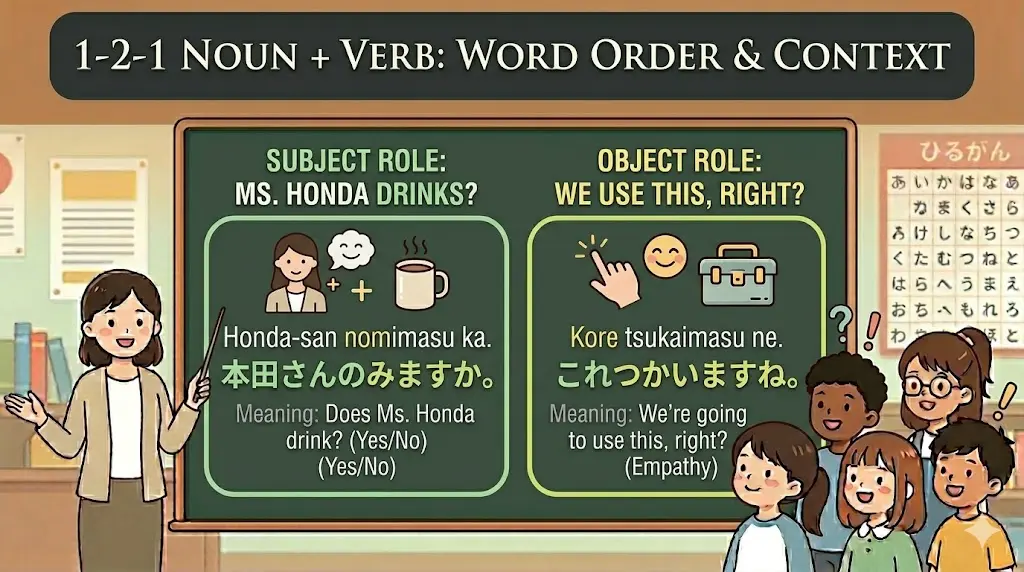
Nouns in a Japanese sentence can relate to the verb in different ways. Here are the main ones:
| Role | Example (Romaji) | Japanese | English |
|---|---|---|---|
| Subject | Honda-san nomimasu ka. | 本田さんのみますか。 | Does Ms. Honda drink? |
| Object | Kore tsukaimasu ne. | これつかいますね。 | We’re going to use this, right? |
The standard word order in Japanese is: Time – Subject – Object – Adverb – Verb. The verb must come at the end, but the noun order before the verb is relatively flexible. When you move a noun to the front of the sentence (outside the usual order), it gets more focus or emphasis.
Watashi kore yoku wakarimasu. — I understand this well. (neutral order)
Kore, watashi yoku wakarimasu. — This, I understand well. (kore is emphasised)
💡 Why does word order flexibility matter? Because in Japanese conversation, what you want to emphasise or highlight often moves to the front of the sentence — similar to how in English we might say “That one — I love it” instead of “I love that one.” Understanding this helps you sound more natural and also helps you understand what native Japanese speakers are emphasising when they talk.
1-2-2 Kore, Sore, Are, Dore – The Ko-So-A-Do Series Explained
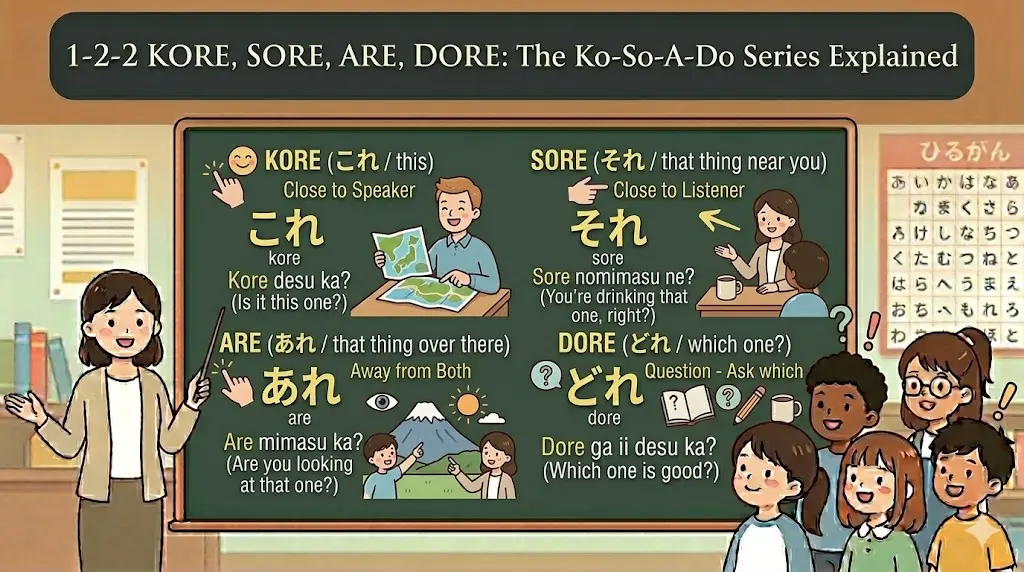
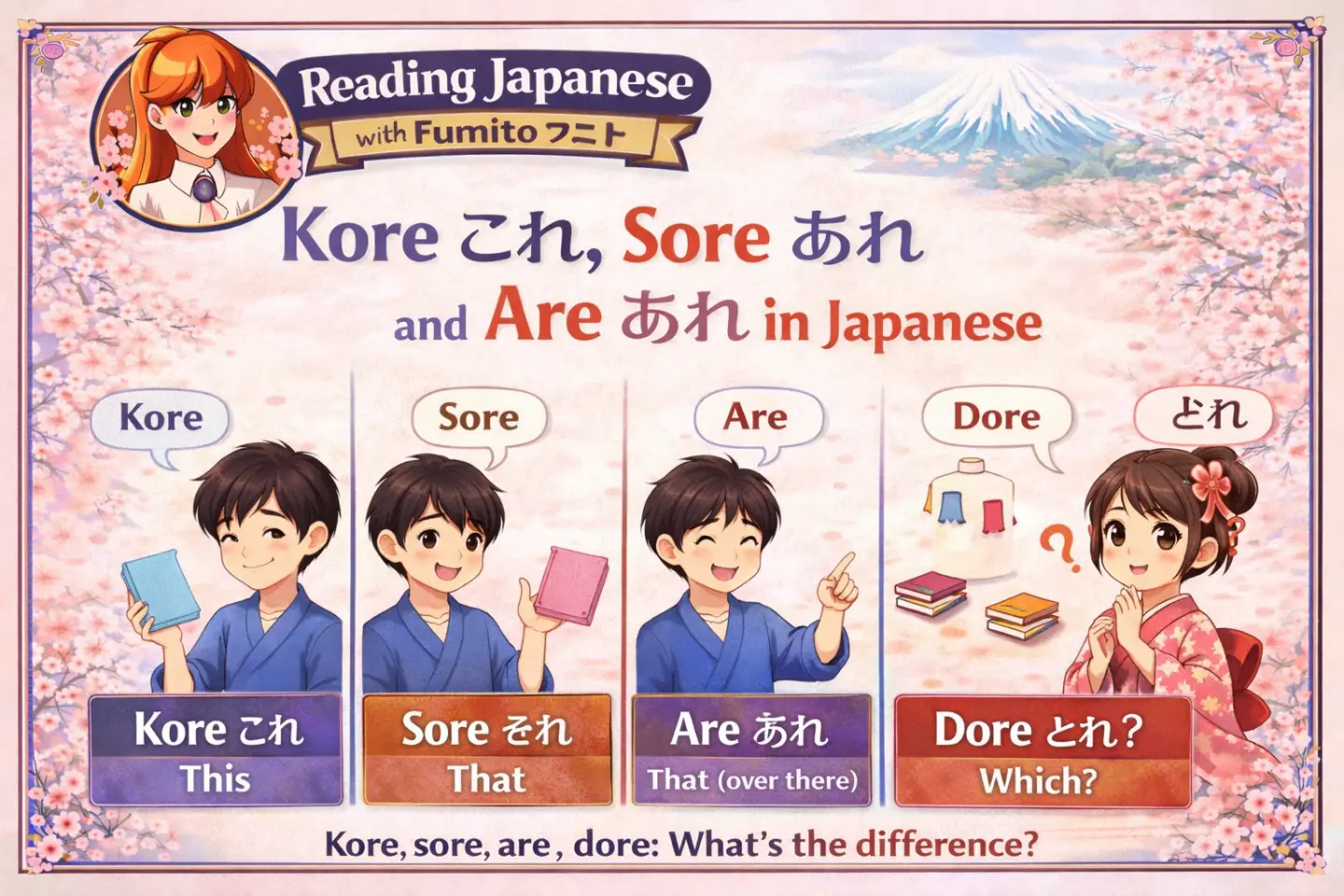
In English, you have a two-way system for pointing at things: this (near me) and that (away from me). Japanese has a three-way system — based on how close something is to the speaker, to the listener, or to neither of them. This is called the ko-so-a-do series.
The first and most important set is for pointing at things (objects):
| Word | Japanese | Meaning | When to use |
|---|---|---|---|
| kore | これ | this thing | Close to the speaker / just mentioned by the speaker |
| sore | それ | that thing (near you) | Close to the listener / just mentioned by the listener |
| are | あれ | that thing (over there) | Away from both speaker and listener / something both know about |
| dore | どれ | which one? | Question — asking which of several things |
⚠️ Ko-so-a-do is a whole system: This is just the first set — for things (objects). The same ko-so-a-do distinction applies to places, directions, types, ways of doing things, and more. For example: koko / soko / asoko / doko (here / there near you / over there / where?). These will all come up in later lessons. Understanding the underlying logic now — speaker, listener, neither — makes all the other sets much easier to learn.
In the dialogue, Honda asks about are (something away from both of them), then asks about kore (something she’s holding or near her). Smith responds with sore (the thing near Honda). This three-way pointing system comes up constantly in everyday Japanese — shopping, cooking, explaining directions, telling stories — so it’s worth getting very comfortable with it early.
1-2-3 The Particle Kedo – How to Say “But” in Japanese
Kedo connects two sentences into one, where the second sentence usually contrasts with or follows on from the first. It works very similarly to “but” in English.
これはかいますけど、あれはかいません。
Kore wa kaimasu kedo, are wa kaimasen.
— I’ll buy this, but I won’t buy that.
すみませんけど、わかりません。
Sumimasen kedo, wakarimasen.
— I’m sorry but I don’t understand.
本田ですけど、失礼します。
Honda desu kedo, shitsurei-shimasu.
— I’m Honda. Excuse me. (entering a room)
One interesting thing about kedo is that the second sentence is often left unfinished or unsaid — because the meaning is already clear from the context, or because the speaker is being polite and leaving space for the other person to respond. In the dialogue, Mr. Smith says kaimasu kedo… (I’ll buy it, but…) and trails off — possibly inviting Honda’s opinion, or softening what might otherwise sound like a too-direct answer.
⚠️ Kedo vs Ga:Ga (が) means the same thing as kedo — “but” — but it’s more formal. You’ll see ga more in writing and formal speeches. In everyday spoken Japanese, kedo is much more common. There are also longer, more formal versions: keredo, kedomo, keredomo — but you don’t need to worry about those right now. Just use kedo in conversation and you’ll be fine.
1-2-4 Particle Wa (は) – Contrast and “How About?”
The particle wa is one of the most frequently used and most misunderstood particles in Japanese. In this lesson we focus on its function as a contrast marker. When wa follows a noun, it signals that there’s an implied contrast — something is being singled out and compared (even if silently) to other possibilities.
わたしはみますけど…
Watashi wa mimasu kedo…
— I watch it, but… (someone else might not)
これはわかります。
Kore wa wakarimasu.
— I understand this (but not the other one).
あしたはかいます。
Ashita wa kaimasu.
— Tomorrow I will buy it (but not today).
Notice how the contrast isn’t always stated outright — it’s implied. When you say kore wa wakarimasu, you’re not just saying “I understand this” — you’re implying “this one I understand, but the other thing is a different story.”
Wa also has a special use with question intonation — when you attach it to a noun and raise your pitch, it becomes “how about X?”:
これは? Kore wa? — How about this one?
🎌 Important: When someone asks kore wa? (how about this one?), don’t answer with just hai or iie — because it’s not a yes-or-no question. It’s asking for your opinion or reaction to that particular thing. Give a fuller response like sore mo irimasu ne (we need that one too) or sore wa kaimasen (I won’t buy that one).
1-2-5 Particle Mo (も) – Addition and “Either”
Mo does the opposite of wa. Where wa contrasts and separates, mo adds and includes. It means “too” or “also” with an affirmative verb, and “(n)either” with a negative verb.
は Wa = contrast / singling out
Kore wa wakarimasu.
これはわかります。
I understand this (but not the other).
も Mo = addition / including
Kore mo wakarimasu.
これもわかります。
I understand this too (as well as the other).
Here are more examples showing mo in use:
本田さんもみます。
Honda-san mo mimasu.
— Ms. Honda watches it, too (as well as someone else).
これもわかりません。
Kore mo wakarimasen.
— I don’t understand this, either (in addition to something else I don’t understand).
あしたもかいます。
Ashita mo kaimasu.
— I’ll buy it tomorrow, too (as well as some other time).
🔑 Quick memory tip for wa vs mo: Think of wa as a spotlight — it picks out one thing and puts everything else in the shadows. Think of mo as a “+1” — it adds the thing to a group that already exists. Once this distinction clicks, you’ll start noticing wa and mo everywhere in Japanese and understanding exactly what they’re doing.
Drill A – Contrast with Wa and Kedo
Someone asks if you do something (referring to a specific item). You respond saying you do the one near you but not the one over there.
MODEL EXCHANGES
Cue: Kore, mimasu ka. — Do you watch this?
これ、みますか。
Response: Hai, sore wa mimasu kedo, are wa mimasen.
はい、それはみますけど、あれはみません。
Yes, I watch it, but I don’t watch that one.
Cue: Kore, shimasu ka. — Do you do it?
これ、しますか。
Response: Hai, sore wa shimasu kedo, are wa shimasen.
はい、それはしますけど、あれはしません。
Yes, I do it, but I don’t do that one.
Practice the same pattern with: kore, yomimasu ka / kore, tsukaimasu ka / kore, kakimasu ka.
Drill A-2 – Addition with Mo
Someone tells you they do something. You ask if they also do this (adding another item with mo).
MODEL EXCHANGES
Cue: Mimasu yo. — I watch them.
みますよ。
Response: Kore mo mimasu ka. — Do you watch this, too?
これもみますか。
Cue: Shimasu yo. — I do it.
しますよ。
Response: Kore mo shimasu ka. — Do you do this, too?
これもしますか。
Practice with: yomimasu yo / tsukaimasu yo / kaimasu yo.
Drill B – Say It in Japanese
You are talking about smartphone apps. Someone has asked if you use them. Try each one yourself before checking the answer.
- Yes, I use them sometimes. → Ee, tokidoki tsukaimasu. ええ、ときどきつかいます。
- Yes, I use them a lot, but I don’t buy them. → Ee, yoku tsukaimasu kedo, kaimasen. ええ、よくつかいますけど、かいません。
- No, I do not use these (while I do use others). → Iie, kore wa tsukaimasen. いいえ、これはつかいません。
- Yes, I will use this one, but not that one. → Ee, kore wa tsukaimasu kedo, are wa tsukaimasen. ええ、これはつかいますけど、あれはつかいません。
- Yes, I often use that one you mentioned, but I don’t use this one at all. → Ee, sore wa yoku tsukaimasu kedo, kore wa zenzen tsukaimasen. ええ、それはよくつかいますけど、これはぜんぜんつかいません。
- No, I don’t use them. I don’t need them at all. → Iie, tsukaimasen. Zenzen irimasen. いいえ、つかいません。ぜんぜんいりません。
- I hear a lot about them but I don’t understand. → Yoku kikimasu kedo, wakarimasen. よくききますけど、わかりません。
Drill C – Act in Japanese (Role Play)
These situational drills put everything together in realistic conversations. If you can practice with a partner, do it — use the appropriate gestures and vary between formal and casual depending on the situation.
- A coworker shows you a smartphone music application. Ask if she listens a lot. → Yoku kikimasu ka. よくききますか。
- You’ve been asked if you read Japanese newspapers online. Tell Ms. Honda that you read them a lot. → Ee, yoku yomimasu. ええ、よくよみます。
- You’ve been asked if you know a particular Japanese word. Tell Ms. Honda that you hear it sometimes but don’t understand. → Tokidoki kikimasu kedo, wakarimasen. ときどきききますけど、わかりません。
- You are looking at a menu at a restaurant. Ask Ms. Honda if she would take a look at this one (a wine list) as well. → Kore mo mimasu ka. これもみますか。
- You’ve been asked if you buy Japanese comics. Tell Ms. Honda that you read them a lot but you don’t buy them. → Yoku yomimasu kedo, kaimasen. よくよみますけど、かいません。
💡 Notice: Drill C item 3 uses tokidoki kikimasu kedo, wakarimasen — combining the adverb tokidoki, the connective kedo, and the negative verb wakarimasen all in one natural sentence. That’s a lot of grammar from just two lessons working together! This is why practicing in context — not just memorising grammar rules — is so much more effective.
FAQ – Kore Sore Are, Wa, Mo and Kedo in Japanese
What is the difference between kore, sore and are in Japanese?
Kore (これ) means “this” — something close to the speaker. Sore (それ) means “that” — something close to the listener. Are (あれ) means “that over there” — something away from both the speaker and listener, or something both people already know about. This three-way distinction is called the ko-so-a-do system and is one of the most fundamental things to understand in Japanese. English only has two (this / that), so the middle category — sore — is the one that needs the most attention for English speakers.
What does “wa” (は) mean in Japanese?
The particle wa (は) is often described as the “topic marker,” but its function is more specifically about contrast. When you attach wa to a noun, you’re singling that noun out and implying a contrast with other possibilities — even if you don’t state what those are. So kore wa wakarimasu doesn’t just mean “I understand this” — it implies “this one I understand (but others are a different story).” When used with question intonation, kore wa? means “how about this one?”
What does “mo” (も) mean in Japanese?
Mo (も) means “too,” “also,” or “(n)either” depending on whether the verb is positive or negative. It adds something to an existing group or category. For example, Honda-san mo mimasu means “Ms. Honda watches it, too” — as well as whoever else already watches it. With a negative verb, kore mo wakarimasen means “I don’t understand this, either.” Where wa separates and contrasts, mo includes and adds.
What is the difference between wa and mo in Japanese?
This is one of the most useful contrasts to understand in Japanese grammar. Wa singles something out and implies contrast with other things (“this one, but not necessarily the others”). Mo adds something to a group (“this one as well as the others”). A good way to remember it: wa is like a spotlight that separates, mo is like a plus sign that includes. They can both attach to subjects, objects, or time expressions.
What does “kedo” mean in Japanese?
Kedo (けど) means “but” in Japanese. It connects two sentences where the second one contrasts with or follows on from the first. For example, yoku kikimasu kedo, wakarimasen means “I hear it a lot, but I don’t understand.” The second sentence is often left unsaid when the meaning is already obvious, which is why you often hear sentences ending in …kedo with a trailing silence. Ga (が) means the same thing but is more formal and appears more in writing.
What is the ko-so-a-do system in Japanese?
The ko-so-a-do system is a set of related Japanese words that point to things based on their distance from the speaker and listener. Ko- words (like kore, koko) refer to things near the speaker. So- words (like sore, soko) refer to things near the listener. A- words (like are, asoko) refer to things away from both. Do- words (like dore, doko) are the question words — “which?” and “where?” The first set (kore / sore / are / dore) is for objects, but the same logic extends to places, types, ways, and more.
What does “chotto” mean in Japanese?
Chotto (ちょっと) means “a little bit” or “a few.” It’s one of the most versatile and commonly used words in everyday Japanese. In the dialogue, chotto irimasu means “I need a few of those.” But chotto also has a softer social function — saying chotto… and trailing off is a very common polite way to decline or hesitate in Japanese without saying a direct “no.” You’ll hear it all the time once you start interacting with Japanese speakers.
How do you answer “kore wa?” in Japanese?
Kore wa? (これは?) means “how about this?” and is not a yes-or-no question, so you shouldn’t just answer with hai or iie. Instead give a fuller response — for example: sore mo irimasu ne (we need that one too), kore wa kaimasen (I won’t buy this one), or kore wa chotto… (this one is a bit… — meaning you’re hesitating or declining politely). The question is inviting your opinion or reaction to a specific item.
What’s Next?
You’ve now got four solid grammar tools from Lesson 1 Dialogue 2 — the ko-so-a-do pointing system (kore / sore / are / dore), the contrast particle wa, the addition particle mo, and the connective kedo. Together with the masu / masen verb patterns from the previous lesson, you can already build a good number of real, natural Japanese sentences.
The drills in this lesson — especially the “say it in Japanese” and roleplay sections — are worth going back to multiple times. Each time you’ll find them a little easier and a little more automatic. That automaticity is what you’re building toward.
For your next step, head to my post on Japanese verb conjugation for beginners to expand your verb range, or go back and review the full masu / masen grammar lesson if any of the verb forms in the drills above felt uncertain.
頑張ってください!(Ganbatte kudasai!) — Keep going! 🎌
— Fumito フミト | reading-japanese.com
📚 Related lessons on reading-japanese.com: