
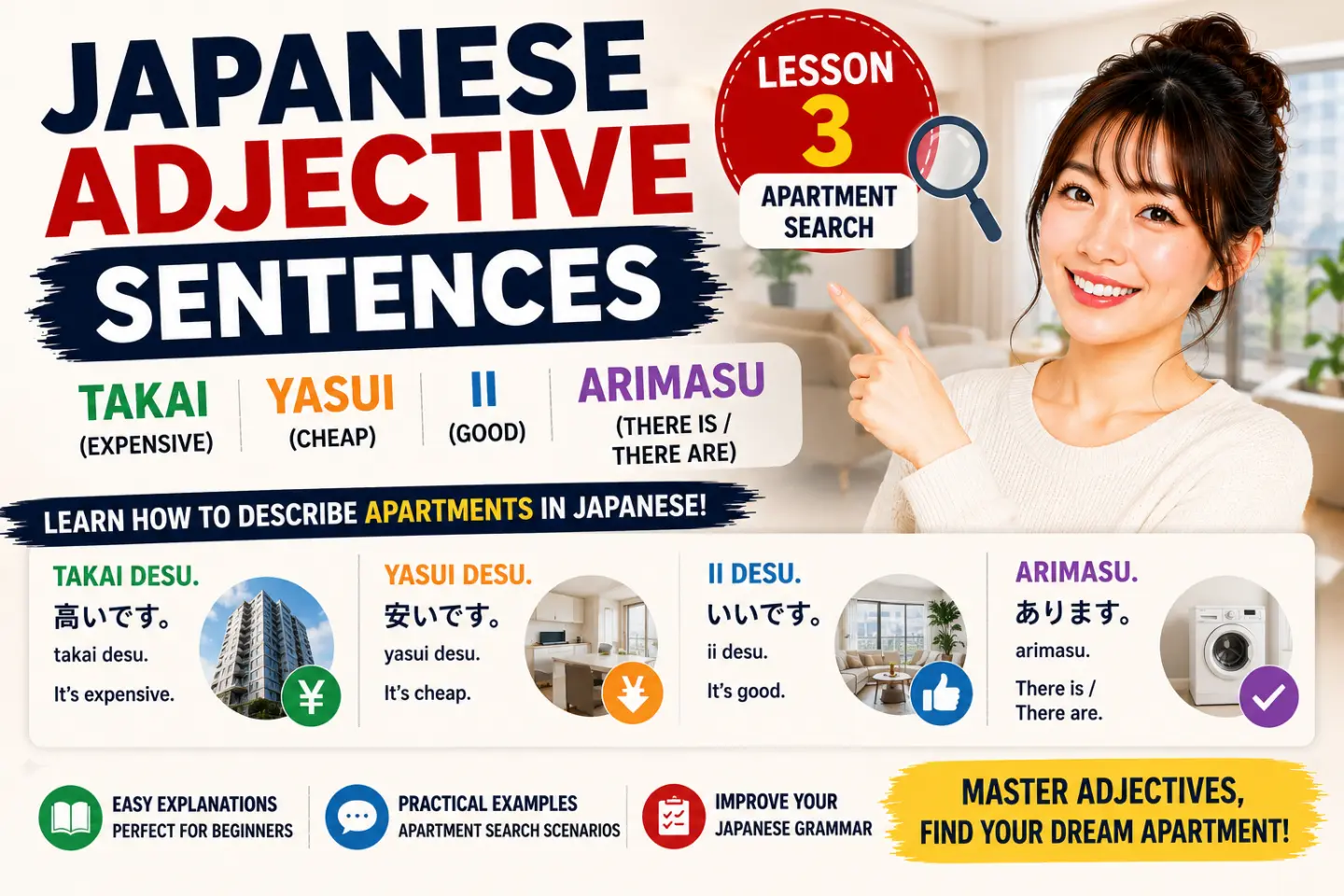

This is Lesson 3 of the beginner Japanese series — and it’s actually a really significant milestone. Up until now you’ve been working with two types of Japanese sentences: verb sentences (wakarimasu, ikimasu) and noun sentences (desu, deshita). In Lesson 3 we add the third and final type — adjective sentences — which means you now have the complete picture of how Japanese sentences are structured.
The dialogue this lesson is built around is Michael looking at apartment listings with Honda — a very practical, real-life situation that gives us natural contexts for describing things as expensive, cheap, big, small, new and old. Exactly the kind of vocabulary you need when you’re apartment hunting, shopping, or giving your opinion on anything in Japanese.
Japanese Adjective Sentences Explained – Takai, Arimasu and All Three Sentence Types for Beginners
Before going through this, make sure you’re comfortable with noun sentences from Lesson 2 — the desu/ja nai desu post and the deshita/ja nakatta desu post are the direct foundation for what we cover here.
📌 What you’ll learn in this lesson: How Japanese adjectives work and conjugate (the -i adjective system), how to make adjective sentences in all four forms, how adjectives modify nouns directly without no, the verb arimasu for existence, and the complete master chart of all three Japanese sentence types side by side.
How to say there is there are in Japanese (arimasu)
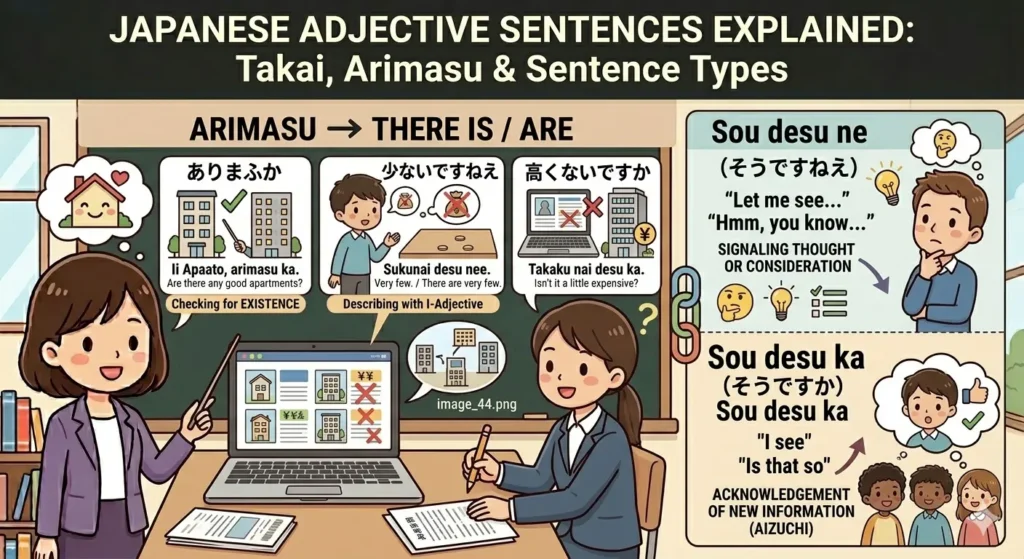
Michael is checking apartment listings with Honda’s help. This scene is completely realistic — the same expressions used here come up constantly when Japanese people discuss housing, products, restaurants, or anything they’re evaluating.
Honda: いいアパート、ありますか。
Ii apaato, arimasu ka. — Are there any good apartments?
Michael: 少ないですねえ。
Sukunai desu nee. — Very few. / There are very few.
Honda: このアパートはどうですか。
Kono apaato wa dou desu ka. — How about this apartment?
Michael: そうですねえ。ちょっと高くないですか。
Sou desu nee. Chotto takaku nai desu ka. — Let me see… Isn’t it a little expensive?
📌 Sou desu nee vs Sou desu ka: You’ve already seen sou desu ka (I see / is that so) as an aizuchi response to new information. Sou desu nee (そうですねえ) is different — it means “let me see…” or “hmm, you know…” and signals that you’re thinking or considering something. Its a pause for reflection rather than an acknowledgement of new information. The intonation matters — ka goes up, nee stays level or trails down thoughtfully.
Vocabulary from the Dialogue
| Romaji | Japanese | Kanji | Meaning |
|---|---|---|---|
| apaato | アパート | — | apartment |
| arimasu | あります | — | there is/are / exists / I have |
| sukunai | すくない | 少ない | few / there are few |
| dou | どう | — | how / in what way |
| sou desu nee | そうですねえ | — | let me see… / hmm, well… |
| takai | たかい | 高い | expensive / high |
| takaku nai | たかくない | 高くない | not expensive |
Additional Vocabulary – Housing and Adjectives
| Romaji | Japanese | Kanji | Meaning |
|---|---|---|---|
| manshon | マンション | — | condominium / apartment building |
| ie | いえ | 家 | house / home |
| heya | へや | 部屋 | room |
| ikaga | いかが | — | how (polite form of dou) |
| ooi | おおい | 多い | many / there are a lot |
| yasui | やすい | 安い | cheap / inexpensive |
| ookii | おおきい | 大きい | large / big |
| chiisai | ちいさい | 小さい | small |
| atarashii | あたらしい | 新しい | new |
| furui | ふるい | 古い | old |
3-1-1 Japanese Adjective Sentences – The -i Adjective System
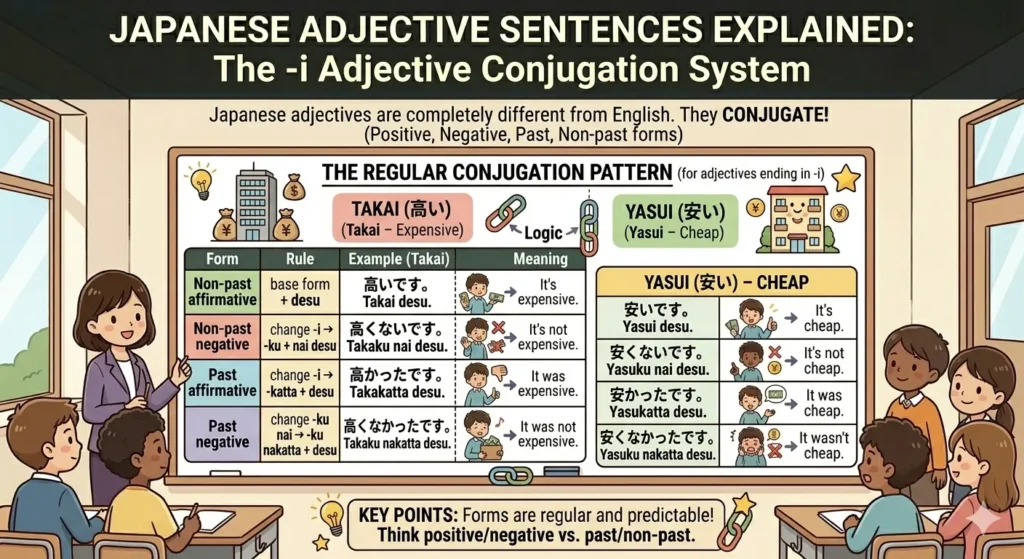
Japanese adjectives are completely different from English adjectives in one important way — they conjugate. They have their own positive, negative, past, and non-past forms, just like verbs. And just like the verb and noun forms you’ve already learned, the adjective forms follow a very regular and predictable pattern.
All Japanese adjectives in this category end in -i in their base form. To change the form, you work with the ending:
| Form | Rule | Example (takai = expensive) | Meaning |
|---|---|---|---|
| Non-past affirmative | base form + desu | 高いです。 Takai desu. | It’s expensive. |
| Non-past negative | change -i → -ku + nai desu | 高くないです。 Takaku nai desu. | It’s not expensive. |
| Past affirmative | change -i → -katta + desu | 高かったです。 Takakatta desu. | It was expensive. |
| Past negative | change -ku nai → -ku nakatta + desu | 高くなかったです。 Takaku nakatta desu. | It was not expensive. |
安いです。 Yasui desu. — It’s cheap.
安くないです。 Yasuku nai desu. — It’s not cheap.
安かったです。 Yasukatta desu. — It was cheap.
安くなかったです。 Yasuku nakatta desu. — It wasn’t cheap.
The Exception – Ii (Good)
Ii (いい, good) is the only irregular adjective in the entire Japanese adjective class. Its the one exception you have to memorise separately:
いいです。 Ii desu. — It’s good.
よくないです。 Yoku nai desu. — It’s not good.
よかったです。 Yokatta desu. — It was good.
よくなかったです。 Yoku nakatta desu. — It wasn’t good.
🔑 Yoku and yokatta: Yoku is already familiar from Lesson 1 — you learned it as an adverb meaning “well” or “a lot” (yoku wakarimasu, yoku tabemasu). Now you can see it’s actually the -ku form of the adjective ii (good). And yokatta desu nee! (よかったですねえ!) — “that’s great!” or “I’m so glad!” — is one of the most common and warmly used expressions in everyday Japanese when responding to good news. Every learner should have this one ready.
Common -i Adjectives to Know
高いtakai高くないexpensive / high
安いyasui安くないcheap / inexpensive
大きいookii大きくないbig / large
小さいchiisai小さくないsmall
新しいatarashii新しくないnew
古いfurui古くないold
少ないsukunai少なくないfew / scarce
多いooi多くないmany / a lot
いいii (irregular)よくないgood
The Complete Master Chart – All Three Japanese Sentence Types
This is a really satisfying moment in Japanese study. With adjective sentences now covered, you have seen all three types of Japanese sentences. Here is the full master reference chart showing all forms side by side — use this as your go-to reference whenever you need to check a form.
Non-Past Forms
| Sentence type | Affirmative (Non-past) | Negative (Non-past) |
|---|---|---|
| 🔵 Verb | わかります。Wakarimasu. — I understand. | わかりません。Wakarimasen. — I don’t understand. |
| 🟡 Noun | 日本です。Nihon desu. — It’s Japan. | 日本じゃないです。Nihon ja nai desu. — It’s not Japan. |
| 🔴 Adjective | 高いです。Takai desu. — It’s expensive. | 高くないです。Takaku nai desu. — It’s not expensive. |
Past Forms
| Sentence type | Affirmative (Past) | Negative (Past) |
|---|---|---|
| 🔵 Verb | わかりました。Wakarimashita. — I understood. | わかりませんでした。Wakarimasen deshita. — I didn’t understand. |
| 🟡 Noun | 日本でした。Nihon deshita. — It was Japan. | 日本じゃなかったです。Nihon ja nakatta desu. — It wasn’t Japan. |
| 🔴 Adjective | 高かったです。Takakatta desu. — It was expensive. | 高くなかったです。Takaku nakatta desu. — It wasn’t expensive. |
🎌 Arimasu alternatives: For noun and adjective sentences, arimasen can substitute for nai desu in the negative, and arimasen deshita can substitute for nakatta desu in the past negative. These sound slightly more formal and elegant. Examples:
Sumaho ja nai desu → Sumaho ja arimasen (It’s not a smartphone)
Takaku nai desu → Takaku arimasen (It’s not expensive)
Sumaho ja nakatta desu → Sumaho ja arimasen deshita (It wasn’t a smartphone)
Takaku nakatta desu → Takaku arimasen deshita (It wasn’t expensive)
3-1-2 Adjective + Noun – Modifying Nouns Directly
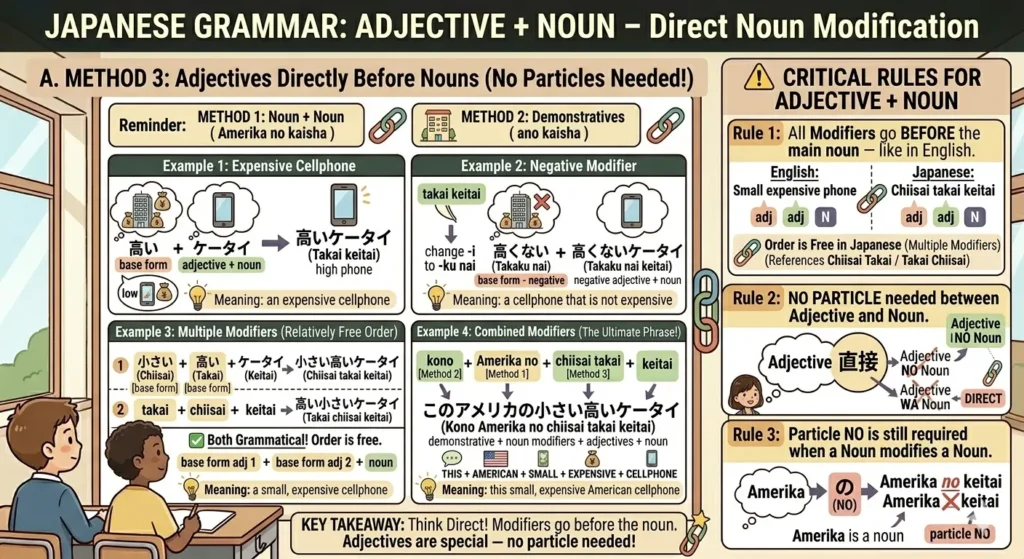
In Lesson 2 you saw two ways to build noun phrases — using no (Amerika no kaisha) and using kono/sono/ano/dono (ano kaisha). Now we add a third way: adjectives can directly modify nouns with no particle needed at all.
高いケータイ takai keitai — an expensive cellphone
高くないケータイ takaku nai keitai — a cellphone that is not expensive
小さい高いケータイ chiisai takai keitai — a small, expensive cellphone
このアメリカの小さい高いケータイ kono Amerika no chiisai takai keitai — this small, expensive American cellphone
⚠️ Important rules for adjective + noun phrases:
1. All modifiers go BEFORE the main noun — just like in English. But unlike English, the order of multiple modifiers is relatively free in Japanese. Chiisai takai keitai and takai chiisai keitai are both grammatical.
2. No particle is needed between an adjective and the noun it modifies — no no, no wa, nothing. Just adjective directly before noun.
3. The particle no is still required when a noun modifies another noun (Amerika no keitai) — it’s only adjectives that modify nouns without a particle.
You can also combine all the different modifier types together in one noun phrase — adjectives, kono/sono, and no all together:
この私のケータイ kono watashi no keitai — this cellphone of mine
私のこのケータイ watashi no kono keitai — this cellphone of mine (same meaning, different word order — both grammatical)
3-1-3 Arimasu – “There Is” and “I Have” in Japanese
The verb arimasu (あります) means “there is/are” or “I have.” It’s used for inanimate things — objects, plants, ideas, events. A different verb is used for people and animals (which will be covered in a later lesson). Understanding this distinction is important because using the wrong verb can sound quite unnatural to native Japanese speakers.
いいアパート、ありますか。
Ii apaato, arimasu ka.
— Are there any good apartments? / Do you have any good apartments?
新しいアパートがありません。
Atarashii apaato ga arimasen.
— There are no new apartments.
昨日、アポがありました。
Kinou, apo ga arimashita.
— I had an appointment yesterday. / There was an appointment yesterday.
An Important Distinction – Identity vs Existence
One of the more subtle but important things about arimasu is what happens when you compare it with noun sentences using desu. The two can look similar but mean very different things:
| Japanese | Romaji | Meaning | Type |
|---|---|---|---|
| 会社じゃありません。 | Kaisha ja arimasen. | It’s not a company. (this thing is not a company) | Identity — what it IS |
| 会社はありません。 | Kaisha wa arimasen. | There is no company. (a company doesn’t exist here) | Existence — whether it EXISTS |
The first sentence (ja arimasen) says something about identity — it denies that something IS a company. The second sentence (wa arimasen) says something about existence — it says a company doesn’t exist in the relevant context. Same word arimasen, very different meaning depending on what particle is used before it.
💡 Negative forms overview: By now you have two negative endings — nai desu and arimasen — that can both appear in noun and adjective negatives. Nai desu is slightly more casual, arimasen is slightly more formal and elegant. Both are correct. As a beginner, nai desu is perfectly fine for all situations. Start incorporating arimasen as your Japanese becomes more natural and you want to sound a bit more polished.
Drill A – Opposite Adjective Responses
Someone asks if something has one quality. You respond that it’s actually the opposite.
MODEL EXCHANGES
Cue: 高いですか。— Is it expensive?
高いですか。
Response: いえ、安いですよ。— No, it’s cheap, I assure you.
いえ、安いですよ。
Cue: 安いですか。— Is it cheap?
安いですか。
Response: いえ、高いですよ。— No, it’s expensive, I assure you.
いえ、高いですよ。
Practice with: 大きいですか → いえ、小さいですよ。/ 新しいですか → いえ、古いですよ。/ 多いですか → いえ、少ないですよ。
Drill B – Amari + Negative Adjective
Someone asks if something has a quality. You say “not very” using amari with the negative adjective form.
MODEL EXCHANGES
Cue: いいですか。— Is it all right?
いいですか。
Response: いいえ、あまりよくないです。— No, it’s not very good.
いいえ、あまりよくないです。
Cue: 安いですか。— Is it cheap?
安いですか。
Response: いいえ、あまり安くないです。— No, it’s not very cheap.
いいえ、あまり安くないです。
Practice with: 大きいですか / 新しいですか / 少ないですか / 高いですか
Drill C – Arimasen Form of Negatives
Someone asks if something is a certain type or has a quality. Deny it using the arimasen / ku arimasen form.
MODEL EXCHANGES
Cue: アパートですか。— Is it an apartment?
アパートですか。
Response: いいえ、アパートじゃありません。— No, it’s not an apartment.
いいえ、アパートじゃありません。
Cue: 安いですか。— Is it cheap?
安いですか。
Response: いいえ、安くありません。— No, it’s not cheap.
いいえ、安くありません。
Practice with: マンションですか / 大きいですか / 新しいですか / いいですか
Drill D – Past Adjective Forms
Someone asks if something was a certain quality in the past. Deny it using the past negative adjective form.
MODEL EXCHANGES
Cue: あれ、高かったですか。— Was that expensive?
あれ、高かったですか。
Response: いえ、高くなかったですよ。— No, it wasn’t.
いえ、高くなかったですよ。
Cue: あれ、新しかったですか。— Was that new?
あれ、新しかったですか。
Response: いえ、新しくなかったですよ。— No, it wasn’t.
いえ、新しくなかったですよ。
Practice with: 安かったですか / 大きかったですか / よかったですか / 少なかったですか
Drill E – Say It in Japanese
You’ve been asked your opinion about an apartment. Try each response yourself before checking.
- Let me see… isn’t it big?
→ Sou desu nee. Chotto ookiku nai desu ka. そうですねえ。ちょっと大きくないですか。 - It’s a little old. Aren’t there any new apartments?
→ Chotto furui desu. Atarashii apaato, nai desu ka. ちょっと古いです。新しいアパート、ないですか。 - It’s not very expensive, but I wonder if it might not be small.
→ Amari takaku nai desu kedo, chiisaku nai desu ka nee. あまり高くないですけど、小さくないですかねえ。 - I saw it yesterday. It was nice.
→ Kinou mimashita. Yokatta desu. きのう見ました。よかったです。 - There are many small apartments, but big ones are scarce, aren’t they?
→ Chiisai apaato wa ooi desu kedo, ookii no wa sukunai desu nee. 小さいアパートは多いですけど、大きいのは少ないですねえ。
Drill F – Act in Japanese (Role Play)
- Ms. Honda is checking apartment listings. Ask if there’s anything good.
→ Ii apaato, arimasu ka. いいアパート、ありますか。 - Ms. Honda recently moved into a new apartment. Find out how she likes it.
→ Apaato wa dou desu ka. アパートはどうですか。 - At a store you saw a nice bag but it’s small. Get the clerk’s attention and ask if there’s a big one.
→ Anou, sumimasen. Ookii no, arimasu ka. あのう、すみません。大きいの、ありますか。 - A co-worker just told you great news. Respond.
→ Yokatta desu nee! よかったですねえ! - Ms. Honda went to see an apartment yesterday. Ask: a) how it was, b) if it was good, c) if it wasn’t old.
→ a) Dou deshita ka. b) Yokatta desu ka. c) Furuku nakatta desu ka. a) どうでしたか。b) よかったですか。c) 古くなかったですか。 - You’ve been asked about your apartment / school / company. Describe each using adjectives.
→ Example: Atarashii desu. Demo, chotto chiisai desu. 新しいです。でも、ちょっと小さいです。
🔑 On Drill F item 3 — “a big one”: Notice the expression ookii no (大きいの) — “a big one.” In Japanese, when you’ve already established what object you’re talking about, you can use adjective + no to mean “a [adjective] one” without repeating the noun. This is a very useful shortcut in natural Japanese conversation. Chiisai no = a small one, atarashii no = a new one, ii no = a good one.
FAQ – Japanese Adjectives, Arimasu and Sentence Types
How do Japanese adjectives work?
Japanese adjectives in the -i category conjugate just like verbs — they have four forms: non-past affirmative (takai desu), non-past negative (takaku nai desu), past affirmative (takakatta desu), and past negative (takaku nakatta desu). The rules are regular: for negative, change -i to -ku and add nai desu. For past, change -i to -katta desu. There is only one irregular adjective in the entire class — ii (good), whose forms are yoku nai desu / yokatta desu / yoku nakatta desu.
What does “takai” mean in Japanese?
Takai (高い) means “expensive” or “high/tall” in Japanese. Its a very common -i adjective. The negative form is takaku nai (not expensive), the past form is takakatta (was expensive), and the past negative is takaku nakatta (wasn’t expensive). You’ll use this word constantly when talking about shopping, apartments, food, or anything you’re evaluating the price of.
What does “yokatta desu” mean in Japanese?
Yokatta desu (よかったです) means “it was good” — the past affirmative form of ii (good). In everyday Japanese, yokatta desu nee! is a very warm and natural expression used when you hear good news or when something turned out well — similar to “that’s great!” or “I’m so glad!” in English. Its one of those expressions that Japanese learners should memorise early because it comes up constantly in conversation.
What does “arimasu” mean in Japanese?
Arimasu (あります) means “there is/are” or “I have” in Japanese. It’s used for inanimate things — objects, events, plants, ideas. For people and animals a different verb is used (introduced later). The negative forms are nai desu or arimasen (the latter is slightly more formal). Past forms are arimashita (there was / I had) and arimasen deshita / nakatta desu (there wasn’t / I didn’t have).
What is the difference between arimasu and desu in Japanese?
Desu expresses identity — what something IS. Arimasu expresses existence — whether something EXISTS. So kaisha ja arimasen (using ja arimasen) = “it’s not a company” (identity denial), while kaisha wa arimasen = “there is no company” (existence denial). This identity/existence distinction is important in Japanese and the particle used before arimasen (ja vs wa) is what signals which meaning you intend.
Do Japanese adjectives need a particle before a noun?
No — Japanese adjectives directly modify nouns with no particle needed at all. Takai keitai = an expensive cellphone (adjective directly before noun, no particle). This is different from noun modifiers, where no is required (Amerika no keitai = an American cellphone). You can also stack multiple modifiers before a noun — chiisai takai keitai = a small, expensive cellphone — and the order is fairly flexible, unlike English where adjective order is more restricted.
What are the three types of sentences in Japanese?
The three types are: verb sentences (wakarimasu / wakarimashita / wakarimasen / wakarimasen deshita), noun sentences (nihon desu / nihon deshita / nihon ja nai desu / nihon ja nakatta desu), and adjective sentences (takai desu / takakatta desu / takaku nai desu / takaku nakatta desu). Each type has its own four-form conjugation pattern. All three use desu in their formal affirmative forms, but the negative and past endings differ depending on the sentence type.
What does “sou desu nee” mean in Japanese?
Sou desu nee (そうですねえ) means “let me see…” or “well, hmm…” — it signals that you’re considering something before answering. Its different from sou desu ka (そうですか) which signals you’ve received new information (“I see / is that so?”). Nee here is the shared-feeling particle you already know — in this expression it creates a thoughtful, reflective tone. Its a very common and natural conversation phrase used when you need a moment to think.
What’s Next?
You’ve now covered all three Japanese sentence types — verb, noun, and adjective — and their complete four-form conjugation tables. That’s the core grammatical structure of everyday Japanese fully in place. From here, Lesson 3 continues with more adjective vocabulary, talking about existence and location, and describing people and places in detail.
In the meantime, practice the apartment dialogue and the drills above out loud. Try describing things around you right now using the adjectives from this lesson — your room, your bag, your phone, your apartment. Ookii desu ka. Furui desu ka. Yokatta desu nee.
All lessons in the series are at reading-japanese.com.
頑張ってください!(Ganbatte kudasai!) — Keep going! 🎌
— Fumito フミト | reading-japanese.com
📚 Related lessons on reading-japanese.com:
- Japanese Language Proficiency Test N2 Grammar Review: Is New Full Master Grammar Worth It?
- JLPT N5 Exam Pattern Explained: Sections, Timing, Scoring & What to Expect in 2026
- Learn Kumihimo on the Marudai: My Honest Review of “Japanese Braiding” by Jacqui Carey
- Japanese Vocabulary QuickStudy Guide Review
- All-in-One Japanese for Beginners Review: Is This 5-in-1 Book Really Worth Your Money?