
So you fell down the Uma Musume rabbit hole.
Maybe it started with the anime. Maybe it was the mobile game. Maybe someone sent you a clip of a cartoon racehorse girl crying after crossing the finish line and you thought, what is happening, and why can’t I stop watching?
And now — somewhere between learning Silence Suzuka’s tragic race history and memorizing Special Week’s stats — you looked at the screen and thought: I actually want to understand what they’re saying.
Welcome. This guide is for you.
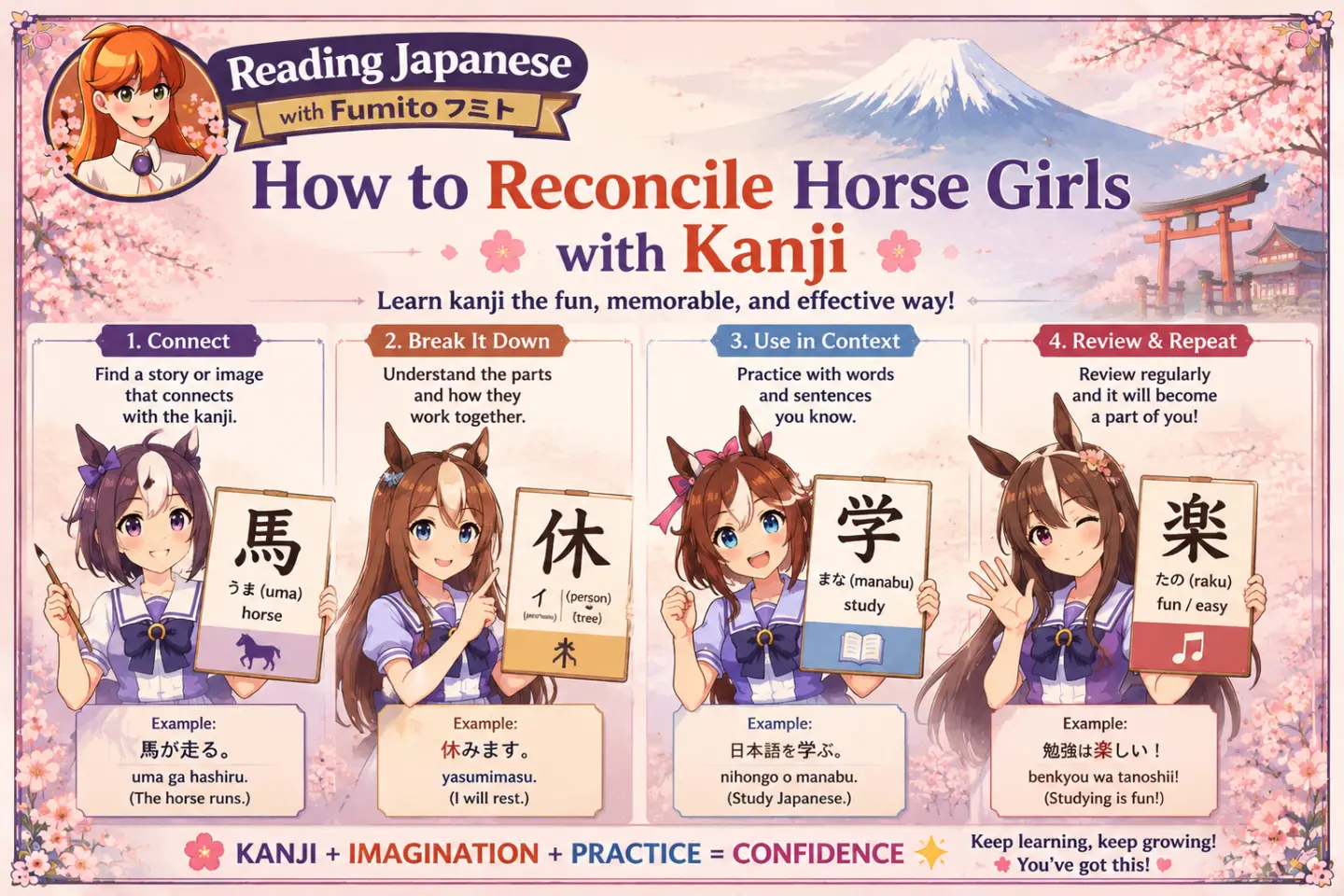
Reconciling your horse girl obsession with learning kanji is not only possible — it’s one of the most effective ways to learn Japanese that exists. You have motivation. You have context. You have emotional investment. Those three things are the entire secret to language acquisition.
This article by Japanese tutor Fumito Emi at reading-japanese.com will walk you through exactly how to use Uma Musume Pretty Derby — the anime, manga, game, and fandom — as your personal kanji classroom.
📚 Table of Contents
- Why Horse Girls Are Actually Perfect for Learning Kanji
- The Horse Girl Kanji You’ll See Everywhere
- Uma Musume Character Names — Kanji Breakdown
- Racing Vocabulary Kanji (The Stuff the Announcers Scream)
- Emotions, Drama & Friendship Kanji
- Training Arc Kanji (Stats, Skills & the Gacha Screen)
- How to Build Your Horse Girl Anki Deck
- How to Watch Uma Musume as a Kanji Study Session
- The Horse Girl Approach to the JLPT
- Your Horse Girl Kanji Study Schedule
- FAQ
- Related Articles
Why Horse Girls Are Actually Perfect for Learning Kanji
Before we get into specific kanji, let’s talk about why this works — because it genuinely does, and the reason is more interesting than “just watch stuff you like.”
You Already Have Emotional Memory Attached to These Words
Language acquisition research consistently shows that words learned in emotionally charged contexts are retained far longer than words studied in isolation. When you learn 勝利 (shouris, victory) from a vocabulary list, it’s just two kanji. When you learn 勝利 because you watched Tokai Teio collapse on the track and then stand back up to win the Japan Cup and the word appeared on screen at that exact moment — you will never, ever forget it.
Uma Musume is essentially a machine for creating emotional memory around Japanese words.
The Game Is Extremely Kanji-Dense
The Uma Musume Pretty Derby mobile game is written almost entirely in Japanese. The training screens, skill descriptions, story events, character dialogue, race results, and stat panels are all in kanji with furigana — which means you get the kanji and the reading simultaneously. This is an ideal learning environment.
Every time you play, you’re doing kanji immersion. The question is whether you’re doing it consciously.
Horse Racing Has Consistent, Repeatable Vocabulary
Unlike a drama where every episode introduces completely new vocabulary, horse racing has a closed vocabulary set. The same words appear over and over: race, victory, training, distance, track condition, stamina, speed. Once you learn the core horse-racing kanji, you can read almost any race scene, commentary, or game screen.
The Fandom Produces Enormous Amounts of Japanese Text
Twitter, Pixiv, Niconico, fan wikis, light novel adaptations — the Uma Musume fandom generates millions of words of Japanese text every day. Once you have basic kanji literacy, this entire world opens up to you. Real fans writing about real emotions in real Japanese. It’s an immersion paradise.
The Horse Girl Kanji You’ll See Everywhere
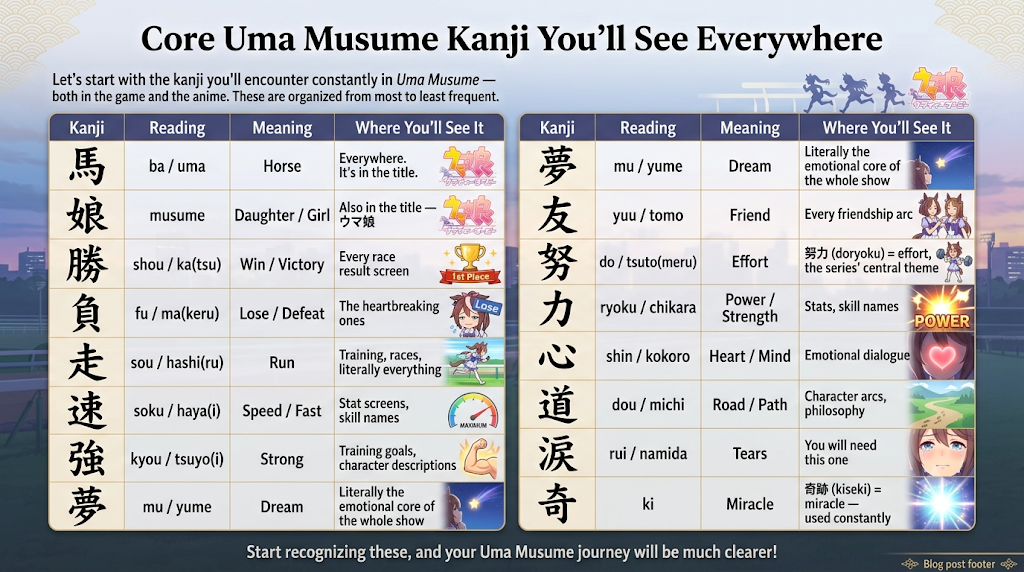
Let’s start with the kanji you’ll encounter constantly in Uma Musume — both in the game and the anime. These are organized from most to least frequent.
Core Uma Musume Kanji
| Kanji | Reading | Meaning | Where You’ll See It |
|---|---|---|---|
| 馬 | ba / uma | Horse | Everywhere. It’s in the title. |
| 娘 | musume | Daughter / Girl | Also in the title — ウマ娘 |
| 勝 | shou / ka(tsu) | Win / Victory | Every race result screen |
| 負 | fu / ma(keru) | Lose / Defeat | The heartbreaking ones |
| 走 | sou / hashi(ru) | Run | Training, races, literally everything |
| 速 | soku / haya(i) | Speed / Fast | Stat screens, skill names |
| 強 | kyou / tsuyo(i) | Strong | Training goals, character descriptions |
| 夢 | mu / yume | Dream | Literally the emotional core of the whole show |
| 友 | yuu / tomo | Friend | Every friendship arc |
| 努 | do / tsuto(meru) | Effort | 努力 (doryoku) = effort, the series’ central theme |
| 力 | ryoku / chikara | Power / Strength | Stats, skill names |
| 心 | shin / kokoro | Heart / Mind | Emotional dialogue |
| 道 | dou / michi | Road / Path | Character arcs, philosophy |
| 涙 | rui / namida | Tears | You will need this one |
| 奇 | ki | Miracle | 奇跡 (kiseki) = miracle — used constantly |
Example Sentences From the Show
勝ちたい! Kachitai! “I want to win!” — screamed by approximately every character at some point.
あの娘は本当に速い。 Ano ko wa hontou ni hayai. “That girl is really fast.” — said about Special Week constantly in season 1.
夢を諦めない。 Yume wo akiramenai. “I won’t give up on my dream.” — the emotional thesis of the entire franchise.
また走れる。 Mata hashireru. “I can run again.” — Tokai Teio, making everyone cry.
Uma Musume Character Names — Kanji Breakdown
One of the most powerful ways to learn kanji is through names you already love. Every Uma Musume character’s name is written in Japanese and derived from the real horse they’re based on. Let’s break them down.
The Main Cast
スペシャルウィーク (Supesharu Wiiku) — Special Week
Written in katakana — but her shortened nickname スペ appears everywhere. However, her dialogue and descriptions use tons of kanji. The real horse Special Week won the 1998 Japan Cup, and the show uses the kanji:
特別な週 (tokubetsu na shuu) — “special week”
- 特 (toku) — Special
- 別 (betsu) — Separate / Distinct
- 週 (shuu) — Week
| Kanji | Reading | Meaning |
|---|---|---|
| 特 | toku | Special |
| 別 | betsu | Separate |
| 週 | shuu | Week |
| 日本 | nihon | Japan |
| 一 | ichi | Number one / First |
Special Week’s key scene kanji: 「日本一のウマ娘になる!」(Nihon-ichi no umamusume ni naru!) — “I’ll become the number one horse girl in Japan!”
- 日本一 (nihon ichi) = Japan’s number one
- なる (naru) = to become
サイレンススズカ (Sairensu Suzuka) — Silence Suzuka
The most emotionally devastating character in the franchise. Based on the real racehorse Silence Suzuka, who was euthanized after a breakdown during the 1998 Tenno Sho.
Her name in Japanese context connects to:
- 静寂 (seijaku) = Silence — 静 (quiet) + 寂 (lonely/still)
- 鈴 (suzu) = Bell
- 鹿 (ka/shika) = Deer/Fawn (the 鹿 part of 鹿毛, a coat color)
| Kanji | Reading | Meaning | Context |
|---|---|---|---|
| 静 | sei / shizu | Quiet / Still | Suzuka’s calm demeanor |
| 寂 | jaku / sabi | Lonely / Still | The silence in her name |
| 速 | soku / haya | Fast | Her legendary speed |
| 前 | zen / mae | Front / Ahead | 先行 (leading race style) |
| 孤 | ko | Alone | Running far ahead of the pack |
Suzuka’s heartbreaking line kanji: 「また一緒に走りたい」(Mata issho ni hashiritai) — “I want to run together again.”
- 一緒 (issho) = Together
- 走る (hashiru) = To run
- たい (tai) = Want to
トウカイテイオー (Toukai Teiou) — Tokai Teio
The comeback queen. Based on the real Tokai Teio, famous for winning the 1992 Japan Cup after an 11-month injury layoff.
帝王 (teiou) — Emperor / King
- 帝 (tei) = Emperor
- 王 (ou) = King
| Kanji | Reading | Meaning | Context |
|---|---|---|---|
| 帝 | tei | Emperor | In her name — “Teio” |
| 王 | ou / oo | King | Also in her name |
| 奇跡 | kiseki | Miracle | Her comeback story |
| 骨 | kotsu / hone | Bone | 骨折 = fracture (her injury) |
| 復活 | fukkatsu | Revival | Her return to racing |
| 諦 | tei / akira | Give up | 諦めない = “won’t give up” |
Teio’s iconic line: 「奇跡なんかじゃない。僕の実力だ。」 Kiseki nanka ja nai. Boku no jitsuryoku da. “It’s not a miracle. It’s my ability.”
- 奇跡 (kiseki) = Miracle
- 実力 (jitsuryoku) = Real ability / Skill
メジロマックイーン (Mejiro McQueen) — Mejiro McQueen
The elegant, aristocratic rival. Based on the legendary stayer Mejiro McQueen.
目白 (mejiro) — A neighborhood in Tokyo + a type of bird (Japanese white-eye)
- 目 (me) = Eye
- 白 (shiro/haku) = White
| Kanji | Reading | Meaning | Context |
|---|---|---|---|
| 目 | moku / me | Eye | In “Mejiro” |
| 白 | haku / shiro | White | In “Mejiro” |
| 品 | hin / shina | Dignity / Goods | Her aristocratic character |
| 誇 | ko / hokoru | Pride | Family pride arc |
| 継 | kei / tsugu | Inherit / Succeed | Inheriting the Mejiro legacy |
ゴールドシップ (Goorudoshippu) — Gold Ship
The chaotic gremlin. Based on the real Gold Ship, famous for being unpredictable and occasionally refusing to enter the starting gate.
| Kanji | Reading | Meaning | Context |
|---|---|---|---|
| 金 | kin / kana | Gold | Gold Ship |
| 船 | sen / fune | Ship | Gold Ship |
| 暴 | bou / aba | Violent / Wild | Her personality |
| 天才 | tensai | Genius | How she describes herself |
| 気まぐれ | kimagure | Whimsical | Her unpredictability |
ウオッカ (Uokka) — Vodka
One of the few female horses to win the Tokyo Yushun (Japan Derby) against male competition. In Uma Musume, she’s a fierce rival.
| Kanji | Reading | Meaning | Context |
|---|---|---|---|
| 競 | kyou / kisou | Compete | 競争 (race / competition) |
| 牝 | hin / mesu | Female (animal) | Used in her historical records |
| 雄 | yuu / osu | Male (animal) | The male opponents she defeated |
| 混 | kon / ma | Mix | Running with males |
ダイワスカーレット (Daiwa Sukaretto) — Daiwa Scarlet
Vodka’s eternal rival. Based on the real Daiwa Scarlet, who fought Vodka in multiple legendary races.
| Kanji | Reading | Meaning | Context |
|---|---|---|---|
| 紅 | kou / beni | Crimson / Scarlet | Her signature color |
| 闘 | tou / tataka | Fight | Her fierce rivalry with Vodka |
| 意地 | iji | Stubbornness / Pride | Her character trait |
| 対決 | taiketsu | Showdown | Every time she meets Vodka |
Racing Vocabulary Kanji
Now let’s get into the kanji you’ll see during every single race. Learn these and the race commentary screens will suddenly make complete sense.
Race Position & Style
| Kanji | Reading | Meaning | Game Term |
|---|---|---|---|
| 逃 | tou / ni(geru) | Escape / Run ahead | 逃げ (nige) = front-runner style |
| 先 | sen / saki | Lead / Ahead | 先行 (senkou) = stalker style |
| 差 | sa / sa(su) | Difference / Insert | 差し (sashi) = mid-field runner |
| 追 | tsui / o(u) | Chase / Follow | 追込 (oikomi) = closer style |
| 騎 | ki | Ride (horse) | 騎手 (kishu) = jockey |
| 着 | chaku / ki(ru) | Arrive / Place | ~着 = finishing position |
| 位 | i / kurai | Rank / Position | 順位 (jun’i) = ranking |
Example from a race screen: 「先行作戦で行け!」 Senkou sakusen de ike! “Go with the stalking strategy!”
- 先行 (senkou) = Stalking / Leading
- 作戦 (sakusen) = Strategy / Tactic
Distance & Track
| Kanji | Reading | Meaning | Context |
|---|---|---|---|
| 距 | kyo | Distance | 距離 (kyori) = distance |
| 離 | ri / hana | Separate / Distance | See above |
| 芝 | shiba | Turf / Grass | 芝コース (shiba course) = turf track |
| 砂 | sa / suna | Sand / Dirt | ダート (daato) = dirt track |
| 内 | nai / uchi | Inside / Inner | 内回り (uchi-mawari) = inner course |
| 外 | gai / soto | Outside / Outer | 外回り (soto-mawari) = outer course |
| 回 | kai / mawa | Turn / Times | 外回り = outer circuit |
| 周 | shuu / mawa | Circuit / Around | 1周 (isshu) = one lap |
| 坂 | han / saka | Slope / Hill | 最後の坂 = the final slope |
| 直 | choku / nao | Straight | 直線 (chokusen) = straight stretch |
The most dramatic sentence in horse racing: 「最後の直線、大外から差してくる!」 Saigo no chokusen, oooto kara sashite kuru! “Coming from the far outside on the final straight!”
Race Conditions
| Kanji | Reading | Meaning | Context |
|---|---|---|---|
| 良 | ryou / yo | Good | 馬場良 (baba ryou) = good track |
| 稍 | shao / yaya | Slightly | 稍重 (yaya omo) = slightly heavy |
| 重 | juu / omo | Heavy | 重馬場 (omo baba) = heavy track |
| 不 | fu / bu | Not / Un- | 不良 (furyo) = bad condition |
| 天 | ten / ama | Heaven / Weather | 天候 (tenkou) = weather conditions |
| 晴 | sei / ha | Sunny / Clear | 晴れ (hare) = sunny |
| 雨 | u / ame | Rain | 雨 (ame) = rain |
| 曇 | don / kumo | Cloudy | 曇り (kumori) = cloudy |
The Finish Line
| Kanji | Reading | Meaning | Context |
|---|---|---|---|
| 勝 | shou / ka | Win | 勝利 (shouri) = victory |
| 負 | fu / ma | Lose | 敗北 (haiboku) = defeat |
| 着 | chaku | Place / Finish | 1着 (ichichaku) = 1st place |
| 差 | sa | Margin | 差し返す (sashikaesu) = overtake |
| 首 | shu / kubi | Head (margin) | ハナ差 (hana sa) = nose margin |
| 記 | ki | Record | 記録 (kiroku) = record |
| 更 | kou / sara | Update / Change | 記録更新 = new record |
| 奇 | ki | Miracle | 奇跡 (kiseki) = miracle |
Emotions, Drama & Friendship Kanji
Uma Musume doesn’t just teach racing vocabulary. It will absolutely destroy you emotionally — and in doing so, teach you some of the most important emotional vocabulary in Japanese.
The Feelings You Will Have While Watching
| Kanji | Reading | Meaning | When You’ll Feel It |
|---|---|---|---|
| 泣 | kyuu / na(ku) | Cry | Suzuka’s race. Teio’s comeback. Always. |
| 涙 | rui / namida | Tears | See above |
| 感動 | kandou | Being moved / Touched | Every finale |
| 嬉 | ki / ureshi | Happy / Glad | Watching someone win after struggling |
| 悲 | hi / kana | Sad | The injuries. The losses. |
| 切 | setsu / ki | Painful / Heartbreaking | 切ない (setsunai) = bittersweet sadness |
| 胸 | kyou / mune | Chest / Heart | 胸が痛い (mune ga itai) = heartache |
| 絆 | kizuna | Bond | The friendship bonds between characters |
| 愛 | ai / ito | Love | The love for racing and each other |
| 誇 | ko / hoko | Pride | After a victory |
The Emotional Core Vocabulary of the Series
努力 (doryoku) — Effort / Hard work
- 努 + 力 = Exert oneself + Strength
- This word appears in practically every episode
諦めない (akiramenai) — Don’t give up
- 諦 (akirame) = Give up / Resign
- ない (nai) = Negative (don’t)
- The most important phrase in the entire franchise
絆 (kizuna) — Bond / Tie
- One of the most emotionally loaded words in Japanese
- Used for the friendships between horse girls
信じる (shinjiru) — To believe / Trust
- 信 (shin) = Faith / Trust
- じる = verb ending
- Used in every pre-race pep talk
奇跡 (kiseki) — Miracle
- 奇 (ki) = Strange / Wondrous
- 跡 (seki/ato) = Trace / Mark
- Tokai Teio’s entire arc in one word
Friendship Dialogue Kanji
These are the kanji you’ll see in the bonding scenes and character story events:
| Sentence | Kanji Breakdown | Translation |
|---|---|---|
| 一緒に走ろう | 一緒 (together) 走る (run) | “Let’s run together” |
| 友達でいてくれ | 友達 (friend) いてくれ (please be) | “Please be my friend” |
| 信じてるよ | 信じる (believe) | “I believe in you” |
| 絶対勝ちに行く | 絶対 (absolutely) 勝つ (win) 行く (go) | “I’m absolutely going to win” |
| あなたのために走る | あなた (you) ために (for) 走る (run) | “I run for you” |
Training Arc Kanji (Stats, Skills & the Gacha Screen)
If you play the Uma Musume mobile game, you spend a lot of time staring at training screens and skill descriptions. This is, frankly, excellent kanji practice.
The Five Core Stats
The game has five training stats, each written in kanji:
| Stat | Kanji | Reading | Meaning |
|---|---|---|---|
| Speed | 速 | soku / haya | How fast your horse girl runs |
| Stamina | スタミナ | sutamina | (Katakana — loanword) Endurance |
| Power | パワー | pawaa | (Katakana) Explosive strength |
| Guts | 根性 | konjou | Willpower / Fighting spirit |
| Wisdom | 賢さ | kashikosa | Intelligence / Race IQ |
Important: 根性 (konjou) is one of the most culturally loaded words in Japanese sports. It means “guts” or “fighting spirit” but carries decades of sports manga and anime tradition. Learning this word through Uma Musume gives you instant cultural context.
Training Type Kanji
| Training | Kanji | Reading | What It Trains |
|---|---|---|---|
| Speed training | 速さトレーニング | hayasa / toreeningu | Speed stat |
| Stamina training | 持久走 | jikyuusou | Stamina stat |
| Power training | 筋トレ | kintore | Power (short for 筋肉トレーニング) |
| Mental training | 精神 | seishin | Mind / Spirit training |
| Rest | 休憩 | kyuukei | Recover stamina |
| Summer camp | 夏合宿 | natsu gasshuku | Intensive training event |
Skill Names and Descriptions
Skills in Uma Musume have names written in kanji that describe exactly what they do. Learning to read these makes the game dramatically more playable.
| Skill | Kanji | Reading | Effect |
|---|---|---|---|
| 直線巧者 | chokusen kousha | Straight specialist | Boost on straight stretches |
| 差し切り | sashikiri | Decisive overtake | Pass all opponents |
| 最終コーナー | saishuu koonaa | Final corner | Speed boost at final turn |
| 末脚 | suashiashi | Finishing kick | Late race acceleration |
| 先手必勝 | sente hisshou | Attack first to win surely | Front-running boost |
| 集中力 | shuuchuuryoku | Concentration | Focus skill |
| 回復 | kaifuku | Recovery | Stamina recovery |
| 加速 | kasoku | Acceleration | Speed increase |
The Gacha Screen Kanji
If you’ve played the game, you’ve stared at the gacha pull screen hoping for an SSR. Here’s what all that text means:
| Text | Reading | Meaning |
|---|---|---|
| 引く | hiku | Pull / Draw |
| 単発 | tanpatsu | Single pull |
| 10連 | juurren | 10-pull |
| 確率 | kakuritsu | Probability / Rate |
| 排出率 | haishutsu ritsu | Drop rate |
| SSR | esu esu aaru | Super Super Rare |
| SR | esu aaru | Super Rare |
| R | aaru | Rare |
| 天井 | tenjou | Ceiling (pity system) |
| サポートカード | sapooto kaado | Support card |
| 育成 | ikusei | Training / Raising |
| シナリオ | shinario | Scenario / Story |
The most important gacha kanji you will learn: 天井 (tenjou) — literally “ceiling” — refers to the pity system where you’re guaranteed a high rarity card after a set number of pulls. Once you learn this kanji, you’ll see it in every gacha game in Japanese.
How to Build Your Horse Girl Anki Deck
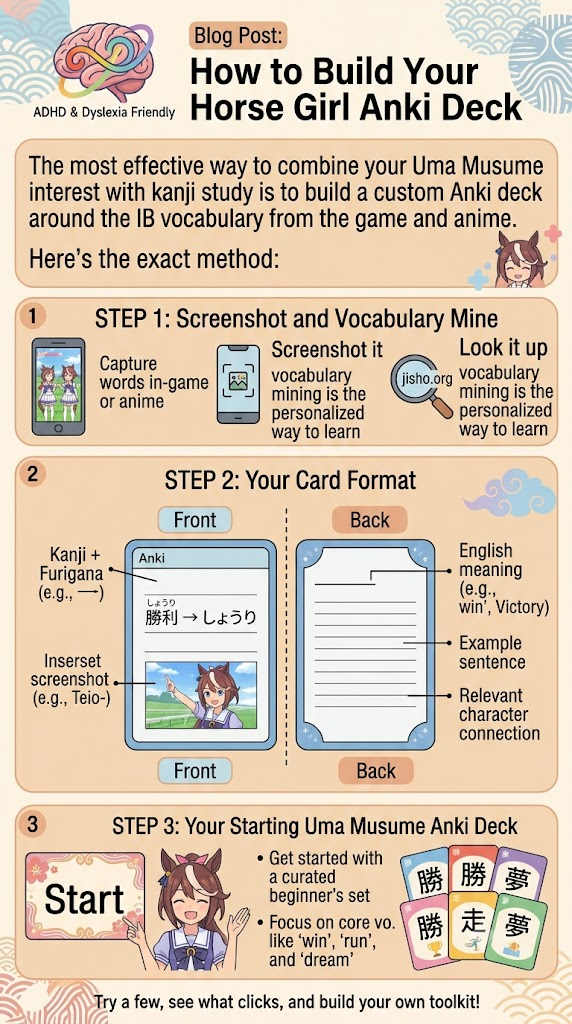
The most effective way to combine your Uma Musume interest with kanji study is to build a custom Anki deck around the vocabulary from the game and anime. Here’s the exact method:
Step 1: Screenshot and Vocabulary Mine
Every time you see a word in Uma Musume that you don’t understand:
- Screenshot it
- Look it up (Jisho.org for quick lookups)
- Add it to your Anki deck
This is called vocabulary mining and it’s the most personalized, effective way to build a deck.
Step 2: Your Card Format
Front of card:
- Kanji + furigana (e.g., 勝利 → しょうり)
- Optional: screenshot of where you found it in the game
Back of card:
- English meaning (e.g., Victory)
- Example sentence from Uma Musume
- Any relevant character connection (e.g., “This is what flashes on screen when Teio wins”)
Step 3: Your Starting Uma Musume Anki Deck
Here are 50 starter cards to add immediately:
| # | Kanji | Reading | Meaning | Uma Musume Context |
|---|---|---|---|---|
| 1 | 馬 | uma / ba | Horse | It’s literally in the title |
| 2 | 娘 | musume | Daughter / Girl | Also in the title |
| 3 | 勝利 | shouri | Victory | Every race win |
| 4 | 敗北 | haiboku | Defeat | The painful losses |
| 5 | 努力 | doryoku | Effort | The series’ central theme |
| 6 | 夢 | yume | Dream | Literally every character’s motivation |
| 7 | 奇跡 | kiseki | Miracle | Tokai Teio’s comeback |
| 8 | 絆 | kizuna | Bond | Friendships in the show |
| 9 | 速度 | sokudo | Speed | Main stat |
| 10 | 根性 | konjou | Fighting spirit / Guts | The guts stat |
| 11 | 賢さ | kashikosa | Wisdom / Intelligence | The wisdom stat |
| 12 | 距離 | kyori | Distance | Race distance |
| 13 | 作戦 | sakusen | Strategy | Race strategy discussions |
| 14 | 先行 | senkou | Stalking / Leading | Racing style |
| 15 | 逃げ | nige | Running away / Front | Running style |
| 16 | 差し | sashi | Mid-field run | Racing style |
| 17 | 追込 | oikomi | Closer style | Racing style |
| 18 | 着 | chaku | Placing / Arrival | 1着 = 1st place |
| 19 | 直線 | chokusen | Straight | Final straight |
| 20 | 坂道 | sakamichi | Slope / Hill | The famous Yushun slope |
| 21 | 芝 | shiba | Turf | 芝コース = turf course |
| 22 | 実力 | jitsuryoku | Real ability | Tokai Teio’s famous line |
| 23 | 諦めない | akiramenai | Don’t give up | Every climax scene |
| 24 | 信じる | shinjiru | Believe / Trust | Pre-race pep talks |
| 25 | 感動 | kandou | Being moved / Touched | Your emotional state |
| 26 | 涙 | namida | Tears | Also your emotional state |
| 27 | 一緒に | issho ni | Together | Friendship scenes |
| 28 | 走る | hashiru | To run | Core verb of the series |
| 29 | 訓練 | kunren | Training | Training sessions |
| 30 | 育成 | ikusei | Raising / Training | The game’s main mode |
| 31 | スキル | sukiru | Skill | Skill screen (katakana) |
| 32 | 確率 | kakuritsu | Probability | Gacha rates |
| 33 | 天井 | tenjou | Ceiling / Pity | Gacha pity system |
| 34 | 記録 | kiroku | Record | Race records |
| 35 | 更新 | koushin | Update / Break | 記録更新 = new record |
| 36 | 復活 | fukkatsu | Revival / Comeback | Teio’s return |
| 37 | 骨折 | kossetsu | Bone fracture | Teio’s injury |
| 38 | 怪我 | kega | Injury | Character injuries |
| 39 | 友達 | tomodachi | Friend | The many friendship arcs |
| 40 | 気持ち | kimochi | Feeling | Emotional dialogue |
| 41 | 本気 | honki | Serious / For real | “I’m getting serious” |
| 42 | 全力 | zenryoku | All one’s strength | Full effort |
| 43 | 前向き | maemuki | Positive / Forward-looking | Character attitude |
| 44 | 諦める | akirameru | To give up | The thing they never do |
| 45 | 帝王 | teiou | Emperor / King | Tokai Teio’s name meaning |
| 46 | 静寂 | seijaku | Silence | Silence Suzuka’s name meaning |
| 47 | 特別 | tokubetsu | Special | Special Week’s name |
| 48 | 誇り | hokori | Pride | Mejiro McQueen’s character |
| 49 | 天才 | tensai | Genius | Gold Ship’s self-description |
| 50 | 蹄 | hizume | Hoof | The horse anatomy detail |
Step 4: Study Schedule
- Daily reviews: All due Anki cards (10–15 minutes)
- New cards: 10–15 new Uma Musume words per day
- Active immersion: 1 episode of Uma Musume per day OR 20 minutes of game play
- Weekly: Read one fan wiki article about a character in Japanese
How to Watch Uma Musume as a Kanji Study Session
Passive watching is fun but won’t teach you kanji. Active watching will. Here’s the difference:
The Passive Approach (What Most People Do)
Watch with English subtitles. Enjoy the show. Learn nothing except that horse girls are emotionally devastating.
The Active Approach (What Actually Works)
Step 1: First watch with Japanese subtitles (if available) The Uma Musume anime is available with Japanese subtitles on some platforms. Turn them on even if you can’t read them yet — your brain will start pattern-matching.
Step 2: The Pause-Screenshot-Mine Method When a word or kanji catches your eye:
- Pause
- Screenshot
- Look it up on Jisho.org
- Add it to Anki if it seems important
- Continue
You won’t understand everything at first. That’s fine. Mine 3–5 words per episode and you’ll build an extraordinary vocabulary in months.
Step 3: Shadowing After watching an episode, find a clip of a scene you loved. Play it back and try to repeat what the characters say out loud. This trains pronunciation and reinforces the vocabulary you’ve been mining.
Step 4: The Episode Rewatch Watch each episode twice: once actively (mining vocab), once passively (just enjoying). The second watch feels like a reward and cements the vocabulary in memory because you’re hearing words you already added to Anki.
Best Episodes for Kanji Study
| Episode | Why It’s Good for Kanji Study |
|---|---|
| S1 Episode 1 | Introduces all core racing vocabulary in context |
| S1 Episode 9 | Suzuka’s race — emotional vocabulary + racing terms |
| S2 Episode 1 | Teio’s story begins — injury and recovery vocabulary |
| S2 Episode 7 | Emotional peak — advanced feeling and relationship vocabulary |
| S2 Episode 13 | The finale — every key word in the series appears |
| Cinderella Gray | Manga — slower pace, great for reading practice |
The Horse Girl Approach to the JLPT
If you’re using Uma Musume as a gateway to the JLPT, here’s how your horse girl vocabulary maps to exam levels.
JLPT N5 — The Uma Musume Starter Pack
Roughly 800 words and ~90 kanji. Almost all of the basic racing and friendship vocabulary falls here.
Horse girl words that are N5:
- 馬 (horse), 走る (run), 速い (fast), 友達 (friend), 夢 (dream), 勝つ (win), 負ける (lose), 強い (strong), 力 (strength), 大好き (love very much)
Our free JLPT N5 vocabulary guide covers all of these.
JLPT N4 — The Training Arc
About 1,500 words. You’re now reading simple dialogue and training descriptions.
Horse girl words that are N4:
- 努力 (effort), 信じる (believe), 作戦 (strategy), 記録 (record), 感動 (being moved), 距離 (distance)
JLPT N3 — The Race Commentary Level
About 3,000 words. At this level, you can follow race commentary in real time.
Horse girl words that are N3:
- 奇跡 (miracle), 根性 (fighting spirit), 実力 (real ability), 諦める (give up), 復活 (revival), 集中力 (concentration)
JLPT N2 and N1 — The Deep Lore Level
At N2 and N1, you can read the game’s deep story events, historical articles about real racehorses, and fan-written long-form analysis. The vocabulary becomes more formal, historical, and nuanced — covering horse breeding, racing regulations, and historical racing eras.
Your Horse Girl Kanji Study Schedule
Here’s a practical 12-week schedule for going from zero kanji to comfortably reading the Uma Musume game and anime:
Weeks 1–2: Learn Hiragana and Katakana
Before kanji, you need the kana. This is non-negotiable.
- Use our free hiragana chart — learn all 46 in one week
- Then our katakana chart — another week
- Once you know katakana, you can read half of Uma Musume’s game text immediately (skills, character names, menu items are often in katakana)
Weeks 3–4: Core Racing Kanji (JLPT N5)
Focus on the 50 words in the starter Anki deck above. Add 10 per day, review daily.
Weeks 5–6: Emotional Vocabulary
Learn the feeling and relationship words from the “Emotions” section. Rewatch your favorite emotional scenes and try to pick out words you’ve studied.
Weeks 7–8: The Game
Start playing Uma Musume Pretty Derby in Japanese. Use the pause-screenshot-mine method for any new words. By now you should recognize ~30% of the text.
Weeks 9–10: Training Kanji + Stats
Focus on the game-specific vocabulary. Understand every stat screen, training option, and skill description.
Weeks 11–12: Fan Content Immersion
Start reading Japanese fan wiki pages for your favorite characters. The Uma Musume wiki on Gamewith, Altema, and the official site is written in clear, consistent Japanese that’s excellent for intermediate learners.
A Note on Why This Method Works
There’s a word in Japanese language teaching: コンテキスト (kontekisuto) — context.
The biggest enemy of kanji study is decontextualized drilling. You sit with a list of 2,136 Joyo kanji, try to memorize them in order, and within three weeks you’ve quit.
Uma Musume solves this problem completely. Every kanji you learn is attached to:
- A character you care about
- An emotional scene you remember
- A gameplay moment you experienced
- A story beat that made you feel something
That’s context. And context is what makes vocabulary stick.
When you see 奇跡 (kiseki) on a flashcard six months from now, you won’t think “strange + trace.” You’ll think of Tokai Teio crossing the finish line at the Japan Cup after everyone said she was finished, and the word will be yours forever.
That’s the reconciliation. The horse girls and the kanji aren’t in conflict — the horse girls are the kanji lesson. Your job is just to pay attention.
FAQ
❓ Do I need to know any Japanese before using Uma Musume to study kanji?
Not at all. The best starting point is learning hiragana and katakana first (about two weeks total), then immediately starting to immerse in Uma Musume while studying basic vocabulary. See our hiragana chart and katakana chart for free guides.
❓ Is the Uma Musume mobile game available in English?
As of this writing, Uma Musume Pretty Derby is officially available only in Japanese (and Traditional Chinese). This is actually ideal for Japanese learners — you’re forced to engage with the Japanese text, and the game provides furigana (small hiragana above kanji) for most words, making it very learner-friendly.
❓ How many kanji do I need to know to play Uma Musume without a dictionary?
For comfortable game play without constant lookups:
- Minimum comfortable level: ~300 kanji (JLPT N4)
- Fully independent level: ~600–800 kanji (JLPT N3)
- Full enjoyment of all story content: ~1,000+ kanji (JLPT N2)
❓ Can I learn kanji just from watching the anime with Japanese subtitles?
Watching with Japanese subtitles is excellent passive input, but it won’t teach you kanji systematically on its own. The best results come from combining passive watching with active vocabulary mining (looking up words you see), Anki review, and occasional focused kanji study. The JLPT N5 vocabulary list is a good structured complement to your immersion.
❓ What is the real historical background of the Uma Musume characters?
The historical research rabbit hole is itself excellent Japanese study practice. Key resources:
- JRA (Japan Racing Association) official website — all in Japanese, excellent for advanced readers
- Wikipedia Japanese pages for each real horse — the kanji in these articles are well within N3-N2 range
- The Uma Musume fan wiki on Gamewith — written in clear, beginner-friendly Japanese
❓ I’m not interested in the JLPT. Can I still use this method?
Absolutely. The JLPT is just a benchmark — you don’t need to take the exam to benefit from structured vocabulary learning. The kanji you learn through Uma Musume will serve you in reading manga, watching anime, playing games, traveling to Japan, and understanding Japanese culture, regardless of exam goals.
❓ Is there an official Uma Musume study resource?
Not officially — but the fan community has produced extensive Japanese-language content. The best approach is:
- Play the game in Japanese
- Watch the anime with Japanese subtitles
- Read character pages on the official site and fan wikis
- Build your personal Anki deck from the vocabulary you encounter
For structured learning alongside your Uma Musume immersion, visit reading-japanese.com for free hiragana and katakana charts, JLPT word lists, and Anki decks.
❓ How do I handle kanji I encounter that aren’t in any standard list?
Racing has some specialized vocabulary and archaic kanji that won’t appear in standard JLPT lists. When you encounter these:
- Add them to a separate “Uma Musume specialist” Anki deck
- Don’t stress if they don’t appear in other contexts — specialized vocabulary is fine
- Note that historical horse names sometimes use older kanji forms
Related Articles
More free guides from Fumito Emi at reading-japanese.com:
- 📘 Learn Hiragana — Free Chart & Complete Guide — Your first step before any kanji
- 📗 Learn Katakana — Free Chart & Complete Guide — Read half of Uma Musume’s text immediately
- 📙 JLPT N5 Vocabulary — Complete Study List — The structured foundation under your Uma Musume immersion
- 📕 1000 Most Common Japanese Words for Anki — Build your full core deck alongside your horse girl deck
- 📒 Joyo Kanji List with Meaning — Free PDF — The complete reference for all 2,136 standard kanji
🎯 Your How to reconcile horse girls with kanji Journey Starts Now
You came here with an obsession. You’re leaving with a study plan.
The kanji are not the enemy of your horse girl fandom. They are the door into it. Every scene you rewatch with new vocabulary knowledge is more meaningful. Every game event you can read without a dictionary feels like a personal victory. Every fan wiki article you parse independently is a small miracle of your own.
Start with hiragana. Add your first 10 Uma Musume words to Anki today. Watch one episode with your new eyes.
The finish line is out there.
走れ。 (Hashire.) Run.
🔗 Start with hiragana today at reading-japanese.com/hiragana-chart — then come back for the kanji.
Written by Fumito Emi | Japanese Language Tutor | reading-japanese.com Uma Musume Pretty Derby is developed by Cygames. This article is an independent fan and educational resource.