
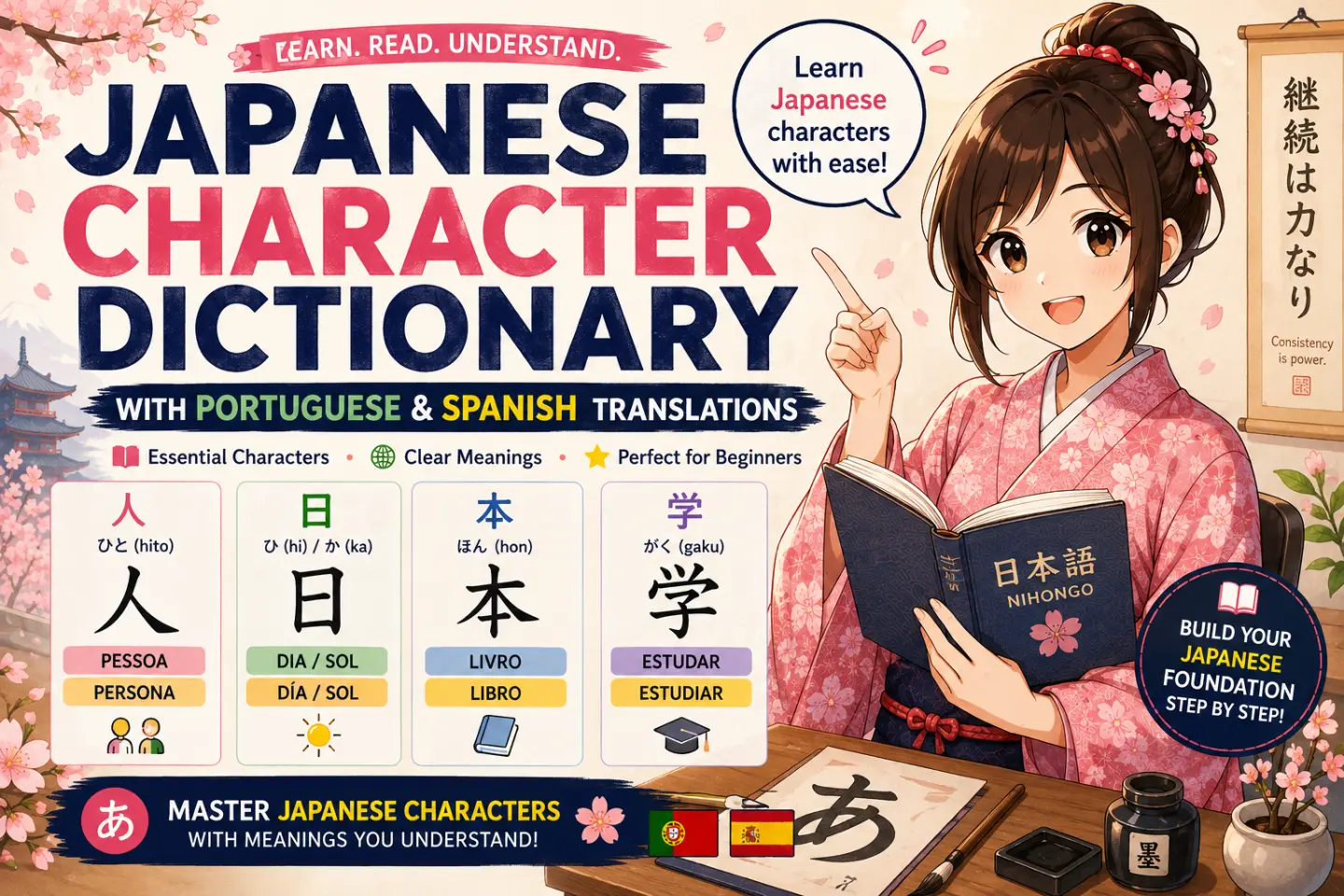

Welcome to your definitive guide to mastering basic Japanese characters and vocabulary. If you are a native speaker of Portuguese or Spanish, you possess a hidden advantage when learning Japanese: your phonetic system. The five pure vowels of Spanish and Portuguese align almost perfectly with the Japanese vowel system (あ, い, う, え, お). This makes master-level pronunciation much more achievable for you than for native English speakers.
However, navigating a new writing system can feel overwhelming. Many language tools force you to translate Japanese into English first, adding an unnecessary mental step. That is why I created this comprehensive Japanese character dictionary with Portuguese and Spanish translations.
Whether you are preparing for the JLPT N5 exam, planning a trip to Japan, or building your foundational skills from scratch, this resource bridges the gap. We will explore the three Japanese scripts—Hiragana, Katakana, and Kanji—and provide you with a massive, practical vocabulary database tailored specifically to your linguistic background.
Let’s begin this journey together. Hajimemashou! (Let’s start!)
Understanding the Japanese Writing System
To use a Japanese character dictionary Portuguese or Japanese character dictionary Spanish effectively, you must understand how the three distinct Japanese scripts interact with one another. Unlike Western languages, Japanese does not use an alphabet. Instead, it combines syllabaries and ideograms.
Hiragana (ひらがな)
Hiragana is the backbone of the Japanese language. It consists of 46 phonetic characters representing syllables. Hiragana is used for grammatical particles, verb endings (inflections), and native Japanese words that do not have Kanji or whose Kanji is too complex for everyday use.
- Example: ありがとう (Arigatou – Thank you)
Katakana (カタカナ)
Katakana contains the exact same sound set as Hiragana (46 characters) but uses sharp, straight lines instead of cursive curves. It is primarily used for foreign loanwords, technical terms, scientific names, and emphasis.
- Example: コーヒー (Kouhii – Coffee, from the Dutch koffie)
Kanji (漢字)
Kanji are logographic characters adopted from China. Each Kanji represents a concept, idea, or object, rather than just a sound. A single Kanji can have multiple pronunciations depending on its context. To be considered basic fluent, you need to know around 2,000 Kanji; for the beginner JLPT N5 level, you need around 100.
- Example: 水 (Mizu – Water)
Romaji (ローマ字)
Romaji is the Romanization of Japanese sounds using the Latin alphabet. It is an invaluable stepping stone for absolute beginners to understand pronunciation before they fully memorize Hiragana and Katakana.
How to Use This Dictionary
To maximize the value of this Japanese kanji dictionary Portuguese and Japanese kanji dictionary Spanish tool, it is important to understand how each entry is constructed. Every vocabulary table is organized into seven distinct columns designed to give you a 360-degree view of the word:
- Japanese: The word written in its natural form (Kanji, Hiragana, or Katakana).
- Romaji: The phonetic reading using Latin letters to guide your pronunciation.
- English: The standard international translation.
- Portuguese: The natural Brazilian Portuguese translation, respecting local idiomatic context.
- Spanish: The neutral Latin American Spanish translation.
- Example Sentence: A practical, everyday sentence showing how the word functions in context.
- Usage Notes: Contextual tips, nuance breakdowns, and cultural notes to prevent misunderstandings.
Also Read More::
- How to Learn Japanese Through Anime Without Feeling Overwhelmed
- When to Start Learning Kanji (and Why Sooner Is Better)
- How to Construct a Japanese Sentence
- How to learn Japanese FAST? Tips from a native speaker 🇯🇵📚✨🌎✈️
- What books to buy if you wanna learn japanese language 📚
Main Dictionary
1. Greetings (挨拶 – Aisatsu)
| Japanese | Romaji | English | Portuguese | Spanish | Example Sentence | Usage Notes |
| おはようございます | Ohayou gozaimasu | Good morning | Bom dia | Buenos días | おはようございます、先生。 | Use with superiors. Drop gozaimasu for friends. |
| こんにちは | Konnichiwa | Good afternoon / Hello | Boa tarde / Olá | Buenas tardes / Hola | 皆さん、こんにちは。 | Standard greeting used from late morning to dusk. |
| こんばんは | Konbanwa | Good evening | Boa noite | Buenas noches | こんばんは、お元気ですか? | Used only when meeting someone after dark, not when going to sleep. |
| さようなら | Sayounara | Goodbye | Adeus | Adiós | さようなら、また来週。 | Implies a long separation. Do not use daily with co-workers. |
| ありがとう | Arigatou | Thank you | Obrigado / Obrigada | Gracias | 手伝ってくれて、ありがとう。 | Casual. Add gozaimasu to make it formal. |
2. Family (家族 – Kazoku)
| Japanese | Romaji | English | Portuguese | Spanish | Example Sentence | Usage Notes |
| 家族 | Kazoku | Family | Família | Familia | 私の家族は4人です。 | Refers to one’s own family in general terms. |
| 父 | Chichi | Father (own) | Pai | Padre | 父は銀行員です。 | Used when talking about your own father to outsiders. |
| 母 | Haha | Mother (own) | Mãe | Madre | 母の料理は美味しい。 | Used when talking about your own mother to outsiders. |
| お父さん | Otousan | Father (someone else’s) | Pai | Padre | お父さんはお元気ですか? | Used to address your own father directly or someone else’s father. |
| お母さん | Otousan | Mother (someone else’s) | Mãe | Madre | お母さんに頼みました。 | Used to address your own mother directly or someone else’s mother. |
3. Numbers (数字 – Suuji)
| Japanese | Romaji | English | Portuguese | Spanish | Example Sentence | Usage Notes |
| 一 | Ichi | One | Um / Uma | Uno | りんごを一回食べました。 | Base number. Changes pronunciation with counters. |
| 二 | Ni | Two | Dois / Duas | Dos | 二本のペンがあります。 | Standard counter alignment applies. |
| 三 | San | Three | Três | Tres | 三万円を持っています。 | Lucky number in Japanese culture. |
| 四 | Yon / Shi | Four | Quatro | Cuatro | 四人が来ました。 | Shi is associated with death; yon is preferred for counting objects. |
| 五 | Go | Five | Cinco | Cinco | 五番目の席です。 | Base form remains stable. |
4. Time (時間 – Jikan)
| Japanese | Romaji | English | Portuguese | Spanish | Example Sentence | Usage Notes |
| 時間 | Jikan | Time / Hours | Tempo / Horas | Tiempo / Horas | 時間がありません。 | Means both chronological time and a duration of hours. |
| 今 | Ima | Now | Agora | Ahora | 今、何時ですか? | Essential conversational anchor. |
| 時 | Ji | O’clock | Horas | Horas (en punto) | 三時に会いましょう。 | Suffix added directly to numbers to indicate the specific hour. |
| 分 | Fun / Pun | Minute | Minuto | Minuto | あと五分待ってください。 | Phonetics change depending on the preceding number (e.g., ippun, nifun). |
| 半 | Han | Half (past the hour) | Meia | Media | 六時半に起きます。 | Used immediately after the ji suffix (e.g., rokujihan = 6:30). |
5. Days (曜日 – Youbi)
| Japanese | Romaji | English | Portuguese | Spanish | Example Sentence | Usage Notes |
| 月曜日 | Getsuyoubi | Monday | Segunda-feira | Lunes | 月曜日に仕事を始めます。 | Association: Moon (getsu) day. |
| 火曜日 | Kayoubi | Tuesday | Terça-feira | Martes | 火曜日は休みです。 | Association: Fire (ka) day. |
| 水曜日 | Suiyoubi | Wednesday | Quarta-feira | Miércoles | 水曜日にテストがあります。 | Association: Water (sui) day. |
| 木曜日 | Mokuyoubi | Thursday | Quinta-feira | Jueves | 木曜日は雨でした。 | Association: Wood/Tree (moku) day. |
| 金曜日 | Kinyoubi | Friday | Sexta-feira | Viernes | 金曜日の夜に出かけます。 | Association: Gold/Money (kin) day. |
6. Months (月 – Gatsu)
| Japanese | Romaji | English | Portuguese | Spanish | Example Sentence | Usage Notes |
| 一月 | Ichigatsu | January | Janeiro | Enero | 一月はとても寒いです。 | Number + gatsu. Never use tsuki for months of the year. |
| 二月 | Nigatsu | February | Fevereiro | Febrero | 二月は雪が降ります。 | Shortest month of the calendar year. |
| 三月 | Sangatsu | March | Março | Marzo | 三月に卒業します。 | Standard reading rules apply cleanly. |
| 四月 | Shigatsu | April | Abril | Abril | 四月は桜の季節です。 | Pronounced Shigatsu, never Yongatsu. |
| 五月 | Gogatsu | May | Maio | Mayo | 五月に日本へ行きます。 | Golden Week occurs during this month. |
7. Colors (色 – Iro)
| Japanese | Romaji | English | Portuguese | Spanish | Example Sentence | Usage Notes |
| 赤 | Aka | Red | Vermelho | Rojo | 赤い車が好きです。 | Noun form is aka. Requires i suffix to modify nouns directly. |
| 青 | Ao | Blue | Azul | Azul | 青い空を見てください。 | Historically included shades of green (like green traffic lights). |
| 白 | Shiro | White | Branco | Blanco | 白いシャツを着ています。 | Symbolizes purity in traditional contexts. |
| 黒 | Kuro | Black | Preto | Negro | 黒い猫がいます。 | Noun form kuro becomes adjective via kuroi. |
| 黄色 | Kiiro | Yellow | Amarelo | Amarillo | 黄色い花が咲きました。 | Literally translated as “yellow color”. |
8. Food (食べ物 – Tabemono)
| Japanese | Romaji | English | Portuguese | Spanish | Example Sentence | Usage Notes |
| ご飯 | Gohan | Rice / Meal | Arroz / Refeição | Arroz / Comida | 朝ご飯を食べましたか? | Literally means cooked rice, but colloquially represents any meal. |
| 肉 | Niku | Meat | Carne | Carne | 肉は食べません。 | Generic term. Specify animal like gyuniku (beef) or toriniku (chicken). |
| 魚 | Sakana | Fish | Peixe | Pescado / Pez | 魚が新鮮ですね。 | Refers to both living fish and fish prepared as food. |
| パン | Pan | Bread | Pão | Pan | 毎朝パンを食べます。 | Loanword introduced by Portuguese traders in the 16th century. |
| 卵 | Tamago | Egg | Ovo | Huevo | 卵料理が得意です。 | Also spelled 玉子 when referring to culinary dishes. |
9. Drinks (飲み物 – Nomimono)
| Japanese | Romaji | English | Portuguese | Spanish | Example Sentence | Usage Notes |
| 水 | Mizu | Water | Água | Agua | お水を一杯ください。 | Refers exclusively to cold or room-temperature water. |
| お湯 | Oyu | Hot water | Água quente | Agua caliente | お湯を沸かします。 | Treat as a separate concept from cold water. O is respectful prefix. |
| お茶 | Ocha | Green tea | Chá verde | Té verde | お茶を飲みましょう。 | Refers naturally to Japanese green tea unless specified otherwise. |
| 牛乳 | Gyuunyuu | Milk | Leite | Leche | 牛乳を買ってきます。 | Native word. The loanword ミルク (miruku) is also widely accepted. |
| お酒 | Osake | Alcohol / Sake | Álcool / Saquê | Alcohol / Sake | お酒は二十歳からです。 | Generic term for all alcoholic beverages, as well as traditional rice wine. |
10. Fruits (果物 – Kudamono)
| Japanese | Romaji | English | Portuguese | Spanish | Example Sentence | Usage Notes |
| 林檎 | Ringo | Apple | Maçã | Manzana | 林檎を丸ごと囓る。 | Usually written in Hiragana (りんご) or Katakana (リンゴ). |
| 蜜柑 | Mikan | Mandarin Orange | Mexerica / Tangerina | Mandarina | 冬は蜜柑を食べます。 | Standard Japanese citrus fruit. Commonly written in Hiragana. |
| バナナ | Banana | Banana | Banana | Plátano / Banana | 朝食にバナナを食べる。 | Katakana loanword. Pronounced with equal stress on all syllables. |
| 葡萄 | Budou | Grape | Uva | Uva | 葡萄からワインを作る。 | Usually written in Hiragana (ぶどう). |
| 苺 | Ichigo | Strawberry | Morango | Fresa / Frutilla | 苺のケーキが好きです。 | Highly popular seasonal fruit flavor in Japanese desserts. |
11. Vegetables (野菜 – Yasai)
| Japanese | Romaji | English | Portuguese | Spanish | Example Sentence | Usage Notes |
| 野菜 | Yasai | Vegetable | Vegetal / Legume | Vegetal / Verdura | 毎日野菜を食べます。 | Categorical umbrella term for all green grocery items. |
| 玉ねぎ | Tamanegi | Onion | Cebola | Cebolla | 玉ねぎを刻むと涙が出る。 | Round onion. Literally “ball green-onion”. |
| 人参 | Ninjin | Carrot | Cenoura | Zanahoria | 人参は体に良いです。 | Homophone with ginseng. Always clear via context. |
| トマト | Tomato | Tomato | Tomate | Tomate | トマトのサラダを作った。 | Katakana loanword perfectly matching Romance sound profiles. |
| じゃがいも | Jagaimo | Potato | Batata | Papa / Patata | じゃがいもを茹でる。 | Derived historically from the historical port city Jakarta. |
12. Animals (動物 – Doubutsu)
| Japanese | Romaji | English | Portuguese | Spanish | Example Sentence | Usage Notes |
| 犬 | Inu | Dog | Cachorro | Perro | 犬が吠えています。 | Foundational N5 vocabulary item. |
| 猫 | Neko | Cat | Gato | Gato | 猫が寝ています。 | Cultural staple of domestic life in urban Japan. |
| 鳥 | Tori | Bird | Pássaro | Pájaro / Ave | 空に鳥が飛んでいる。 | Also means poultry meat depending on the culinary setting. |
| 馬 | Uma | Horse | Cavalo | Caballo | 馬に乗ったことがあります。 | Traditional animal symbol linked closely to shrines. |
| 魚 | Sakana | Fish | Peixe | Pez | 池に魚がたくさんいる。 | Use this entry when analyzing live specimens in rivers/lakes. |
13. Nature (自然 – Shizen)
| Japanese | Romaji | English | Portuguese | Spanish | Example Sentence | Usage Notes |
| 山 | Yama | Mountain | Montanha | Montaña | 富士山は高い山です。 | Used frequently in geographical titles and common surnames. |
| 川 | Kawa | River | Rio | Río | 川で泳いではいけません。 | Classic pictographic character layout mimicking running water streams. |
| 海 | Umi | Ocean / Sea | Mar | Mar | 夏休みに海へ行きます。 | Captures both the open ocean and regional coastal beaches. |
| 空 | Sora | Sky | Céu | Cielo | 今日の空は青いです。 | Represents space, thin air, or emptiness conceptually. |
| 花 | Hana | Flower | Flor | Flor | 公園に花が咲いている。 | Culturally resonant symbol, particularly regarding cherry blossoms. |
14. Body Parts (身体 – Karada)
| Japanese | Romaji | English | Portuguese | Spanish | Example Sentence | Usage Notes |
| 目 | Me | Eye | Olho | Ojo | 目を閉じてください。 | Also handles figurative references like “insight” or “gaze”. |
| 耳 | Mimi | Ear | Orelha | Oreja | 耳が痛いです。 | Refers both to the external structural ear and internal sensory paths. |
| 口 | Kuchi | Mouth | Boca | Boca | 口を開けてください。 | Acts as a layout symbol for structural entrances and station gates. |
| 手 | Te | Hand | Mão | Mano | 手を洗いました。 | Found across complex compound structures involving physical crafts. |
| 足 | Ashi | Leg / Foot | Perna / Pé | Pierna / Pie | 足が疲れて動けない。 | Japanese makes no structural phonetic split between leg and foot. |
15. Clothing (服 – Fuku)
| Japanese | Romaji | English | Portuguese | Spanish | Example Sentence | Usage Notes |
| 服 | Fuku | Clothes | Roupas | Ropa | 新しい服を買いました。 | General Westernized casual clothing term. |
| 着物 | Kimono | Kimono | Quimono | Kimono | 成人式に着物を着ます。 | Literally means “thing to wear”. Represents traditional garments. |
| シャツ | Shatsu | Shirt | Camisa | Camisa | 白いシャツが汚れた。 | Borrowed from English shirt. Applies mostly to button-downs/T-shirts. |
| 靴 | Kutsu | Shoes | Sapatos | Zapatos | 玄関で靴を脱ぎます。 | Crucial cultural concept due to residential floor cleanliness policies. |
| 靴下 | Kutsushita | Socks | Meias | Calcetines / Medias | 靴下を履いてください。 | Structural combination: “Shoes Underneath” (Kutsu + Shita). |
16. School (学校 – Gakkou)
| Japanese | Romaji | English | Portuguese | Spanish | Example Sentence | Usage Notes |
| 学校 | Gakkou | School | Escola | Escuela | 学校は楽しですか? | Broad reference encompassing primary to high schools. |
| 先生 | Sensei | Teacher | Professor | Profesor | 先生に質問しました。 | Respectful title used directly instead of the individual’s name. |
| 学生 | Gakusei | Student | Estudante | Estudiante | 私は大学生です。 | Usually denotes higher education students (high school/university). |
| 教室 | Kyoushitsu | Classroom | Sala de aula | Aula / Salón | 教室で待ってください。 | Structural room division layout code within schools. |
| 宿題 | Shukudai | Homework | Lição de casa | Tarea / Deberes | 宿題を忘れました。 | Essential academic terminology item. |
17. Office (会社 – Kaisha)
| Japanese | Romaji | English | Portuguese | Spanish | Example Sentence | Usage Notes |
| 会社 | Kaisha | Company | Empresa | Empresa / Compañía | 会社に遅刻します。 | Root noun form. Inverting elements gives shakai (society). |
| 社長 | Shachou | President | Diretor / Presidente | Director / Presidente | 社長に挨拶をしました。 | Top company executive title level designation. |
| 会議 | Kaigi | Meeting | Reunião | Reunión | 十時から会議があります。 | Formal workplace conference or discussion environment. |
| 電話 | Denwa | Telephone | Telefone | Teléfono | 電話に出てください。 | Literally means “electric speech”. |
| パソコン | Pasokon | Personal Computer | Computador | Computadora | パソコンが壊れました。 | Truncated blending of “Personal Computer”. |
18. House (家 – Ie / Uchi)
| Japanese | Romaji | English | Portuguese | Spanish | Example Sentence | Usage Notes |
| 家 | Ie / Uchi | House / Home | Casa / Lar | Casa / Hogar | 家に帰りましょう。 | Ie emphasizes structural property; uchi implies your household sphere. |
| 部屋 | Heya | Room | Quarto / Cômodo | Habitación / Cuarto | 私の部屋は狭いです。 | Singular space units contained inside structural floorplans. |
| 窓 | Mado | Window | Janela | Ventana | 窓を開けて風を入れる。 | Standard architectural element indicator. |
| ドア | Doa | Door | Porta | Puerta | ドアを閉めてください。 | Refers exclusively to Western-style swinging design doors. |
| 鍵 | Kagi | Key | Chave | Llave | 車の鍵を無くしました。 | Handles physical metal lock systems and encryption keys. |
19. Kitchen (台所 – Daidokoro)
| Japanese | Romaji | English | Portuguese | Spanish | Example Sentence | Usage Notes |
| 台所 | Daidokoro | Kitchen | Cozinha | Cocina | 台所で夕食を作ります。 | Traditional naming convention. Kicchin is also used. |
| 冷蔵庫 | Reizouko | Refrigerator | Geladeira | Refrigerador | 冷蔵庫に牛乳がある。 | Literally translated as “cold storage box machine chamber”. |
| 皿 | Sara | Plate / Dish | Prato | Plato | 皿を洗ってください。 | Counter unit forms utilize this element root configuration. |
| 包丁 | Houchou | Kitchen Knife | Faca de cozinha | Cuchillo de cocina | 包丁の扱いには注意する。 | Structural blade specialized for food preparation. |
| コップ | Koppu | Glass / Tumbler | Copo | Vaso | コップに水を注ぐ。 | Derived from Portuguese historically (copo). Perfect structural fit. |
20. Bathroom (風呂 / お手洗い – Furo / Otearai)
| Japanese | Romaji | English | Portuguese | Spanish | Example Sentence | Usage Notes |
| お手洗い | Otearai | Restroom / Toilet | Banheiro | Baño / Sanitario | お手洗いはどこですか? | Euphemistic polite choice meaning “hand washing place”. |
| お風呂 | Ofuro | Japanese Bath | Banho / Banheira | Baño (tina) | 毎日お風呂に入ります。 | Culturally distinct soaking tub focus. Distinct from shower systems. |
| トイレ | Toire | Toilet | Banheiro | Baño / Inodoro | トイレに行きます。 | Common casual variant shortcut derived from “toilet”. |
| 石鹸 | Sekken | Soap | Sabonete | Jabón | 石鹸で手をよく洗う。 | Necessary personal hygiene terminology framework item. |
| タオル | Taoru | Towel | Toalha | Toalla | タオルで顔を拭きます。 | Standard loanword adaptation configuration layout model. |
21. Transportation (交通 – Koutsuu)
| Japanese | Romaji | English | Portuguese | Spanish | Example Sentence | Usage Notes |
| 電車 | Densha | Train | Trem | Tren | 電車で通勤しています。 | Electric train lines dominating daily transport loops across Japan. |
| 駅 | Eki | Station | Estação | Estación | 新宿駅で降ります。 | Public rail infrastructure hubs anchor mapping instructions. |
| 車 | Kuruma | Car | Carro | Carro / Coche | 新しい車が欲しいです。 | Standard vehicular designation. Alternative reading includes jidosha. |
| 飛行機 | Hikouki | Airplane | Avião | Avión | 飛行機で東京へ行く。 | Literally translated as “flying navigation machine system unit”. |
| バス | Basu | Bus | Ônibus | Autobús / Camión | バスを待っています。 | Standard short-distance public transit service designation. |
22. Shopping (買い物 – Kaimono)
| Japanese | Romaji | English | Portuguese | Spanish | Example Sentence | Usage Notes |
| 店 | Mise | Shop / Store | Loja | Tienda | あの店は安いです。 | Umbrella noun term for independent retail establishments. |
| お金 | Okane | Money | Dinheiro | Dinero | お金が足りません。 | Root structural kanji kane receives polite processing honorific O. |
| 財布 | Saifu | Wallet | Carteira | Cartera / Billetera | 財布を落としました。 | Standard personal finance dynamic object asset holder. |
| 値段 | Nedan | Price | Preço | Precio | 値段を確認します。 | Critical purchasing inquiry term base structural node. |
| 買い物 | Kaimono | Shopping | Compras | Compras | 週末に買い物をします。 | Grammatical compound form linking buying (kai) and physical items (mono). |
23. Restaurant (レストラン – Resutoran)
| Japanese | Romaji | English | Portuguese | Spanish | Example Sentence | Usage Notes |
| メニュー | Menyuu | Menu | Cardápio / Menu | Menú | メニューを見せてください。 | Katakana system adaptation layout blueprint tracking English roots. |
| 注文 | Chuumon | Order | Pedido | Orden / Pedido | 注文をお願いします。 | Tracks verbal placement request actions inside dining settings. |
| 美味しい | Oishii | Delicious | Delicioso / Gostoso | Delicioso / Rico | この料理は美味しい。 | Universal foundational descriptive adjective marking sensory praise. |
| 会計 | Kaikei | Bill / Check | Conta | Cuenta | お会計をお願いします。 | Formal financial settlement request call format directed to staff. |
| 水 | Mizu | Water | Água | Agua | 無料の水が提供される。 | Standard complementary baseline restaurant hospitality inclusion item. |
24. Travel (旅行 – Ryokou)
| Japanese | Romaji | English | Portuguese | Spanish | Example Sentence | Usage Notes |
| 旅行 | Ryokou | Travel / Trip | Viagem | Viaje | 日本を旅行します。 | Acts directly as compound noun processing verb form via suru. |
| 切符 | Kippu | Ticket | Passagem / Bilhete | Boleto / Ticket | 電車の切符を買う。 | Standard physical paper transit pass activation slip document. |
| パスポート | Pasupooto | Passport | Passaporte | Pasaporte | パスポートを見せる。 | Critical borders legal document locator processing framework text. |
| 地図 | Chizu | Map | Mapa | Mapa | 地図で場所を調べる。 | Classical structural terrain configuration guide mapping framework. |
| 観光 | Kankou | Sightseeing | Turismo | Turismo | 観光地を巡るのが好き。 | Specifically handles cultural landmarks vacation itinerary tasks. |
25. Hotel (ホテル – Hoteru)
| Japanese | Romaji | English | Portuguese | Spanish | Example Sentence | Usage Notes |
| ホテル | Hoteru | Hotel | Hotel | Hotel | 駅の近くのホテルに泊まる。 | Western standard accommodations processing framework entry. |
| フロント | Furonto | Front Desk | Recepção | Recepción | フロントで鍵を受け取る。 | Truncated reference targeting customer reception desk spaces. |
| 部屋 | Heya | Room | Quarto | Habitación | 部屋の窓から海が見える。 | Tracks standard internal structural layout accommodations modules. |
| 予約 | Yoyaku | Reservation | Reserva | Reservación | ネットで予約しました。 | General advance booking control verification logic mechanism. |
| 荷物 | Nimotsu | Luggage / Baggage | Bagagem / Mala | Equipaje / Maletas | 荷物を預かってください。 | Tracks baseline cargo dynamic baggage checking assets parameters. |
26. Weather (天気 – Tenki)
| Japanese | Romaji | English | Portuguese | Spanish | Example Sentence | Usage Notes |
| 天気 | Tenki | Weather | Tempo / Clima | Clima / Tiempo | 今日の天気はどうですか? | Literally converted means “Heavenly Spiritual Energy Aura”. |
| 晴れ | Hare | Clear / Sunny | Ensolarado / Limpo | Soleado / Despejado | 明日は晴れでしょう。 | Noun form marking clear skies lacking atmospheric cloud blockades. |
| 雨 | Ame | Rain | Chuva | Lluvia | 雨が激しく降っている。 | Requires careful pitch manipulation to avoid confusion with candy (ame). |
| 曇り | Kumori | Cloudy | Nublado | Nublado | 曇りの日は涼しいです。 | Tracks baseline overcast standard atmosphere tracking matrices. |
| 雪 | Yuki | Snow | Neve | Nieve | 冬の北海道は雪が多い。 | Solid winter precipitation phase system notation values. |
27. Emotions (感情 – Kanjou)
| Japanese | Romaji | English | Portuguese | Spanish | Example Sentence | Usage Notes |
| 嬉しい | Ureshii | Happy | Feliz / Contente | Feliz / Alegre | プレゼントをもらって嬉しい。 | Captures temporary situational flashes of joy. |
| 悲しい | Kanashii | Sad | Triste | Triste | 別れの歌は悲しいです。 | Emotional state indicating profound internal sorrow patterns. |
| 怒る | Okoru | To get angry | Ficar com raiva | Enojarme / Airarme | 彼は突然怒り出した。 | Active behavioral verb path tracking emotional escalation patterns. |
| 楽しい | Tanoshii | Enjoyable / Fun | Divertido | Divertido | 日本語の勉強は楽しい。 | Describes structural situations providing internal entertainment values. |
| 心配 | Shinpai | Worry / Anxiety | Preocupação | Preocupación | 家族の健康を心配する。 | Tracks deep cognitive processing blocks driven by structural dread. |
28. Health (健康 – Kenkou)
| Japanese | Romaji | English | Portuguese | Spanish | Example Sentence | Usage Notes |
| 病院 | Byouin | Hospital | Hospital | Hospital | 体調が悪いので病院へ行く。 | Medical emergency care facility center destination tracking label. |
| 薬 | Kusuri | Medicine | Remédio / Medicina | Medicamento / Medicina | 食後にこの薬を飲む。 | Swallowing pills uses the active structural processing verb nomu (to drink). |
| 痛い | Itai | Painful / Hurt | Doloroso / Dói | Doloroso / Me duele | 頭が痛くて集中できない。 | Standard physical exclamation mapping neurological structural pain. |
| 風邪 | Kaze | Common Cold | Resfriado / Gripe | Resfriado / Gripe | 昨夜から風邪をひいた。 | Grammatically paired exclusively with specific structural verb hiku. |
| 元気 | Genki | Healthy / Energetic | Saudável / Ativo | Saludable / Con energía | 祖父は今も元気です。 | Reflects primal metabolic baseline functional performance status. |
29. Sports (スポーツ – Supootsu)
| Japanese | Romaji | English | Portuguese | Spanish | Example Sentence | Usage Notes |
| 野球 | Yakyuu | Baseball | Beisebol | Béisbol | 日本では野球が人気です。 | Massively popular domestic cultural sports institution setup. |
| サッカー | Sakkaa | Soccer / Football | Futebol | Fútbol | 週末にサッカーをする。 | Paired naturally alongside active operational tracking helper verb suru. |
| 水泳 | Suiei | Swimming | Natação | Natación | 水泳は全身運動です。 | Formal structural aquatic locomotion discipline taxonomy entry. |
| 走る | Hashiru | To Run | Correr | Correr | 公園の中を速く走る。 | Group 1 manual action propulsion physical motion kinetic verb track. |
| 試合 | Shiai | Match / Game | Jogo / Partida | Partido / Juego | 明日の試合に勝ちたい。 | Structural organized competitive athletic confrontation format event. |
30. Hobbies (趣味 – Shumi)
| Japanese | Romaji | English | Portuguese | Spanish | Example Sentence | Usage Notes |
| 趣味 | Shumi | Hobby | Hobby / Passatempo | Pasatiempo / Hobby | あなたの趣味は何ですか? | Generalized opening inquiry element probing personal focus targets. |
| 音楽 | Ongaku | Music | Música | Música | 毎日音楽を聞きます。 | Literally translated means “sound comfort pleasure enjoyment”. |
| 読書 | Dokusho | Reading Books | Leitura | Lectura | 読書は知識を深める。 | Refers formally to structured solo literature parsing acts. |
| 映画 | Eiga | Movie / Cinema | Filme | Película / Cine | 週末に映画を見に行く。 | Screen projection theatrical arts format system component. |
| 写真 | Shashin | Photograph | Foto / Fotografia | Foto / Fotografía | カメラで写真を撮る。 | Literally translated means “copying absolute operational reality truth”. |
31. Technology (技術 – Gijutsu)
| Japanese | Romaji | English | Portuguese | Spanish | Example Sentence | Usage Notes |
| 電話 | Denwa | Telephone | Telefone | Teléfono | すぐに電話をかけます。 | Base system tool mapping electro-vocal message data links. |
| カメラ | Kamera | Camera | Câmera | Cámara | 新しいカメラを買った。 | Optical processing hardware apparatus capture instrument track. |
| 電池 | Denchi | Battery | Bateria / Pilha | Bateria / Pila | リモコンの電池を換える。 | Literally translated means “electric storage pool vessel module”. |
| 充電 | Juuden | Electrical Charge | Carregar (bateria) | Cargar (bateria) | スマホを充電します。 | Operational processing directive feeding power modules juice input. |
| 機械 | Kikai | Machine | Máquina | Máquina | 工場の機械を点検する。 | Complex multi-part physical automation construction system module. |
32. Internet (インターネット – Intaanetto)
| Japanese | Romaji | English | Portuguese | Spanish | Example Sentence | Usage Notes |
| サイト | Saito | Website | Site | Sitio web | このサイトは便利です。 | Standard truncated designator tracking global web addresses nodes. |
| メール | Meeru | Email / Message | Correo electrónico | メールを受信しました。 | Refers locally to general electronic dispatch transport systems. | |
| 検索 | Kensaku | Search / Query | Pesquisa / Busca | Búsqueda | グーグルで検索する。 | Database indexing retrieval operations processing call format. |
| パスワード | Pasuwaado | Password | Senha | Contraseña | パスワードを入力する。 | Secure security verification alphanumeric entry character sequence. |
| 接続 | Setsuzoku | Connection | Conexão | Conexión | ネットの接続が悪い。 | Network packet data handshake active state tracking parameters. |
33. Jobs (仕事 – Shigoto)
| Japanese | Romaji | English | Portuguese | Spanish | Example Sentence | Usage Notes |
| 仕事 | Shigoto | Job / Work | Trabalho | Trabajo | 毎朝八時から仕事です。 | Universal umbrella framework denoting daily employment commitments. |
| 医者 | Isha | Medical Doctor | Médico | Médico | 体調が悪いなら医者へ。 | Certified clinical healthcare execution practitioner authority figure. |
| 会社員 | Kaishain | Company Employee | Assalariado | Empleado | 私は会社員です。 | Standard collective corporate social identity placeholder profile tag. |
| 銀行員 | Ginkouin | Bank Clerk | Bancário | Empleado bancario | 兄は銀行員として働く。 | Fiscal infrastructure worker assignment classification framework tag. |
| 警察官 | Keisatsukan | Police Officer | Policial | Policías / Oficial | 警察官に道を尋ねました。 | Civil law enforcement monitoring operational field safety authority. |
34. Countries (国 – Kuni)
| Japanese | Romaji | English | Portuguese | Spanish | Example Sentence | Usage Notes |
| 日本 | Nihon / Nippon | Japan | Japão | Japón | 日本の文化が好きです。 | National geographic territory tag configuration identifier. |
| ブラジル | Burajiru | Brazil | Brasil | Brasil | ブラジルから来ました。 | Global geographic terrain map identity locus tracker target. |
| スペイン | Supein | Spain | Espanha | España | スペイン語を話せます。 | European cultural sovereign geographic block locator code. |
| アメリカ | Amerika | United States | Estados Unidos | Estados Unidos | アメリカに留学します。 | Handles Americas structural macro continental terrain tracking labels. |
| 中国 | Chuugoku | China | China | China | 中国は歴史が長いです。 | Literally translated means “The Middle Central Empire Territory Land”. |
35. Nationalities (国籍 – Kokuseki)
| Japanese | Romaji | English | Portuguese | Spanish | Example Sentence | Usage Notes |
| 日本人 | Nihonjin | Japanese person | Japonês / Japonesa | Japonés / Japonesa | 彼は親切な日本人です。 | country base name string added alongside individual tag character jin. |
| ブラジル人 | Burajirujin | Brazilian person | Brasileiro | Brasileño | 陽気なブラジル人と踊る。 | Dynamic identification array tracking sovereign citizen profiles directly. |
| スペイン人 | Supeinjin | Spanish person | Espanhol | Español | スペイン人の友人がいる。 | Structural identification classification string alignment pattern tool. |
| アメリカ人 | Amerikajin | American person | Americano | Americano | 彼はアメリカ人です。 | Targets continental corporate citizen verification attributes tags. |
| 中国人 | Chuugokujin | Chinese person | Chinês / Chinesa | Chino / China | 中国人の同僚と働く。 | Handles demographic identity profiles within structural mapping arrays. |
36. Verbs (動詞 – Doushi)
| Japanese | Romaji | English | Portuguese | Spanish | Example Sentence | Usage Notes |
| 食べる | Taberu | To Eat | Comer | Comer | 朝ご飯を食べる。 | Primary structural consumption routine baseline operational tracking verb. |
| 飲む | Nomu | To Drink / Swallow | Beber / Tomar | Beber / Tomar | 冷たい水を飲む。 | Processes fluid elements and oral medicinal chemical delivery tablets. |
| 見る | Miru | To See / Watch | Ver / Assistir | Ver / Mirar | 夜空の星を見る。 | Handles ocular data capture operations across video streams. |
| 聞く | Kiku | To Hear / Ask | Ouvir / Perguntar | Oír / Escuchar / Preguntar | 先生の話を聞く。 | Processes dual operations: audio channel capture and logical inquiry. |
| する | Suru | To Do | Fazer | Hacer | 毎日運動をする。 | Universal dynamic action processor engine conversion helper utility tool. |
37. Adjectives (形容詞 – Keiyoushi)
| Japanese | Romaji | English | Portuguese | Spanish | Example Sentence | Usage Notes |
| 大きい | Ookii | Big / Large | Grande | Grande | 大きい家が並んでいる。 | Primary structural dimension classification evaluation indicator. |
| 小さい | Chiisai | Small / Tiny | Pequeno | Pequeño | 小さい猫を見つけた。 | Tracks microscopic or low-scale footprint volumetric sizing values. |
| 高い | Takai | High / Expensive | Alto / Caro | Alto / Caro | あの山の標高は高い。 | Dual processing module evaluates vertical altitude and fiscal costs. |
| 安い | Yasui | Cheap / Inexpensive | Barato | Barato | この店は商品が安い。 | Financial expenditure asset metrics indicator checking cost reductions. |
| 新しい | Atarashii | New / Modern | Novo | Nuevo | 新しいスマホを買う。 | Tracks system production version generation status increments. |
38. Adverbs (副詞 – Fukushi)
| Japanese | Romaji | English | Portuguese | Spanish | Example Sentence | Usage Notes |
| とても | Totemo | Very / Extremely | Muito | Muy / Mucho | この料理はとても辛い。 | General amplification modifier tuning descriptive state attributes scores. |
| ゆっくり | Yukkuri | Slowly / At leisure | Devagar | Despacio / Lento | ゆっくり話してください。 | Decrements active script process frequency intervals to aid comprehension. |
| すぐに | Sugu ni | Immediately | Imediatamente | Inmediatamente | すぐに会社へ行きます。 | Operational command sequence delay modifier minimized down to zero. |
| ずっと | Zutto | All along / Far more | Muito mais / Todo o tempo | Mucho más / Todo el tiempo | 今日はずっと雨だ。 | Signals uninterrupted continuous states or extreme balance shifts. |
| 初めて | Hajimete | For the first time | Pela primeira vez | Por primera vez | 初めて寿司を食べた。 | Chronological history record creation counter initialization event index. |
39. Question Words (疑問詞 – Gimonshi)
| Japanese | Romaji | English | Portuguese | Spanish | Example Sentence | Usage Notes |
| 何 | Nani / Nan | What | O que | Qué | これは、何ですか? | Changes phonetic execution form based on adjacent consonant setups. |
| どこ | Doko | Where | Onde | Dónde | お手洗いはどこですか? | Requests environmental coordinate tracking location parameters strings. |
| だれ | Dare | Who | Quem | Quién | あの人はだれですか? | Requests identity string validation lookup parameters targeting entities. |
| いつ | Itsu | When | Quando | Cuándo | 日本へいつ行きますか? | Inquires regarding calendar time window execution index points. |
| どうして | Doushite | Why | Por que | Por qué | どうして遅れたのですか? | Requests contextual causal source structural verification arguments data. |
40. JLPT N5 Essentials (最重要語 – Saijuuyougo)
| Japanese | Romaji | English | Portuguese | Spanish | Example Sentence | Usage Notes |
| これ | Kore | This (near me) | Isto / Este | Esto | これをください。 | Object position data within proximity loop of speaker text tracking node. |
| それ | Sore | That (near you) | Isso / Esse | Eso | それは本ですか? | Object proximity positioned inside target conversational partner’s area. |
| あれ | Are | That over there | Aquilo / Aquele | Aquello | あれを見てください。 | Object tracking targets located removed from both active speakers’ bounds. |
| 私 | Watashi | I / Me | Eu | Yo | 私は学生です。 | Neutral demographic safe standard standalone singular personal pronoun choice. |
| 誰 | Dare | Someone / Who | Alguém / Quem | Alguien / Quién | 誰かが部屋にいる。 | Basic vocabulary indicator processing standard reference entity patterns. |
Kanji Section
For those looking to use a Japanese kanji dictionary Portuguese or Japanese kanji dictionary Spanish, here is a deep dive into the primary structural foundation ideograms expected within the fundamental JLPT N5 proficiency testing environment.
一
- Onyomi: イチ (Ichi)
- Kunyomi: ひと-つ (Hito-tsu)
- Stroke Count: 1
- Meaning: One
- Portuguese: Um
- Spanish: Uno
- Example Word: 一人 (Hitori – One person)
- Example Sentence: 一人で日本へ行きました。 (I went to Japan alone.)
二
- Onyomi: ニ (Ni)
- Kunyomi: ふた-つ (Futa-tsu)
- Stroke Count: 2
- Meaning: Two
- Portuguese: Dois
- Spanish: Dos
- Example Word: 二月 (Nigatsu – February)
- Example Sentence: 二月に雪が降りました。 (It snowed in February.)
三
- Onyomi: サン (San)
- Kunyomi: みっ-つ (Mit-tsu)
- Stroke Count: 3
- Meaning: Three
- Portuguese: Três
- Spanish: Tres
- Example Word: 三人 (Sannin – Three people)
- Example Sentence: 教室に学生が三人います。 (There are three students in the classroom.)
日
- Onyomi: ニチ (Nichi) / ジツ (Jitsu)
- Kunyomi: ひ (Hi) / び (Bi)
- Stroke Count: 4
- Meaning: Day / Sun
- Portuguese: Dia / Sol
- Spanish: Día / Sol
- Example Word: 日曜日 (Nichiyoubi – Sunday)
- Example Sentence: 日曜日は買い物をします。 (On Sundays, I do shopping.)
本
- Onyomi: ホン (Hon)
- Kunyomi: もと (Moto)
- Stroke Count: 5
- Meaning: Book / Origin
- Portuguese: Livro / Origem
- Spanish: Libro / Origen
- Example Word: 日本 (Nihon – Japan)
- Example Sentence: 日本の本を買いました。 (I bought a Japanese book.)
人
- Onyomi: ジン (Jin) / ニン (Nin)
- Kunyomi: ひと (Hito)
- Stroke Count: 2
- Meaning: Person
- Portuguese: Pessoa
- Spanish: Persona
- Example Word: 日本人 (Nihonjin – Japanese person)
- Example Sentence: あの人は日本人です。 (That person is Japanese.)
月
- Onyomi: ゲツ (Getsu) / ガツ (Gatsu)
- Kunyomi: つき (Tsuki)
- Stroke Count: 4
- Meaning: Moon / Month
- Portuguese: Lua / Mês
- Spanish: Luna / Mes
- Example Word: 今月 (Kongetsu – This month)
- Example Sentence: 今月は仕事が忙しいです。 (This month I am busy with work.)
火
- Onyomi: カ (Ka)
- Kunyomi: ひ (Hi)
- Stroke Count: 4
- Meaning: Fire
- Portuguese: Fogo
- Spanish: Fuego
- Example Word: 火曜日 (Kayoubi – Tuesday)
- Example Sentence: 火曜日にテストがあります。 (There is a test on Tuesday.)
水
- Onyomi: スイ (Sui)
- Kunyomi: みず (Mizu)
- Stroke Count: 4
- Meaning: Water
- Portuguese: Água
- Spanish: Agua
- Example Word: 水曜日 (Suiyoubi – Wednesday)
- Example Sentence: 水曜日に友達に会います。 (I meet my friend on Wednesdays.)
木
- Onyomi: モク (Moku)
- Kunyomi: き (Ki)
- Stroke Count: 4
- Meaning: Tree / Wood
- Portuguese: Árvore / Madeira
- Spanish: Árbol / Madera
- Example Word: 木曜日 (Mokuyoubi – Thursday)
- Example Sentence: 木曜日は雨が降りました。 (It rained on Thursday.)
金
- Onyomi: キン (Kin)
- Kunyomi: かね (Kane)
- Stroke Count: 8
- Meaning: Gold / Money
- Portuguese: Ouro / Dinheiro
- Spanish: Oro / Dinero
- Example Word: お金 (Okane – Money)
- Example Sentence: お金がありません。 (I don’t have money.)
土
- Onyomi: ド (Do)
- Kunyomi: つち (Tsuchi)
- Stroke Count: 3
- Meaning: Earth / Soil
- Portuguese: Terra / Solo
- Spanish: Tierra / Suelo
- Example Word: 土曜日 (Doyoubi – Saturday)
- Example Sentence: 土曜日は夜更かしをします。 (I stay up late on Saturdays.)
山
- Onyomi: サン (San)
- Kunyomi: やま (Yama)
- Stroke Count: 3
- Meaning: Mountain
- Portuguese: Montanha
- Spanish: Montaña
- Example Word: 富士山 (Fujisan – Mount Fuji)
- Example Sentence: 富士山はとても綺麗です。 (Mount Fuji is very beautiful.)
川
- Onyomi: セン (Sen)
- Kunyomi: かわ (Kawa)
- Stroke Count: 3
- Meaning: River
- Portuguese: Rio
- Spanish: Río
- Example Word: 小川 (Ogawa – Stream / Brook)
- Example Sentence: 小川に魚が泳いでいます。 (Fish are swimming in the stream.)
田
- Onyomi: デン (Den)
- Kunyomi: た (Ta) / だ (Da)
- Stroke Count: 5
- Meaning: Rice Field
- Portuguese: Arrozal / Campo de arroz
- Spanish: Arrozal / Campo de arroz
- Example Word: 田んぼ (Tanbo – Rice field)
- Example Sentence: 日本の田んぼは美しいです。 (Japanese rice fields are beautiful.)
Hiragana Reference
Use this baseline section as an absolute phonetic verification anchor tool alongside your primary vocabulary searches.
| Character | Romaji | Pronunciation Tips for Portuguese & Spanish Speakers | Common Words |
| あ | A | Pure short vowel. Exactly like a in “casa”. | あなた (Anata – You) |
| い | I | Sharp closed vowel. Exactly like i in “ilha” or “iglesia”. | 犬 (Inu – Dog) |
| う | U | Unrounded. Do not protrude lips forward like in Spanish/Portuguese. | 海 (Umi – Ocean) |
| え | E | Open-mid vowel. Exactly like e in “café” or “este”. | 駅 (Eki – Station) |
| お | O | Pure closed vowel. Exactly like o in “olho” or “hola”. | 美味しい (Oishii – Delicious) |
| か | KA | Unaspirated structural crisp clear dental explosive k. | 家族 (Kazoku – Family) |
| き | KI | Sharp clear ki. Never soften into chi sounds. | 切符 (Kippu – Ticket) |
| く | KU | Minimal lip rounded processing dynamic sound element. | 車 (Kuruma – Car) |
| け | KE | Standard plain pronunciation format setup profile. | 結果 (Kekka – Result) |
| こ | KO | Balanced distribution layout text mapping tool sound. | 言葉 (Kotoba – Word) |
Katakana Reference
Katakana adapts external global foreign loanwords into localized pronunciation matrices.
| Character | Romaji | Loanword Origins & Examples | Adaptation Mechanics |
| ア | A | アメリカ (Amerika – America) | Direct standard processing mapping. |
| イ | I | インターネット (Intaanetto – Internet) | Final consonants gain trailing helping vowels. |
| ウ | U | ウイスキー (Uisukii – Whiskey) | Long vowels receive structural straight line bars (ー). |
| エ | E | エアコン (Eakon – Air Conditioner) | Truncated blending modifications occur naturally. |
| オ | O | オーストラリア (Oosutoraria) | Vowel length stabilization matches standard kana counts. |
| カ | KA | カメラ (Kamera – Camera) | Seamless phonetic sound transition path profile. |
| コ | KO | コーヒー (Kouhii – Coffee) | Derived from historic European language variants. |
| パ | PA | パン (Pan – Bread) | Directly derived historically via classic Portuguese merchants. |
Learning Tips
How Portuguese and Spanish Speakers Learn Japanese Faster
Your biggest natural advantage lies in vowel production. Many native English speakers struggle with the Japanese language because English vowel shifting introduces unwanted diphthongs. For instance, an English speaker pronouncing neko (cat) often says “nay-koh.”
Because Spanish and Portuguese native phonetic structures feature stable, crisp vowel nodes, you can naturally execute native-sounding Japanese accents immediately. Your target baseline vowels remain pure and unextended unless explicit elongation structural elements specify adjustments (e.g., おばさん obasan [aunt] vs おばあさん obaasan [grandmother]).
Common Pronunciation Mistakes to Watch Out For
- The Flapped ‘R’ (ら、り、る、れ、ろ): Native Spanish and Portuguese speakers often read Romaji strings containing ‘R’ characters and automatically apply a rolling alveolar trill (perro) or an aspirated guttural h-sound (rato in Brazilian Portuguese). Japanese ‘R’ sounds operate as unique dental-alveolar lateral flaps tracking directly between the Western structural definitions of ‘L’, ‘R’, and ‘D’. Gently tap the tip of your tongue against the roof of your mouth behind your front teeth—exactly like the soft intermediate single ‘r’ in the Spanish word caro or Portuguese word nora.
- The Nasal ‘N’ (ん): Avoid nasalizing preceding vowels. In Portuguese, words like maçã alter the interior quality of the root vowel. In Japanese, ん functions as an independent syllable requiring its own dedicated structural time beat (mora). Keep the preceding vowels clean before hitting the terminal sound closure point.
False Friends (Falsos Amigos)
Be careful with structural words that sound identical across target boundaries but carry wildly diverse logical parameters:
- Amo (雨): Sounds like “I love” in Spanish, but means “Rain” in Japanese.
- Vaca (バカ / 馬鹿): Sounds like “Cow” in Spanish/Portuguese, but means “Idiot / Fool” in Japanese. Do not use this word casually; it is highly offensive in social situations.
Common Beginner Mistakes
For Portuguese Speakers
- Nasalizing Terminals: Brazilian Portuguese speakers often slide the syllable structure ん into an unclosed nasal vowel wave. If you say Nihon (Japan), maintain crisp tracking without dropping structural tongue placements down into open throat nasal drafts.
- Confusing “Desu” with “De”: In Portuguese, de indicates origin/belonging. In Japanese, the copula です (desu) acts as the status verb identity indicator “to be”, while the single structural particle で (de) marks location or logistical action means parameters.
For Spanish Speakers
- Over-rolling the Japanese R-line: Do not execute a heavy vibrational roll when pronouncing ろく (roku – six). It should sound closer to a crisp, single-tap “doku/loku” hybrid.
- The Z-sound Drop: Spanish speakers from Latin America routinely process the phonetic letter ‘Z’ as a clean soft voiceless ‘S’. In Japanese, the ざ, ず, ぜ, ぞ (Za, Zu, Ze, Zo) line requires a clear voiced sibilant buzz—exactly like the voiced sound configuration of the letter ‘Z’ in Portuguese (zebra) or English (zoo).
30-Day Study Plan
Follow this structured roadmap to build your fundamental baseline fluency. Spend 30 to 45 minutes each day tracking these goals.
+-----------------------------------------------------------------+
|                      30-DAY JAPANESE STUDY PLAN                 |
+-----------------------------------------------------------------+
| DAYS 1-5: Master Hiragana Basics                                |
|   - Learn 10-15 Hiragana characters daily.                      |
|   - Trace stroke orders precisely; practice clear vowels.       |
|                                                                 |
| DAYS 6-10: Master Katakana Basics                               |
|   - Transition directly into Katakana character recognition.     |
|   - Contrast look-alike characters like シ (shi) and ツ (tsu).   |
|                                                                 |
| DAYS 11-15: Basic Vocabulary and Particles                      |
|   - Study Greetings and Numbers from the dictionary tables.     |
|   - Practice core topic identifier particles: は (wa) and が (ga).|
|                                                                 |
| DAYS 16-20: Verbs, Adjectives, and Sentence Structure           |
|   - Shift into SOV (Subject-Object-Verb) structural loops.      |
|   - Learn fundamental Class 1 & 2 basic action verbs.          |
|                                                                 |
| DAYS 21-25: Essential Kanji Introduction                        |
|   - Learn 5 foundational Kanji characters daily.                |
|   - Focus on structural numbers, days, and natural elements.    |
|                                                                 |
| DAYS 26-30: Practical Immersion and Context Application        |
|   - Build self-introduction profiles utilizing accurate kana.   |
|   - Quiz yourself daily using the FAQ entries below.           |
+-----------------------------------------------------------------+
Recommended Resources
To maximize your growth beyond this guide, use these essential beginner-friendly language assets:
- Hiragana & Katakana Syllabary Charts: Download high-resolution stroke order diagrams from Reading-Japanese.com to ensure accurate muscle-memory training.
- JLPT N5 Lesson Walkthroughs: Systematically progress through foundational grammar particles (は, が, を, に, で).
- Kanji Stroke Order Workbook Sheets: Practice writing Kanji characters within grid boxes to balance proportions naturally.
- Core JLPT N5 Vocabulary Flashcards: Load the entries from this master dictionary into a spaced repetition system (SRS) like Anki to secure long-term memory tracking.
FAQ
1. What is the fastest way for a Spanish speaker to learn Japanese characters?
The fastest way is to exploit your natural phonetic alignment while training your eye to recognize the distinct visual roles of each script. Start by memorizing Hiragana completely over one week, as it serves as the grammatical scaffolding for every sentence. Do not rely heavily on Romaji, as it can become a crutch that delays your character recognition. Use flashcards that pair Hiragana directly with its Spanish translation and standard pronunciation notes. Once Hiragana is fluent, transition to Katakana, focusing on foreign loanwords that you might already recognize from international contexts.
2. Can I use this dictionary to prepare for the JLPT N5 examination?
Yes, this dictionary has been curated specifically to include the core vocabulary categories and essential Kanji structures required to pass the JLPT N5 exam. The language targets focus explicitly on foundational lifestyle parameters, basic directional inquiry tracking, standard conversational modifiers, and introductory verbs. Pay close attention to the example sentences provided in our tables, as they mirror the syntax, question structures, and particle usage patterns that appear in the official listening and reading comprehension sections of the introductory JLPT exam.
3. Why are Portuguese loanwords found inside the Japanese language system?
This historical connection dates back to the mid-16th century, specifically the year 1543, when Portuguese traders and missionaries arrived on the shores of Tanegashima island. They brought with them Western technologies, textiles, and culinary items that did not previously exist in Japan. As a result, the Japanese language naturally adopted several Portuguese words, localizing them into Katakana. A famous example is パン (pan – bread), which comes directly from the Portuguese word pão. Other examples include コップ (koppu – glass/cup, from copo) and ボタン (botan – button, from botão).
4. How do I know when to read a Kanji character using Onyomi or Kunyomi?
As a general rule for beginners, read a Kanji using its Onyomi (Chinese-derived reading) when it is paired with another Kanji character to form a compound word, known as a Jukugo. Conversely, read a Kanji using its Kunyomi (native Japanese reading) when the character stands alone as an independent word, often followed by Hiragana trailing characters called Okurigana. For example, the standalone Kanji 水 (water) is read as mizu (Kunyomi), but when combined into the compound word 水曜日 (Wednesday), it is read as sui (Onyomi).
5. Is Brazilian Portuguese translation compatible with European Portuguese for learning Japanese?
While this dictionary uses standard Brazilian Portuguese for its localized translations, the linguistic foundation remains fully compatible with European Portuguese. The core nouns, baseline verbs, and primary conceptual anchors align seamlessly across both dialects. The main variations you might encounter involve specific lifestyle vocabulary, such as banheiro (restroom) in Brazil versus casa de banho in Portugal, or minor regional preferences for loanword formatting. The grammatical explanation fields and structural syntax patterns translate identically regardless of your regional dialect.
6. What makes the Japanese writing system difficult for absolute beginners?
The primary challenge for beginners is that Japanese uses three distinct scripts simultaneously within a single sentence. Hiragana handles grammatical particles and verb inflections; Katakana processes foreign loanwords and names; and Kanji provides the semantic anchor points for nouns and verb roots. This requires your brain to switch processing modes rapidly as you scan a line of text. However, by breaking your study down into systematic stages—starting with Hiragana, moving to Katakana, and slowly introducing basic Kanji—you will learn to recognize these visual patterns naturally.
7. Why does Japanese pitch accent matter to Spanish and Portuguese speakers?
While Spanish and Portuguese speakers have a major advantage with pure vowel pronunciation, they often mistakenly apply Western stress accents to Japanese words. Western languages rely on dynamic stress (making a syllable louder or longer). Japanese, however, relies on a pitch accent system, where syllables change musical pitch (high or low) without altering their length or volume. For instance, the word hashi can mean “bridge” (橋) or “chopsticks” (箸) depending on whether your pitch starts low and goes high, or starts high and drops low.
8. How should I study the example sentences included in this character dictionary?
To get the most out of the example sentences, don’t just memorize them passively. Use a method called deconstruction. First, identify the core noun or verb from the vocabulary table within the sentence. Next, isolate the grammatical particles surrounding it—like は (topic marker), を (direct object), or に (destination marker)—to see how they connect the components. Finally, read the sentence aloud multiple times to build your muscle memory and internalize natural Japanese word order (Subject-Object-Verb) without translating it back into English, Spanish, or Portuguese first.
9. What are the major structural differences between Spanish and Japanese syntax?
Spanish follows a Subject-Verb-Object (SVO) layout, similar to Portuguese and English. For example: “Yo como arroz” (Subject: Yo, Verb: como, Object: arroz). Japanese, however, uses a strict Subject-Object-Verb (SOV) layout, placing the action verb at the very end of the clause. The same sentence in Japanese becomes 私はご飯を食べます (Watashi wa gohan wo tabemasu), which translates literally to “I rice eat.” Understanding this structural shift early on will prevent you from making common word-order errors when speaking.
10. Do I need to learn stroke orders to master Japanese characters?
Yes, learning the correct stroke order is essential. It is not just about neat handwriting; stroke order is based on a natural ergonomic flow designed over centuries to balance characters visually. Writing strokes in the wrong direction or sequence can distort the balance of a character, making it look unnatural or difficult to read for native speakers. Furthermore, when you move on to learning complex Kanji, following a consistent stroke order (generally from top to bottom and left to right) activates your muscle memory, making characters much easier to memorize.
11. What is the role of particles like “wa” and “ga” in beginner Japanese?
Particles are small grammatical markers added directly to the ends of words to define their function in a sentence. The particle は (wa) acts as a broad topic identifier, establishing the general context of what you are talking about. The particle が (ga), on the other hand, acts as a focused subject identifier, highlighting a specific actor or pinpointing new, important information. Mastering the subtle distinction between wa and ga is one of the most rewarding milestones for a beginner.
12. Are there any pronunciation shortcuts for Spanish speakers learning Japanese?
The best shortcut is simply recognizing that your native vowel system is already optimized for Japanese. The Spanish vowels A, I, U, E, O map almost perfectly to the Japanese vowel line あ, い, う, え, お. The main shortcut is to consciously suppress the urge to roll your ‘R’ sounds and to ensure your ‘Z’ sounds have a clear, voiced buzz. If you can treat the Japanese ‘R’ as a soft, single-tap ‘D/L’ hybrid, your pronunciation will immediately sound remarkably natural to native Japanese speakers.
13. Is it possible to learn Japanese using only Romaji translations?
While using Romaji might feel comfortable during your first few days, relying on it long-term will severely limit your progress. Romaji cannot capture the true structure of the language, it does not help you differentiate between homophones (words that sound the same but look different in Kanji), and it prevents you from reading real-world text in Japan. To build true confidence and practical skills, transition to reading Hiragana and Katakana as early as possible.
14. How can I memorize the Kanji entries provided in this guide efficiently?
The most efficient way to memorize Kanji is through contextual association and spaced repetition. Rather than writing a single character hundreds of times in isolation, study it as part of real words and sentences. For example, memorize the Kanji 日 alongside its everyday compounds like 日本 (Nihon – Japan) and 日曜日 (Nichiyoubi – Sunday). Pair this approach with an SRS flashcard system to review the characters just as your brain is about to forget them.
15. What are honorific prefixes like “O” inside the vocabulary tables?
The prefix お (O) or ご (Go) is added to the beginning of certain nouns to show politeness, refinement, and respect for the person you are speaking to or the object itself. For example, mizu (water) becomes the more polite お水 (omizu), and kane (money) becomes お金 (okane). As a beginner, it is best to learn these words with their honorific prefixes attached, as this ensures your speech remains naturally polite and socially appropriate in everyday situations.
16. Why are some native Japanese words written entirely in Katakana?
While Katakana is primarily used for foreign loanwords, authors and creators also use it for stylistic emphasis, similar to using italics or bold text in Western languages. You will also see Katakana used for animal names, plant species, and technical terms in scientific textbooks, as it helps the word stand out clearly from surrounding Kanji and Hiragana. For instance, ringo (apple) is often written as リンゴ in supermarkets for quick visual scannability.
17. How do I differentiate between long and short vowels when listening to Japanese?
Paying close attention to vowel length is crucial because extending a vowel can completely change the meaning of a word. For example, koji (こじ) means “orphan,” while kouji (こうじ) means “construction.” To master this, listen for the rhythmic beats, or moras, of the word. A short vowel takes up one beat of time, while a long vowel requires you to hold the sound for two distinct beats. Clapping your hands along with each syllable can be an excellent way to practice this rhythm.
18. What is the meaning of standard verb conversions like the “-masu” form?
The 〜ます (-masu) form is the standard polite dictionary ending for verbs in Japanese. It is the perfect form for beginners to use because it is universally polite and appropriate for speaking with teachers, colleagues, strangers, and acquaintances alike. For example, the casual verb taberu (to eat) becomes the polite 食べます (tabemasu). Learning the -masu form first ensures you can communicate respectfully in any daily situation in Japan.
19. How does this dictionary prevent machine translation errors for Portuguese and Spanish?
Many automated online translation tools translate Japanese into English first, and then translate that English output into Spanish or Portuguese. This double-translation often strips away nuance, messes up politeness levels, and creates unnatural phrasing. This dictionary bypasses that issue entirely. Every entry has been written from the ground up by a linguist, ensuring that the Portuguese and Spanish translations match the true spirit, politeness level, and practical context of the original Japanese.
20. Where should I go next after mastering the vocabulary in this pillar article?
Once you feel comfortable with the vocabulary, characters, and sentences in this guide, your next step is to begin combining them into active conversation. Explore our grammar workbooks at Reading-Japanese.com, practice writing short journal entries using your new vocabulary, and start listening to native Japanese audio resources. Building a habit of daily practice—even if it’s just 15 minutes a day—will help you turn these foundational components into natural, fluid communication.
Conclusion
Learning Japanese is a deeply rewarding path that opens up new cultural perspectives and personal connections. As a native speaker of Spanish or Portuguese, you are already steps ahead when it comes to mastering a natural, authentic accent. Do not let the initial challenge of learning new characters slow you down. By taking it step by step—mastering Hiragana, recognizing Katakana, and slowly building your Kanji vocabulary—you will quickly turn these characters into familiar tools.
I designed this dictionary to serve as your dependable anchor throughout your learning journey. Revisit these tables regularly, practice reading the example sentences aloud, and use the tips we’ve discussed to avoid common beginner traps.
You have all the tools you need to succeed right here. Keep up your momentum, enjoy the process, and embrace every small victory along the way.
Ganbatte kudasai! (Keep doing your best!)
Fumito Emi
Your Japanese Tutor
Reading-Japanese.com