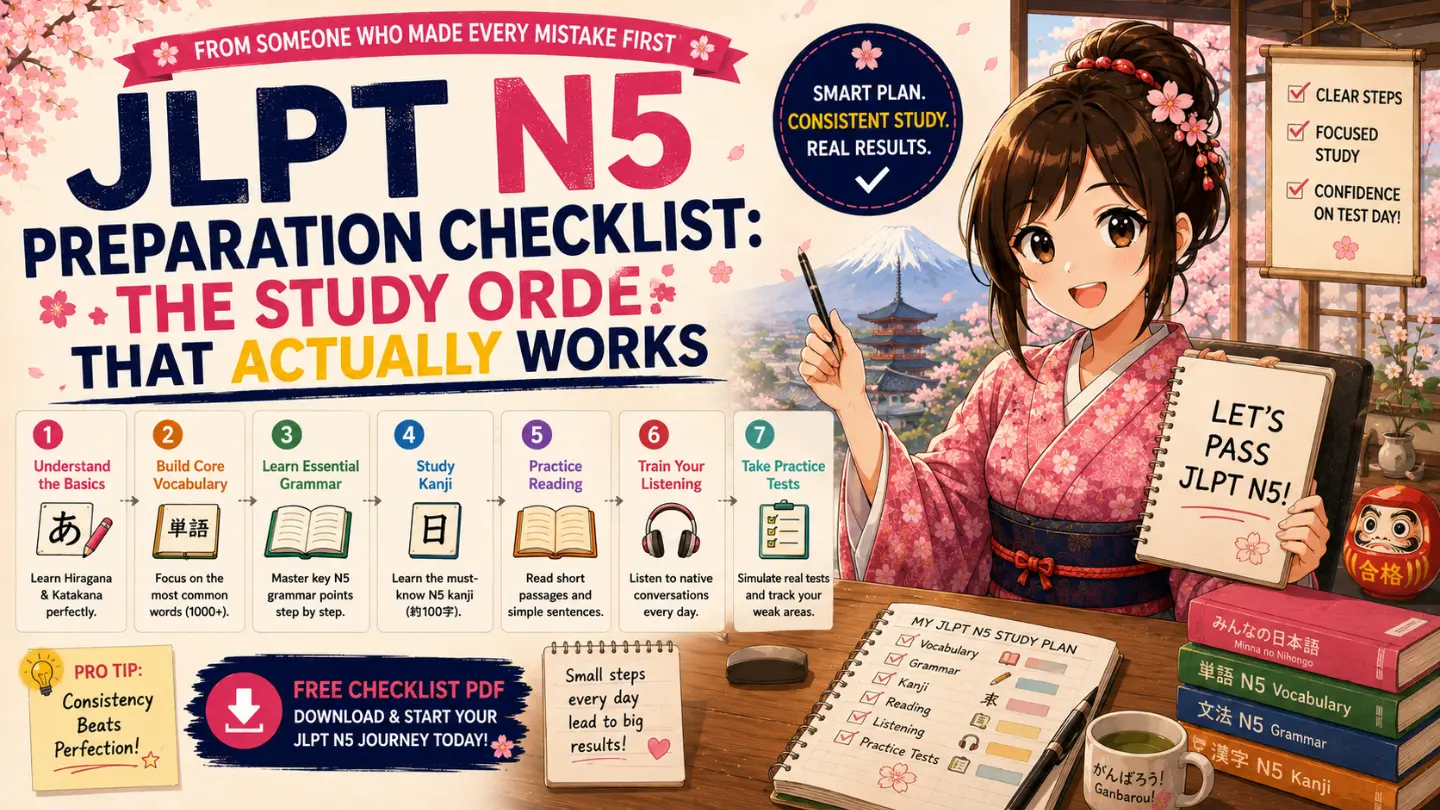
JLPT N5 Preparation Checklist: The Study Order That Actually Works (From Someone Who Made Every Mistake First)

Okay, I want to talk about a question that almost every beginner ask me, in comment section, in email, even one time a student ask me this in middle of unrelated lesson: “Emi-sensei, I know my hiragana already, so… what do I study next?”
JLPT N5 Preparation Checklist: The Study Order That Actually Works
This question, it come up SO much that I think, maybe I collect a thread I saw on r/LearnJapanese, because honestly, the community answer to this is very good, and it match almost exactly what I tell my own students. So today, not just my opinion — I combine it with real advice from real learners who already walk this road. Let’s make the checklist together.
The Question That Start Everything
The original poster say something very relatable: kana reading is confident already, but no idea if next step should be vocabulary, grammar, or kanji.
If this is you right now — please don’t worry. This confusion is 100% normal. Almost every single one of my students feel this exact same “now what” moment right after hiragana and katakana. It is like, you learn to hold the chopsticks, but nobody tell you what food to eat first.
So here is the truth I always say: you do not study vocabulary, grammar, and kanji in separate boxes. For N5 level, they must go together, like three legs of one small stool. If you only study one leg, the stool falls down.
But there IS a correct order for how you approach them. Let me break it down.
The N5 Study Order Checklist
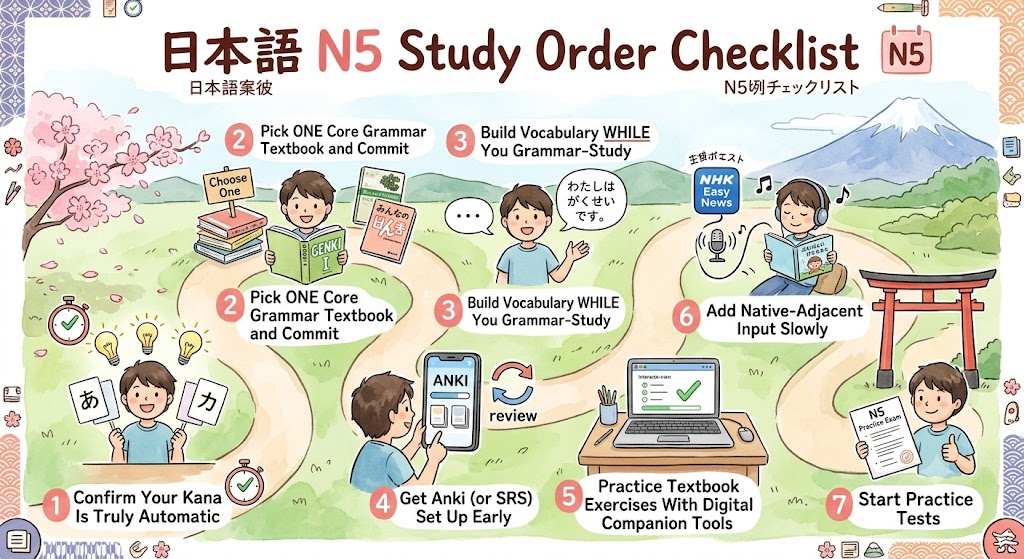
✅ Step 1: Confirm Your Kana Is Truly Automatic
Before anything else — and I mean truly before — your hiragana and katakana reading must be automatic. Not “I can figure it out if I think for 3 seconds.” I mean you see あ and your brain say “a” without effort, same like you see letter “A” in English.
If you still hesitate on katakana especially (this is normal, everyone hesitate on katakana longer than hiragana), spend one more week just on this before move forward. Katakana is sneaky — it look similar between characters like シ and ツ, so many learner think they finish but actually still confusing them.
✅ Step 2: Pick ONE Core Grammar Textbook and Commit
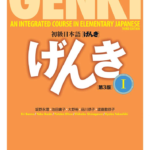
This is the part where the Reddit thread and my own teaching agree 100%. The most recommend resource, by far, was Genki I and II — and I also recommend this to almost every one of my beginner students, especially if you like structure and workbook-style practice.
One commenter say something I really like: with a textbook like Genki, “you will be going through grammar and gradually learn kanji along the way.” This is the key insight! You are not studying grammar OR vocabulary OR kanji — a good textbook naturally weave all three together, so you absorb them at the same time, in context, not as separate lonely lists.
If Genki is not in your budget, Tae Kim’s Grammar Guide is completely free and cover all the major basic grammar point. It’s a bit more dry, more “just the facts,” compare to Genki, but many learners start here successfully. Just know: some people find it little overwhelming without a teacher explaining alongside.
For learners who want even more depth later (this is more N4/N3 territory but good to know it exists), IMABI is there — but I will be honest, for absolute beginner this one might feel like drinking from fire hose. Save it for later.
✅ Step 3: Build Vocabulary WHILE You Grammar-Study, Not After
This is a common misunderstanding! Someone in the thread ask directly — “does Genki go through vocab?” — and answer is yes, of course. Any proper textbook naturally teaches vocabulary as you go, because you cannot practice grammar pattern with zero words to put into it, right?
So please don’t think “first I finish all grammar, THEN I start vocabulary.” This create weak foundation. Instead:
- Learn the vocabulary list attach to each textbook chapter
- Immediately after, drill those same words with a spaced repetition tool
Which bring me to…
✅ Step 4: Get Anki (or similar SRS tool) Set Up Early
I cannot stress this enough — spaced repetition system, most famous one is Anki, is basically non-negotiable for JLPT prep at any level, but ESPECIALLY N5 where you are building your very first vocabulary foundation. Anki is free, and there are premade N5 vocabulary decks you can download instead of making cards yourself if you are short on time.
Set a small daily goal — even 10-15 new cards a day is enough at N5 stage. Consistency beat intensity every time. I tell my students: 15 minutes every day is much better than 3 hours once a week.
✅ Step 5: Practice Textbook Exercises With Digital Companion Tools
If you’re using Genki, there are free companion resource online that give you the same textbook exercises in interactive digital format — very useful for checking your answer instantly instead of waiting to compare with answer key in back of book. This kind of tool make self-study (no teacher, no classroom) much more realistic, especially important if you are studying completely alone like many of my readers.
✅ Step 6: Add Native-Adjacent Input Slowly
You don’t need to jump into raw native content yet at N5 — that come more around N3/N2 stage, once your textbook material “run out,” as one commenter nicely put it. But even at N5, start light exposure:
- NHK Easy News (very simplified real news)
- Kids’ picture books
- Simple YouTube content made FOR learners (not necessarily native speaker content yet)
This isn’t your main study method at N5. Think of it more like seasoning — small amount, just to remind your brain that Japanese is a real living language, not only textbook exercises.
✅ Step 7: Start Practice Tests Once You Finish Genki I (or equivalent)
Once you complete a full beginner textbook cycle, start doing official-style N5 practice questions. This tell you clearly what area is weak — usually it’s either kanji reading speed or listening comprehension for most learners, in my experience.
Quick Reference Table: What To Study, In What Order
| Stage | Focus | Primary Tool | Daily Time Estimate |
|---|---|---|---|
| Before Step 1 | Hiragana + Katakana mastery | Any kana app or chart | 15-20 min |
| Step 2-3 | Grammar + Vocabulary together | Genki I / Tae Kim’s Guide | 30-45 min |
| Step 4 | Vocabulary retention | Anki (SRS) | 10-15 min |
| Step 5 | Exercise reinforcement | Textbook companion site | 15-20 min |
| Step 6 | Light native exposure | NHK Easy, learner YouTube | 10 min |
| Step 7 | Test readiness | N5 practice test sets | 30 min (weekly) |
A Note About Free PDF Textbooks
I noticed in the original thread, someone mention downloading a Genki PDF because they don’t have money for the physical book. I understand this reality very well — Japanese learning material can be expensive, and not everyone in same financial situation. What I will say is: please look first for official, legal free resource (many exist! I link some below), or your local library, or older used edition, before downloading from unofficial source. Not because I want to lecture you, but because officially published material is usually more accurate, and creators of good learning content deserve support so they can keep making it. Okay, tutor lecture over, moving on!
FAQ: JLPT N5 Study Order
Q: Should I study kanji separately from vocabulary? At N5 level, no — not really. The kanji you need for N5 is a small, manageable set (around 100 characters), and they show up naturally in your vocabulary words. Studying kanji completely isolated, with no vocabulary context, tend to feel much more boring and harder to retain.
Q: How long does N5 preparation usually take? This depends very much on your study consistency, but most learners studying 30-60 minutes daily complete solid N5 preparation in 3 to 6 months. Please don’t compare your timeline to others too much — everyone’s life and schedule is different.
Q: Do I need a teacher, or can I self-study for N5? N5 is very achievable through self-study. Many successful learners never took a formal class before N5. A textbook plus Anki plus consistency can take you very far at this level.
Q: What if I can’t afford Genki? Tae Kim’s Grammar Guide is completely free and cover similar grammar ground. Combine it with a free N5 Anki deck and you have a workable, zero-cost study path.
This checklist grow out of real questions from real learners — including a great discussion thread on r/LearnJapanese that I referenced while writing this. If you have your own N5 study order that worked for you, I would love to hear about it in the comments below.