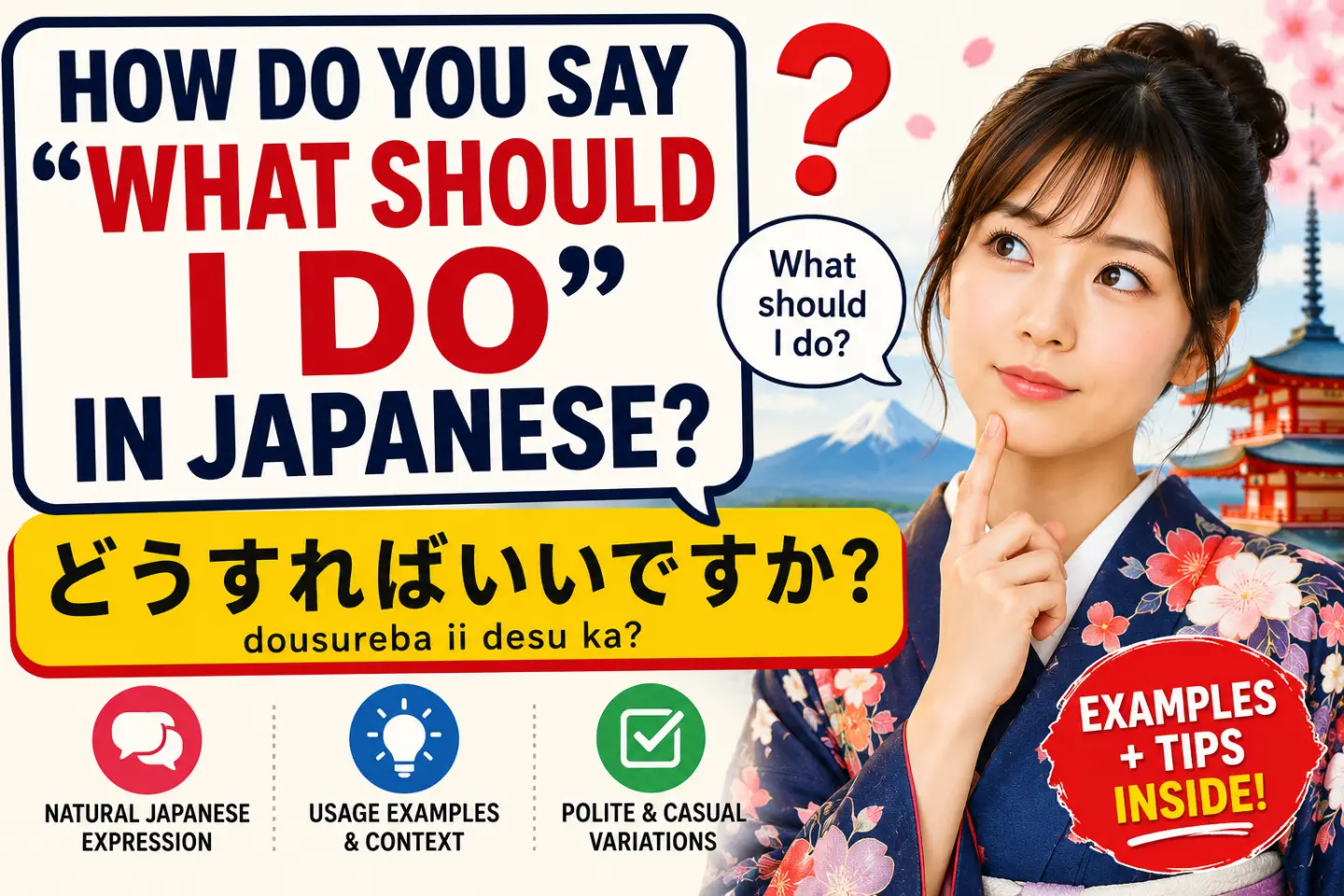

How to Say “What Should I Do” in Japanese – Dou Sureba Ii, Dou Shiyou and Every Form Explained
By Fumito フミト | reading-japanese.com | Japanese Phrases · Beginner to Advanced
“What should I do?” — its one of those phrases that comes up in almost every situation imaginable. You’re lost, you’re confused at work, someone’s asking for your help, or you’ve made a mistake and you don’t know how to fix it. Whatever the context, you’ll need this phrase in Japanese — and unlike English where one phrase pretty much covers it, Japanese has several different versions depending on who you’re talking to, what the situation is, and what exactly you mean.
How to Say “What Should I Do” in Japanese – Dou Sureba Ii, Dou Shiyou and Every Form Explained
This post covers every main way to say “what should I do” in Japanese — from the most casual everyday expressions all the way up to very formal polite versions, plus the Osaka dialect version and some nuance notes that most beginner guides skip over.
If your just getting started with Japanese, you’ll want to know your verb basics first — check out how Japanese verbs work (masu and masen) and compound verbs with shimasu before diving into the more complex forms here. For intermediate learners, this post should fill in a lot of gaps you might have around expressing uncertainty and seeking direction in Japanese.
📌 Quick summary for beginners: The most common and versatile expression is どうすればいい? (Dou sureba ii?) — use this first. Once you’re comfortable with it, you can expand into the other forms depending on the situation.
Quick Reference – “What Should I Do” in Japanese
どうすればいい?Dou sureba ii?What’s the best thing to do? (casual)
どうすればいいですか?Dou sureba ii desu ka?What should I do? (polite)
どうしよう?Dou shiyou?What should I do? (most casual/emotional)
どうしたらいい?Dou shitara ii?What should I do? (casual, very common)
どうしましょうか?Dou shimashou ka?What shall we do? / What should I do for you?
どのようにすればよいでしょうか?Donoyouni sureba ii deshou ka?How should I go about this? (very formal)
いかが致しましょうか?Ikaga itashimashou ka?What shall I do for you? (super formal/service)
The Most Common Way – Dou Sureba Ii (どうすればいい?)
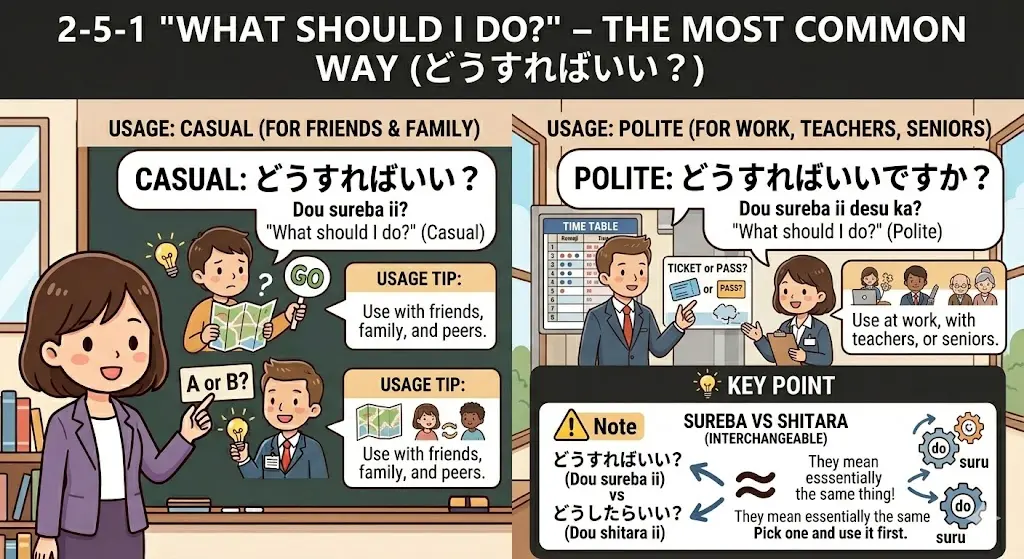
This is the one to learn first. Dou sureba ii literally breaks down as: dou (how/what way) + sureba (if [I] do) + ii (good). So literally its something like “if I do something, what would be good?” — but it translates naturally as “what should I do?” or “what’s the best thing to do?”
Casual
どうすればいい?Dou sureba ii?”What should I do?” / “What’s the right thing to do?”
Best used with friends, family, or people your close with. Most versatile casual form — works in almost any situation where you genuinely want advice or guidance on what the best course of action is.
Polite
どうすればいいですか?Dou sureba ii desu ka?”What should I do?” (polite version)
Same meaning as above but with desu ka at the end to make it polite and formal. Use this at work, with your teacher, with strangers, or anyone senior to you.
⚠️ Sureba vs shitara: You’ll see both dou sureba ii and dou shitara ii — they mean essentially the same thing. Sureba uses the conditional form of suru (do), and shitara uses a different conditional form. In everyday conversation both are completely natural and interchangeable. Don’t overthink the grammar difference at beginner level — just pick one and get comfortable with it first.
The Most Casual and Emotional Version – Dou Shiyou (どうしよう?)
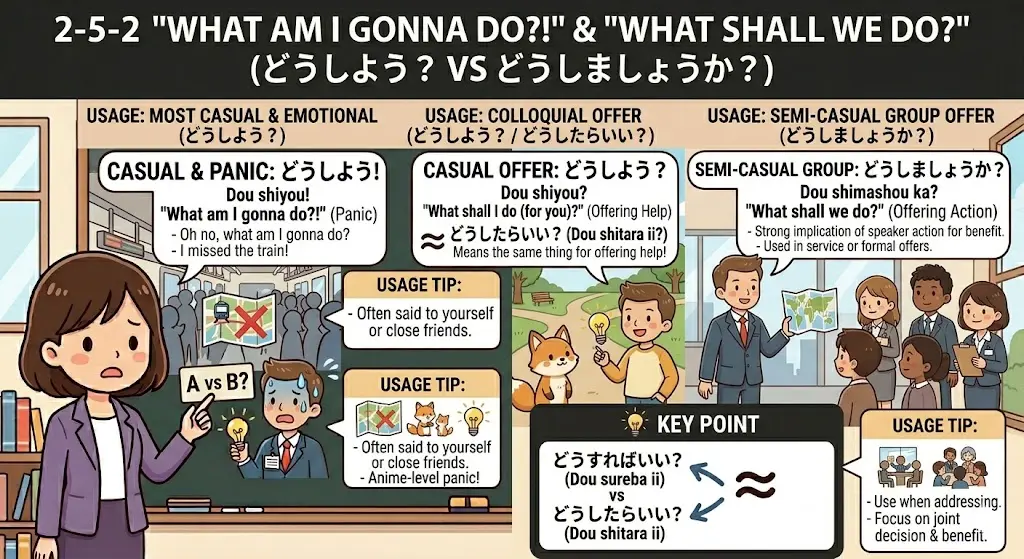
This one is the most raw, emotional, off-the-cuff version. When something has gone wrong and you’re panicking, or you’re stuck and you don’t know what to do — this is what comes out naturally. You’ll hear it all the time in anime and everyday conversation.
Most CasualEmotional / Urgent
どうしよう?Dou shiyou?”What should I do?” / “What am I gonna do?!”
The most colloquial and casual form. Often said to yourself, or to a close friend in a moment of stress or panic. This is the one you hear characters say in anime when something’s gone wrong. It can be said with a questioning tone or an exclamation tone depending on how urgent the situation feels.
どうしよう、電車を乗り遅れた!
Dou shiyou, densha wo nori okureta!
— Oh no, what am I gonna do — I missed the train!
This is also related to dou shimashou ka (どうしましょうか) — a slightly more polite version that you might say out loud when addressing a group or when something has come up that affects everyone.
Semi-casual / Group
どうしましょうか?Dou shimashou ka?”What shall we do?” / “What should I do (for you)?”
This form strongly implies the speaker is going to do something for someone else’s benefit — “what shall I do for you?” or “what shall we do about this?” It’s commonly used in service settings or when you’re offering to handle something on behalf of someone.
When You’re Stuck and Clueless – Nani wo Shimasu Ka (何をしますか?)
This form is a bit different in nuance. While dou sureba ii asks for advice on the best course of action, nani wo shimasu ka is more like “what do I do here?” — asked when you’re looking at something and have absolutely no idea where to start.
Practical / Clueless
何をしますか?Nani wo shimasu ka?”What should I do?” / “What do I do here?”
Used when you’re standing in front of something — a machine, a situation, a task — and you genuinely don’t know where to start or what action is required. Less about what the “best” choice is, more about “I’m completely lost here, tell me what to do.” Note: this same phrase can also mean “what will you do?” depending on context, so the situation matters.
Polite and Formal Versions – For Work and Senior Relationships
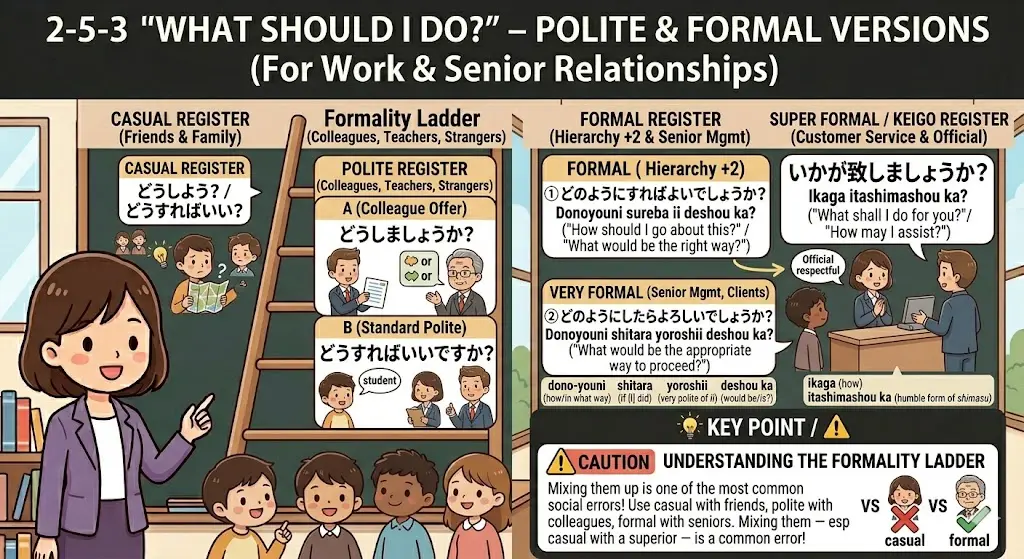
Japanese has some beautifully precise levels of formality when it comes to asking for guidance from someone above you. Here are the main formal versions:
Formal
どのようにすればよいでしょうか?Donoyouni sureba ii deshou ka?”How should I go about this?” / “What would be the right way to do this?”
Used with someone significantly senior — at least two levels above you in a hierarchy. Implies you know there are options but you want the other person’s guidance on which way to proceed, or that you genuinely have no clue and are asking them how they would approach it in your position.
Very Formal
どのようにしたらよろしいでしょうか?Donoyouni shitara yoroshii deshou ka?”What would be the appropriate way to proceed?”
Even more formal. Yoroshii is the very polite form of ii (good). Use this in formal business or professional settings with senior management, clients, or in official situations.
Super Formal / Keigo
いかが致しましょうか?Ikaga itashimashou ka?”What shall I do for you?” / “How may I assist?”
This is keigo (honorific language) — the highest level of polite Japanese. Used by customer service staff, hotel receptionists, and anyone in a service role strongly implying they’re going to do something for the other person’s benefit. Itashimasu is the humble form of shimasu.
🔑 Understanding the formality ladder: Japanese has at least three distinct registers for “what should I do” — casual (どうしよう / どうすればいい?), polite (どうすればいいですか? / どうしましょうか?), and super-formal keigo (いかが致しましょうか?). The casual forms are for friends and family. The polite forms are for colleagues, teachers, and strangers. The keigo form is for customer-facing situations or extremely senior relationships. Mixing them up — especially using casual forms with a superior — is one of the most common social errors foreigners make in Japanese workplaces.
Asking “What Should I Do to Help?” – A Slightly Different Meaning
Sometimes “what should I do” in English is less about asking for advice and more about offering help — “is there anything I can do?” Japanese has a specific expression for this:
Offering Help
何か手伝いことありますか?Nanika tetsudai koto arimasu ka?”Is there anything I can do to help?”
Use this when you want to offer assistance. Its not asking what you personally should do next, its asking if the other person needs you to do something for them. A natural, considerate phrase to use in work or social situations.
Quick Guide – Which Version to Use When
| Situation | Japanese | Romaji | Level |
|---|---|---|---|
| Asking a friend for advice | どうすればいい? | Dou sureba ii? | Casual |
| Panicking / emotional moment | どうしよう? | Dou shiyou? | Most casual |
| Asking a colleague or teacher | どうすればいいですか? | Dou sureba ii desu ka? | Polite |
| Offering to do something for someone | どうしましょうか? | Dou shimashou ka? | Semi-formal |
| Asking a senior / boss at work | どのようにすればよいでしょうか? | Donoyouni sureba ii deshou ka? | Formal |
| Customer service / keigo context | いかが致しましょうか? | Ikaga itashimashou ka? | Super formal |
| Completely lost / no clue what to do | 何をしますか? | Nani wo shimasu ka? | Neutral |
| Offering help | 何か手伝いことありますか? | Nanika tetsudai koto arimasu ka? | Polite |
The Osaka Dialect Version – Donaisho (どないしょ)
Japanese isn’t just one uniform language — regional dialects (方言, hougen) are a real and important part of how Japanese is actually spoken across different parts of the country. The Kansai region (Osaka, Kyoto, Kobe) has one of the most well-known and widely recognised dialects, and “what should I do” sounds quite different there.
Osaka / Kansai Dialect
いや、どないしょ!Iya, donaisho!”Oh no, what should I do?!” (Osaka dialect)
Donaisho is the Osaka/Kansai dialect version of dou shiyou. The nai in donai is the Kansai equivalent of the standard Japanese nani (what) or the directional dou (how). If you’re watching Osaka-based Japanese media, working in the Kansai region, or chatting with someone from Osaka, you’ll hear this one a lot. Its casual, emphatic, and very Osaka.
💡 Regional dialects in Japan: If you’ve been learning standard Japanese (Tokyo/standard dialect) and you visit Osaka or watch Kansai content, some expressions will sound quite different. Donaisho for dou shiyou, aho instead of baka, nandeyanen as a comedic retort — these are just a few examples. You don’t need to learn Kansai dialect as a beginner, but its worth being aware it exists so your not completely caught off guard when you hear it.
Saying “I Don’t Know What to Do” in Japanese
Sometimes you’re not asking someone else — you’re just expressing your own confusion. Here are ways to express “I don’t know what to do”:
どうしたらいいのかわからない。
Dou shitara ii no ka wakaranai.
— I don’t know what to do.
どうすべきかな。
Dou subeki kana.
— I wonder what I should do. / What ought I to do?
The expression dou shitara ii no ka wakaranai is particularly useful when your not asking someone for help but talking through your own feelings — like journaling, venting to a friend, or thinking out loud. Its a complete, natural sentence that covers that feeling of being stuck with no clear path forward.
The Difference Between Dou Shiyou and Dou Sureba Ii
This is a question that comes up a lot among learners — both phrases are translated as “what should I do?” in English, but they have a slightly different feel in Japanese:
| Expression | Feeling / Nuance | Best used when… |
|---|---|---|
| どうしよう? Dou shiyou? | Emotional, spontaneous, a bit panicky | Something has just gone wrong or you’re suddenly unsure and reacting in the moment |
| どうすればいい? Dou sureba ii? | Thoughtful, genuinely seeking advice | You want someone’s considered input on what the best course of action is |
Think of it this way — dou shiyou is the thing you say when you drop your phone and it cracks. Dou sureba ii is the thing you say when your sitting across from a friend asking them for advice about a difficult decision. Same English translation, quite different feeling in Japanese.
🎌 Tip for learners: Start with dou sureba ii as your main “what should I do” phrase. Its the most universally applicable, works in both casual and semi-formal settings, and native speakers will always understand exactly what you mean. Add the others to your toolkit gradually as you get more comfortable with Japanese conversation.
Related Phrases You Should Also Know
Once you know how to ask “what should I do,” these related expressions are very useful to have nearby:
| Japanese | Romaji | Meaning |
|---|---|---|
| した方がいいです。 | Shita hou ga ii desu. | You should do [X]. / It would be better to do [X]. |
| しない方がいいです。 | Shinai hou ga ii desu. | You shouldn’t do [X]. / Better not to do [X]. |
| どうしたらいいのか、教えてください。 | Dou shitara ii no ka, oshiete kudasai. | Please tell me what I should do. |
| わかりました。 | Wakarimashita. | Got it / Understood. (response after being told what to do) |
| どうすれば良かったですか。 | Dou sureba yokatta desu ka. | What should I have done? (asking about the past) |
For a deeper look at how wakarimashita and wakarimasu work as responses, see my post on Japanese verbs for beginners. And if you want to practice all of this in context, the lesson on chotto and polite refusals covers the social side of Japanese communication that goes hand in hand with these kinds of expressions.
FAQ – “What Should I Do” in Japanese
How do you say “what should I do” in Japanese?
The most common way to say “what should I do” in Japanese is dou sureba ii (どうすればいい?) in casual speech, or dou sureba ii desu ka (どうすればいいですか?) in polite speech. The most emotional/urgent version is dou shiyou (どうしよう?), often said in moments of panic or stress. For very formal situations — like speaking to a senior at work — use dou surebayoi deshou ka or donoyouni sureba ii deshou ka.
What is the difference between “dou shiyou” and “dou sureba ii” in Japanese?
Dou shiyou (どうしよう?) is more emotional and spontaneous — it’s what you say in the moment when something goes wrong, often to yourself or a close friend. Dou sureba ii (どうすればいい?) is more thoughtful — you’re genuinely asking for advice on what the best course of action is. Both translate to “what should I do?” in English but the feeling is quite different. Dou sureba ii is more universally useful for beginners.
How do you say “what should I do” in Japanese politely (for work)?
For polite situations at work, use dou sureba ii desu ka (どうすればいいですか?) as a starting point. For more formal contexts or when speaking to someone significantly more senior than you, use donoyouni sureba ii deshou ka (どのようにすればよいでしょうか?) or donoyouni shitara yoroshii deshou ka. In customer service or very high-formality settings, ikaga itashimashou ka (いかが致しましょうか?) is the most refined option.
What does “dou sureba ii” mean in Japanese?
Dou sureba ii (どうすればいい?) literally breaks down as dou (how / in what way) + sureba (if [I] do / conditional form of suru) + ii (good). So it means something like “if I do something, what would be good?” — which translates naturally as “what should I do?” or “what’s the right thing to do?” Its the most versatile and widely applicable expression for this meaning in everyday Japanese.
How do you say “I don’t know what to do” in Japanese?
“I don’t know what to do” in Japanese is dou shitara ii no ka wakaranai (どうしたらいいのかわからない). This is used when you’re expressing confusion or feeling stuck — often to yourself or when venting to a friend. The polite version is dou shitara ii no ka wakarimasen (どうしたらいいのかわかりません). You can also say dou subeki kana (どうすべきかな) — “I wonder what I should do.”
What does “dou shiyou” mean in Japanese?
Dou shiyou (どうしよう?) means “what should I do?” or “what am I going to do?!” in Japanese. Its the most casual and emotional form of the expression — often said in moments of panic, surprise, or when something has gone unexpectedly wrong. You’ll hear this phrase constantly in anime when a character is in trouble or doesn’t know what to do next. Its not typically used in polite or formal settings.
How do you say “what should I do” in Osaka dialect Japanese?
In Osaka/Kansai dialect, the equivalent of dou shiyou is donaisho (どないしょ!). Donai is the Kansai dialect version of dou (how/what way). So iya, donaisho! = “Oh no, what should I do?!” in Osaka dialect. You’ll hear this in Osaka-set anime, comedians from the Kansai region, and in everyday speech if you spend time in Osaka or the wider Kansai area.
How do you say “what shall I do for you” in Japanese?
There are several ways depending on formality. In semi-formal settings: dou shimashou ka (どうしましょうか?) — “what shall I do / what shall we do?” In very formal or customer service contexts: ikaga itashimashou ka (いかが致しましょうか?) — “what shall I do for you?” / “how may I assist?” The key difference from other forms is that dou shimashou ka and ikaga itashimashou ka both strongly imply that you’re going to take action on behalf of the other person.
Final Thoughts
Japanese gives you a lot of options for expressing “what should I do” — and which one you use says a lot about the relationship you have with the person you’re talking to, and exactly what kind of “should” you mean. That’s one of the things that makes Japanese so interesting and sometimes challenging — the language is built around social context in a way English really isn’t.
For most everyday situations, dou sureba ii and dou shiyou will carry you a long way. Master those two first. Then, as your Japanese grows, start to feel the situations where the more formal versions are appropriate — and use them. People genuinely appreciate it when a Japanese learner shows they understand not just the words but the social level they’re being used at.
Browse all Japanese phrase guides and grammar lessons at reading-japanese.com.
頑張ってください!(Ganbatte kudasai!) — Keep going! 🎌
— Fumito フミト | reading-japanese.com
📚 Related posts on reading-japanese.com: