
Download free printable hiragana practice sheets for beginners. Includes tracing worksheets, stroke order guides, and a printable hiragana chart PDF. Start writing hiragana today!
If you are looking for hiragana practice sheets you can print right now and start using today, you are in the right place. This guide gives you everything you need: a printable hiragana chart, tracing worksheets, stroke order guidance, and daily practice tips — all explained in plain, beginner-friendly language.
Free Hiragana Practice Sheets Printable: Your Complete Beginner’s Guide
No Japanese experience required. No complicated grammar. Just pick up a pencil and start writing.
→ Jump straight to the printable sheets section below, or keep reading to learn how to get the most out of your hiragana writing practice.
What Are Hiragana Practice Sheets?
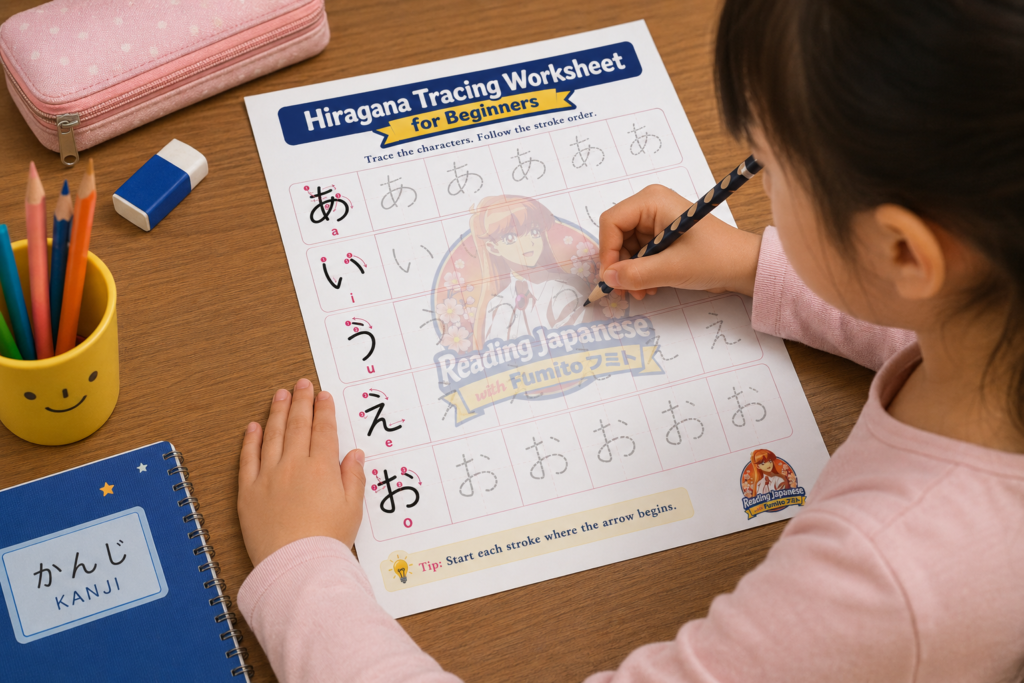
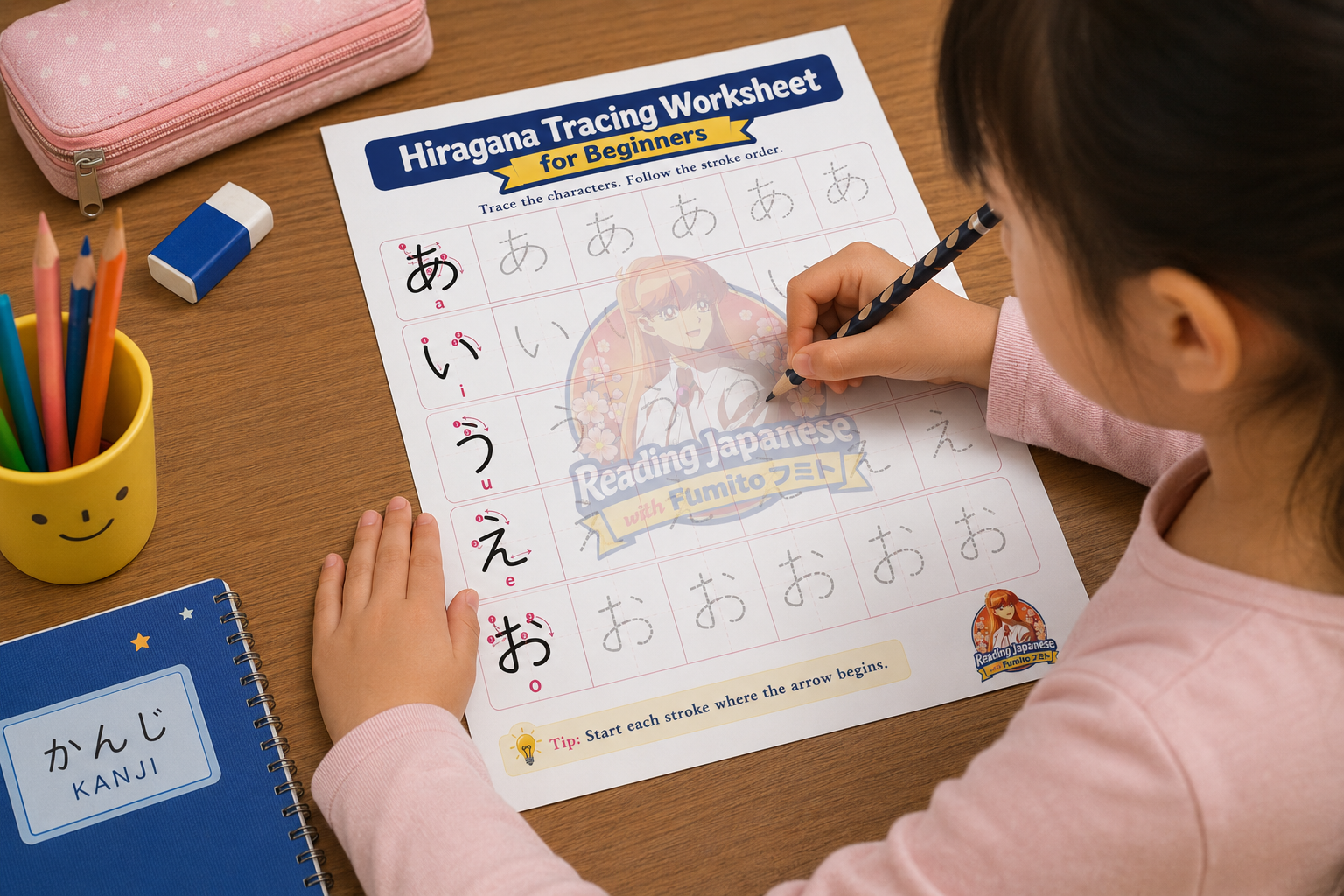
Hiragana practice sheets are printable worksheets designed to help beginners learn and memorize all 46 basic hiragana characters. Each sheet typically shows you:
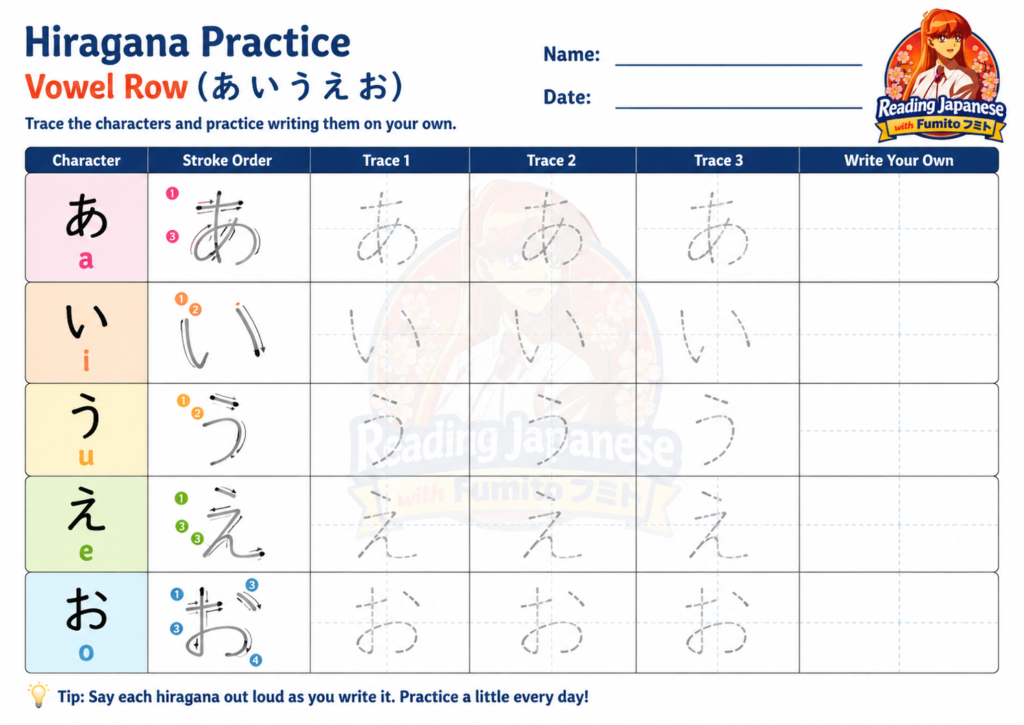
- The hiragana character in large, clear print
- The correct stroke order (the exact sequence of pen strokes used to write it)
- Dotted or light grey tracing guides so you can copy the character
- Empty boxes to practice writing it on your own
- The romanized pronunciation (called romaji) so you know how to say it
Think of them as handwriting workbooks — the same idea you used when learning to write the alphabet as a child, but adapted for Japanese script.
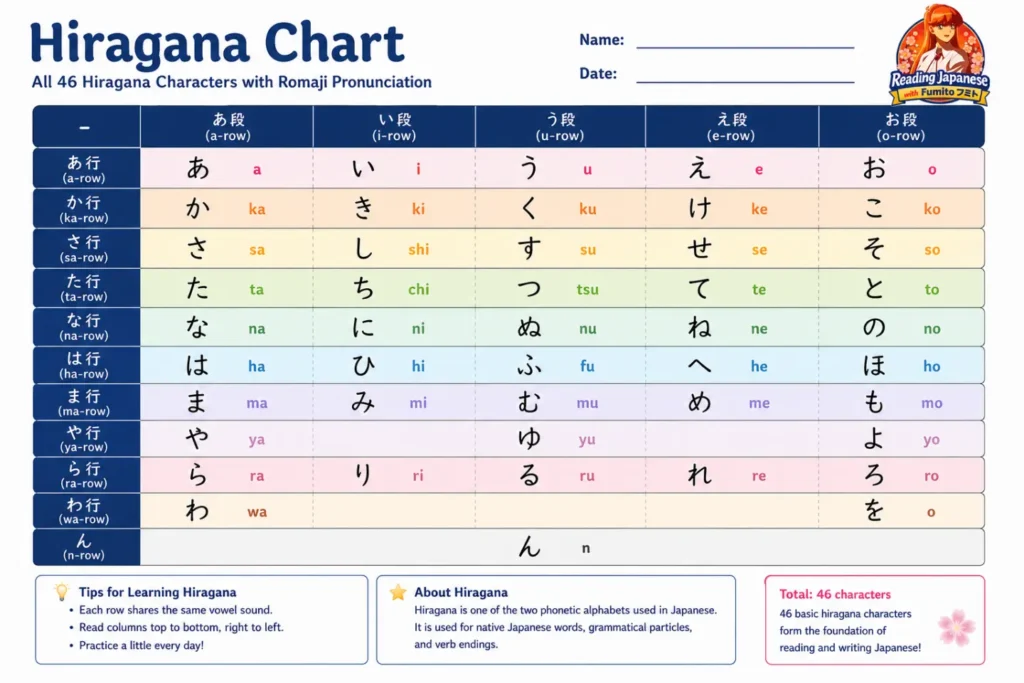
A good hiragana practice PDF covers all five vowel sounds (a, i, u, e, o), all consonant-vowel combinations (ka, ki, ku, ke, ko, and so on), and the special characters used for sounds like n, ya, yu, and yo. Many sheets also include a full printable hiragana chart on a single reference page so you can check any character at a glance while you practice.
Why Hiragana Is the Best Place to Start Learning Japanese
Hiragana is the first writing system every Japanese child learns, and it is the foundation of the entire language. Before you learn kanji (Chinese-origin characters) or katakana (used for foreign loan words), you need hiragana.
Here is why it matters:
- It unlocks pronunciation. Japanese pronunciation is very consistent. Once you know hiragana, you can read and pronounce almost any Japanese word correctly.
- It covers everything. Every sound in Japanese can be written in hiragana. Children’s books, beginner textbooks, and furigana (pronunciation guides printed above kanji) all use it.
- It is learnable fast. Most dedicated beginners can recognize all 46 characters within two to three weeks when they use structured hiragana worksheets daily.
Skipping hiragana and trying to read Japanese only in romaji is one of the biggest mistakes beginners make. Romaji slows you down and does not reflect how Japanese is actually written or read. Learning hiragana properly from the start — using hiragana writing practice sheets — sets you up for long-term success.
How to Use Printable Hiragana Sheets Effectively
Printing the sheets is the easy part. Here is how to actually get results from them.
Step 1 – Print Your Sheets
Print each worksheet on standard A4 or US Letter paper. Black and white printing works perfectly — you do not need color ink. If you want to reuse the sheets, print on card stock or slip them into a plastic sleeve and use a dry-erase marker.
For young learners or anyone with larger handwriting, you can scale the print size to 120–130% in your printer settings to give yourself more room in the practice boxes.
Step 2 – Start With the Five Vowels
Every hiragana character is built around one of five vowel sounds: a (あ), i (い), u (う), e (え), o (お). These are the backbone of the entire system. Practice these first until you can write them without looking at the guide.
Do not rush to memorize all 46 at once. Learning five to seven new characters per day and reviewing the previous day’s characters is far more effective than trying to absorb the whole chart in one sitting.
Step 3 – Trace First, Then Write From Memory
Every sheet has two stages:
- Trace along the grey or dotted guide characters.
- Write from memory in the empty boxes, glancing at the guide only when needed.
The tracing stage trains your hand to feel the shape. The free-writing stage is where actual memorization happens. Do not skip the second stage — it is the most important part.
Step 4 – Say Each Character Out Loud
As you write each character, say its sound aloud. This connects three things at once: what the character looks like, what your hand does to write it, and what it sounds like. This multi-sensory approach is why hiragana tracing sheets work so much better than flashcard apps alone.
Step 5 – Review Daily
Spend 10 to 15 minutes per day. Consistency matters more than long sessions. A short daily practice beats a two-hour cram session once a week, every time.
Hiragana Stroke Order: Why It Matters and How to Follow It
Hiragana stroke order is the specific sequence and direction in which each line and curve of a character is drawn. It is not arbitrary — stroke order reflects how the characters are written naturally and efficiently by hand.
Following the correct stroke order matters for three reasons:
- Your handwriting looks correct. Characters written with wrong stroke order often look slightly off to native readers, even if you cannot pinpoint why.
- It becomes automatic faster. Writing in the right sequence becomes a motor memory. Once that memory is set, you can write hiragana without thinking.
- It prepares you for kanji. Kanji stroke order follows the same logical rules as hiragana. Build the habit now.
The Basic Stroke Order Rules
Every hiragana character follows a small set of consistent rules:
- Top to bottom. When there are horizontal strokes, the top one comes first.
- Left to right. Left strokes come before right strokes.
- Horizontal before vertical in most cases (with some exceptions).
- Main body before finishing strokes. For characters like き (ki) or さ (sa), the body is written before the final crossing stroke.
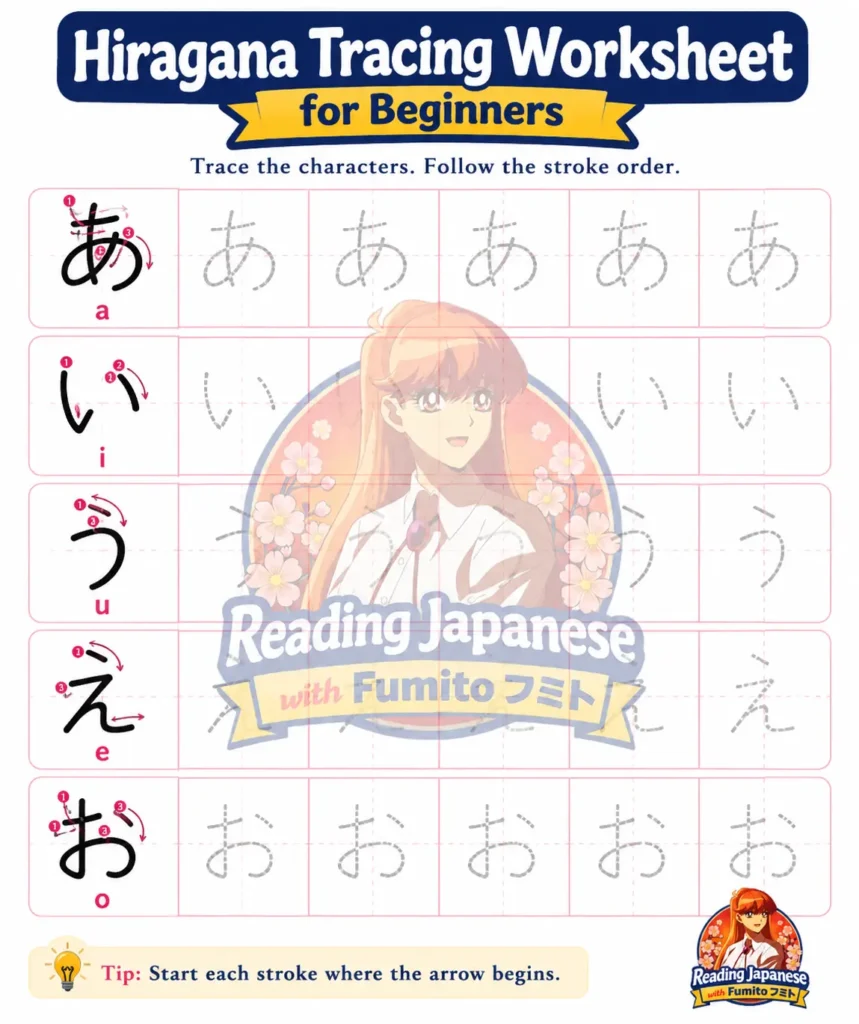
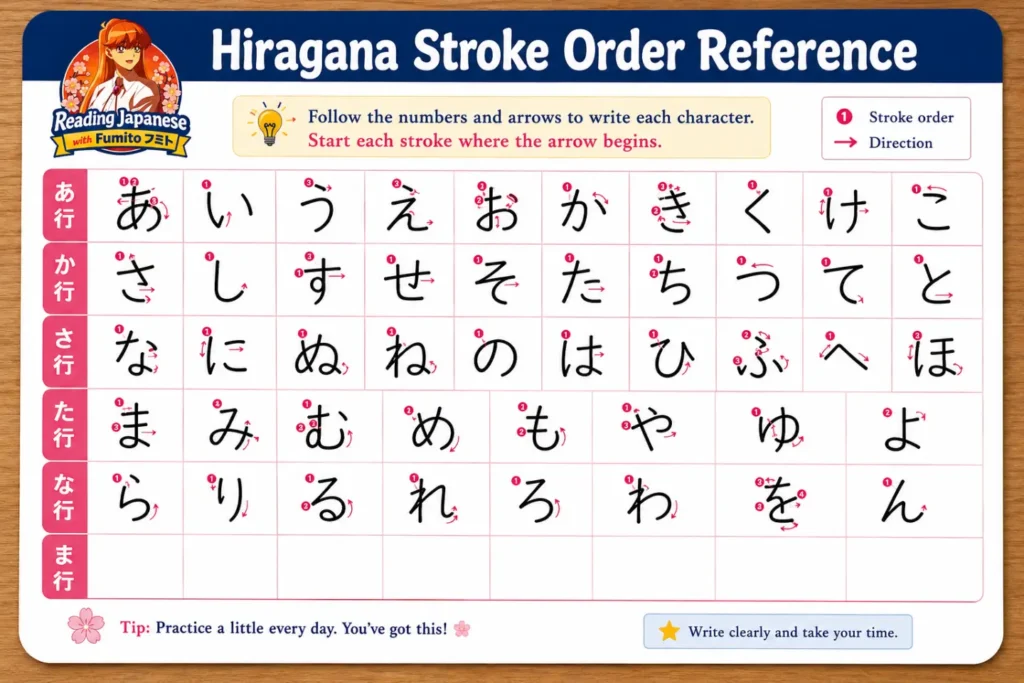
Our hiragana stroke order worksheets show a numbered sequence of mini-arrows on each character so you can see exactly where each stroke starts, which direction it travels, and where it ends. Follow the numbers in order every time you trace.
Best Way to Practice Hiragana Daily
Here is a simple weekly structure that works well for absolute beginners:
Days 1–2: Learn the five vowels — あ い う え お Write each one 10 times. Quiz yourself at the end of each session.
Days 3–5: Add the K-row and S-row — か き く け こ / さ し す せ そ Review the vowels first, then add the new characters.
Days 6–7: Review everything so far. Write each character from memory without looking at the chart.
Week 2 onwards: Add one new row per day (T-row, N-row, H-row, M-row, Y-row, R-row, W-row), always reviewing everything learned so far before adding new characters.
By the end of two weeks, most learners can recognize all 46 basic characters. Writing them from memory usually takes another week or two of daily review.
One extra tip: Write the characters in real Japanese words, not just in isolation. For example, once you know あ, い, う, try writing あおい (aoi, meaning blue) or いぬ (inu, meaning dog). Seeing hiragana in context makes it stick faster.
Free Printable Hiragana Practice Sheets – Download and Print
At reading-japanese.com, you can find the following free printable resources:
→ [Download the Full Hiragana Practice Sheet Bundle – Free PDF]
The bundle includes:
- Printable Hiragana Chart (1 page) — All 46 characters laid out in the traditional gojūon grid, with romaji. Pin it to your wall or desk for quick reference.
- Hiragana Tracing Sheets (10 pages) — One page per character row, with large traced guides and free-write boxes. Each character includes numbered stroke order arrows.
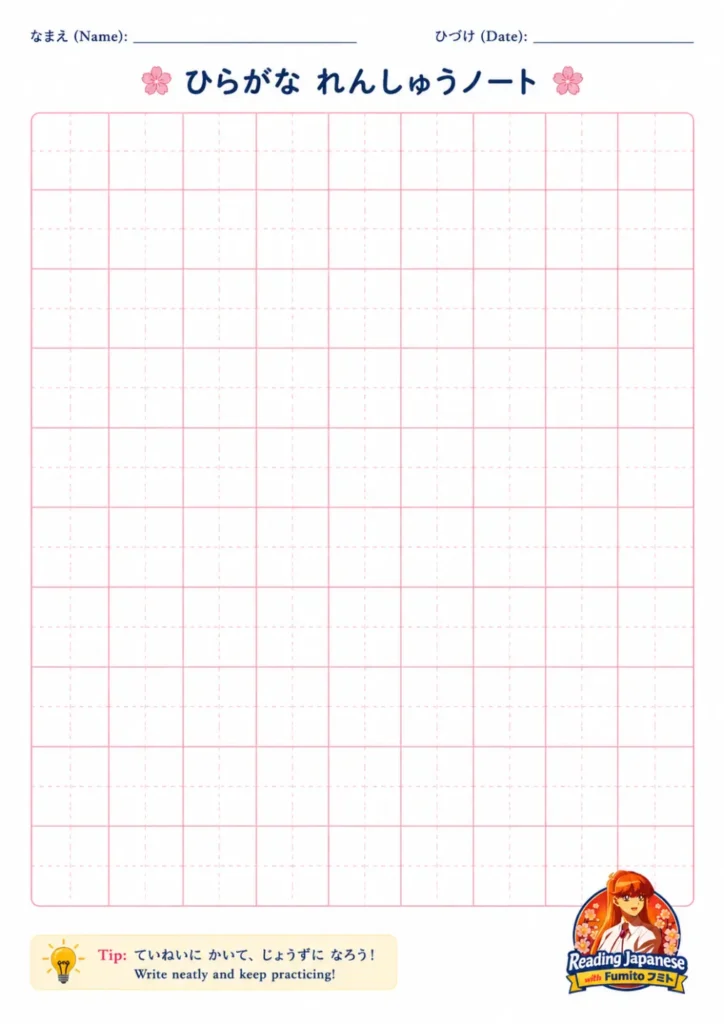
- Hiragana Writing Practice Grid Sheets (5 pages) — Blank Japanese writing grid paper sized for hiragana, perfect for independent practice once you have learned the characters.
- Hiragana Stroke Order Reference Card (2 pages) — A compact at-a-glance guide showing the stroke order for all 46 characters, small enough to carry with your notebook.
All sheets are designed to print cleanly on A4 or US Letter paper at home. No sign-up required — click, download, and print.
Also useful:
- How to Learn Japanese Through Anime Without Feeling Overwhelmed
- When to Start Learning Kanji (and Why Sooner Is Better)
- How to Construct a Japanese Sentence
- How to learn Japanese FAST? Tips from a native speaker 🇯🇵📚✨🌎✈️
- What books to buy if you wanna learn japanese language 📚
- How to Learn Katakana After Hiragana →
- Japanese Writing Paper (Genkouyoushi Grid) – Free Printable →
- Beginner’s Guide to Japanese Stroke Order →
Tips for Beginners: Getting the Most From Your Hiragana Worksheets
Use pencil, not pen. You will make mistakes. Pencil lets you erase cleanly and redo a character without wasting paper.
Write slowly at first. Speed comes naturally with repetition. Rushing early practice produces sloppy muscle memory that is hard to correct later.
Do not skip characters you find easy. Even characters that feel simple in isolation can be confused with similar-looking ones. あ and お look alike at first. さ and き can trip you up. Practice everything equally.
Use the reference chart as a check, not a crutch. Glance at it to verify your answer after writing, not before. The moment you stop checking before writing is when real learning kicks in.
Celebrate small wins. Completing a row is an achievement. Recognizing a hiragana character on a Japanese restaurant menu or product label is an even bigger one. Notice those moments — they keep you motivated.
Pair sheets with audio. There are many free resources online where you can hear each hiragana character pronounced correctly. Listen, repeat, then write. This is especially important for sounds that do not exist in English, like the Japanese r sound (ら り る れ ろ).
Frequently Asked Questions
Q1: How many hiragana characters are there?
There are 46 basic hiragana characters. Once you learn those, you will also encounter combined characters (like きゃ kya or にゅ nyu) and characters with diacritical marks (like が ga or ざ za). But the 46 basics are all you need to start reading and writing.
Q2: How long does it take to learn hiragana with practice sheets?
Most beginners can recognize all 46 characters within two to three weeks of daily practice, spending about 15 minutes per day. Writing them from memory confidently usually takes four to six weeks total. Using structured hiragana tracing sheets from the beginning speeds this up significantly compared to studying without them.
Q3: Are these printable hiragana sheets suitable for children?
Yes. The worksheets are designed to be simple and clear, making them ideal for children as well as adult learners. For younger children (ages 5–8), you may want to print at a larger scale (120–150%) so the practice boxes are easier to write in. Parents and teachers often use them in the same way they would use letter-formation worksheets for English handwriting.
Q4: What is the difference between hiragana and katakana?
Hiragana and katakana represent the same set of sounds but are two different scripts. Hiragana (curved, flowing characters) is used for native Japanese words, grammatical endings, and children’s texts. Katakana (more angular characters) is used mainly for foreign loan words, brand names, and scientific terms. Most learners study hiragana first, then move on to katakana. You can find a free katakana practice sheet PDF on reading-japanese.com →.
Q5: Do I need to learn stroke order, or can I just copy the shape?
Stroke order is important and worth learning from the start. While you can technically copy a hiragana character by just matching its overall shape, characters written with wrong stroke order often look slightly unnatural and become harder to write quickly. More importantly, the habits you form with hiragana carry directly into kanji, where stroke order is even more critical. The worksheets on this site include numbered stroke-order arrows on every character so it is easy to follow.
Q6: Can I use these sheets to teach a Japanese class?
Absolutely. The PDFs are free to download and print for classroom use. Teachers are welcome to print multiple copies for students. If you are looking for a structured lesson plan to accompany the worksheets, see our guide on Teaching Hiragana to Beginners →.
Conclusion: Print Your Hiragana Sheets and Start Today
Learning to write hiragana is one of the most rewarding early steps in your Japanese language journey. With the right hiragana practice sheets printable format — clear characters, correct stroke order, and space to write — you can go from zero to reading basic Japanese in just a few weeks.
The sheets are free. The process is simple. All you need to do is print and pick up a pencil.
→ Download Your Free Hiragana Practice PDF Now →
Bookmark this page, share it with anyone learning Japanese, and come back when you are ready to move on to katakana and beyond. You have got everything you need to get started right here.
Suggested Internal Linking Anchors
- “katakana practice sheets” → /katakana-practice-sheets-printable
- “Japanese writing paper” → /japanese-writing-paper-printable
- “hiragana stroke order guide” → /japanese-stroke-order-guide
- “how to teach hiragana” → /how-to-teach-hiragana
- “hiragana for beginners” → /hiragana-for-beginners-guide
- “Japanese for beginners” → /japanese-for-beginners