
This lesson covers Dialogue 4 from Lesson 2 — a quick workplace exchange where Michael and Honda are checking a schedule and realise they’ve mixed up which day an appointment is on. Its a short dialogue, but it introduces three grammar points that come up constantly in everyday Japanese: days of the week, the particle to for connecting nouns, and the past forms of noun sentences — deshita and ja nakatta desu.
If you’ve been working through this series, you’ve already covered noun sentences with desu and ja nai desu in the Lesson 2 Dialogue 1 post. This lesson completes the four-form picture for noun sentences — the same way Lesson 1 gave you the full four-form verb chart. By the end, you’ll be able to talk about appointments, schedules, and past events in natural, realistic Japanese.
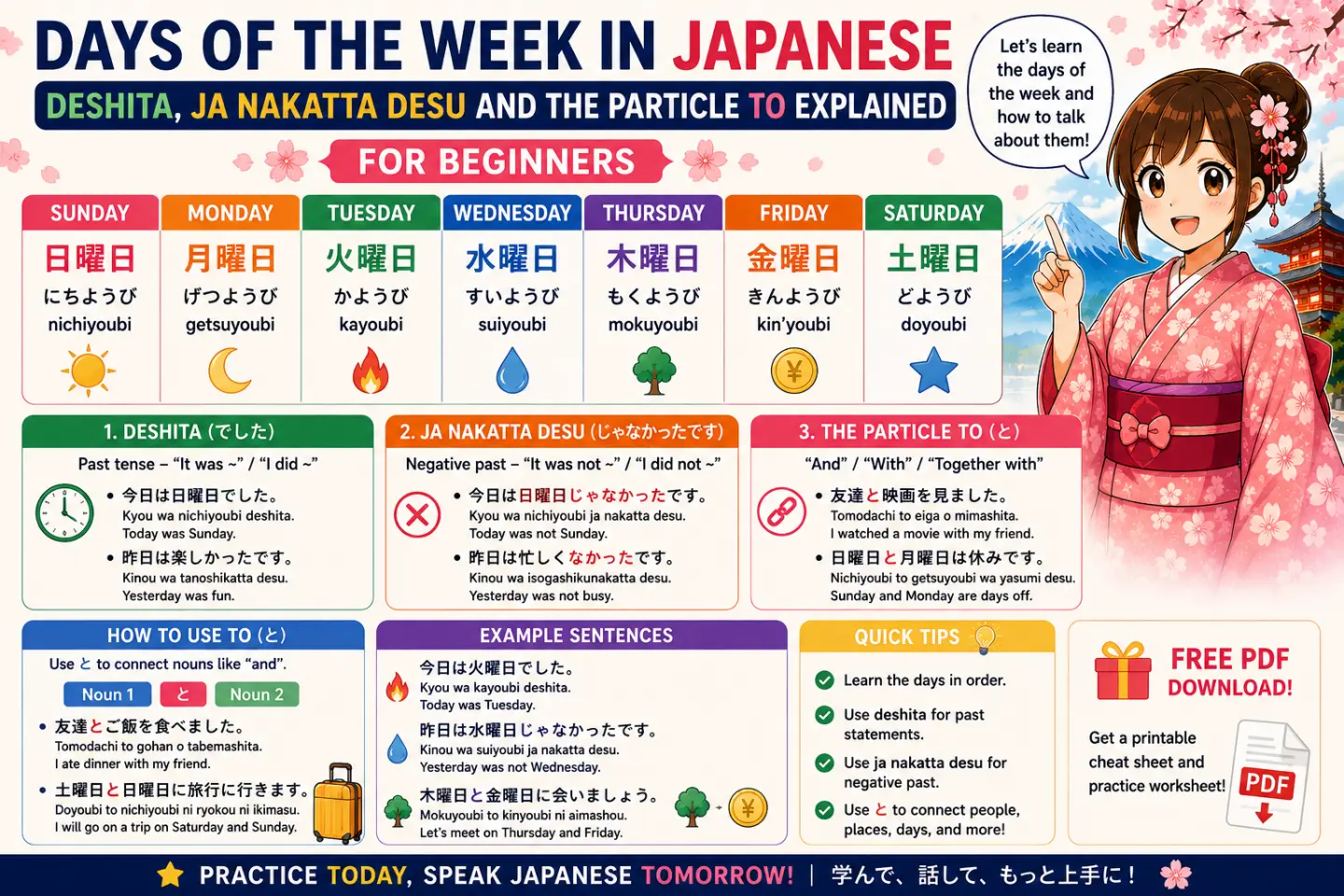
Days of the Week in Japanese – Deshita, Ja Nakatta Desu and the Particle To Explained for Beginners
📌 What you’ll learn: All seven days of the week in Japanese and their abbreviations, how to use to to connect nouns (Saturday and Sunday, Tuesday and Thursday), the past forms of noun sentences — deshita and ja nakatta desu — and how past forms are also used for recalling scheduled future events.
Dialogue 4 – Checking the Schedule
Michael and Honda are reviewing a work schedule together. This kind of dialogue — checking dates, correcting mix-ups, apologising for errors — is the kind of Japanese you need very early in a work or study environment.
Michael: 土曜と日曜は休みですね?
Doyou to nichiyou wa yasumi desu ne. — We’re off on Saturday and Sunday, right?
Honda: もちろんです。
Mochiron desu. — Of course.
Michael: アジア銀行のアポは、月曜日でしたね。
Ajia ginkou no apo wa getsuyoubi deshita ne. — The appointment with Bank of Asia was on Monday, right?
Honda: え?火曜日じゃなかったですか。
E? Kayoubi ja nakatta desu ka. — Huh? Wasn’t it on Tuesday?
Michael: ああ、そうでしたね。すみません。
Aa, sou deshita ne! Sumimasen. — Oh, that’s right! Sorry.
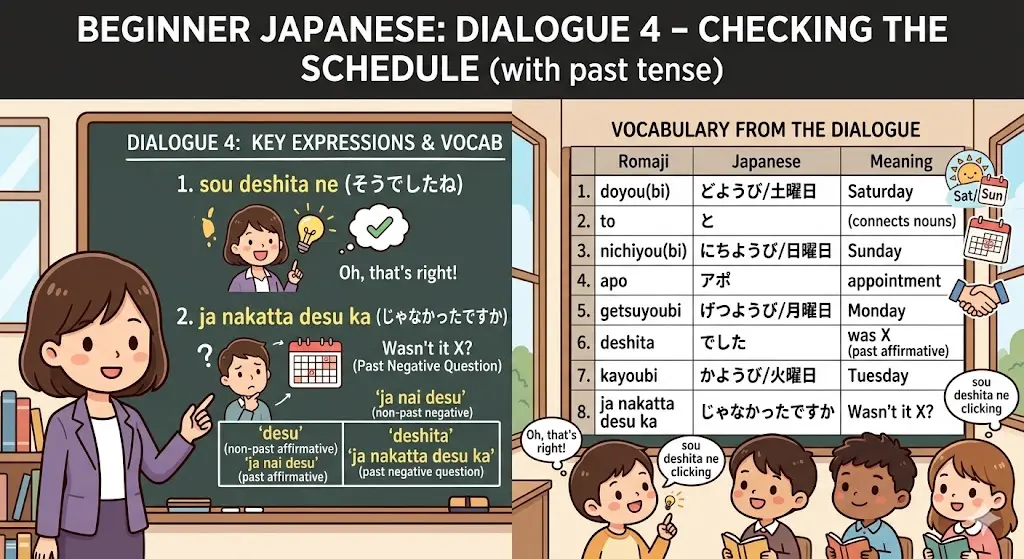
📌 Notice “sou deshita ne”: You already learned sou desu ka (I see / is that so) as an aizuchi expression. Here Michael uses sou deshita ne — the past form — which means “oh, that’s right!” when something clicks into memory. This is a very natural, frequently used expression when you suddenly remember something you’d forgotten.
Vocabulary from the Dialogue
| Romaji | Japanese | Kanji | Meaning |
|---|---|---|---|
| doyou(bi) | どようび | 土曜日 | Saturday |
| to | と | — | and (connects nouns only) |
| nichiyou(bi) | にちようび | 日曜日 | Sunday |
| mochiron | もちろん | — | of course |
| apo | アポ | — | appointment (from English “appointment”) |
| getsuyoubi | げつようび | 月曜日 | Monday |
| deshita | でした | — | was X (past affirmative of desu) |
| e? | え? | — | What? / Oh? (surprise or mishearing) |
| kayoubi | かようび | 火曜日 | Tuesday |
| ja nakatta desu ka | じゃなかったですか | — | Wasn’t it X? (past negative question) |
Additional Vocabulary – School and Office
| Romaji | Japanese | Kanji | Meaning |
|---|---|---|---|
| itsu | いつ | — | when? |
| jugyou | じゅぎょう | 授業 | class / lesson |
| shukudai | しゅくだい | 宿題 | homework |
| shiken | しけん | 試験 | exam / test |
| kaigi | かいぎ | 会議 | meeting / conference |
| orienteishon | オリエンテーション | — | orientation |
| purezen | プレゼン | — | presentation |
| hon | ほん | 本 | book |
| kyoukasho | きょうかしょ | 教科書 | textbook |
| manga | まんが | — | manga / comic |
| anime | アニメ | — | anime |
| nooto | ノート | — | notebook |
| kami | かみ | 紙 | paper |
| enpitsu | えんぴつ | 鉛筆 | pencil |
| pen | ペン | — | pen |
2-4-1 Days of the Week in Japanese – Youbi
The word for day of the week in Japanese is youbi (曜日). Each day is formed by combining an element (sun, moon, fire, water, wood, gold, earth) with youbi. The kanji connections to nature are one of the things that makes Japanese days of the week really memorable once you know them.
日曜日Nichi-youbiSunday (sun day)
月曜日Getsu-youbiMonday (moon day)
火曜日Ka-youbiTuesday (fire day)
水曜日Sui-youbiWednesday (water day)
木曜日Moku-youbiThursday (wood/tree day)
金曜日Kin-youbiFriday (gold day)
土曜日Do-youbiSaturday (earth day)
何曜日Nan-youbiWhat day of the week?
Formality Levels and Common Abbreviations
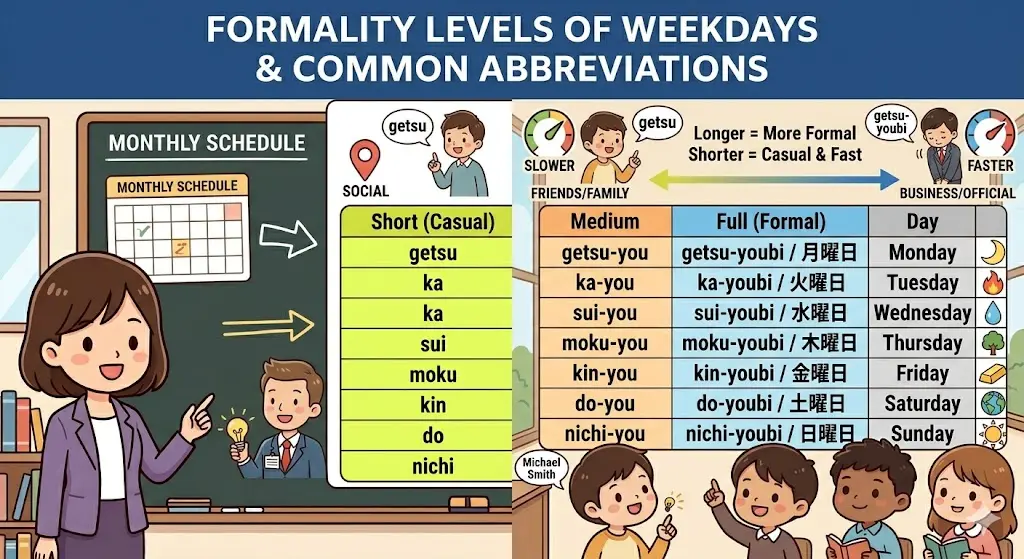
Each day has three formality variants — the longer the form, the more formal. All are correct, the shorter forms are just more casual and faster to say in conversation.
| Short (casual) | Medium | Full (formal) | Day |
|---|---|---|---|
| getsu | getsu-you | getsu-youbi | Monday |
| ka | ka-you | ka-youbi | Tuesday |
| sui | sui-you | sui-youbi | Wednesday |
| moku | moku-you | moku-youbi | Thursday |
| kin | kin-you | kin-youbi | Friday |
| do | do-you | do-youbi | Saturday |
| nichi | nichi-you | nichi-youbi | Sunday |
You’ll also see days combined into groups — these are very common abbreviations in Japanese workplace and school schedules:
月水金Getsu-sui-kin
Mon – Wed – Fri
火木Kaa-moku
Tue – Thu
土日Do-nichi
Sat – Sun (weekend)
⚠️ Nan-youbi vs the date: Nan-youbi (何曜日) asks “what day of the week?” — Monday, Tuesday etc. It does NOT ask “what date of the month?” — that requires a different question word, which is covered in a later lesson. Don’t use nan-youbi when you want to know the date number.
2-4-2 The Particle To – Connecting Nouns in Japanese
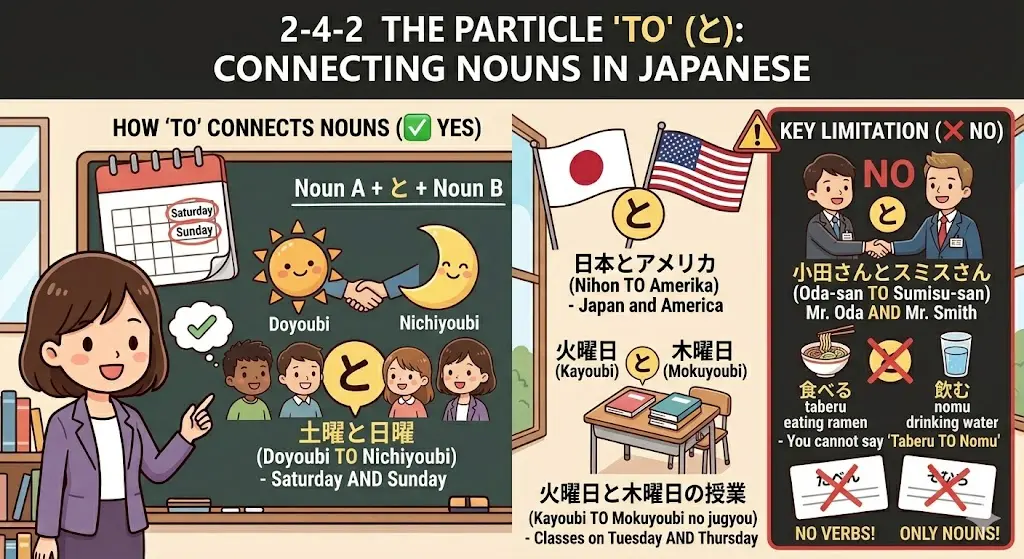
The particle to (と) means “and” when used between nouns. Its one of the simplest and most frequently used particles once you start talking about schedules, people, and items.
土曜と日曜は休みです。
Doyou to nichiyou wa yasumi desu.
— Saturday and Sunday are days off.
日本とアメリカ
Nihon to Amerika
— Japan and America
アジア銀行の小田さんとJ-ネットのスミスさん
Ajia Ginkou no Oda-san to J-Netto no Sumisu-san
— Mr. Oda from Asia Bank and Mr. Smith from J-Net
火曜日と木曜日の授業
Kayoubi to mokuyoubi no jugyou
— Classes on Tuesday and Thursday
この日本語の教科書とあの本
Kono nihongo no kyoukasho to ano hon
— This Japanese textbook and that book
🔑 Important — to only connects nouns: In English, “and” can connect almost anything — adjectives, verbs, sentences. But in Japanese, to can only connect nouns or noun phrases. You cannot use to to connect two verbs or two sentences. For connecting sentences, kedo (but) and other connectors are used. Also note that unlike English where you can pause before “and,” in Japanese there is no pause between the noun and to — they run together smoothly.
2-4-3 Past Noun Sentences – Deshita and Ja Nakatta Desu
In the previous Lesson 2 post you learned the non-past forms of noun sentences — desu (is X) and ja nai desu (is not X). Now we add the past forms to complete the full four-form picture:
| Affirmative | Negative | |
|---|---|---|
| Non-past | 〜です (-desu) 日本語です。 It’s Japanese. | 〜じゃないです (-ja nai desu) 日本語じゃないです。 It’s not Japanese. |
| Past | 〜でした (-deshita) 日本語でした。 It was Japanese. | 〜じゃなかったです (-ja nakatta desu) 日本語じゃなかったです。 It wasn’t Japanese. |
Here are more examples from real situations:
月曜日でしたね。 Getsuyoubi deshita ne. — It was Monday, right?
火曜日じゃなかったですか。 Kayoubi ja nakatta desu ka. — Wasn’t it Tuesday?
ああ、そうでしたね。 Aa, sou deshita ne. — Oh, that’s right!
試験は昨日でしたか。 Shiken wa kinou deshita ka. — Was the exam yesterday?
⚠️ Critical: do NOT use deshita in the past negative. The past negative is ja nakatta desu — not ja nai deshita. This is a common mistake. The correct forms are:
✅ getsuyoubi ja nakatta desu — it wasn’t Monday
❌ getsuyoubi ja nai deshita — incorrect form
Using Past Forms for Scheduled Future Events
One really interesting feature of Japanese that surprises most learners — the past form of desu is also used when recalling information about scheduled future events. In English this would be strange (“the meeting was tomorrow”), but in Japanese it’s completely natural when you’re trying to remember something you’d previously noted or planned.
会議はあしたでしたね。
Kaigi wa ashita deshita ne.
— The meeting was tomorrow, right? (= If I remember correctly, the meeting is tomorrow, right?)
いや、あさってじゃなかったですか。
Iya, asatte ja nakatta desu ka.
— No, wasn’t it the day after tomorrow?
🎌 Why past form for future events? When you use deshita for a future scheduled event, it signals that you’re recalling something you previously noted or heard — “I remember being told it was tomorrow.” Its a really natural feature of Japanese that reflects how the language handles memory and information rather than just time. Once you hear it in real Japanese conversations it clicks quite quickly.
Drill E – Correcting the Day of the Week
Someone tells you what day they think it is today. Express surprise and correct them with the next day.
MODEL EXCHANGES
Cue: Kyou wa getsuyoubi desu ne. — Today is Monday, right?
今日は月曜日ですね。
Response: E? Kayoubi ja nai desu ka. — What? Isn’t it Tuesday?
え?火曜日じゃないですか。
Cue: Kyou wa mokuyoubi desu ne. — Today is Thursday, right?
今日は木曜日ですね。
Response: E? Kinyoubi ja nai desu ka. — What? Isn’t it Friday?
え?金曜日じゃないですか。
Practice with: kayoubi → suiyoubi / suiyoubi → mokuyoubi / kinyoubi → doyoubi
Drill F – Confirming Past Events with Ja Nakatta Desu Ka
Someone mentions something from the past using deshita ne. Confirm it using the past negative question form.
MODEL EXCHANGES
Cue: Kinou wa ame deshita ne. — It rained yesterday, right?
きのうはあめでしたね。
Response: Ee, ame ja nakatta desu ka. — Yes, didn’t it rain?
ええ、あめじゃなかったですか。
Cue: Shiken wa getsuyou deshita ne. — The exam was Monday, right?
試験は月曜でしたね。
Response: Ee, getsuyou ja nakatta desu ka. — Yes, wasn’t it on Monday?
ええ、月曜じゃなかったですか。
Practice with: shiken wa kayou deshita ne / kaigi wa suiyou deshita ne / jugyou wa mokuyou deshita ne
Drill G – Say It in Japanese
Part 1 – About Last Week’s Meeting
- When was it? → Itsu deshita ka. いつでしたか。
- What day of the week was it? → Nan-youbi deshita ka. 何曜日でしたか。
- What time was it? → Nan-ji deshita ka. 何時でしたか。
- Where was it? → Doko deshita ka. どこでしたか。
- Which country was it held in? → Dono kuni deshita ka. どの国でしたか。
- Which company was it held at? → Dono kaisha deshita ka. どの会社でしたか。
- Who was the teacher? → Sensei wa donata deshita ka. 先生はどなたでしたか。
- Of what nationality was the teacher? → Sensei wa doko no kata deshita ka. 先生はどこの方でしたか。
- In what language was it? → Nanigo deshita ka. 何語でしたか。
- Which textbook was used? → Dono kyoukasho deshita ka. どの教科書でしたか。
Part 2 – Asking Emily About the Course Catalog
- What days of the week are the Japanese classes? → Nihongo no jugyou wa nan-youbi desu ka. 日本語の授業は何曜日ですか。
- What time are they? → Nan-ji desu ka. 何時ですか。
- Who is the instructor? → Sensei wa donata desu ka. 先生はどなたですか。
- Is homework due every day? → Shukudai wa mainichi desu ka. 宿題は毎日ですか。
- What time is the Tuesday orientation for exchange students? → Kayoubi no orienteishon wa nan-ji desu ka. 火曜日のオリエンテーションは何時ですか。
Part 3 – Replying to the Questions Above
- It’s Monday, Wednesday and Friday. → Getsu-sui-kin desu. 月水金です。
- Aren’t they at nine and eleven thirty? → Ku-ji to juu-ichi-ji-han ja nai desu ka. 九時と十一時半じゃないですか。
- The instructors are Japanese and American. The Japanese teacher is Prof. Sato, but I don’t know the American teacher’s name. → Nihon-jin to Amerika-jin desu. Nihon-jin no sensei wa Satou-sensei desu. Amerika-jin no sensei no namae wa wakarimasen. 日本人とアメリカ人です。日本人の先生は佐藤先生です。アメリカ人の先生の名前はわかりません。
- Of course, it’s every day, I tell you. → Mochiron, mainichi desu yo. もちろん、毎日ですよ。
- The Tuesday orientation is at 10:30, but the second-year students don’t go. → Kayoubi no orienteishon wa juu-ji-han desu kedo, ninensei wa ikimasen. 火曜日のオリエンテーションは十時半ですけど、二年生は行きません。
Drill H – Act in Japanese (Role Play)
- Find out from the teacher what day and what time the Japanese exam is scheduled.
→ Sensei, nihongo no shiken wa nan-youbi desu ka. Nan-ji desu ka. 先生、日本語の試験は何曜日ですか。何時ですか。 - You’ve just been told there is an exam today! Express your surprise.
→ E? Kyou desu ka! え?今日ですか! - You need to write something down. Ask for paper and a pen.
→ Anou, kami to pen, onegaishimasu. あのう、紙とペン、お願いします。 - A coworker is wondering about yesterday’s weather. You remember it rained. Let him know.
→ Kinou wa ame deshita yo. きのうはあめでしたよ。 - You have an appointment with a business associate this week. Confirm it’s at ten on Thursday and thank her in advance.
→ Mokuyoubi no juu-ji desu ne. Yoroshiku onegaishimasu. 木曜日の十時ですね。よろしくお願いします。
💡 On Drill H item 3 — asking for paper and a pen: Notice how to does the work here — kami to pen (paper and pen) using one particle to connect the two nouns cleanly. This is exactly the kind of short, practical sentence that the to particle makes very easy. No complicated grammar needed — just noun, to, noun, onegaishimasu.
FAQ – Days of the Week, Deshita and Particle To in Japanese
What are the days of the week in Japanese?
Sunday = nichiyoubi (日曜日), Monday = getsuyoubi (月曜日), Tuesday = kayoubi (火曜日), Wednesday = suiyoubi (水曜日), Thursday = mokuyoubi (木曜日), Friday = kinyoubi (金曜日), Saturday = doyoubi (土曜日). To ask “what day of the week?” say nan-youbi (何曜日). Each day corresponds to a natural element — sun, moon, fire, water, wood/tree, gold, earth — which makes them easier to memorise once you know the connection.
What does “deshita” mean in Japanese?
Deshita (でした) is the past affirmative form of desu — it means “was X.” So getsuyoubi deshita = “it was Monday,” ame deshita = “it was raining / it was rain,” kaigi deshita = “it was a meeting.” It’s also used when recalling information about scheduled future events — kaigi wa ashita deshita ne = “the meeting was tomorrow, right?” (meaning you’re recalling a previously noted plan).
What does “ja nakatta desu” mean in Japanese?
Ja nakatta desu (じゃなかったです) is the past negative form of a noun sentence — it means “was not X.” Getsuyoubi ja nakatta desu = “it wasn’t Monday.” Ame ja nakatta desu = “it wasn’t raining.” As a question — kayoubi ja nakatta desu ka = “wasn’t it Tuesday?” — it’s used to express uncertainty or gently correct someone, very similar to how ja nai desu ka works in the non-past. Do NOT use deshita in the negative past — the correct form is always ja nakatta desu, not ja nai deshita.
What is the particle “to” in Japanese?
The particle to (と) means “and” between nouns or noun phrases. Doyou to nichiyou = Saturday and Sunday. Kami to pen = paper and pen. Unlike English “and” which can connect verbs, adjectives, and sentences, Japanese to can only connect nouns or noun phrases. There is also no pause between the noun and to when speaking — they flow together. There’s no limit on how many nouns you can connect, but in natural speech adult speakers rarely list more than three or four at a time.
How do you ask “what day of the week” in Japanese?
“What day of the week?” in Japanese is nan-youbi (何曜日). For example: nan-youbi desu ka = “what day of the week is it?” and nan-youbi deshita ka = “what day of the week was it?” Note that nan-youbi only asks about the day of the week (Monday, Tuesday etc.) — it does NOT ask about the date (the 1st, 2nd, 15th etc.). Those require a different question word introduced in a later lesson.
What does “mochiron” mean in Japanese?
Mochiron (もちろん) means “of course.” It’s a standalone expression often followed by desu — mochiron desu = “of course (it is).” You can also combine it with yo for emphasis: mochiron desu yo = “of course I tell you / certainly!” It’s one of those simple words that comes up constantly in casual and semi-formal Japanese conversation and it makes you sound natural when you use it confidently.
What are common Japanese schedule abbreviations for days?
Three very common abbreviations used in Japanese school and work schedules: getsu-sui-kin (月水金) = Monday, Wednesday, Friday. Ka-moku (火木) = Tuesday, Thursday. Do-nichi (土日) = Saturday and Sunday (the weekend). These compound abbreviated forms are used on class schedules, timetables, and in casual conversation and are worth memorising early if you’re studying or working in Japan.
What is the full conjugation table for desu in Japanese?
The four forms of desu in formal Japanese are: non-past affirmative = desu (is X), non-past negative = ja nai desu (is not X), past affirmative = deshita (was X), past negative = ja nakatta desu (was not X). The critical thing to remember is that the past negative is ja nakatta desu — NOT ja nai deshita. This is one of the most common errors beginners make with noun sentences.
What’s Next?
You’ve now completed the full four-form picture for both verb sentences (masu / masen / mashita / masen deshita) and noun sentences (desu / ja nai desu / deshita / ja nakatta desu). That’s the core conjugation foundation of formal Japanese — a huge milestone for any beginner.
Combined with days of the week, time expressions, weather vocabulary, ko-so-a-do pointing words, the to particle, and all the verb and particle grammar from Lesson 1, you now have a genuinely functional toolkit for everyday Japanese conversation.
The next step in Lesson 2 expands into more complex noun connections using the particle no — which you’ve seen briefly already in expressions like kyou no sukejuuru (today’s schedule) and Tookyoo-daigaku no Satou-sensei (Prof. Sato of the University of Tokyo). That particle is one of the most productive and widely used in all of Japanese, so its coming up very soon.
You can browse all lessons in order at reading-japanese.com.
頑張ってください!(Ganbatte kudasai!) — Keep going! 🎌
— Fumito フミト | reading-japanese.com
📚 Related lessons on reading-japanese.com: