
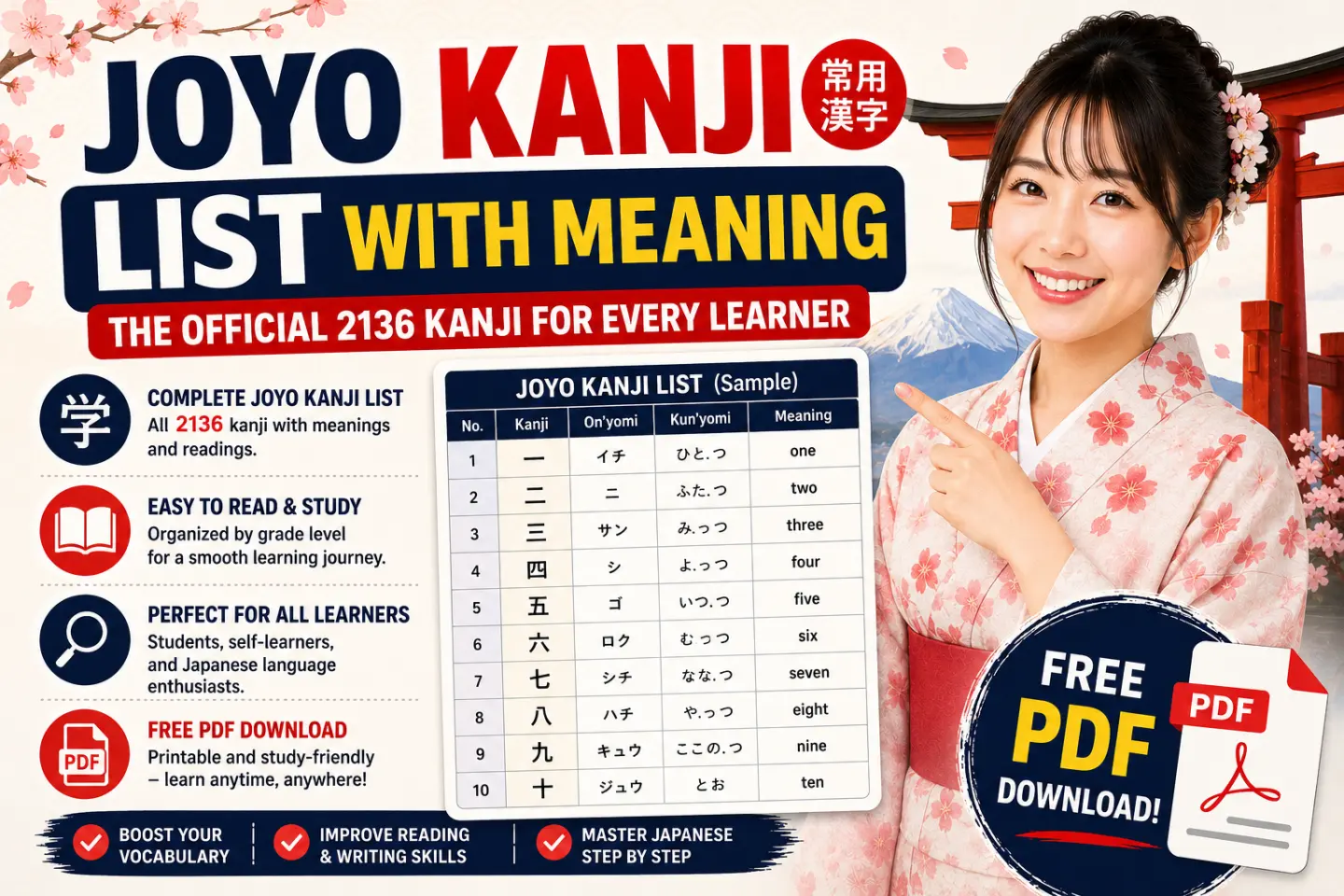

If you are serious about learning Japanese, the Joyo Kanji (常用漢字) list is one of the most important things you can study. These are the official everyday-use kanji recognized by the Japanese government and taught in Japanese schools.
Whether you are preparing for the JLPT, improving your reading skills, or building vocabulary for anime, manga, newspapers, and daily conversation, learning the Joyo Kanji is the fastest path toward Japanese fluency.
In this guide, you will learn:
- What Joyo Kanji are
- How many Joyo Kanji exist
- Why they matter for Japanese learners
- The official school grade order
- A large Joyo Kanji list with meanings
- Tips for memorizing kanji faster
- Where to download and practice Joyo Kanji PDF sheets
Joyo Kanji List With Meaning PDF (Beginner to Advanced Guide) What Are Joyo Kanji?
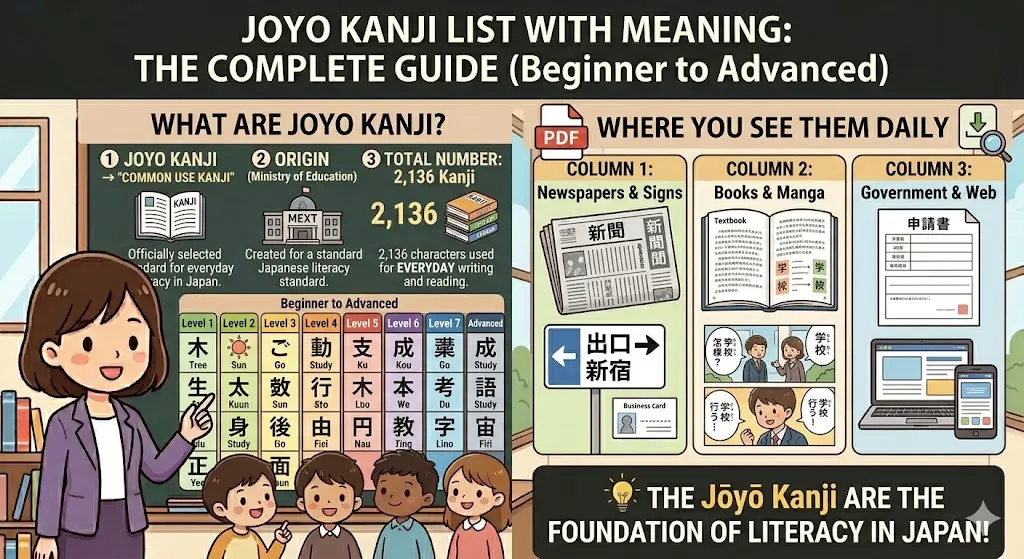
Joyo Kanji (常用漢字) means “commonly used kanji.” These are the standard kanji officially selected for everyday reading and writing in Japan.
The Japanese Ministry of Education created this list so students and adults can have a common literacy standard.
Today, the official Joyo Kanji list contains:
Total Number of Joyo Kanji
2,136 kanji
These characters are used in:
- Newspapers
- Books
- Manga
- Signs
- School textbooks
- Government documents
- Websites and apps
If you can read all Joyo Kanji, you can understand most written Japanese.
Why Learn Joyo Kanji?
Learning Joyo Kanji gives you several major advantages.
1. Read Native Japanese
Most Japanese content uses Joyo Kanji. Learning them allows you to read:
- Manga
- Novels
- Japanese websites
- News articles
- Game menus
- Subtitles
2. Prepare for JLPT
The JLPT heavily relies on kanji knowledge.
Approximate levels:
| JLPT Level | Estimated Kanji |
|---|---|
| N5 | 100 |
| N4 | 300 |
| N3 | 650 |
| N2 | 1,000+ |
| N1 | 2,000+ |
Mastering Joyo Kanji covers nearly all JLPT kanji.
3. Improve Vocabulary Fast
Kanji are connected to vocabulary.
For example:
- 学 = study
- 校 = school
- 学校 = school
- 学生 = student
- 大学 = university
One kanji can unlock dozens of words.
Joyo Kanji by Japanese School Grade
Japanese students learn kanji gradually.
Elementary School (Kyōiku Kanji)
Students learn:
- Grade 1: 80 kanji
- Grade 2: 160 kanji
- Grade 3: 200 kanji
- Grade 4: 202 kanji
- Grade 5: 193 kanji
- Grade 6: 191 kanji
Total:
1,026 educational kanji
The remaining kanji are learned in junior high and high school.
Large Joyo Kanji List With Meaning
Below is a large selection of important Joyo Kanji with meanings and common readings.
Basic Joyo Kanji (Grade 1)
| Kanji | Meaning | Common Reading |
|---|---|---|
| 一 | one | ichi / hito |
| 二 | two | ni |
| 三 | three | san |
| 四 | four | shi / yon |
| 五 | five | go |
| 六 | six | roku |
| 七 | seven | shichi / nana |
| 八 | eight | hachi |
| 九 | nine | kyuu |
| 十 | ten | juu |
| 百 | hundred | hyaku |
| 千 | thousand | sen |
| 万 | ten thousand | man |
| 円 | yen / circle | en |
| 日 | sun / day | nichi / hi |
| 月 | moon / month | getsu / tsuki |
| 火 | fire | ka / hi |
| 水 | water | sui / mizu |
| 木 | tree | moku / ki |
| 金 | gold / money | kin / kane |
| 土 | earth | do / tsuchi |
| 人 | person | jin / hito |
| 子 | child | shi / ko |
| 女 | woman | jo / onna |
| 男 | man | dan / otoko |
| 上 | up | jou / ue |
| 下 | down | ka / shita |
| 中 | middle | chuu / naka |
| 大 | big | dai / oo |
| 小 | small | shou / chiisai |
| 山 | mountain | san / yama |
| 川 | river | sen / kawa |
| 田 | rice field | den / ta |
| 天 | heaven | ten |
| 気 | spirit / energy | ki |
| 学 | study | gaku |
| 校 | school | kou |
| 生 | life / student | sei / ikiru |
| 先 | previous | sen |
| 年 | year | nen |
| 時 | time | ji / toki |
| 本 | book / origin | hon |
| 名 | name | mei / na |
| 文 | sentence | bun |
| 字 | character | ji |
| 見 | see | ken / miru |
| 行 | go | kou / iku |
| 食 | eat | shoku / taberu |
| 飲 | drink | in / nomu |
Common Intermediate Joyo Kanji
| Kanji | Meaning | Common Reading |
|---|---|---|
| 愛 | love | ai |
| 悪 | bad | aku / warui |
| 安 | cheap / safe | an / yasui |
| 暗 | dark | an / kurai |
| 医 | medicine | i |
| 意 | meaning / intention | i |
| 員 | member | in |
| 運 | carry / luck | un |
| 英 | England / English | ei |
| 駅 | station | eki |
| 横 | side | ou / yoko |
| 屋 | shop / roof | oku / ya |
| 温 | warm | on / atatakai |
| 化 | change | ka |
| 荷 | luggage | ni |
| 界 | world | kai |
| 開 | open | kai / hiraku |
| 階 | floor / level | kai |
| 寒 | cold | kan / samui |
| 感 | feeling | kan |
| 漢 | Chinese / Han | kan |
| 館 | building | kan |
| 顔 | face | gan / kao |
| 願 | wish | gan / negau |
| 危 | danger | ki / abunai |
| 喜 | joy | ki / yorokobu |
| 起 | wake / happen | ki / okiru |
| 議 | discussion | gi |
| 客 | guest | kyaku |
| 急 | hurry | kyuu / isogu |
| 泣 | cry | kyuu / naku |
| 教 | teach | kyou / oshieru |
| 業 | business / work | gyou |
| 空 | sky / empty | kuu / sora |
| 銀 | silver | gin |
| 区 | district | ku |
| 苦 | suffer | ku / kurushii |
| 軽 | light | kei / karui |
| 血 | blood | ketsu / chi |
| 決 | decide | ketsu / kimeru |
| 研 | polish / study | ken |
| 湖 | lake | ko |
| 向 | direction | kou / mukau |
| 港 | harbor | kou / minato |
| 号 | number | gou |
| 根 | root | კონ / ne |
| 最 | most | sai |
| 材 | material | zai |
| 殺 | kill | satsu / korosu |
| 産 | produce | san |
| 残 | remain | zan / nokoru |
| 死 | death | shi / shinu |
| 試 | test | shi / tamesu |
| 児 | child | ji |
| 治 | govern / heal | ji / naoru |
| 辞 | resign / dictionary | ji |
| 失 | lose | shitsu |
| 借 | borrow | shaku / kariru |
| 酒 | alcohol / sake | shu / sake |
| 種 | type / seed | shu / tane |
| 州 | state / province | shuu |
| 習 | learn | shuu / narau |
| 住 | live | juu / sumu |
| 重 | heavy / important | juu / omoi |
| 宿 | inn | shuku / yado |
| 所 | place | sho / tokoro |
| 勝 | win | shou / katsu |
| 商 | commerce | shou |
| 消 | extinguish | shou / kesu |
| 焼 | burn | shou / yaku |
| 笑 | laugh | shou / warau |
| 信 | believe | shin |
| 神 | god | shin / kami |
| 真 | true | shin / makoto |
| 親 | parent | shin / oya |
| 数 | number | suu / kazu |
| 星 | star | sei / hoshi |
| 声 | voice | sei / koe |
| 青 | blue | sei / ao |
| 赤 | red | seki / aka |
| 切 | cut | setsu / kiru |
| 雪 | snow | setsu / yuki |
| 線 | line | sen |
| 選 | choose | sen / erabu |
| 相 | mutual | sou / ai |
| 送 | send | sou / okuru |
| 想 | think / idea | sou |
| 足 | foot | soku / ashi |
| 速 | fast | soku / hayai |
| 族 | tribe / family | zoku |
| 続 | continue | zoku / tsuzuku |
Advanced Joyo Kanji
| Kanji | Meaning | Common Reading |
|---|---|---|
| 識 | knowledge | shiki |
| 警 | warn | kei |
| 験 | test / experience | ken |
| 騒 | noisy | sou / sawagu |
| 臓 | organ | zou |
| 蔵 | storehouse | zou / kura |
| 鋼 | steel | kou / hagane |
| 織 | weave | shoku / oru |
| 難 | difficult | nan / muzukashii |
| 覧 | view | ran |
| 議 | debate | gi |
| 護 | protect | go |
| 宝 | treasure | hou / takara |
| 憲 | constitution | ken |
| 権 | authority | ken |
| 論 | theory | ron |
| 複 | multiple | fuku |
| 額 | forehead / amount | gaku |
| 績 | achievements | seki |
| 導 | guide | dou / michibiku |
| 革 | leather / reform | kaku / kawa |
| 観 | observe | kan |
| 類 | type / category | rui |
| 競 | compete | kyou / kisou |
| 資 | resources | shi |
| 編 | compile | hen |
| 講 | lecture | kou |
| 環 | ring / environment | kan |
| 断 | cut off | dan |
| 災 | disaster | sai |
| 認 | recognize | nin |
| 障 | obstacle | shou |
| 航 | navigate | kou |
| 鉄 | iron | tetsu |
| 録 | record | roku |
| 輸 | transport | yu |
| 縦 | vertical | juu / tate |
| 縮 | shrink | shuku / chijimu |
| 優 | superior / kind | yuu |
| 臨 | face / attend | rin |
| 奮 | inspired | fun |
| 脳 | brain | nou |
| 燃 | burn | nen / moeru |
| 舞 | dance | bu / mau |
| 密 | secret | mitsu |
| 訳 | translation / reason | yaku |
| 欲 | desire | yoku / hoshii |
| 翌 | next | yoku |
| 乱 | chaos | ran / midareru |
| 卵 | egg | ran / tamago |
| 裏 | back / reverse | ri / ura |
| 律 | law / rhythm | ritsu |
| 留 | stay | ryuu / tomaru |
| 例 | example | rei |
| 歴 | history | reki |
| 連 | connect | ren / tsuranaru |
| 労 | labor | rou |
| 老 | old | rou / oiru |
| 録 | record | roku |
| 湾 | bay | wan |
Most Important Joyo Kanji for Beginners
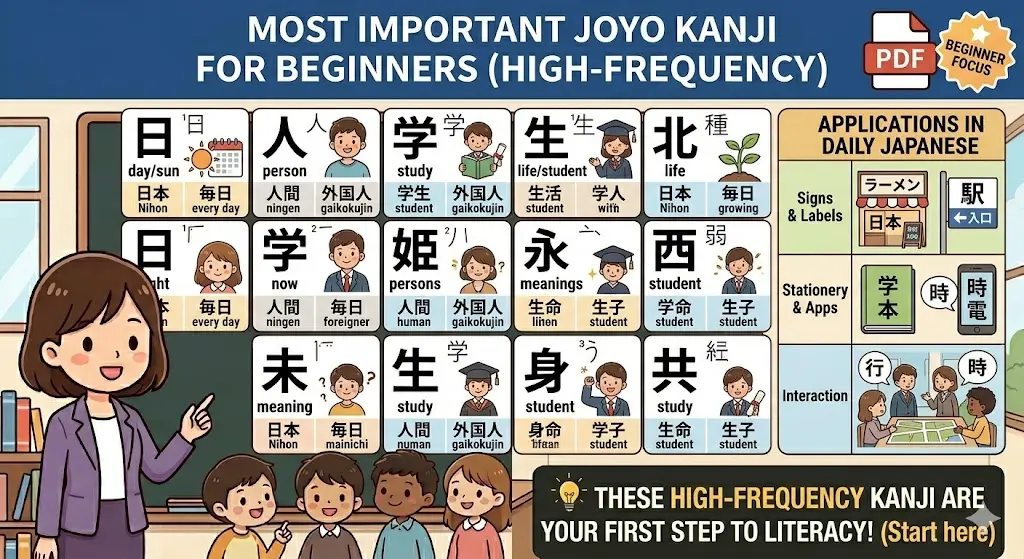
If you are just starting Japanese, focus on these high-frequency kanji first:
- 日 – day/sun
- 人 – person
- 学 – study
- 生 – life/student
- 時 – time
- 行 – go
- 見 – see
- 食 – eat
- 飲 – drink
- 本 – book
- 水 – water
- 火 – fire
- 木 – tree
- 金 – money/gold
- 土 – earth
- 月 – moon/month
- 山 – mountain
- 川 – river
- 車 – car
- 電 – electricity
These appear everywhere in daily Japanese.
How to Memorize Joyo Kanji Faster
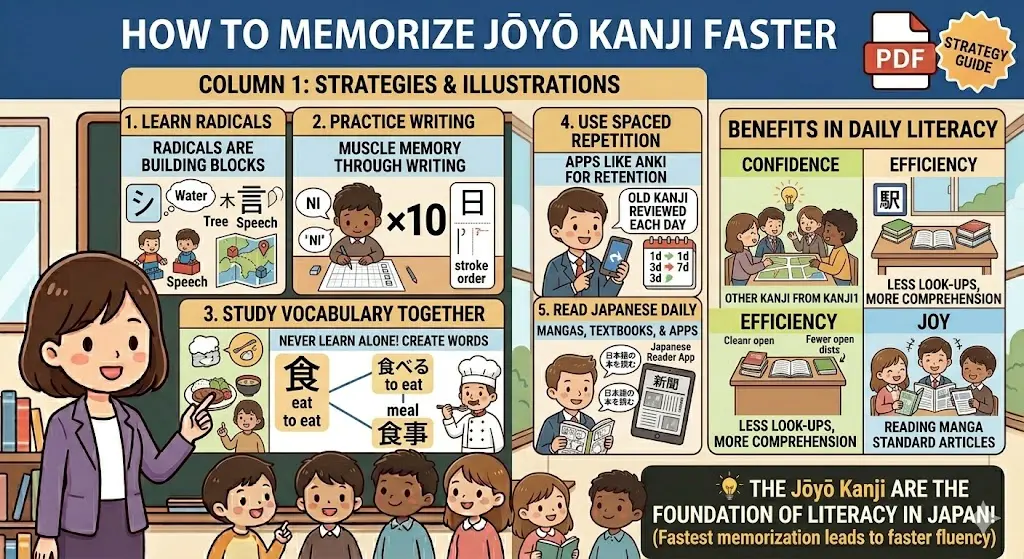
1. Learn Radicals
Radicals are building blocks inside kanji.
Example:
- 氵 = water radical
- 木 = tree radical
- 言 = speech radical
Recognizing radicals makes kanji easier to remember.
2. Practice Writing
Writing helps muscle memory.
Try:
- Writing each kanji 10 times
- Saying the reading aloud
- Creating example words
3. Study Vocabulary Together
Never learn kanji alone.
Instead of only learning:
- 食 = eat
Also learn:
- 食べる = to eat
- 食事 = meal
- 食堂 = cafeteria
4. Use Spaced Repetition
Apps like Anki can dramatically improve retention.
Review old kanji every day.
5. Read Japanese Daily
Reading manga, graded readers, and subtitles helps you encounter kanji naturally.
Recommended Joyo Kanji Study Order
A smart study order:
- Grade 1 kanji
- Grade 2 kanji
- JLPT N5 kanji
- JLPT N4 kanji
- Daily vocabulary kanji
- Newspaper kanji
Do not try to memorize all 2,136 at once.
Consistency is more important than speed.
Best Resources for Joyo Kanji PDF Practice
You can create or download:
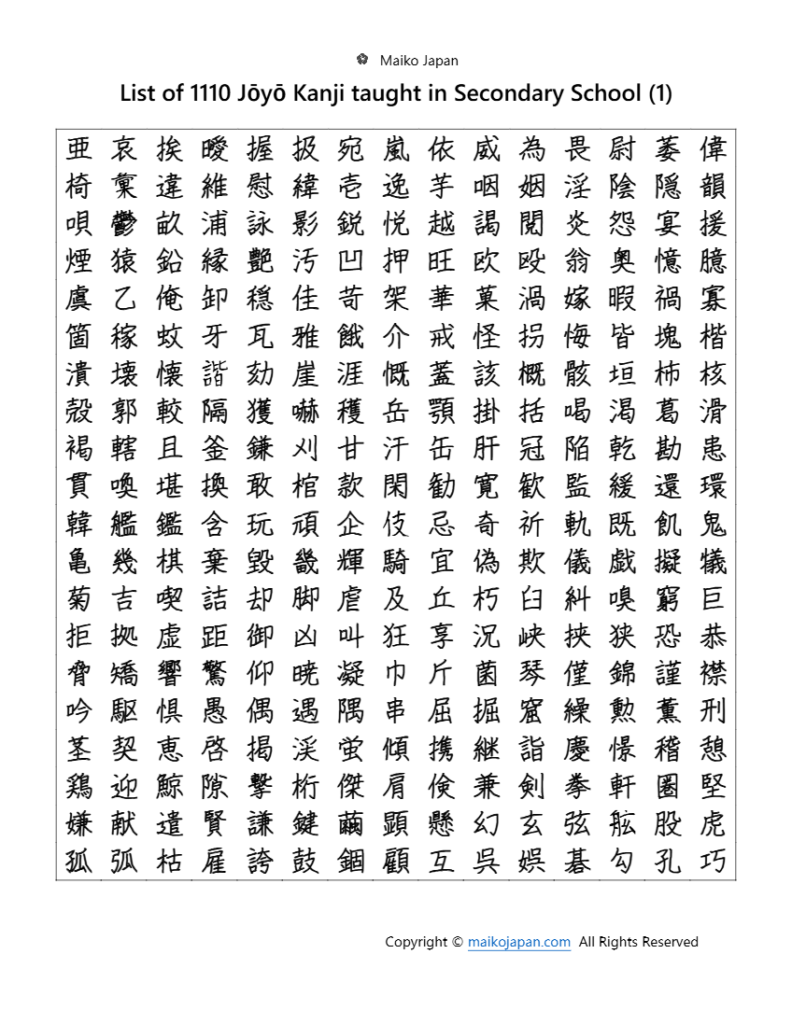
2136 Jōyō Kanji in PDF for FREE
List of 1110 Jōyō Kanji taught in Secondary School in Japan.
- Printable kanji charts
- Stroke order sheets
- Writing practice PDFs
- JLPT kanji lists
- Flashcards
- Graded kanji workbooks
Useful study materials include:
- Kanji writing notebooks
- Genki kanji practice sheets
- Kodansha Kanji Learner’s Course
- Remembering the Kanji
- JLPT kanji workbooks
Frequently Asked Questions
How many Joyo Kanji should beginners learn first?
Start with 100–300 high-frequency kanji. That is enough for basic reading.
Are all JLPT kanji included in Joyo Kanji?
Almost all commonly tested JLPT kanji are included in the Joyo list.
Is learning all 2,136 Joyo Kanji necessary?
For full Japanese literacy, yes.
But conversational Japanese requires far fewer.
How long does it take to learn Joyo Kanji?
Most learners need:
- 1–2 years for basic kanji
- 3–5 years for advanced literacy
Daily practice speeds up progress significantly.
Final Thoughts
The Joyo Kanji list is the foundation of written Japanese.
Learning these kanji helps you:
- Read native material
- Understand vocabulary faster
- Pass the JLPT
- Improve writing skills
- Enjoy Japanese media without relying on translations
Start small, practice daily, and gradually build your kanji knowledge.
Even learning 5 new kanji every day can completely transform your Japanese ability over time.
If you want printable study materials, make sure to also check:
- Printable Hiragana Charts
- Katakana Practice Sheets
- JLPT Vocabulary Lists
- Kanji Stroke Order PDFs
- Japanese Reading Practice for Beginners