
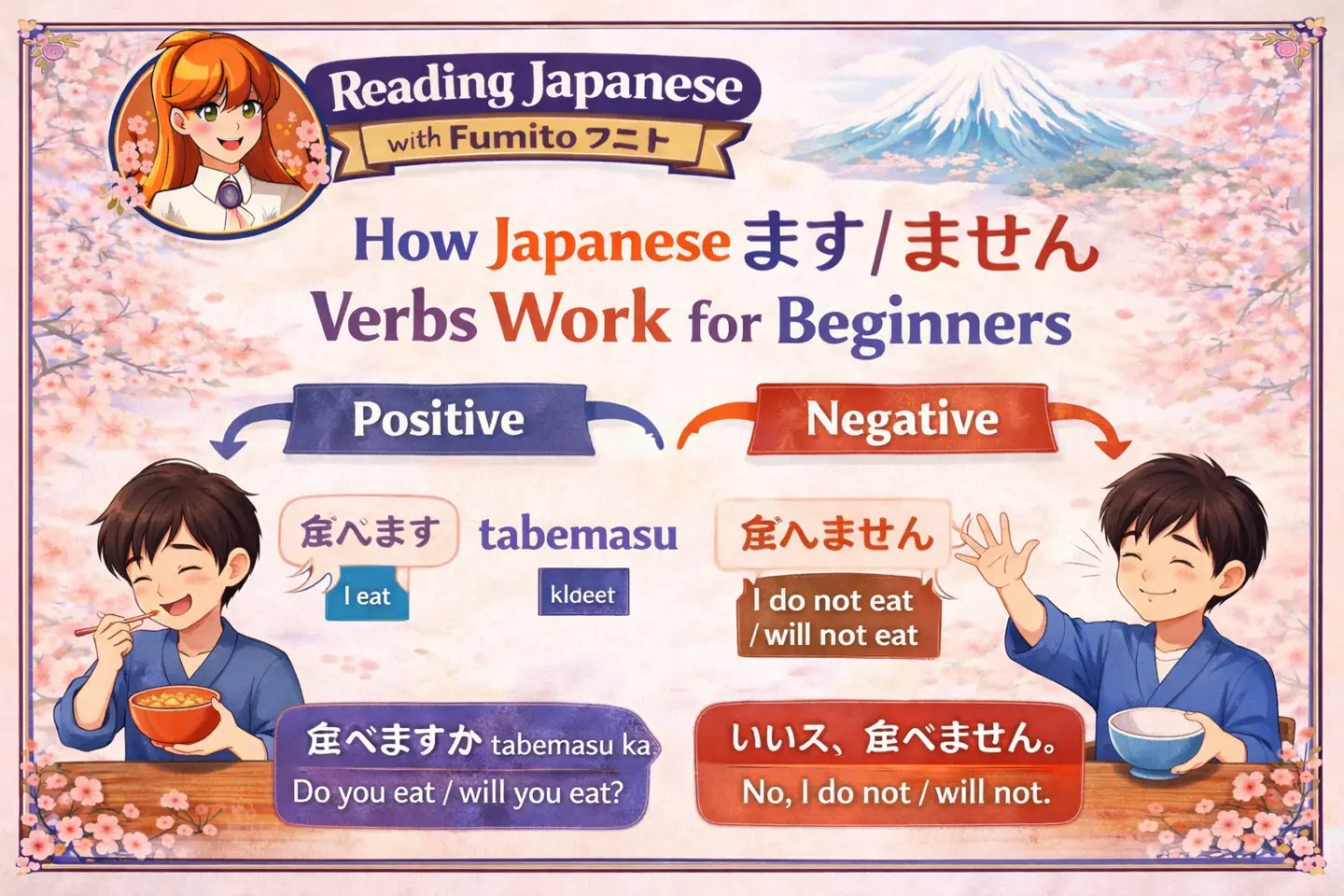

One of the biggest “aha” moments in learning Japanese is when you realise how simple and regular the basic verb structure is. Unlike English where verbs change in all kinds of unpredictable ways, Japanese verbs in their formal form follow a very consistant pattern — and once you get it, you can immediately start making real sentences.
In this lesson we cover the first grammar points from Lesson 1 of a real Japanese course — focused on a workplace dialogue between two new employees. We’ll look at how Japanese verbs work in positive and negative sentences, how hai and iie actually function (which is different from what most beginners think!), how the sentence particles ka and ne work, and how adverbs like amari and zenzen change the meaning of a verb.
How Japanese Verbs Work for Beginners – Masu, Masen, Hai, Iie and Sentence Particles Explained
If you’re just starting out, make sure you’ve read the Japanese greetings and daily phrases post and the pronunciation lesson on long vowels and pitch accent — this grammar post builds directly on those foundations.
📌 How to use this lesson: Read through the grammar notes first to understand the rules, then work through the drills out loud. Don’t just read the drill answers — say them. That’s what actually builds the habit of speaking.
The Lesson 1 Dialogue – Two New Employees at Work
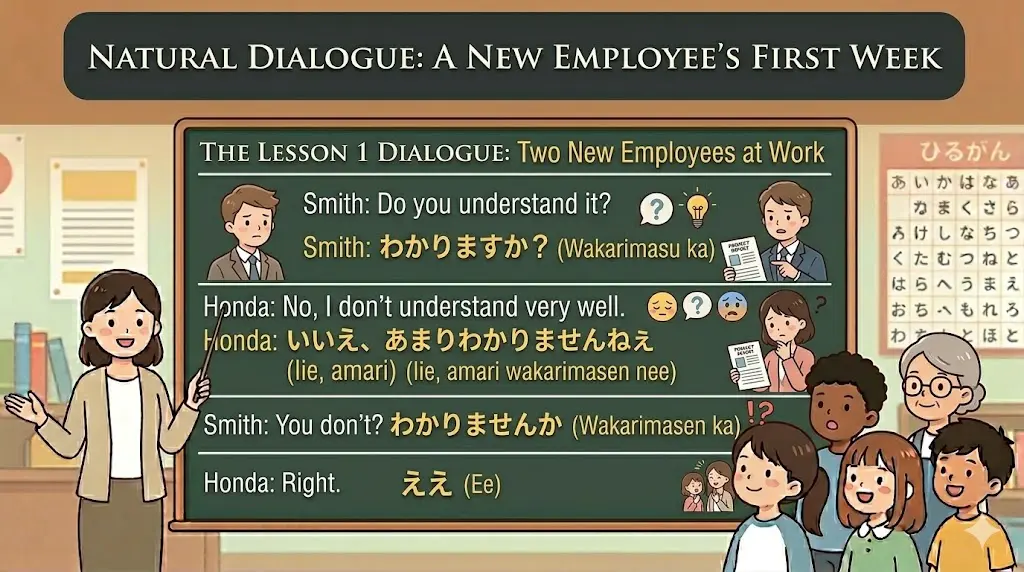
This short dialogue is the starting point for everything in this lesson. Mr. Smith and Ms. Honda are new employees talking about a project report they’re supposed to be working on. Its a completely natural, realistic exchange — exactly the kind of conversation you’d have on your first week at a Japanese company.
Practice each line aloud, and build up one line at a time until you can do the whole thing from memory.
Smith: わかりますか。
Wakarimasu ka. — Do you understand it?
Honda: いいえ、あまりわかりませんねえ。
Iie, amari wakarimasen nee. — No, I don’t understand very well.
Smith: わかりませんか。
Wakarimasen ka. — You don’t?
Honda: ええ。
Ee. — Right.
Vocabulary from the Dialogue
| Romaji | Japanese | Meaning |
|---|---|---|
| wakarimasu | わかります | understand |
| ka | か | question particle |
| amari | あまり | (not) very much — used with negative verb |
| wakarimasen | わかりません | don’t understand |
| nee | ねえ | sentence particle indicating empathy |
| ee | ええ | yes, that’s right (less formal than hai) |
Additional Vocabulary (Related Words)
| Romaji | Japanese | Kanji | Meaning |
|---|---|---|---|
| zenzen | ぜんぜん | 全然 | not at all (used with negative verb) |
| yoku | よく | — | well / a lot / often |
| tokidoki | ときどき | 時々 | sometimes |
| shimasu | します | — | do / play |
| tabemasu | たべます | 食べます | eat |
| nomimasu | のみます | 飲みます | drink |
| tsukurimasu | つくります | 作ります | make |
| norimasu | のります | 乗ります | ride / get on |
1-1-1 Japanese Verb Forms – Masu and Masen (Non-Past, Formal)
Verbs in Japanese always come at the end of the sentence. This is one of the first big differences from English, where the verb comes in the middle. In Japanese, the structure is Subject – Object – Verb, instead of Subject – Verb – Object like English.
The other thing that surprises beginners is that Japanese doesn’t require a subject if its already obvious from context. So when Mr. Smith says wakarimasu ka, he’s not saying “do you understand it” word by word — he’s just saying the verb with a question particle at the end, and the “you” and “it” are both understood from the situation.
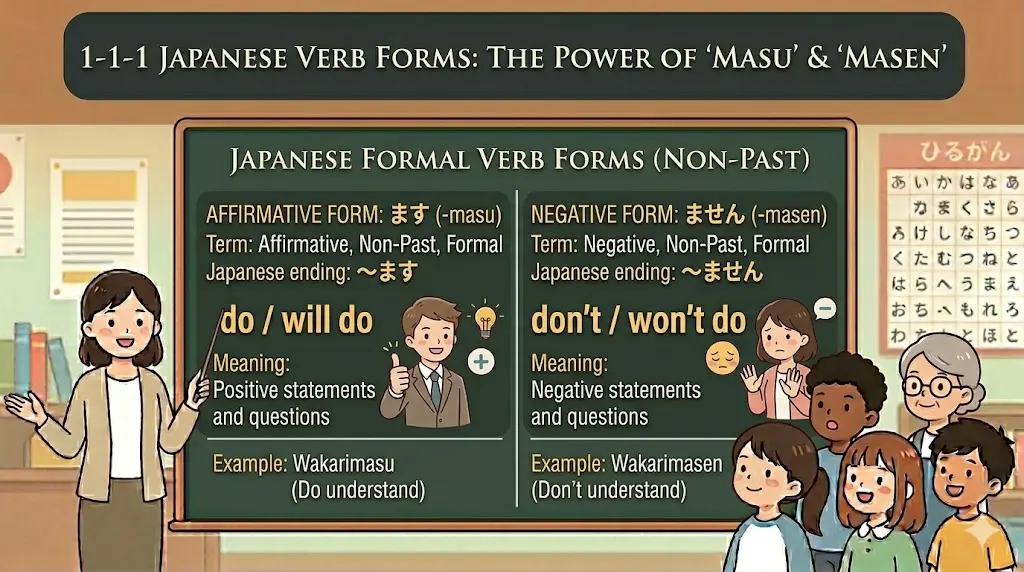
The formal verb forms you need to know first are:
| Form | Ending | Meaning | When to use |
|---|---|---|---|
| Affirmative, Non-Past, Formal | 〜ます (-masu) | do / will do | Positive statements and questions |
| Negative, Non-Past, Formal | 〜ません (-masen) | don’t / won’t do | Negative statements and questions |
⚠️ “Non-past” doesn’t mean “present”: Non-past in Japanese covers two things — actions that happen regularly (habits), and actions that will happen in the future. It does NOT describe something happening right now at this very moment. For example, tabemasu means “I eat (in general)” or “I will eat” — not “I am eating right now.” The -masu form is also the formal form, which makes it the safest form for beginners to use with anyone.
Here’s the same verb shown in both forms:
わかります。 Wakarimasu. — I understand.
わかりません。 Wakarimasen. — I don’t understand.
たべます。 Tabemasu. — I eat it.
たべません。 Tabemasen. — I don’t eat it.
のみます。 Nomimasu. — I drink it.
のみません。 Nomimasen. — I don’t drink it.
Notice how you just swap masu for masen to make the negative. This is one of the most useful and regular patterns in Japanese. For more on how this verb pattern extends into other tenses, check out my post on Japanese verb conjugation for beginners.
1-1-2 Hai and Iie – Not Just “Yes” and “No”
This is one of the things that trips up almost every English-speaking Japanese learner, and its worth spending some time on because the logic is different from English.
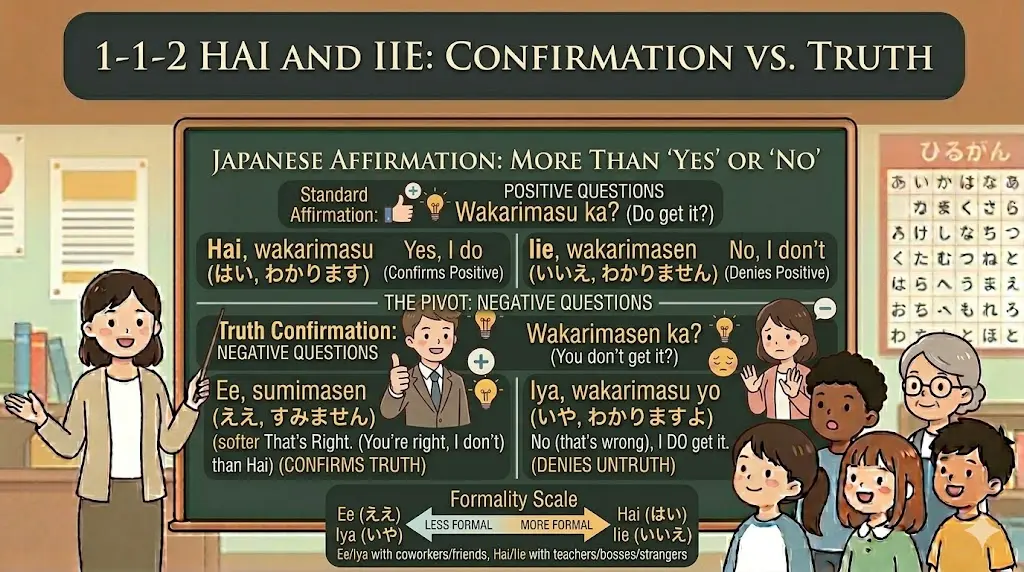
In English, “yes” confirms the positive and “no” denies it. But in Japanese, hai and iie work differently — they respond to whether what the other person said is correct or incorrect, regardless of whether the sentence was positive or negative.
Hai means “what you said is right.”
Iie means “what you said is incorrect.”
This sounds the same as English when the question is positive:
わかりますか。 Wakarimasu ka. — Do you get it?
はい、わかります。 Hai, wakarimasu. — Yes, I do.
いいえ、わかりません。 Iie, wakarimasen. — No, I don’t.
But here’s where it gets different from English — when the question is negative:
わかりませんか。 Wakarimasen ka. — You don’t get it?
ええ、すみません。 Ee, sumimasen. — That’s right. I’m sorry. (= you’re right, I don’t)
いや、わかりますよ。 Iya, wakarimasu yo. — No (that’s wrong), I do get it.
So when someone asks “you don’t understand, right?” and you DO understand — you say iie (no/wrong) to correct them, and then say the positive verb. In English you’d say “yes” in that situation. In Japanese you say “iie.” This is a very common source of confusion for beginners, so it’s worth practicing specifically.
⚠️ Formality levels: Ee (ええ) is less formal than hai (はい). Iya (いや) is less formal than iie (いいえ). Use hai and iie with teachers, bosses, clients, and people you don’t know well. Ee and iya are fine with coworkers and friends once you have an established relationship.
1-1-3 Japanese Sentence Particles Ka and Ne – How They Work
Sentence particles in Japanese are small words that attach to the end of a sentence and change its function or tone. The two most important ones for beginners are ka and ne/nee.
The Question Particle Ka (か)
Ka is the simplest particle to understand — it turns any statement into a question. You don’t need to change the word order like English does. You just add ka to the end.
たべます。 Tabemasu. — I eat it.
たべますか。 Tabemasu ka. — Do you eat it?
のみます。 Nomimasu. — I drink it.
のみますか。 Nomimasu ka. — Do you drink it?
Its that straightforward. This is one of the things that makes basic Japanese sentence structure easier than English in some ways — making a question is just a matter of adding ka.
The Empathy Particle Ne / Nee (ね/ねえ)
Ne and nee are the same particle — nee is just a longer, more emphatic version. This particle expresses that you assume the other person shares your feeling or opinion. It’s similar to “right?” or “don’t you think?” or “isn’t it?” in English, but in Japanese it comes at the end of the sentence.
With falling intonation, ne/nee indicates you’re stating something and assume the listener agrees:
よくのみますねえ。 Yoku nomimasu nee. — You drink a lot, don’t you!
わかりませんねえ。 Wakarimasen nee. — We don’t know, do we.
With rising intonation (like a question), ne checks whether your assumption is correct:
たべませんね? Tabemasen ne? — You don’t eat it, right?
🎌 Cultural note: The ne particle reflects something really important in Japanese communication culture — the idea of creating shared feeling and mutual understanding with the person you’re talking to. Using ne naturally in conversation signals that you’re engaged, empathetic, and in sync with the other person. It makes your Japanese sound much more natural and less robotic when you start using it properly.
1-1-4 Japanese Adverbs – Amari, Zenzen and Yoku
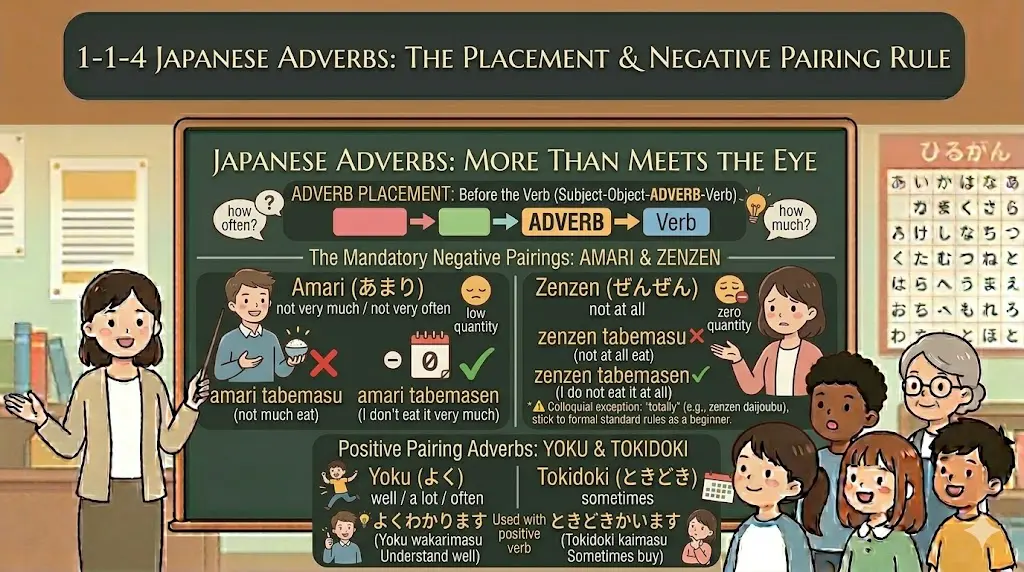
Adverbs in Japanese come before the verb in a sentence. They describe how much, how often, or in what way something happens. The three most important beginner adverbs are amari, zenzen, and yoku.
| Adverb | Japanese | Meaning | Used with |
|---|---|---|---|
| amari | あまり | not very much / not very often | Negative verb (masen) |
| zenzen | ぜんぜん / 全然 | not at all | Negative verb (masen) |
| yoku | よく | well / a lot / often | Positive verb (masu) |
| tokidoki | ときどき / 時々 | sometimes | Positive verb (masu) |
The key rule to remember: amari and zenzen must be used with a negative verb. You can not say amari tabemasu — you have to say amari tabemasen. This is different from English where you’d just say “I don’t eat it much” — in Japanese the “not much” part (amari) and the negative verb (masen) both have to be there together.
あまりたべません。 Amari tabemasen. — I don’t eat it very much.
ぜんぜんはなしません。 Zenzen hanashimasen. — I do not speak it at all.
よくわかります。 Yoku wakarimasu. — I understand well.
よくかいます。 Yoku kaimasu. — I buy it a lot / often.
⚠️ Special case — zenzen with affirmative: In colloquial (casual, everyday spoken) Japanese, zenzen is sometimes used with a positive verb to mean “totally” or “completely” — for example, zenzen daijoubu (totally fine). But this is colloquial usage. In formal and standard Japanese, zenzen goes with a negative verb. As a beginner, stick with the standard rule: zenzen + negative verb.
Drill A – Positive Responses with Yoku
In this drill someone asks if you do something, and you respond positively using yoku (a lot / often).
MODEL EXCHANGES
Cue: Shimasu ka. — Do you play?
しますか。
Response: Ee, yoku shimasu. — Yes, I play a lot.
ええ、よくします。
Cue: Tabemasu ka. — Do you eat this?
たべますか。
Response: Ee, yoku tabemasu. — Yes, I eat it a lot.
ええ、よくたべます。
Now practice the same pattern with: nomimasu ka / tsukurimasu ka / norimasu ka. Use ee, yoku [verb] each time.
Drill B – Negative Responses with Amari
This time someone asks if you do something, and you respond negatively using amari (not very much) with the nee empathy particle at the end.
MODEL EXCHANGES
Cue: Shimasu ka. — Do you do it?
しますか。
Response: Iie, amari shimasen nee. — No, we don’t do it much.
いいえ、あまりしませんねえ。
Cue: Tabemasu ka. — Do you eat it?
たべますか。
Response: Iie, amari tabemasen nee. — No, I don’t eat it much.
いいえ、あまりたべませんねえ。
Practice the same pattern with: nomimasu ka / tsukurimasu ka / norimasu ka.
Drill C – Confirming a Negative with Zenzen
Here the question itself is already negative, and you’re confirming it with zenzen (not at all).
MODEL EXCHANGES
Cue: Shimasen ka. — Don’t you play?
しませんか。
Response: Ee, zenzen shimasen nee. — Right, I don’t play at all.
ええ、ぜんぜんしませんねえ。
Cue: Tabemasen ka. — Don’t you eat it?
たべませんか。
Response: Ee, zenzen tabemasen nee. — Right, we don’t eat it at all.
ええ、ぜんぜんたべませんねえ。
Practice with: nomimasen ka / tsukurimasen ka / norimasen ka.
Drill D – Say It in Japanese
You are talking about a Japanese dish and someone has asked if you eat it. Try each one yourself before checking the answer.
- No, I don’t eat it at all. → Iie, zenzen tabemasen. いいえ、ぜんぜんたべません。
- No, I don’t eat it very often. → Iie, amari tabemasen. いいえ、あまりたべません。
- Yes, I eat it often. → Ee, yoku tabemasu. ええ、よくたべます。
- Yes, I make it sometimes. → Ee, tokidoki tsukurimasu. ええ、ときどきつくります。
- Yes, I make it often. → Ee, yoku tsukurimasu. ええ、よくつくります。
Drill E – Act in Japanese (Role Play)
These short situational drills practice using everything from this lesson in realistic conversations. Try with a partner if you can — one person plays the role of Ms. Honda, the other responds.
- Ms. Honda is watching a Chinese video. Find out if she understands it. → Honda-san, wakarimasu ka.
- Ms. Honda is talking about a video game. Ask if she plays it often. → Yoku shimasu ka.
- Ms. Honda has asked you if you eat sushi a lot. Tell her not very often. → Iie, amari tabemasen nee.
- You heard Ms. Honda say that she does not drink at all. Check if you heard her correctly. → Zenzen nomimasen ka.
💡 Remember: In all of these situations you’re talking to a coworker — Honda-san. In a real Japanese office, use the polite -masu / -masen forms with someone you’ve just met, even if they’re the same level as you. Once you’ve built a closer relationship, more casual forms come naturally over time.
FAQ – Japanese Verb Grammar for Beginners
What is the difference between masu and masen in Japanese?
Masu (ます) is the affirmative ending for formal, non-past verbs in Japanese — it means you do something or will do something. Masen (ません) is the negative form — it means you don’t or won’t do something. For example, tabemasu means “I eat” and tabemasen means “I don’t eat.” This pattern is the same for almost all verbs in their formal form, which makes it one of the most useful things to learn first in Japanese grammar.
What does “non-past” mean in Japanese grammar?
Non-past in Japanese refers to two things: regular habits (“I eat sushi often”) and future actions (“I will eat sushi tomorrow”). It does NOT mean something happening right now at this moment. That’s different from English where “I eat” can sometimes imply the present. Japanese has a separate -te iru form to express ongoing actions happening right now. As a beginner, the main thing to understand is that the -masu form covers both habits and future — not the current moment.
What is the difference between hai and iie in Japanese?
This is one of the most misunderstood things in beginner Japanese. Hai (はい) doesn’t simply mean “yes” — it means “what you said is correct.” Iie (いいえ) means “what you said is incorrect.” So if someone asks “you don’t eat sushi, right?” and you DO eat sushi, you say iie (because their statement is wrong) — even though in English you’d say “yes.” This reversed logic with negative questions catches most English speakers off guard at first.
What does the particle “ka” do in Japanese?
Ka (か) is the question particle in Japanese. You attach it to the end of any sentence to turn it into a question, without changing word order. So tabemasu (I eat) becomes tabemasu ka (Do you eat?). Its one of the most straightforward grammar rules in the language — making a question in Japanese is simply a matter of adding ka at the end.
What does “ne” mean in Japanese?
Ne (ね) and its longer version nee (ねえ) are sentence-ending particles that express shared feeling or seek agreement from the listener. With falling intonation it’s like saying “right?” or “don’t you think?” — assuming the person agrees. With rising intonation it becomes a genuine question checking if the other person shares your view. Using ne naturally is a big step towards sounding more natural in Japanese conversation.
What is the difference between amari and zenzen in Japanese?
Both are adverbs used with negative verbs, but they express different degrees. Amari (あまり) means “not very much” — a partial negative. Zenzen (ぜんぜん) means “not at all” — a complete negative. So amari tabemasen = “I don’t eat it very much” and zenzen tabemasen = “I don’t eat it at all.” Both must be paired with a negative verb ending (masen).
Do Japanese sentences need a subject?
Not if the subject is obvious from context — which is most of the time in natural conversation. Unlike English, Japanese does not require you to state “I” or “you” or “it” if the meaning is already clear from the situation. So wakarimasu ka can mean “do you understand it?” with no explicit “you” or “it” in the sentence at all. This is a very common feature of Japanese and it’s one of the things that makes natural Japanese sound quite different from translated Japanese.
Where do adverbs go in a Japanese sentence?
Adverbs in Japanese go before the verb. So the order is: (Subject) – (Object) – Adverb – Verb. For example: yoku tabemasu (often eat), amari nomimansen (don’t drink much), tokidoki tsukurimasu (sometimes make). This is consistent across Japanese sentences and is a good rule to memorize early on.
What’s Next?
You’ve now covered the core grammar of Lesson 1 — how Japanese verbs work in formal positive and negative forms, how hai and iie function logically (not just as “yes” and “no”), how to make questions with ka, how to add nuance with ne, and how to use the key adverbs amari, zenzen, and yoku. That’s a solid set of tools for making real simple sentences in Japanese.
The next step is to expand your verb vocabulary and start combining these patterns with nouns and more context — building slightly longer, more expressive sentences. Head over to my post on Japanese verb conjugation for beginners to continue, or revisit the pronunciation lesson to keep sharpening how these verbs and words actually sound.
頑張ってください!(Ganbatte kudasai!) — Keep going! 🎌
— Fumito フミト | reading-japanese.com
📚 Related lessons on reading-japanese.com: