
One of the things that surprises beginners the most about Japanese is how much communication happens between the words — through hesitation, tone, small filler phrases, and the way you listen as much as how you speak. This lesson gets into exactly that.
We’re covering Dialogue 3 from Lesson 1 — a short but culturally rich conversation where a group of coworkers are figuring out who’s going out tonight. From this one dialogue we get five really useful grammar and culture points: how negative questions work as invitations in Japanese, how chotto softens refusals, what aizuchi is and why it matters, how Japanese people refer to themselves and others, and how the sentence particle yo differs from ne.
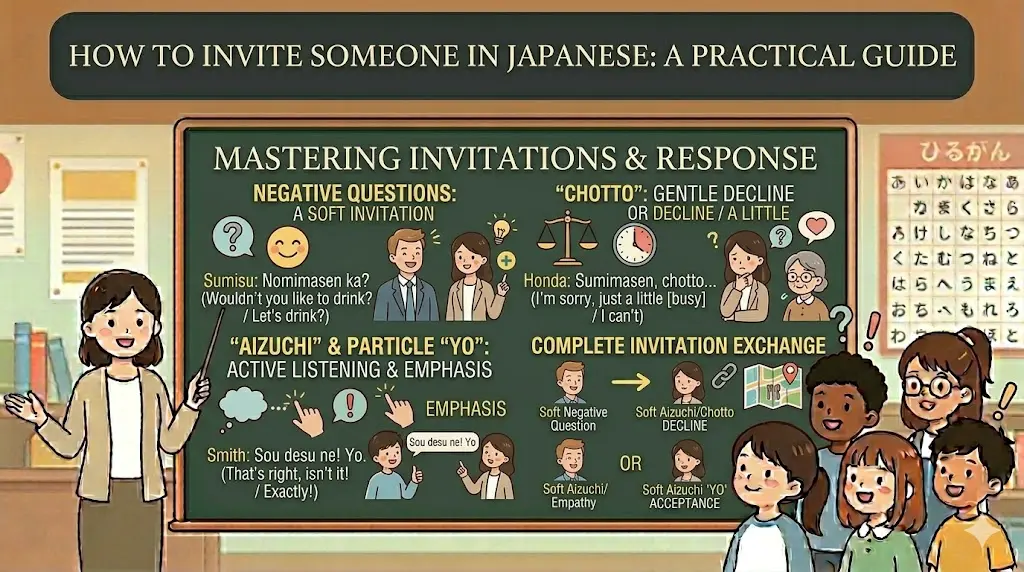
How to Invite Someone in Japanese – Negative Questions, Chotto, Aizuchi and Particle Yo Explained
This lesson builds on the grammar from the previous posts — if you haven’t already covered how Japanese verbs work (masu and masen) and kore, sore, are and the particles wa and mo, those are worth going through first.
📌 Note on this lesson: A lot of what’s covered here is cultural as much as grammatical. Japanese communication style is quite different from English — understanding the why behind these patterns makes them much easier to actually use naturaly in conversation.
Dialogue 3 – Going Out Tonight
A group of coworkers are deciding who’s joining them for a night out. Pay attention to how Mr. Smith declines without saying “no” — and how Ms. Honda smoothly moves on to ask someone else. This kind of natural, indirect communication is very typical in Japanese workplaces and social situations.
Honda: 行きませんか。
Ikimasen ka. — Do you want to go? (lit. Won’t you go?)
Smith: 今日はちょっと、、、
Kyou wa chotto… — Today is a little… (= I’m sorry, I can’t today)
Honda: ああ、そうですか。じゃあ、また。
Aa, sou desu ka. Ja, mata. — Oh, I see. Well then, next time.
Honda: 山田さんは?
Yamada-san wa? — How about you, Mr. Yamada?
Yamada: 私は行きますよ。
Watashi wa ikimasu yo. — I’m going. (assuring her)
Vocabulary from the Dialogue
| Romaji | Japanese | Kanji | Meaning |
|---|---|---|---|
| ikimasu | いきます | 行きます | go |
| ikimasen ka | いきませんか | 行きませんか | Won’t you go? / Shall we go? |
| kyou | きょう | 今日 | today |
| chotto | ちょっと | — | a little / (polite refusal) |
| sou | そう | — | so / that way |
| sou desu ka | そうですか | — | Is that so? / I see. |
| Yamada | やまだ | 山田 | Yamada (surname) |
| watashi | わたし | 私 | I / me |
| yo | よ | — | sentence particle — new information / assurance |
Additional Vocabulary
| Romaji | Japanese | Kanji | Meaning |
|---|---|---|---|
| boku | ぼく | 僕 | I (male speakers only, less formal) |
| ashita | あした | — | tomorrow |
| asatte | あさって | — | the day after tomorrow |
| mainichi | まいにち | 毎日 | every day |
| kimasu | きます | 来ます | come |
| kaerimasu | かえります | 帰ります | return / go home / come home |
| dekakemasu | でかけます | — | go out |
| yasumimasu | やすみます | 休みます | rest / take time off |
1-3-1 Negative Questions as Invitations – Ikimasen Ka and Tabemasen Ka
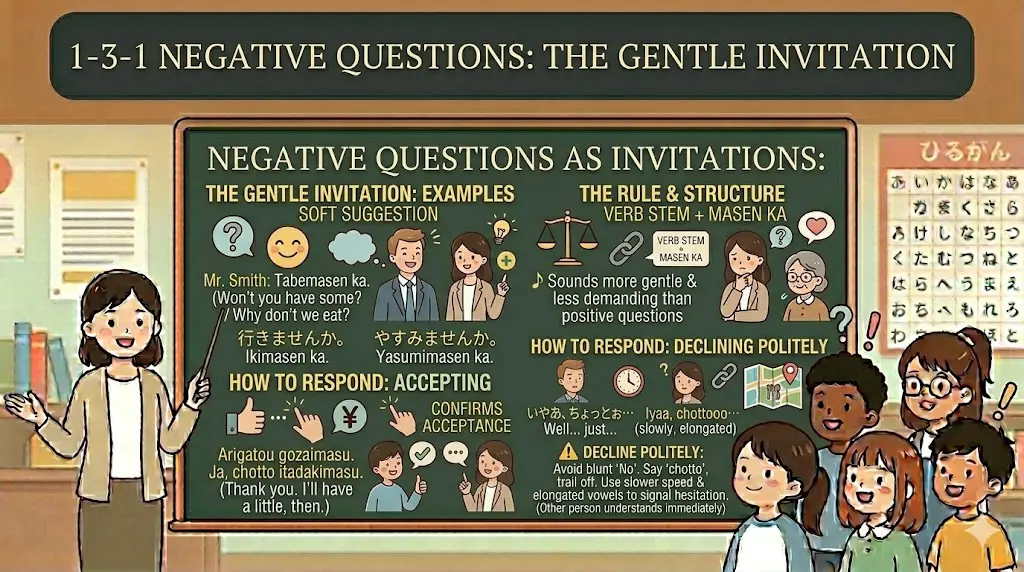
In English, when you want to invite someone to do something, you usually use a positive question — “Do you want to come?” or “Shall we eat?” In Japanese, its actually very common to use a negative question as an invitation or suggestion. It sounds more gentle and less demanding than a direct positive question.
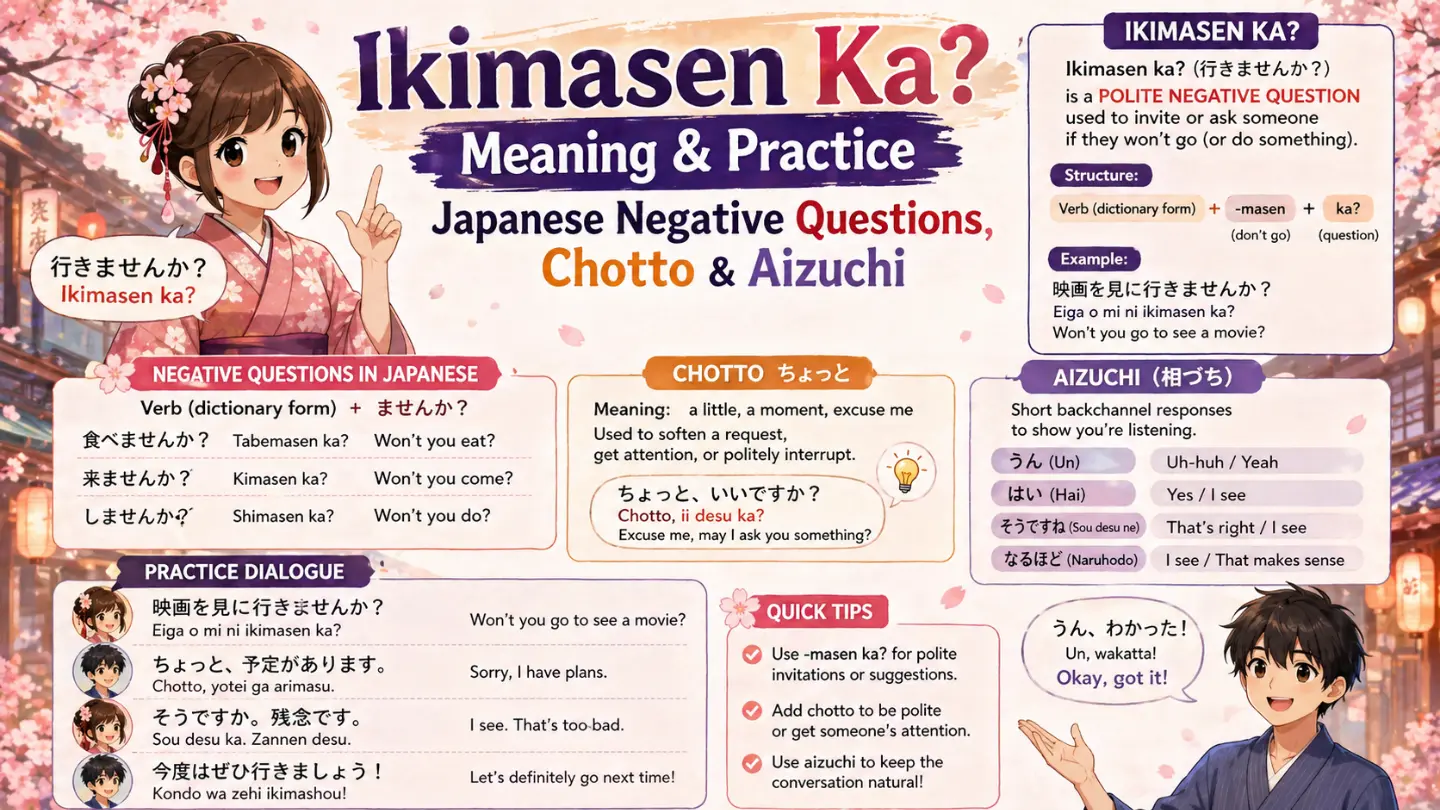
たべませんか。 Tabemasen ka. — Won’t you have some? / Why don’t we eat?
行きませんか。 Ikimasen ka. — Won’t you go? / Shall we go?
やすみませんか。 Yasumimasen ka. — Shall we take a break?
The structure is simply: verb stem + masen ka. You already know the masen (negative) ending from the previous grammar lesson — adding ka turns it into an invitation. This is one of those patterns that sounds very natural once you start using it, and Japanese people use it all the time for everything from offering food to suggesting a meeting.
How you respond to these invitations matters too. There are basically two ways — accepting and declining — and the Japanese approach to declining is quite different from English:
✅ Accepting the invitation
ありがとうございます。じゃ、ちょっといただきます。
Arigatou gozaimasu. Ja, chotto itadakimasu.
Thank you. I’ll have a little, then.
🙏 Declining politely
いやあ、ちょっとお…
Iyaa, chottooo…
Well… just… (spoken slowly, vowels elongated)
⚠️ The Japanese way of saying no: When declining an invitation in Japanese, avoid saying no directly. The polite way is to say chotto (a little / kind of…) and trail off, speaking slowly and elongating your vowels. This signals hesitation without giving a blunt refusal — which is much more in keeping with Japanese communication norms. The other person will understand immediately. A direct “no” can come accross as rude in many social situations in Japan.
1-3-2 Chotto – Japanese’s Most Useful Softening Word
You’ve already seen chotto used to mean “a little bit” or “a few” — but in real Japanese conversation, chotto does a lot more than that. It’s one of the most versatile words in the language, and its main job is to soften the impact of what you’re about to say.
Japanese communication highly values avoiding discomfort and awkwardness in social situations — and chotto is one of the main linguistic tools for doing that. Here are all the main ways it gets used:
- To get someone’s attentionちょっと。 Chotto. — Hey, excuse me. (calling someone over)
- To be humble when accepting somethingじゃ、ちょっといただきます。 Ja, chotto itadakimasu. — Well, I’ll just have a little then.
- To be modest when asked if you know somethingちょっとわかりますけど… Chotto wakarimasu kedo… — I understand a little, but…
- To soften a requestすいません。ちょっとお願いします。 Suimasen. Chotto onegai-shimasu. — Excuse me. Can I just ask a favour?
- To soften “I don’t know”ちょっとわかりませんねえ。 Chotto wakarimasen nee. — I just don’t know.
- To suggest a break (regardless of actual length)ちょっと、やすみませんか。 Chotto, yasumimasen ka. — Shall we take a short break?
- To politely decline an invitation今日はちょっと、、、 Kyou wa chotto… — Today is a bit… (= I can’t today, sorry)
🔑 Why does chotto matter so much? Because it reflects something fundamental about how Japanese social communication works. There’s a strong cultural preference for avoiding direct confrontation or awkwardness — and chotto lets you signal hesitation, modesty, or refusal without being blunt about it. Once you start noticing it in Japanese conversations (and in anime!), you’ll realise how often it comes up. Learning to use it naturally is one of the quickest ways to sound more like a real Japanese speaker.
1-3-3 Aizuchi – How to Be a Good Listener in Japanese
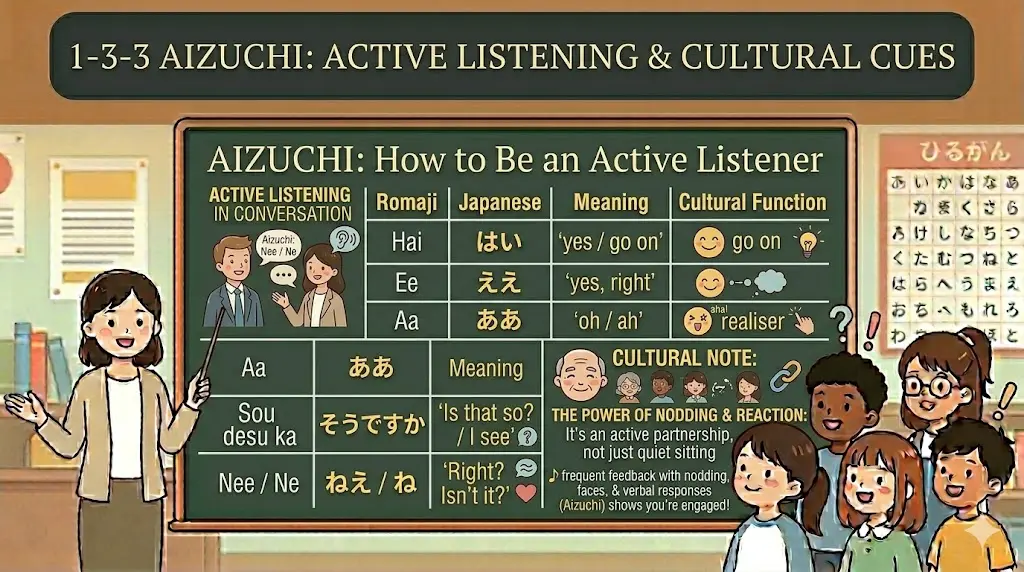
This is one of the most important cultural points for anyone learning Japanese for real conversations, not just textbook exercises. In Japanese, being a good listener is an active, participatory thing — not just sitting quietly and paying attention.
When you’re in a Japanese conversation, you’re expected to give frequent feedback to show that you’re engaged and following along. This feedback includes nodding, making facial expressions, and using short verbal responses. All of these responses together are called aizuchi (相槌).
Common aizuchi expressions include:
| Expression | Japanese | Function |
|---|---|---|
| Hai | はい | I’m listening / yes, go on |
| Ee | ええ | Yes, right (softer than hai) |
| Aa | ああ | Oh / ah (realising something) |
| Sou desu ka | そうですか | Is that so? / I see. (shows you’re taking in info) |
| Nee / Ne | ねえ/ね | Right? / Isn’t it? (shared feeling) |
🎌 Cultural note — nodding in Japanese: You’ll notice Japanese speakers nodding very frequently while someone else is talking. This nodding means “I’m listening” — it does NOT necessarily mean “I agree.” This is an important distinction. Don’t stare blankly at someone while they talk (which can feel rude or disengaged in Japan), but also don’t assume that someone nodding along means they agree with everything your saying. The nod is a listening signal, not an agreement signal. Smile, nod, and use your aizuchi — it makes a big difference in how conversations feel.
Sou desu ka is especially worth memorising early. It’s one of those expressions you’ll use in almost every conversation — it signals that you’ve understood what the other person just told you and your processing it. In the dialogue, Honda uses aa, sou desu ka the moment she understands that Smith can’t come. It’s smooth, natural, and shows social grace.
1-3-4 Watashi, Boku and How to Refer to People in Japanese
Japanese handles personal pronouns very differently from English, and this is one of those areas where just translating directly from English leads to mistakes.
Referring to Yourself
| Word | Japanese | Who uses it | Formality |
|---|---|---|---|
| watashi | わたし / 私 | Anyone | Standard / neutral — safest for beginners |
| boku | ぼく / 僕 | Male speakers only | Less formal than watashi |
Watashi is the safest option for beginners regardless of gender. Boku is used by male speakers in informal situations — you’ll hear it a lot in anime from male characters talking to friends. Other forms exist with different levels of formality and social implication, but those come later.
One very important thing — don’t overuse watashi. In Japanese, the subject is dropped from the sentence when its already clear from context. Saying watashi all the time (because English always requires “I”) is one of the most common mistakes made by beginner learners. Only use it when there’s a real reason to clarify who you’re talking about.
Referring to Other People
Choosing how to address or refer to someone in Japanese is more nuanced than English. Here are the main rules:
- Last name + san — most common and safest. Use this by default with anyone you don’t know well.
- Sensei — required for teachers, professors, doctors. Using san instead of sensei for a teacher is considered rude.
- First name (with or without san) — more informal. Used between friends or with people in subordinate positions.
- Anata (you) — be careful with this one. Unlike English “you,” anata has very limited use in Japanese. It’s typically for anonymous addressees — if you know the person’s name or title, use that instead. Using anata when you know someone’s name can sound cold or strange.
⚠️ When to switch to casual address: In Japanese social and workplace settings, switching to a more casual form of address (like first name, or dropping san) is usually initiated by the superior in the relationship, not the junior. If someone older or more senior than you hasn’t made that switch, don’t make it yourself — stick with last name + san until they signal otherwise. Being conservative here is always safer than being too familiar too soon.
1-3-5 Particle Yo – New Information and Assurance
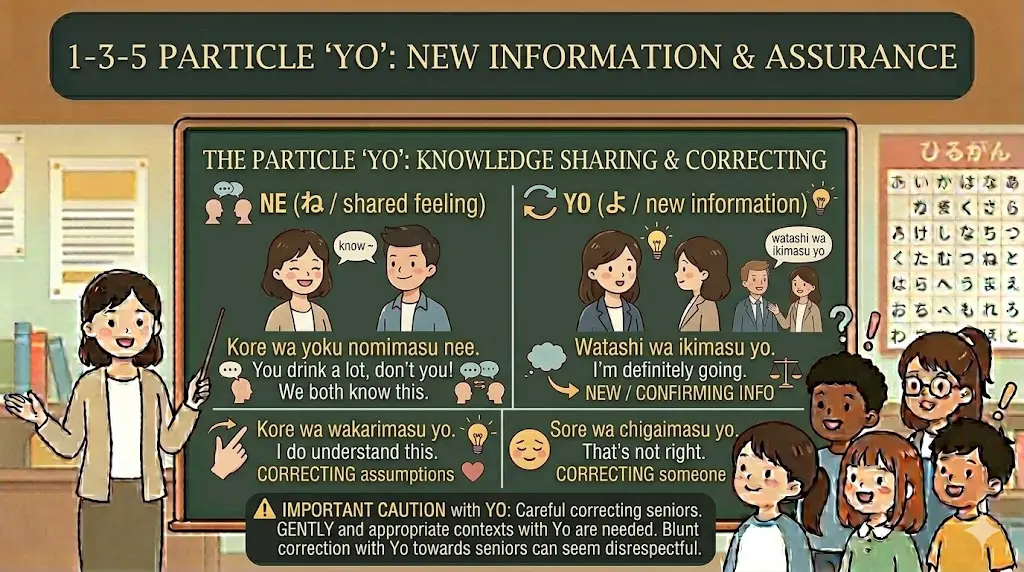
You’ve already learned about the particle ne/nee from the previous lessons. The particle yo is its counterpart — and the two work in opposite ways.
ね Ne / Nee — shared information
Used when you assume the listener already knows or shares your feeling.
Yoku nomimasu nee.
よくのみますねえ。
You drink a lot, don’t you! (we both know this)
よ Yo — new information
Used when you think this is new information to the listener, or to correct / assure someone.
Watashi wa ikimasu yo.
わたしは行きますよ。
I’m going. (assuring her — she may not have known)
In the dialogue, Yamada uses yo at the end of watashi wa ikimasu yo because Honda was checking — she didn’t know if Yamada was going. Yo here assures her: yes, I am definitely going. It signals that this is new or confirming information.
これはわかりますよ。 Kore wa wakarimasu yo. — I do understand this. (correcting someone’s assumption)
それはちがいますよ。 Sore wa chigaimasu yo. — That’s not right. (correcting someone)
💡 Important caution with yo: Because yo often implies you’re correcting or asserting something the listener doesn’t know, you need to be careful about when and how you use it. Using yo to correct a superior or someone older than you needs to be done appropriately — make sure you’re actually in a position to correct them, and do it gently. In casual conversation between peers it’s fine, but blunt correction with yo toward a senior can come accross as disrespectful.
Drill A – Inviting with Masen Ka
Someone asks if you’re doing something. You confirm you are, then invite Ms. Honda to join too using a negative question.
MODEL EXCHANGES
Cue: Ikimasu ka. — Are you going?
いきますか。
Response: Hai, ikimasu. Honda-san mo ikimasen ka.
はい、いきます。本田さんもいきませんか。
Yes, I am. Won’t you go, too, Ms. Honda?
Cue: Shimasu ka. — Do you do it?
しますか。
Response: Hai, shimasu. Honda-san mo shimasen ka.
はい、します。本田さんもしませんか。
Yes, I do. Won’t you do it, too, Ms. Honda?
Practice with: tabemasu ka / nomimasu ka / kaerimasu ka / dekakemasu ka
Drill B – Responding to Yo with Watashi Mo
Someone tells you they’re doing something (with yo — asserting it). You respond with surprise and say you’ll do it too.
MODEL EXCHANGES
Cue: Ikimasu yo. — I’m going.
いきますよ。
Response: Aa, sou desu ka. Jaa watashi mo ikimasu.
ああ、そうですか。じゃあ、わたしもいきます。
Oh, really? Well then I’ll go, too.
Cue: Shimasu yo. — I’ll do it.
しますよ。
Response: Aa, sou desu ka. Jaa watashi mo shimasu.
ああ、そうですか。じゃあ、わたしもします。
Oh, really? Well then I’ll do it, too.
Practice with: tabemasu yo / kimasu yo / dekakemasu yo / kaerimasu yo
Drill C – Say It in Japanese
You are talking about events for new employees and you’ve been asked if you’re going. Try each one yourself before checking the answer.
- Yes, I am. How about you, Ms. Honda? → Hai, ikimasu. Honda-san wa? はい、いきます。本田さんは?
- Today I’m not going, but tomorrow I will. → Kyou wa ikimasen kedo, ashita wa ikimasu. 今日はいきませんけど、あしたはいきます。
- No, I’m going home. Won’t you go home too, Ms. Honda? → Iie, kaerimasu. Honda-san mo kaerimasen ka. いいえ、かえります。本田さんもかえりませんか。
- Today is a bit… I’m sorry. → Kyou wa chotto… Sumimasen. 今日はちょっと、、、すみません。
Now invite Ms. Honda to do each of the following:
- Go out today → Kyou dekakemasen ka. 今日でかけませんか。
- Write this (a form to fill out) → Kore, kakimasen ka. これ、かきませんか。
- Read that (a book over there) → Are, yomimasen ka. あれ、よみませんか。
- Drink this (coffee) → Kore, nomimasen ka. これ、のみませんか。
- Talk the day after tomorrow → Asatte, hanashimasen ka. あさって、はなしませんか。
- Come (to your house) → Kimasen ka. きませんか。
Drill D – Act in Japanese (Role Play)
These roleplay scenarios practice everything from this lesson in realistic social situations. Use appropriate facial expressions, tone, and — where relevant — the chotto softening technique.
- You brought cookies for everyone in your office. Offer them. → Kore, tabemasen ka. これ、たべませんか。
- Everyone is enjoying cookies but Ms. Honda is holding back to be polite. Invite her to eat as well. → Honda-san mo tabemasen ka. 本田さんもたべませんか。
- You’ve been asked if you go out often. Downplay how much you actually go out. → Amari dekakemasen nee. あまりでかけませんねえ。
- Your group has been working hard. Suggest that you take a short break. → Chotto, yasumimasen ka. ちょっと、やすみませんか。
- You’ve been offered a food you do not care for. Politely indicate you don’t want it. → Iyaa, chottooo… (trail off, elongate vowels, speak slowly) いやあ、ちょっとお、、、
- Mr. Yamada has asked if you read an online newspaper. Tell him you do every day, and find out if he does. → Mainichi yomimasu yo. Yamada-san wa? 毎日よみますよ。山田さんは?
💡 On Drill D item 5: The key to declining politely in Japanese is not just the words — it’s the delivery. Say iyaa slowly with a slightly pained or apologetic expression, drag out the chottooo, and trail off. The elongated vowels signal hesitation and genuine regret. Done right, it’s much more socially smooth than any direct refusal would be.
FAQ – Invitations, Chotto, Aizuchi and Particle Yo in Japanese
How do you invite someone in Japanese?
The most natural and polite way to invite someone in Japanese is to use a negative question — verb stem + masen ka. For example, ikimasen ka (won’t you go? / shall we go?) or tabemasen ka (won’t you have some?). This sounds softer and more considerate than a direct positive question, because it gives the other person easy room to decline without feeling pressured. When accepting, say arigatou gozaimasu or ja, itadakimasu. When declining, use chotto and trail off politely.
What does “chotto” mean in Japanese conversation?
Chotto (ちょっと) literally means “a little bit” but in conversation it functions as a social softener. It’s used to politely decline invitations (kyou wa chotto… = today is a bit…), to soften requests (chotto onegaishimasu = can I just ask a favour?), to be modest when accepting something, and to signal hesitation generally. When used as a refusal, the key is to say it slowly and elongate the vowel — chottooo… — which signals polite regret without being direct about the no.
What is aizuchi in Japanese?
Aizuchi (相槌) refers to the short verbal and nonverbal feedback that Japanese speakers give while listening to someone talk. It includes nodding, making facial expressions, and saying short phrases like hai, ee, aa, sou desu ka, and nee. Giving aizuchi is considered an active and important part of being a good conversational partner in Japanese. If you just listen silently with no reaction, it can come accross as disengaged or even rude. Importantly — nodding means “I’m listening,” not necessarily “I agree.”
What does “sou desu ka” mean in Japanese?
Sou desu ka (そうですか) means “is that so?” or “I see.” It’s one of the most common aizuchi expressions in Japanese — you use it to acknowledge that you’ve just received and processed new information from the other person. It’s not really a question (you don’t expect an answer) — its more of a signal that you understood what was just said. In the dialogue, Honda uses aa, sou desu ka the moment she understands that Smith can’t come out tonight.
What is the difference between watashi and boku in Japanese?
Both watashi (わたし) and boku (ぼく) mean “I” in Japanese. Watashi is gender-neutral and appropriate in all situations — it’s the safest form for beginners. Boku is only used by male speakers and is less formal than watashi. You’ll hear boku often in anime from young male characters. For female speakers, watashi (or the casual atashi) is standard. As a beginner of any gender, stick with watashi until you’re comfortable with when and how the alternatives are used.
What does “anata” mean and when should you use it?
Anata (あなた) is the Japanese word for “you,” but unlike English, it has very limited and specific use in Japanese conversation. If you know someone’s name, use their name (plus san or their title) instead of anata. Using anata with someone whose name you know can sound cold, distant, or even condescending. Anata is mainly used for anonymous addressees — like in surveys, signs, or situations where you genuinely don’t know who you’re addressing.
What is the difference between particle yo and particle ne in Japanese?
Ne (ね) indicates shared information — you’re assuming the listener already knows or feels the same thing (“right?” / “don’t you think?”). Yo (よ) indicates new information — you’re telling the listener something they may not know, or correcting / assuring them. In the dialogue, Yamada uses yo because Honda genuinely didn’t know if he was coming. If she already knew, he’d more likely use ne. The distinction is subtle but important for sounding natural in Japanese.
How do you politely say no in Japanese?
In Japanese, a direct “no” (iie) to an invitation or request can feel abrupt and socially uncomfortable. The polite approach is to use chotto (a little…) and trail off — speaking slowly and elongating vowels to convey hesitation and regret. For example, when someone invites you out and you can’t go, you say kyou wa chotto… (today is a little bit…) and let it hang. The other person will understand immediately. This indirect style of declining is deeply ingrained in Japanese communication culture.
What’s Next?
This lesson covered a lot of ground — not just grammar but the social and cultural layer of Japanese communication that textbooks don’t always give enough attention to. Knowing what to say in Japanese is only half of it. Knowing how to say it — the pacing, the softening, the aizuchi — is what makes you actually comfortable to talk to in Japanese.
The patterns from this lesson will come up again and again in real conversations. Practice the roleplay drills with a partner if you can — Drill D especially is worth doing multiple times until the chotto refusal and the negative-question invitation both feel natural.
For the next step, head to Japanese verb conjugation for beginners to expand your verb range further, or revisit kore, sore, are and the particles wa and mo to make sure the pointing words and contrast particles from the previous lesson are solid before continuing.
頑張ってください!(Ganbatte kudasai!) — Keep going! 🎌
— Fumito フミト | reading-japanese.com
📚 Related lessons on reading-japanese.com: