
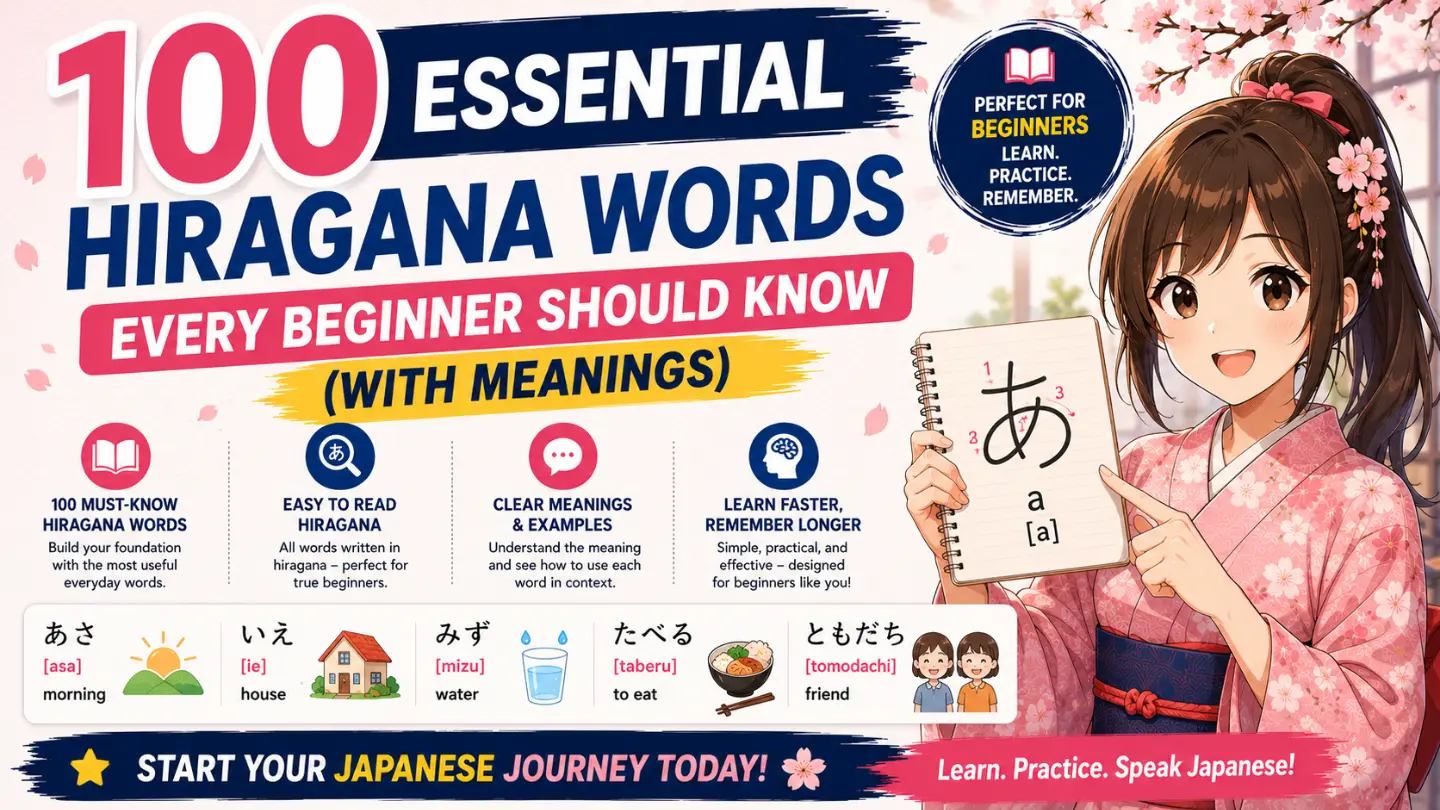

When I first started teaching Japanese, one thing became clear very quickly: students don’t fall in love with hiragana because they memorized the chart. They fall in love with it the moment they realize they can actually read something — a word, a sign, a snack wrapper, a line in a manga.
That’s why I put together this list of 100 essential hiragana words, grouped by theme so you can study in small, manageable chunks instead of one giant overwhelming pile. I’ve taught these exact words to beginners for years, and they form the backbone of almost every early conversation you’ll have in Japanese.
Grab a notebook, say each word out loud as you go (seriously — don’t skip this part), and let’s get started.
How to Use This List
Before we dive in, a quick tip from my own lessons: don’t try to memorize all 100 words in one sitting. Pick one category a day. Read the words, cover the meanings, quiz yourself, then move on. By the time you loop back around, you’ll be surprised how much has already stuck.
Alright — let’s get into it.
1. Greetings & Basic Phrases
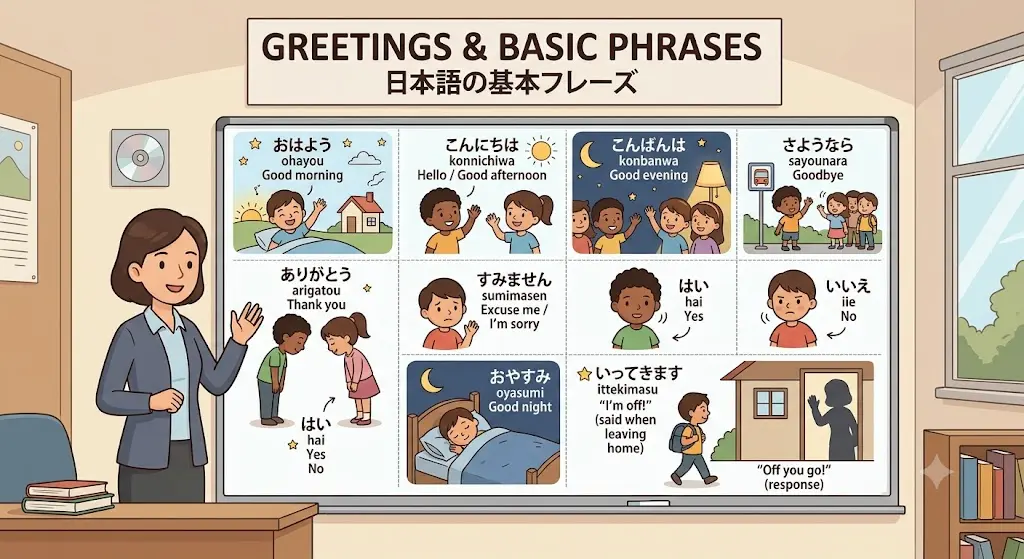
| Hiragana | Romaji | Meaning |
|---|---|---|
| おはよう | ohayou | Good morning |
| こんにちは | konnichiwa | Hello / Good afternoon |
| こんばんは | konbanwa | Good evening |
| さようなら | sayounara | Goodbye |
| ありがとう | arigatou | Thank you |
| すみません | sumimasen | Excuse me / I’m sorry |
| はい | hai | Yes |
| いいえ | iie | No |
| おやすみ | oyasumi | Good night |
| いってきます | ittekimasu | “I’m off!” (said when leaving home) |
Fumito’s tip: These ten alone will get you through your first real-life interaction in Japan. Practice saying おはよう and ありがとう until they feel automatic — they come up constantly.
2. Family Words
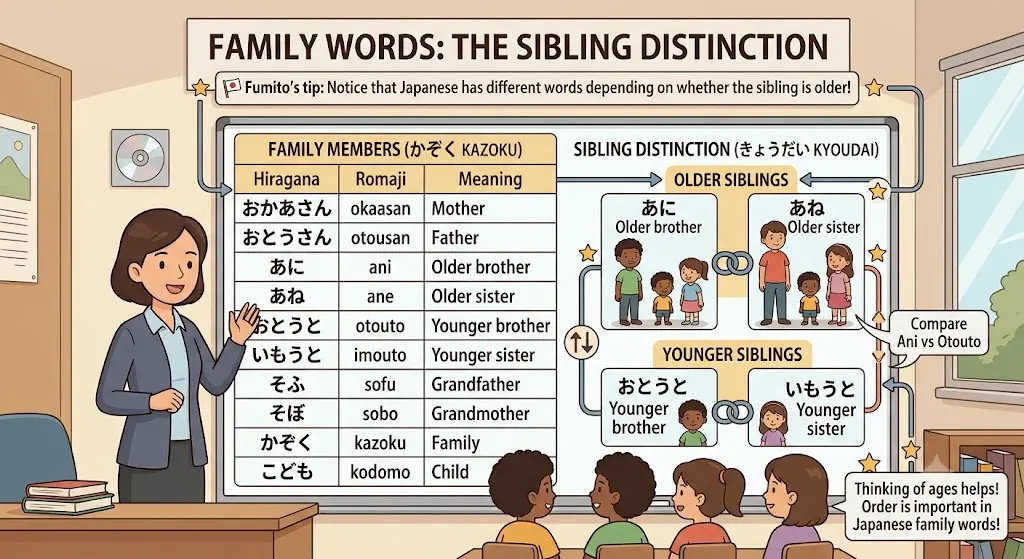
| Hiragana | Romaji | Meaning |
|---|---|---|
| おかあさん | okaasan | Mother |
| おとうさん | otousan | Father |
| あに | ani | Older brother |
| あね | ane | Older sister |
| おとうと | otouto | Younger brother |
| いもうと | imouto | Younger sister |
| そふ | sofu | Grandfather |
| そぼ | sobo | Grandmother |
| かぞく | kazoku | Family |
| こども | kodomo | Child |
Fumito’s tip: Notice that Japanese has different words depending on whether the sibling is older or younger — there’s no single word just for “brother” or “sister.” This trips up a lot of my students at first, so don’t worry if it feels unfamiliar.
3. Numbers 1–10
| Hiragana | Romaji | Meaning |
|---|---|---|
| いち | ichi | One |
| に | ni | Two |
| さん | san | Three |
| よん | yon | Four |
| ご | go | Five |
| ろく | roku | Six |
| なな | nana | Seven |
| はち | hachi | Eight |
| きゅう | kyuu | Nine |
| じゅう | juu | Ten |
Fumito’s tip: Some numbers have alternate readings (4 can be し shi, 7 can be しち shichi), but よん and なな are the safer, more commonly used versions in daily conversation. Start with these.
4. Time & Days
| Hiragana | Romaji | Meaning |
|---|---|---|
| きょう | kyou | Today |
| あした | ashita | Tomorrow |
| きのう | kinou | Yesterday |
| いま | ima | Now |
| あさ | asa | Morning |
| ひる | hiru | Noon / Daytime |
| よる | yoru | Night |
| まいにち | mainichi | Every day |
| しゅうまつ | shuumatsu | Weekend |
| じかん | jikan | Time |
5. Food & Drink
| Hiragana | Romaji | Meaning |
|---|---|---|
| ごはん | gohan | Rice / Meal |
| みず | mizu | Water |
| おちゃ | ocha | Tea |
| さかな | sakana | Fish |
| にく | niku | Meat |
| やさい | yasai | Vegetable |
| くだもの | kudamono | Fruit |
| たまご | tamago | Egg |
| おかし | okashi | Sweets / Snack |
| みそしる | misoshiru | Miso soup |
Fumito’s tip: ごはん is a great example of how one word can carry two meanings — literally “cooked rice,” but also used to mean “meal” in general. Context does a lot of heavy lifting in Japanese, so get comfortable with it early.
6. Nature & Weather
| Hiragana | Romaji | Meaning |
|---|---|---|
| そら | sora | Sky |
| うみ | umi | Sea |
| やま | yama | Mountain |
| かわ | kawa | River |
| き | ki | Tree |
| はな | hana | Flower |
| あめ | ame | Rain |
| ゆき | yuki | Snow |
| かぜ | kaze | Wind |
| たいよう | taiyou | Sun |
7. Body Parts
| Hiragana | Romaji | Meaning |
|---|---|---|
| あたま | atama | Head |
| かお | kao | Face |
| め | me | Eye |
| みみ | mimi | Ear |
| はな | hana | Nose |
| くち | kuchi | Mouth |
| て | te | Hand |
| あし | ashi | Leg / Foot |
| おなか | onaka | Stomach |
| からだ | karada | Body |
Also Reading More:
- How to Learn Japanese Through Anime Without Feeling Overwhelmed
- When to Start Learning Kanji (and Why Sooner Is Better)
- How to Construct a Japanese Sentence
- How to learn Japanese FAST? Tips from a native speaker 🇯🇵📚✨🌎✈️
- What books to buy if you wanna learn japanese language 📚
Fumito’s tip: You’ll notice はな shows up twice in this article — once meaning “flower” and once meaning “nose.” Same hiragana, completely different meaning. This is exactly why context and pitch accent matter so much once you move past the beginner stage.
8. Common Verbs
| Hiragana | Romaji | Meaning |
|---|---|---|
| たべる | taberu | To eat |
| のむ | nomu | To drink |
| いく | iku | To go |
| くる | kuru | To come |
| みる | miru | To see / watch |
| きく | kiku | To listen / ask |
| はなす | hanasu | To speak |
| よむ | yomu | To read |
| かく | kaku | To write |
| ねる | neru | To sleep |
9. Common Adjectives
| Hiragana | Romaji | Meaning |
|---|---|---|
| おおきい | ookii | Big |
| ちいさい | chiisai | Small |
| あたらしい | atarashii | New |
| ふるい | furui | Old |
| たかい | takai | Expensive / Tall |
| やすい | yasui | Cheap |
| あつい | atsui | Hot |
| さむい | samui | Cold |
| おいしい | oishii | Delicious |
| たのしい | tanoshii | Fun |
10. Daily Life
| Hiragana | Romaji | Meaning |
|---|---|---|
| いえ | ie | House |
| がっこう | gakkou | School |
| しごと | shigoto | Work / Job |
| ともだち | tomodachi | Friend |
| でんわ | denwa | Telephone |
| くるま | kuruma | Car |
| ほん | hon | Book |
| かばん | kaban | Bag |
| まど | mado | Window |
| とけい | tokei | Clock / Watch |
A Few Final Thoughts From Me
If there’s one thing I want you to take away from this list, it’s this: don’t just read these words — use them. Say them out loud, write them by hand, drop them into a sentence, even if the sentence is clumsy. Hiragana becomes second nature through repetition, not through staring at a chart.
I always tell my students the same thing: you don’t need to know a thousand words to start having real conversations in Japanese. You need to know the right hundred, and know them well. Consider this list your starting hundred.
頑張って (ganbatte) — you’ve got this.
— Fumito Emi