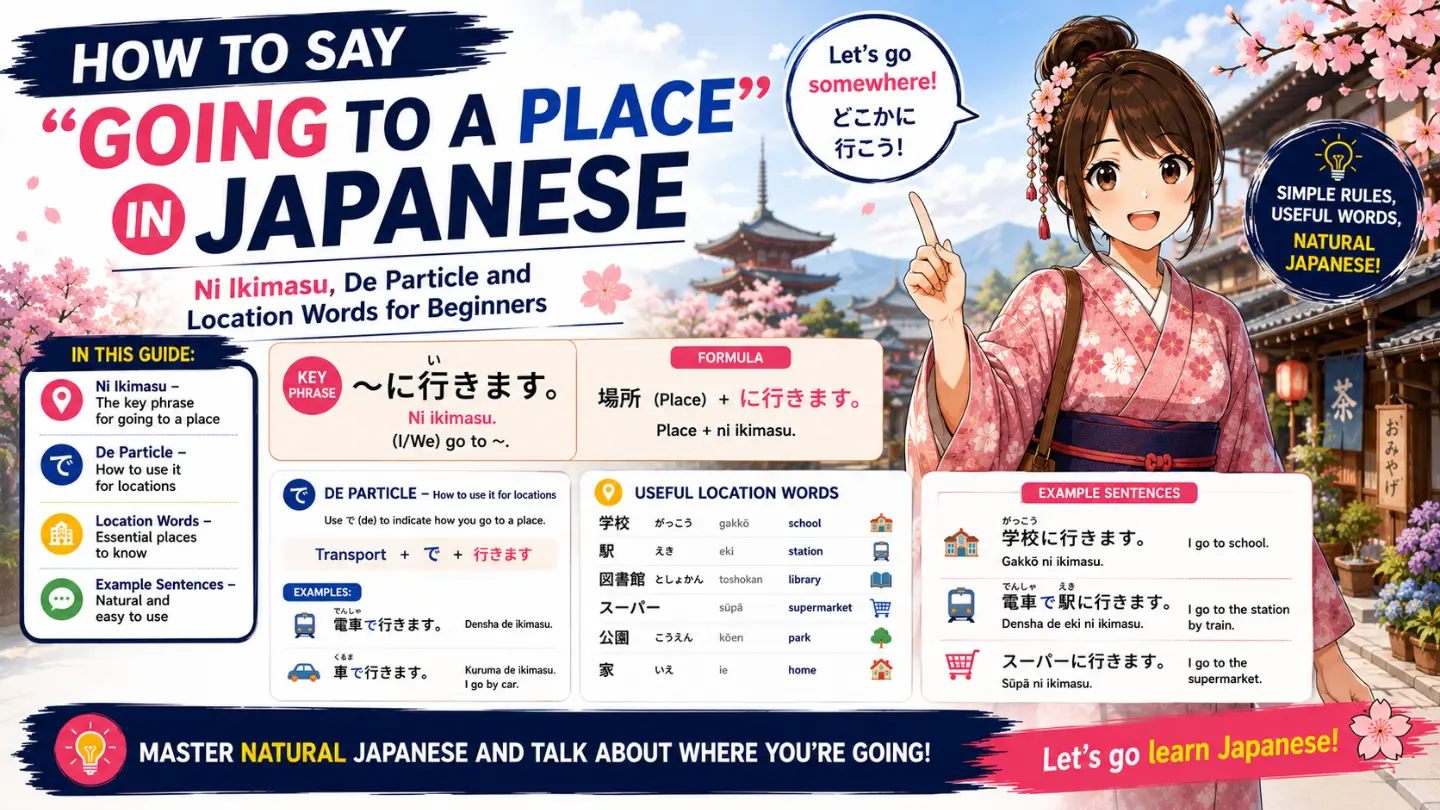
How to Say “Going to a Place” in Japanese – Ni Ikimasu, De Particle and Location Words for Beginners

One of the most fundamental things you need to talk about in any language is where you are, where you’re going, and where something is happening. In this lesson we cover exactly that — Lesson 4, Dialogue 2, where the project team is deciding where to hold their meeting and Michael is figuring out how to get there.
From this dialogue we get three grammar points that are absolutely essential for everyday Japanese: the destination particle ni (for where you’re going), the location particle de (for where an action takes place), and a set of location words — here, there, over there, and where — that are the third set in the ko-so-a-do system you’ve been building throughout this course.
If you haven’t covered the ko-so-a-do system yet, you can find the first two sets in the kore/sore/are lesson and the kono/sono/ano lesson. And if you want to review the mashou form from Dialogue 1 of this lesson, the mashou post covers everything before this one.
📌 What you’ll learn: The destination particle ni with movement verbs (ikimasu, kimasu, kaerimasu), the action-location particle de, location words koko / soko / asoko / doko, how to express the purpose of going somewhere, and key vocabulary for places, transport, and meetings in Japanese.
Dialogue 2 – The Meeting Location
The project team needs to hold a meeting, but there’s a problem — the usual conference room is full. Michael has to figure out where to go and how to get there. Short dialogue, huge amount of practical vocabulary and grammar packed in.
Tanaka: 会議室、使えますか。
Kaigishitsu, tsukaemasu ka. — Can we use the conference room?
Michael: 今日はちょっと…田中さんの部屋でしましょうか。
Kyou wa chotto… Tanaka-san no heya de shimashou ka. — Today it’s a bit… Shall we do it in Ms. Tanaka’s office?
Tanaka: じゃ、後で田中さんの部屋に来てください。
Ja, ato de Tanaka-san no heya ni kite kudasai. — Well then, please come to Ms. Tanaka’s office later.
Michael: あのう、どこですか。
Anou, doko desu ka. — Um… where is it?
Tanaka: あそこです。エレベーターのそばです。
Asoko desu. Erebeetaa no soba desu. — It’s over there. Next to the elevator.
Michael: わかりました。後で行きます。
Wakarimashita. Ato de ikimasu. — Got it. I’ll go later.
Vocabulary from the Dialogue
| Romaji | Japanese | Kanji | Meaning |
|---|---|---|---|
| kaigishitsu | かいぎしつ | 会議室 | conference room |
| tsukaemasu | つかえます | 使えます | can use (potential form of tsukaimasu) |
| heya | へや | 部屋 | room / office |
| de | で | — | location particle — where action takes place |
| ato de | あとで | 後で | later / afterwards |
| ni | に | — | destination particle — where you’re going to |
| kite kudasai | きてください | 来てください | please come |
| doko | どこ | — | where? |
| asoko | あそこ | — | over there (away from both) |
| erebeetaa | エレベーター | — | elevator |
| soba | そば | — | near / next to / beside |
Additional Vocabulary – Places, Transport and Location
| Romaji | Japanese | Kanji | Meaning |
|---|---|---|---|
| koko | ここ | — | here (near speaker) |
| soko | そこ | — | there (near listener) |
| resutoran | レストラン | — | restaurant |
| kissaten | きっさてん | 喫茶店 | café / coffee shop |
| depato | デパート | — | department store |
| suupaa | スーパー | — | supermarket |
| ginkou | ぎんこう | 銀行 | bank |
| byouin | びょういん | 病院 | hospital / clinic |
| toshokan | としょかん | 図書館 | library |
| eki | えき | 駅 | station |
| kuruma | くるま | 車 | car |
| basu | バス | — | bus |
| chikatetsu | ちかてつ | 地下鉄 | subway / underground |
| densha | でんしゃ | 電車 | train |
| jitensha | じてんしゃ | 自転車 | bicycle |
| aruite | あるいて | 歩いて | on foot / by walking |
4-2-1 The Ko-So-A-Do Location Words – Koko, Soko, Asoko, Doko
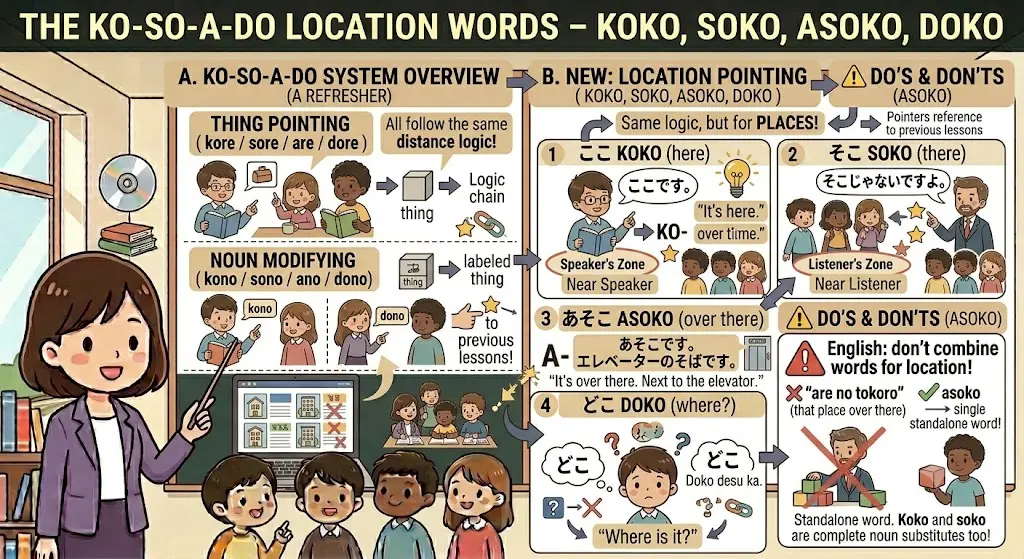
You already know two sets of the ko-so-a-do system:
- Set 1: kore / sore / are / dore — for pointing at things (this one / that one / that one over there / which one?)
- Set 2: kono / sono / ano / dono — for modifying nouns (this X / that X / that X over there / which X?)
Now we add the third set — for pointing at places and locations:
ここkokohere (near speaker)
そこsokothere (near listener)
あそこasokoover there (away from both)
どこdokowhere?
The same ko-so-a-do distance logic applies — ko- is near the speaker, so- is near the listener, a- is away from both of them. Just like all the other ko-so-a-do sets.
ここです。 Koko desu. — It’s here.
そこじゃないですよ。 Soko ja nai desu yo. — It’s not there.
あそこです。エレベーターのそばです。 Asoko desu. Erebeetaa no soba desu. — It’s over there. Next to the elevator.
どこですか。 Doko desu ka. — Where is it?
⚠️ Asoko, not “are no tokoro”: English speakers sometimes try to say “that place over there” by combining words. In Japanese, asoko (あそこ) is a single standalone word that means “that place over there” — you don’t need to construct it. Similarly, koko means “this place” (here) and soko means “that place near you” (there). They work as complete noun substitutes for locations.
Location Words with No — Building Longer Phrases
The location words koko/soko/asoko/doko can combine with no to modify a noun:
ここのレストランはどうですか。
Koko no resutoran wa dou desu ka.
— How about the restaurant here?
そこの銀行はどこですか。
Soko no ginkou wa doko desu ka.
— Where is the bank over there?
どこのカフェですか。
Doko no kafe desu ka.
— Which café are you talking about? / From where?
4-2-2 The Destination Particle Ni – Where You’re Going
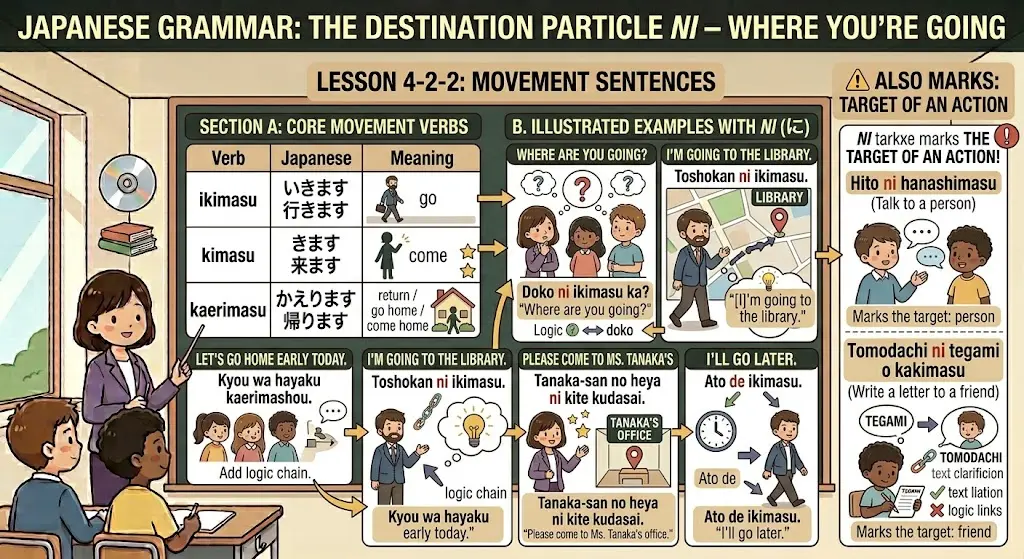
When you’re talking about moving from one place to another — going, coming, returning — Japanese uses the particle ni (に) to mark the destination. This is the “to” of Japanese movement sentences.
The movement verbs that take ni as a destination particle are:
| Verb | Japanese | Meaning |
|---|---|---|
| ikimasu | いきます / 行きます | go |
| kimasu | きます / 来ます | come |
| kaerimasu | かえります / 帰ります | return / go home / come home |
田中さんの部屋に来てください。
Tanaka-san no heya ni kite kudasai.
— Please come to Ms. Tanaka’s office.
後で行きます。
Ato de ikimasu.
— I’ll go later.
今日は早く帰りましょう。
Kyou wa hayaku kaerimashou.
— Let’s go home early today.
どこに行きますか。
Doko ni ikimasu ka.
— Where are you going?
図書館に行きます。
Toshokan ni ikimasu.
— I’m going to the library.
🎌 Ni also marks the target of an action — not just physical destinations: You’ve already seen ni used in some other contexts (like kite ni narimashita). The destination function is the most common one for beginners. But keep in mind that ni in Japanese broadly marks a target or goal — which is why it works for going to a place, but also for giving something to someone, attaching something to something else, and more. The destination use is the foundation — the others build on the same core idea.
4-2-3 The Location Particle De – Where the Action Happens
While ni marks where you’re going to, the particle de (で) marks where an action is performed — the location where something takes place. This is the “at” or “in” of Japanese action sentences.
に ni — destination (going TO)
Marks where you are heading. Used with movement verbs — ikimasu, kimasu, kaerimasu.
会議室に行きます。
Kaigishitsu ni ikimasu.
I’m going TO the conference room.
で de — location (action AT)
Marks where an action takes place. Used with action verbs — shimasu, tabemasu, nomimasu, etc.
会議室で会議をします。
Kaigishitsu de kaigi o shimasu.
I hold the meeting AT the conference room.
More examples of de in context:
田中さんの部屋でしましょうか。
Tanaka-san no heya de shimashou ka.
— Shall we do it IN Ms. Tanaka’s office?
レストランで食べましょう。
Resutoran de tabemashou.
— Let’s eat AT the restaurant.
図書館で勉強します。
Toshokan de benkyou-shimasu.
— I study AT the library.
喫茶店でコーヒーを飲みました。
Kissaten de koohii o nomimashita.
— I drank coffee AT the café.
⚠️ De is also used for transport — the vehicle you use: As well as marking where an action takes place, de also marks the means or method used — including the transport you take to get somewhere. Densha de ikimasu = I’ll go BY train. Jitensha de kimashita = I came BY bicycle. Aruite ikimasu = I’ll go ON FOOT (walking is the one exception — aruite, not ashi de). This “means/method” use of de is directly related to the “location of action” use — both mark the context in which an action takes place.
The Three Key Particles Together – Wo, Ni, De
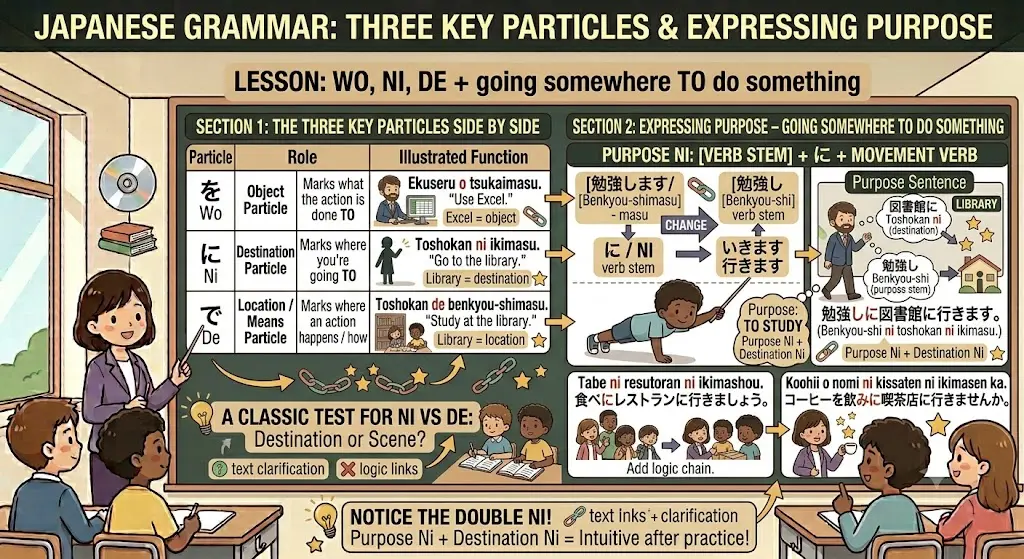
You’ve now accumulated three major case particles. Here’s a summary of all three side by side to make it easier to see the logic:
を Wo
Object particle
Marks what the action is done TO
エクセルを使います。
Use Excel.
に Ni
Destination particle
Marks where you’re going TO
図書館に行きます。
Go to the library.
で De
Location / means particle
Marks where an action happens / how
図書館で勉強します。
Study at the library.
🔑 A classic test for ni vs de: Ask yourself — is the place the destination (am I going TO it?) or the scene of the action (is the action happening THERE)? “I’m going to the library” — library is the destination → ni. “I’m studying at the library” — library is where the studying happens → de. Once this distinction clicks, the two particles become much more intuitive. Its one of the most important particle contrasts in all of Japanese grammar.
Expressing Purpose – Going Somewhere TO Do Something
When you go somewhere to do something — going to the library to study, going to the restaurant to eat — Japanese has a specific way to express that purpose. The structure uses the verb stem (the masu form minus the -masu) + ni + movement verb.
勉強しに図書館に行きます。
Benkyou-shi ni toshokan ni ikimasu.
— I’m going to the library TO STUDY.
食べにレストランに行きましょう。
Tabe ni resutoran ni ikimasu.
— Let’s go to the restaurant TO EAT.
コーヒーを飲みに喫茶店に行きませんか。
Koohii o nomi ni kissaten ni ikimasen ka.
— Shall we go to the café TO DRINK coffee?
💡 Notice the double ni: In purpose sentences you often get two ni particles in one sentence — the first marks the purpose (“to study”), the second marks the destination (“to the library”). Benkyou-shi ni toshokan ni ikimasu — purpose ni + destination ni. At first this looks strange, but it quickly becomes natural once you’ve practiced it a few times.
Useful Location Expressions – Soba, Tonari, Mae, Ushiro
These location words describe where something is in relation to something else. They are typically combined with no to form noun phrases:
| Word | Japanese | Kanji | Meaning | Example |
|---|---|---|---|---|
| soba | そば | — | near / beside / next to | エレベーターのそば |
| tonari | となり | 隣 | next to / adjoining (directly adjacent) | 銀行のとなり |
| mae | まえ | 前 | in front of / before | 駅のまえ |
| ushiro | うしろ | 後ろ | behind / at the back | 学校のうしろ |
| naka | なか | 中 | inside / in | 鞄のなか |
| ue | うえ | 上 | on top of / above | 机のうえ |
| shita | した | 下 | below / under | 机のした |
| hidari | ひだり | 左 | left | エレベーターのひだり |
| migi | みぎ | 右 | right | 駅のみぎ |
あそこです。エレベーターのそばです。
Asoko desu. Erebeetaa no soba desu.
— It’s over there. Next to the elevator.
銀行は駅のとなりです。
Ginkou wa eki no tonari desu.
— The bank is next to the station.
喫茶店のまえに来てください。
Kissaten no mae ni kite kudasai.
— Please come in front of the café.
Drill A – Destination Ni with Movement Verbs
Someone asks where you’re going. Respond using X ni ikimasu.
MODEL EXCHANGES
Cue: Doko ni ikimasu ka. — Where are you going?
どこに行きますか。
Response: Toshokan ni ikimasu. — I’m going to the library.
図書館に行きます。
Cue: Doko ni kaerimasu ka. — Where are you returning to?
どこに帰りますか。
Response: Ie ni kaerimasu. — I’m going home.
家に帰ります。
Practice with: eki / kaigishitsu / gakkou / ginkou / byouin / Tanaka-san no heya
Drill B – Location De with Action Verbs
Someone asks where you’ll do something. Answer with X de [verb].
MODEL EXCHANGES
Cue: Doko de tabemasu ka. — Where will you eat?
どこで食べますか。
Response: Resutoran de tabemasu. — I’ll eat at the restaurant.
レストランで食べます。
Cue: Doko de kaigi o shimasu ka. — Where will you hold the meeting?
どこで会議をしますか。
Response: Kaigishitsu de shimasu. — I’ll do it in the conference room.
会議室でします。
Practice with: toshokan de benkyou-shimasu / kissaten de koohii o nomimasu / kaisha de renshuu-shimasu
Drill C – Transport De – How You’re Getting There
Someone asks how you’ll get somewhere. Answer using transport + de.
MODEL EXCHANGES
Cue: Dou yatte ikimasu ka. — How will you get there?
どうやって行きますか。
Response: Densha de ikimasu. — I’ll go by train.
電車で行きます。
Cue: Basu de kimashita ka. — Did you come by bus?
バスで来ましたか。
Response: Iie, aruite kimashita. — No, I came on foot.
いいえ、歩いて来ました。
Practice with: chikatetsu / jitensha / kuruma / basu
Drill D – Say It in Japanese
The project team is organising an off-site meeting. Try each one yourself before checking.
- Where shall we hold the meeting?
→ Doko de kaigi o shimashou ka. どこで会議をしましょうか。 - Let’s do it at that restaurant over there.
→ Asoko no resutoran de shimashou. あそこのレストランでしましょう。 - Where is the restaurant?
→ Resutoran wa doko desu ka. レストランはどこですか。 - It’s in front of the station, next to the bank.
→ Eki no mae desu. Ginkou no soba desu. 駅の前です。銀行のそばです。 - How shall we get there? Shall we go by train?
→ Dou yatte ikimashou ka. Densha de ikimasen ka. どうやって行きましょうか。電車で行きませんか。 - No, let’s go by bicycle. It’s not far.
→ Iie, jitensha de ikimashou. Tooku nai desu. いいえ、自転車で行きましょう。遠くないです。 - I’ll go to the library to study after this.
→ Kono ato, benkyou-shi ni toshokan ni ikimasu. この後、勉強しに図書館に行きます。 - Please come to the conference room at three o’clock.
→ San-ji ni kaigishitsu ni kite kudasai. 三時に会議室に来てください。
📚 Related lessons on reading-japanese.com:
Drill E – Act in Japanese (Role Play)
- Ms. Honda is heading out. Ask where she’s going.
→ Doko ni ikimasu ka. どこに行きますか。 - You’re looking for the elevator. Ask Ms. Honda where it is.
→ Anou, erebeetaa wa doko desu ka. あのう、エレベーターはどこですか。 - Ms. Honda invites you to a café. Accept and ask which one.
→ Ee, ikimashou. Doko no kissaten desu ka. ええ、行きましょう。どこの喫茶店ですか。 - Suggest holding the meeting at the café near the station instead of the conference room.
→ Kaigishitsu ja nakute, eki no soba no kissaten de shimashou ka. 会議室じゃなくて、駅のそばの喫茶店でしましょうか。 - Find out how Ms. Honda usually gets to the office.
→ Itsumo dou yatte kaisha ni kimasu ka. いつもどうやって会社に来ますか。 - Tell Ms. Honda you’ll go to the bank and come back later.
→ Ginkou ni itte, ato de kaerimasu. 銀行に行って、後で帰ります。 - Your coworker looks lost. Ask if he’s looking for the conference room and point him in the right direction.
→ Kaigishitsu desu ka. Asoko desu yo. Erebeetaa no tonari desu. 会議室ですか。あそこですよ。エレベーターのとなりです。
💡 On Drill E item 7 — giving directions: Notice how you can give a full two-part direction in Japanese very efficiently — asoko desu yo (it’s over there) + erebeetaa no tonari desu (next to the elevator). No complicated grammar needed — just two noun sentences with location words. This is exactly how Japanese people give casual directions in everyday situations.
FAQ – Ni Ikimasu, De Particle and Japanese Location Words
What is the particle “ni” used for in Japanese?
In this lesson, ni (に) marks the destination of a movement — where you are going TO. It’s used with movement verbs like ikimasu (go), kimasu (come), and kaerimasu (return / go home). For example: toshokan ni ikimasu = I’m going to the library. Kaigishitsu ni kite kudasai = please come to the conference room. In broader Japanese grammar, ni marks any target or goal — not just physical destinations — but for beginners, the destination use is the most important one to master first.
What is the difference between ni and de in Japanese?
Ni (に) marks destination — where you’re going TO. De (で) marks the location where an action takes place — where something happens AT. So toshokan ni ikimasu = “I’m going to the library” (destination), while toshokan de benkyou-shimasu = “I study at the library” (location of action). The quick test: if you’re moving TOWARD it → ni. If an action is taking place THERE → de. De also marks the means of transport — densha de ikimasu = go by train.
What do koko, soko, asoko and doko mean in Japanese?
These are location words from the ko-so-a-do system. Koko (ここ) = here (near the speaker). Soko (そこ) = there (near the listener). Asoko (あそこ) = over there (away from both). Doko (どこ) = where? They follow the same distance logic as the other ko-so-a-do sets (kore/sore/are/dore for things, kono/sono/ano/dono for noun modifiers). They can also combine with no to modify nouns — koko no resutoran = the restaurant here.
How do you say “how do you get there” in Japanese?
“How do you get there?” in Japanese is dou yatte ikimasu ka (どうやって行きますか). To answer, use transport + de + ikimasu: densha de ikimasu (go by train), basu de ikimasu (go by bus), chikatetsu de ikimasu (go by subway), jitensha de ikimasu (go by bicycle), kuruma de ikimasu (go by car). For walking, the form is aruite ikimasu (go on foot) — aruite is used instead of ashi de.
How do you say “where are you going” in Japanese?
“Where are you going?” in Japanese is doko ni ikimasu ka (どこに行きますか). The question word doko (where) combines with the destination particle ni and the verb ikimasu (go). Similarly, “where are you coming from?” isn’t common as a direct question in Japanese — but “where are you going?” and “where did you go?” (doko ni ikimashita ka) are used constantly in everyday conversation.
How do you say “next to” and “in front of” in Japanese?
“Next to” (close beside) in Japanese is soba (そば) — erebeetaa no soba = next to the elevator. “Directly adjacent” is tonari (となり) — ginkou no tonari = next door to the bank. “In front of” is mae (まえ) — eki no mae = in front of the station. “Behind” is ushiro (うしろ) — gakkou no ushiro = behind the school. All of these follow the pattern: place/thing + no + location word.
What is “ato de” in Japanese?
Ato de (後で) means “later” or “afterwards” in Japanese. It’s a time expression used at the beginning of a sentence or before the verb: ato de ikimasu = I’ll go later. Ato de Tanaka-san no heya ni kite kudasai = please come to Ms. Tanaka’s office later. Its very commonly used in workplace situations to defer or schedule actions — “I’ll handle that later,” “please come later,” etc.
How do you express purpose in Japanese (going somewhere to do something)?
To express “going somewhere to do something” in Japanese, use the verb stem + ni + movement verb structure. The verb stem is the masu form minus the masu. For example: tabe (from tabemasu) + ni + ikimasu = go to eat. Benkyou-shi ni toshokan ni ikimasu = I go to the library to study. Koohii o nomi ni kissaten ni ikimasu = I go to the café to drink coffee. You’ll often see two ni particles in the same sentence — one for purpose, one for destination.
What’s Next?
You’ve now completed both dialogues from Lesson 4 and added some really substantial grammar to your Japanese toolkit. Between the mashou form, the object particle wo, the particle kara, and now the destination particle ni, the location particle de, and the full set of location words — you can now talk about where you are, where you’re going, how you’re getting there, and where things are happening.
These are exactly the kinds of things you need for navigating Japan, organising meetings, making plans with friends, and getting around in Japanese daily life.
Browse the full series at reading-japanese.com, or review any of the previous lessons linked below.
頑張ってください!(Ganbatte kudasai!) — Keep going! 🎌
— Fumito フミト | reading-japanese.com