Skip to content
-
Subscribe to our newsletter & never miss our best posts. Subscribe Now!
Reading Japanese with Fumito フミト Logo Reading Japanese with Fumito フミト

Read Japanese Like Your Favorite Anime Hero – With Fumito フミト!

Reading Japanese with Fumito フミト Logo Reading Japanese with Fumito フミト

Read Japanese Like Your Favorite Anime Hero – With Fumito フミト!

  • Home
  • About Me
  • Contact Fumito フミト
  • Blog
  • Privacy Policy
  • Terms and Conditions
  • Disclaimer 
  • Resources
  • Start Reading
    • Hiragana Guide
    • Katakana Guide
    • Vocabulary
    • JLPT N5 Reading
  • Home
  • About Me
  • Contact Fumito フミト
  • Blog
  • Privacy Policy
  • Terms and Conditions
  • Disclaimer 
  • Resources
  • Start Reading
    • Hiragana Guide
    • Katakana Guide
    • Vocabulary
    • JLPT N5 Reading
Close

Search

  • https://www.facebook.com/
  • https://twitter.com/
  • https://t.me/
  • https://www.instagram.com/
  • https://youtube.com/
Subscribe
how to say i got your back in japanese
How to Say

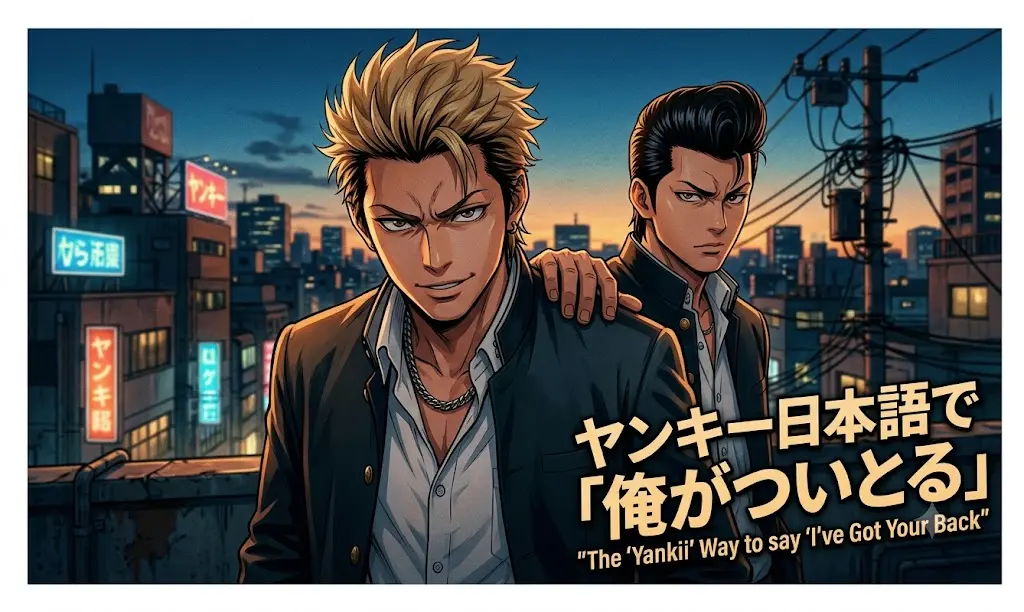
How to say “ I’ve got your back “in yankii Japanese!?

By Fumito Emi
June 29, 2026 2 Min Read
0

Yo! What’s up, language learners? It’s Fumito. 😎

If you’ve ever watched a classic anime or a live-action drama featuring yankii (ヤンキー — Japanese delinquents with golden hearts and questionable hair choices), you know they have a unique way of speaking. It’s rough, it’s intense, but when it comes to loyalty, nobody says it better.

Today, we’re looking at a crucial phrase for any ride-or-die friendship: “I’ve got your back.”

If you want to sound less like a textbook and more like a fierce ally ready to jump into a brawl (or just help your friend through a tough exam), here is how you say it in yankii Japanese.

1. 俺がついてる (Ore ga tsuiteru)

  • The Meaning: “I’m right here with you” / “I’ve got you.”
  • The Vibe: Ultimate reassurance.

This is arguably the most natural way to tell someone they aren’t alone. By using 俺 (ore)—the highly masculine, informal pronoun for “I”—and pairing it with ついてる (tsuiteru), which implies being attached or accompanying someone, you are essentially saying, “I’m sticking by you, no matter what.”

Yankii Twist: Drop the particles and say it with a slightly dropped jaw for maximum impact: “Ore ga tsuiteru.”

2. 任せとけ (Makasetoke)

  • The Meaning: “Leave it to me!”
  • The Vibe: Complete confidence.

The standard form is makasete kudasai (Please leave it to me) or makasete. But a true yankii commands the situation. They command the verb by shifting it to the imperative 任せとけ (makasetoke).

When your buddy is stressed or overwhelmed, slap them on the back and say this. It instantly signals that you’re taking care of the problem.

3. 後ろは任せろ (Ushiro wa makasero)

  • The Meaning: “Leave your back to me.”
  • The Vibe: Straight out of an action movie.

If you want a literal “I’ve got your back” that screams combat-ready brotherhood, this is the one. 後ろ (ushiro) means back or behind. 任せろ (makasero) is another heavy, commanding way to say “leave it to me.”

You’ll hear this right before a major anime showdown when two rivals-turned-friends team up.

How to Say It Like a Pro (The Accent)

To make these phrases sound genuinely yankii, you can’t just say the words; you have to deliver them with the right flavor:

  • Roll your R’s: If a word has an “r” sound (like makasero), give it a slight trill (maka-serrrro).
  • Lower your voice: Speak a little lower in your throat than you usually would in polite Japanese.
  • Keep your expression tough: A straight face or a confident smirk sells the phrase.

Also Read More:

  • How to Learn Japanese Through Anime Without Feeling Overwhelmed 
  • When to Start Learning Kanji (and Why Sooner Is Better)
  • How to Construct a Japanese Sentence
  • How to learn Japanese FAST? Tips from a native speaker 🇯🇵📚✨🌎✈️
  • What books to buy if you wanna learn japanese language 📚

A Quick Word of Caution ⚠️

While these phrases are amazing for showing loyalty and practicing your casual slang, keep them among close friends! Dropping a “makasetoke!” on your Japanese boss or professor might get you some very confused (or terrified) looks.

Which phrase is your favorite? Let me know in the comments below, and go tell a friend “Ore ga tsuiteru” today!

Until next time, keep reading and keep rockin’ your Japanese! 👊

Author

Fumito Emi

Hi, I’m Fumito フミト Let me help you be confident in Japanese☺️ 🇯🇵 Learn Japanese daily 📘 Free Kanji PDF ↓ 🎧 Free audiobook trial 🎓 Speak with native tutors 👇 Start here reading-japanese.com

Follow Me
Other Articles
Japanese From Zero! Book 1 Review (2026)
Previous

Japanese From Zero! Book 1 Review (2026): Is It Still the Best Way to Learn Japanese From Scratch?

Free Hiragana Stroke Order Practice Tool Online (Learn Japanese Writing)
Next

Free Hiragana Stroke Order Practice Tool Online (Learn Japanese Writing)

No Comment! Be the first one.

    Leave a Reply Cancel reply

    Your email address will not be published. Required fields are marked *

    Learning Japanese Workbook for Beginners: Hiragana Katakana And Kanji - Quick and Easy Way to Learn the Basic Japanese Up-to 300 Pages (EXPANDED EDITION)
    Fumito Emi
    Fumito Emi Image

    Hi, I’m Fumito フミト, your friendly guide to mastering Japanese through reading! I blend my passion for anime, daily life Japanese, and digital teaching to make language learning fun and effective for absolute beginners. Follow My social Media for daily updates.

    Book is bigger than expected but it's easy to follow and provides a good fundamental foundation. Good for beginners along with other reference materials.
    • Facebook
    • Instagram
    • TikTok
    • YouTube
    • Threads
    • X
    • Reddit
    • Pinterest

    Recent Posts

    • How to Learn Japanese Through Anime Without Feeling Overwhelmed 
    • When to Start Learning Kanji (and Why Sooner Is Better)
    • How to Construct a Japanese Sentence
    • How to learn Japanese FAST? Tips from a native speaker 🇯🇵📚✨🌎✈️
    • What books to buy if you wanna learn japanese language 📚

    Archives

    • October 2026
    • September 2026
    • August 2026
    • July 2026
    • June 2026
    • May 2026
    • April 2026

    Categories

    • Blog
    • Hiragana Guide
    • How to Say
    • JLPT N5 Reading
    • Katakana Guide
    • Resources
    • Start Reading
    • Vocabulary
    • About Me
    • Contact Fumito フミト
    • Disclaimer 
    • Privacy Policy
    • Terms and Conditions
    • The Best Japanese Sentence Builder 2026 By Fumito フミト
    Copyright 2026 — Reading Japanese with Fumito フミト. All rights reserved. Blogsy WordPress Theme