
If you’ve ever stared at a kanji and thought I have no idea what this means and I never will — this article is going to change everything.
The secret that most beginners miss isn’t vocabulary lists or grammar charts. It’s radicals.
214 Japanese Kanji Radicals (部首) with Meanings, Stroke Count & Examples
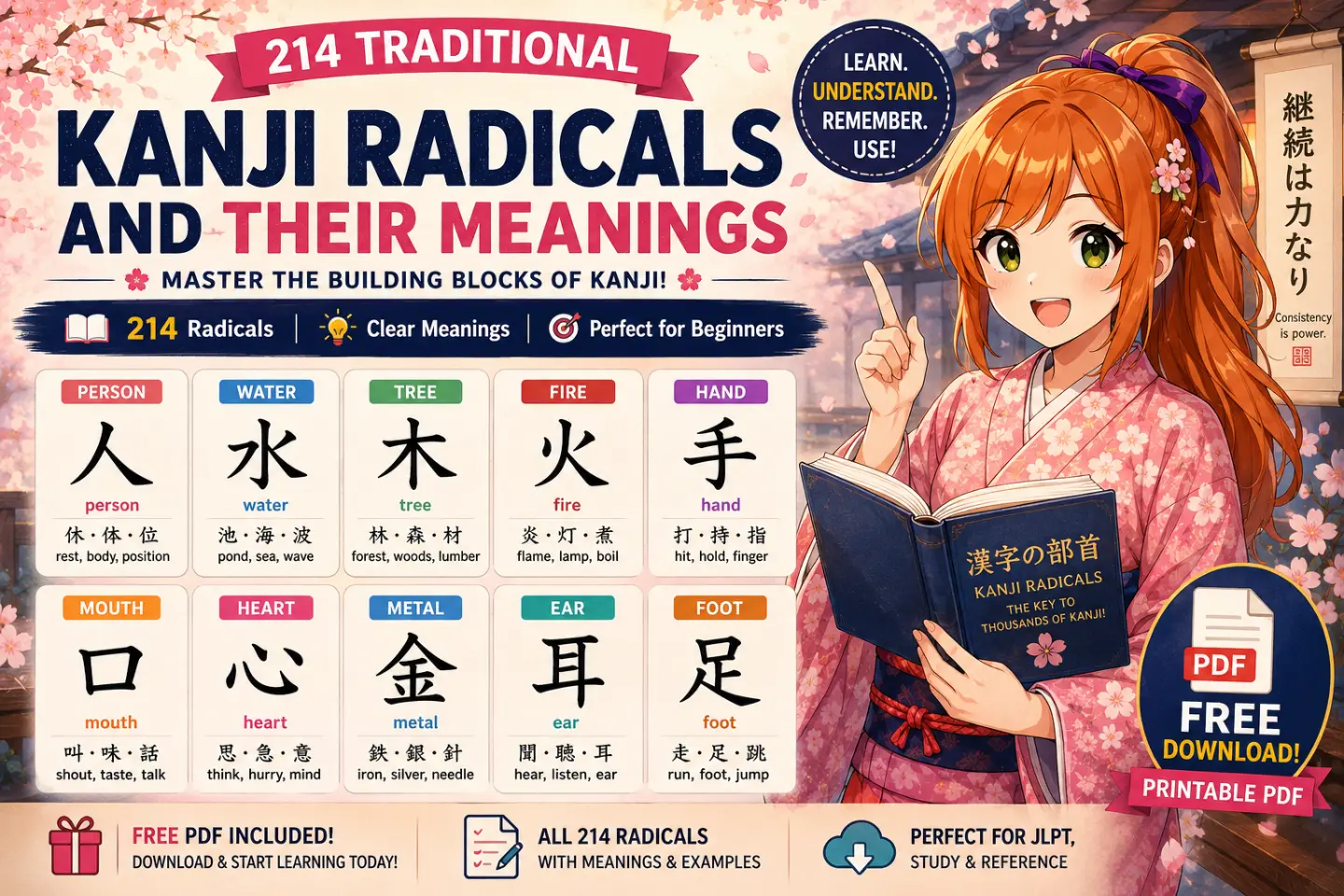
The 214 Japanese kanji radicals (部首, bushu) are the building blocks that almost every kanji is made from. Learn them and you’ll start to see inside characters — recognizing familiar pieces, guessing meanings, and memorizing new kanji at three to five times the speed.
In this guide, Japanese tutor Fumito Emi at reading-japanese.com breaks down all 214 Kangxi radicals with their meanings, stroke counts, and example kanji — you can use with Anki, as a printable reference, or as a study companion at your desk.
Before we dive in: if you haven’t yet learned hiragana and katakana, do that first. The hiragana chart and katakana chart on this site and will take about two weeks combined. Radicals become dramatically easier once you have the kana foundation.
What Are the 214 Kanji Radicals?

A radical (部首, bushu) is the key component used to classify and index a kanji in a dictionary.
Every single kanji — all 2,136 Joyo kanji, all 50,000+ characters in existence — belongs to one of these 214 groups. When you look up a kanji you don’t know in a traditional dictionary, you find it by identifying its radical, looking that radical up in the index, then counting the remaining strokes.
The 214 Kangxi radicals were established in China’s Kangxi Dictionary of 1716 (康熙字典, Kōki Jiten), one of the most comprehensive Chinese dictionaries ever compiled. Despite being over 300 years old, this classification system is still used in modern Japanese and Chinese dictionaries today.
In Japanese, radicals are called 部首 (bushu) — 部 means “section” and 首 means “head” or “beginning.” Together: the “section head” of a character grouping.
Why Learning Radicals Changes Everything
Let me be direct about this, because most Japanese study materials bury it.
Radicals are not optional. They are the difference between treating kanji as meaningless shapes to memorize and treating kanji as a logical, decodable system.
Here’s what changes when you know your radicals:
You Can Guess the Meaning of Unfamiliar Kanji
Look at these characters:
- 海 (sea)
- 河 (river)
- 泳 (swim)
- 汚 (dirty)
- 波 (wave)
- 湖 (lake)
What do they all share? The 水 (water) radical, which appears as 氵 on the left side. If you know that radical, you know every one of these characters has something to do with water — before you’ve ever studied them.
That’s not magic. That’s the system working exactly as intended.
You Memorize Kanji Three to Five Times Faster
Research in language acquisition consistently shows that information organized into meaningful chunks is retained far better than isolated facts. Radicals are the chunking mechanism for kanji.
When you learn 休 (rest), don’t memorize it as an abstract shape. Learn that it’s 人 (person) + 木 (tree) — a person leaning against a tree, resting. That image takes ten seconds to understand and doesn’t fade.
You Can Look Up Kanji Without a Reading
When you encounter a kanji you’ve never seen — in a menu, on a sign, in a manga — and you have no idea how to read it, radicals are how you find it. Identify the radical, count the strokes, check the index.
Before smartphone OCR existed, this was the only way. And it’s still faster than drawing in most situations.
Patterns Emerge Across Hundreds of Characters
Once you know that 心 (heart/mind) appears as 忄 in characters related to feelings and thought, you’ll notice it everywhere:
- 情 (emotion) — 忄 + more strokes
- 悲 (sad) — 忄+ more strokes
- 怒 (angry) — 忄 + more strokes
- 慢 (arrogant) — 忄 + more strokes
Knowing one radical gives you a hook for dozens of kanji simultaneously.
How the 214 Radicals Are Organized
The Kangxi system organizes radicals by stroke count — from 1 stroke to 17 strokes. Within each stroke group, radicals are numbered from 1 to 214.
Here’s the distribution by stroke count:
| Strokes | Count | Examples |
|---|---|---|
| 1 | 6 | 一、丨、丶、丿、乙、亅 |
| 2 | 23 | 人、刀、力、口、十、水 |
| 3 | 31 | 口、土、女、子、山、手 |
| 4 | 34 | 心、日、月、木、火、水 |
| 5 | 23 | 田、目、石、立、生、用 |
| 6 | 29 | 竹、米、糸、耳、肉、虫 |
| 7 | 20 | 見、角、言、走、足、車 |
| 8 | 9 | 金、門、雨、長、阜、隹 |
| 9 | 11 | 食、音、風、面、革、頁 |
| 10 | 8 | 馬、骨、高、鬼、鬥、魚 |
| 11 | 6 | 魚、鳥、鹿、麦、麻、鹵 |
| 12 | 4 | 黄、黍、黒、黹 |
| 13–17 | 10 | 鼎、鼓、鼠、鼻、龍、龜、龠 |
Complete List: All 214 Kangxi Radicals
1–2 Stroke Radicals (Radicals 1–30)
These are the most abstract radicals — basic strokes and shapes that appear inside more complex characters. Many of them don’t look like recognizable objects, but they’re essential because they appear constantly.
| # | Radical | Strokes | Meaning | Memory Hook |
|---|---|---|---|---|
| 1 | 一 | 1 | One / horizontal stroke | The simplest stroke — one horizontal line |
| 2 | 丨 | 1 | Vertical stroke | A single vertical line downward |
| 3 | 丶 | 1 | Dot | A single dot or droplet |
| 4 | 丿 | 1 | Diagonal sweep / slash | A left-sweeping stroke like a falling leaf |
| 5 | 乙 | 1 | The second; a bent stroke | Second Heavenly Stem — a curved line |
| 6 | 亅 | 1 | Hook | A vertical stroke ending in a hook |
| 7 | 二 | 2 | Two | Two horizontal lines stacked |
| 8 | 亠 | 2 | Lid, top cover | A dot and horizontal line — a roof |
| 9 | 人 | 2 | Person | A person walking in profile |
| 10 | 儿 | 2 | Human legs | The lower legs of a walking person |
| 11 | 入 | 2 | To enter | An arrow entering a space |
| 12 | 八 | 2 | Eight | Two strokes spreading apart — also means “to divide” |
| 13 | 冂 | 2 | To enclose / borders | An open frame surrounding space |
| 14 | 冖 | 2 | Cover, crown | A covering lid or cap |
| 15 | 冫 | 2 | Ice | Two ice crystals — frozen water |
| 16 | 几 | 2 | Table, small table | A low table |
| 17 | 凵 | 2 | Open container, box | An open-sided container |
| 18 | 刀 | 2 | Knife, sword | A blade shape |
| 19 | 刂 | 2 | Knife (side form) | Knife radical on the right side of a character |
| 20 | 力 | 2 | Power, strength | A flexed muscle |
| 21 | 勹 | 2 | To wrap | Something wrapping around — a person bending |
| 22 | 匕 | 2 | Spoon, ladle | A spoon; also means “to compare” |
| 23 | 匚 | 2 | Box, container | An open-sided box |
| 24 | 匸 | 2 | To conceal, hide | Something hidden behind a barrier |
| 25 | 十 | 2 | Ten | A cross shape — the Roman numeral ten |
| 26 | 卜 | 2 | Oracle, divination | A crack in oracle bone for fortune-telling |
| 27 | 卩 | 2 | Stamp, seal | A kneeling figure; also a seal |
| 28 | 厂 | 2 | Cliff, hillside | An overhanging cliff or shelter |
| 29 | 厶 | 2 | Private; Katakana Mu | Something personal, kept to oneself |
| 30 | 又 | 2 | Again; right hand | The right hand reaching |
3–4 Stroke Radicals (Radicals 31–99)
This is the richest group — it contains some of the most important radicals in all of Japanese. 心 (heart), 手 (hand), 日 (sun), 木 (tree), 水 (water), 火 (fire) are all here. Master these and you’ve unlocked the core of the kanji system.
| # | Radical | Strokes | Meaning | Memory Hook |
|---|---|---|---|---|
| 31 | 口 | 3 | Mouth | A square mouth opening |
| 32 | 囗 | 3 | Border, enclosure | A surrounding boundary wall |
| 33 | 土 | 3 | Earth, soil | Ground beneath our feet — cross on a line |
| 34 | 士 | 3 | Man, scholar, samurai | A learned man; warrior (compare with 土) |
| 35 | 夂 | 3 | To follow | Following steps behind |
| 36 | 夊 | 3 | To go slowly | Slow, dragging movement |
| 37 | 夕 | 3 | Evening, dusk | A crescent moon at dusk |
| 38 | 大 | 3 | Large, big | A person with arms spread wide |
| 39 | 女 | 3 | Woman | A woman in a graceful kneeling pose |
| 40 | 子 | 3 | Child, son | A baby with arms reaching out |
| 41 | 宀 | 3 | Roof, house | A peaked roof sheltering what’s below |
| 42 | 寸 | 3 | Inch (2.25 cm) | A measure from thumb to wrist |
| 43 | 小 | 3 | Small | Something tiny, three small dots |
| 44 | 尢 | 3 | Lame leg | A bent, uneven leg |
| 45 | 尸 | 3 | Corpse, awning | A lying body; also an overhang |
| 46 | 屮 | 3 | Sprout, seedling | A plant pushing up through the earth |
| 47 | 山 | 3 | Mountain | Three peaks rising from the earth |
| 48 | 巛 | 3 | Winding river | A meandering river course |
| 49 | 工 | 3 | Work, skill | A carpenter’s square — precision work |
| 50 | 己 | 3 | Self, oneself | The coiled self |
| 51 | 巾 | 3 | Cloth, towel | A cloth hanging from a rod |
| 52 | 干 | 3 | Dry, shield | Dryness; also an ancient shield |
| 53 | 幺 | 3 | Young, slight | Something small and thread-like |
| 54 | 广 | 3 | Slanting roof, shelter | A lean-to shelter against a wall |
| 55 | 廴 | 3 | To move, stretch | Movement extended along a path |
| 56 | 廾 | 3 | Folded hands | Two hands cupped together |
| 57 | 弋 | 3 | Javelin, dart | A dart attached to a cord |
| 58 | 弓 | 3 | Bow (archery) | An archer’s curved bow |
| 59 | 彐 | 3 | Pig’s head | The snout of a pig |
| 60 | 彡 | 3 | Hair, light rays | Flowing hair or radiating light |
| 61 | 彳 | 3 | Step, stride | Half of a crossroads — one step |
| 62 | 心 | 4 | Heart, mind, spirit | The emotional center — seen in 思, 悲, 愛 |
| 63 | 忄 | 4 | Heart (side form) | Heart radical on the left — 情, 怒, 慢 |
| 64 | 手 | 4 | Hand | An open hand with fingers — 持, 打, 拾 |
| 65 | 扌 | 4 | Hand (side form) | Hand radical on the left side |
| 66 | 支 | 4 | Branch, support | A branch off the trunk |
| 67 | 攴 | 4 | To strike, hit | A hand holding a stick to strike |
| 68 | 文 | 4 | Literature, letters | Writing and culture — 文化, 文字 |
| 69 | 斗 | 4 | Big Dipper; ladle | The Big Dipper constellation shape |
| 70 | 斤 | 4 | Ax; (600g weight) | An axe; also a unit of weight |
| 71 | 方 | 4 | Direction, flag | A square direction marker |
| 72 | 无 | 4 | Not, negation | Non-existence |
| 73 | 日 | 4 | Sun, day, time | The sun — 明, 時, 春, 晴 |
| 74 | 曰 | 4 | To say | A mouth speaking — note: different from 日 |
| 75 | 月 | 4 | Moon, month | The crescent moon — 明, 期, 朝 |
| 76 | 木 | 4 | Tree, wood | A tree with roots and branches — 林, 森, 休 |
| 77 | 欠 | 4 | To lack, yawn | A person opening their mouth wide |
| 78 | 止 | 4 | To stop | A foot that has halted |
| 79 | 歹 | 4 | Death, decay | Evil and the decomposing body |
| 80 | 殳 | 4 | Lance shaft, action | A weapon or action tool |
| 81 | 毋 | 4 | Not; (mother) | Prohibition; related to 母 (mother) |
| 82 | 比 | 4 | To compare | Two things placed side by side |
| 83 | 毛 | 4 | Hair, fur | Body hair or animal fur |
| 84 | 氏 | 4 | Family, clan | A family name or lineage |
| 85 | 气 | 4 | Steam, air, breath | Vital energy rising like steam |
| 86 | 水 | 4 | Water | Flowing water — 海, 川, 泳, 泣 |
| 87 | 氵 | 4 | Water (side form) | Water radical on the left — extremely common |
| 88 | 火 | 4 | Fire | Flames rising upward — 炎, 燃, 焼 |
| 89 | 灬 | 4 | Fire (bottom form) | Fire radical at the bottom — 熱, 黒, 然 |
| 90 | 爪 | 4 | Claw, nail | An animal’s curved claw |
| 91 | 爫 | 4 | Claw (top form) | Claw radical when it appears on top |
| 92 | 父 | 4 | Father | A father figure holding something |
| 93 | 爻 | 4 | To mix, intertwine | Interweaving lines |
| 94 | 爿 | 4 | Split wood (left piece) | The left half of split timber |
| 95 | 片 | 4 | Split wood (right) | A flat slice or piece |
| 96 | 牙 | 4 | Fang, canine tooth | A protruding tusk or fang |
| 97 | 牛 | 4 | Cow, ox | A cow face-on, with horns |
| 98 | 犬 | 4 | Dog | A dog with a tail dot |
| 99 | 犭 | 4 | Beast (side form) | Animal radical on the left — 猫, 狐, 狼 |
5–6 Stroke Radicals (Radicals 100–155)
| # | Radical | Strokes | Meaning | Memory Hook |
|---|---|---|---|---|
| 100 | 玄 | 5 | Darkness, mystery | Deep, dark, and unknowable |
| 101 | 玉 | 5 | Jewel, jade | Precious jade — 王 with a dot |
| 102 | 王 | 5 | Jeweled king (side) | King or jade on left side of character |
| 103 | 瓜 | 5 | Melon, gourd | A vine melon hanging |
| 104 | 瓦 | 5 | Tile, earthenware | A curved roof tile |
| 105 | 甘 | 5 | Sweet | Sweetness — something pleasant |
| 106 | 生 | 5 | Birth, to be born | Life sprouting from the earth |
| 107 | 用 | 5 | To use | Usefulness — a fence or tool |
| 108 | 田 | 5 | Rice paddy, field | A divided rice field seen from above |
| 109 | 疋 | 5 | Roll of cloth | A bolt of fabric |
| 110 | 疒 | 5 | Sickness, disease | The illness radical — 病, 痛, 疲 |
| 111 | 癶 | 5 | Outspread legs | Two feet pointing away from each other |
| 112 | 白 | 5 | White, pure | The color white; purity |
| 113 | 皮 | 5 | Skin, hide, peel | The outer covering of a body or fruit |
| 114 | 皿 | 5 | Plate, dish, bowl | A vessel or plate for food |
| 115 | 目 | 5 | Eye | A human eye standing upright |
| 116 | 矛 | 5 | Spear, halberd | A thrusting spear |
| 117 | 矢 | 5 | Arrow | A flying arrow in flight |
| 118 | 石 | 5 | Stone, rock | A cliff with a stone below |
| 119 | 示 | 5 | Altar, religious ceremony | A ritual altar — 神, 祭, 福 |
| 120 | 礻 | 5 | Altar (side form) | Spirit/altar radical on the left |
| 121 | 禸 | 5 | Footprint | An animal footprint |
| 122 | 禾 | 5 | Grain, rice plant | A grain stalk bending under weight |
| 123 | 穴 | 5 | Hole, cave | A cave or hollow in the earth |
| 124 | 立 | 5 | To stand | A person standing upright on the ground |
| 125 | 竹 | 6 | Bamboo | Bamboo stalks with drooping leaves |
| 126 | 米 | 6 | Rice, grain | Scattered rice grains |
| 127 | 糸 | 6 | Thread, silk | Twisted silk threads — 紙, 紅, 細 |
| 128 | 缶 | 6 | Earthen jar, can | A clay pot or container |
| 129 | 网 | 6 | Net | A fishing net |
| 130 | 羊 | 6 | Sheep | A sheep face-on with curling horns |
| 131 | ⺶ | 6 | Sheep (top form) | Sheep radical on top of a character |
| 132 | 羽 | 6 | Feather, wing | Paired feathers — 習, 翼 |
| 133 | 老 | 6 | Old, old age | An elderly person walking with a cane |
| 134 | 而 | 6 | And, but, yet | A conjunction connecting two ideas |
| 135 | 耒 | 6 | Plow | An ancient wooden farming plow |
| 136 | 耳 | 6 | Ear | A human ear — 聞, 聴, 職 |
| 137 | 聿 | 6 | Writing brush | A hand holding a calligraphy brush |
| 138 | 肉 | 6 | Flesh, meat | Muscle and flesh — appears as 月 in some positions |
| 139 | 臣 | 6 | Retainer, minister | A minister bowing before the emperor |
| 140 | 自 | 6 | Self, from | The nose; by extension, oneself |
| 141 | 至 | 6 | To arrive, reach | An arrow reaching its target |
| 142 | 臼 | 6 | Mortar, quern | A hollowed stone mortar |
| 143 | 舌 | 6 | Tongue | A tongue emerging from a mouth |
| 144 | 舛 | 6 | Contrary, to err | Two feet going in opposite directions |
| 145 | 舟 | 6 | Ship, boat | A wooden boat hull |
| 146 | 艮 | 6 | Boundary, limit | A stopping point or boundary |
| 147 | 色 | 6 | Color, hue | Color and appearance |
| 148 | 艸 | 6 | Grass, plant | Wild grass growing — appears as 艹 on top |
| 149 | 虍 | 6 | Tiger (top) | The stripes on a tiger’s head |
| 150 | 虫 | 6 | Worm, insect, bug | A wriggling creature — 蛇, 蟹, 蚊 |
| 151 | 血 | 6 | Blood | Blood collected in a ritual vessel |
| 152 | 行 | 6 | To go, travel | Walking at a crossroads |
| 153 | 衣 | 6 | Clothing, garment | A robe or full garment |
| 154 | 衤 | 6 | Clothing (side form) | Clothing radical on the left |
| 155 | 西 | 6 | West, cover | The setting sun — western direction |
7–8 Stroke Radicals (Radicals 156–184)
| # | Radical | Strokes | Meaning | Memory Hook |
|---|---|---|---|---|
| 156 | 見 | 7 | To see | An eye mounted on legs — to go and observe |
| 157 | 角 | 7 | Horn, corner | An animal’s horn or a corner |
| 158 | 言 | 7 | Words, to speak | A mouth emitting sound waves — 語, 話, 読 |
| 159 | 谷 | 7 | Valley | A valley between two mountains |
| 160 | 豆 | 7 | Bean, vessel | A bean or a ritual vessel on a stand |
| 161 | 豕 | 7 | Pig | The body of a pig |
| 162 | 豸 | 7 | Badger, reptile | A prowling cat-like beast |
| 163 | 貝 | 7 | Shell, wealth, money | Cowrie shell — used as ancient money |
| 164 | 赤 | 7 | Red, crimson | The color red — fire and blood |
| 165 | 走 | 7 | To run | A person running at full speed |
| 166 | 足 | 7 | Foot, leg | A human foot and lower leg |
| 167 | 身 | 7 | Body | The body, especially a pregnant belly |
| 168 | 車 | 7 | Vehicle, wheel, car | A wheeled vehicle seen from above |
| 169 | 辛 | 7 | Bitter, hardship | Toil, suffering, and spicy bitterness |
| 170 | 辰 | 7 | Morning (7–9 AM) | The fifth zodiac sign; the dragon hour |
| 171 | 辵 | 7 | To advance, move | Movement along a road — appears as 辶 |
| 172 | 邑 | 7 | Community, town | A settled, populated community |
| 173 | 酉 | 7 | Sake jar, bird | A wine vessel; also the 10th zodiac sign |
| 174 | 釆 | 7 | To separate, distinguish | Separating or distinguishing things |
| 175 | 里 | 7 | Village; (3.93 km) | A village; also a unit of distance |
| 176 | 金 | 8 | Metal, gold | Metal buried in the earth — 鉄, 銀, 銅 |
| 177 | 長 | 8 | Long, chief, leader | Long hair of an elder; a senior person |
| 178 | 門 | 8 | Gate, door | Two panels of a gate standing open |
| 179 | 阜 | 8 | Hill, mound (left) | A mound of earth — appears as 阝on left |
| 180 | 隶 | 8 | To capture, seize | Catching hold of something |
| 181 | 隹 | 8 | Small bird | A short-tailed bird |
| 182 | 雨 | 8 | Rain | Raindrops falling from clouds |
| 183 | 青 | 8 | Blue, green | The blue-green of nature |
| 184 | 非 | 8 | Wrong, non-, not | Two wings going in opposite directions |
9–10 Stroke Radicals (Radicals 185–204)
| # | Radical | Strokes | Meaning | Memory Hook |
|---|---|---|---|---|
| 185 | 面 | 9 | Face, surface | The human face |
| 186 | 革 | 9 | Leather (tanned) | Processed animal hide |
| 187 | 韋 | 9 | Leather (soft) | Soft or woven leather |
| 188 | 韭 | 9 | Leek, chive | A leek plant with many stems |
| 189 | 音 | 9 | Sound, noise | A sound coming from a mouth |
| 190 | 頁 | 9 | Head, page | A human head — 顔, 頭, 題 |
| 191 | 風 | 9 | Wind | Wind moving an insect through the air |
| 192 | 飛 | 9 | To fly | A bird spreading its wings in flight |
| 193 | 食 | 9 | Food, to eat | A bowl of rice with a lid — 飲, 飯 |
| 194 | 飠 | 9 | Food (side form) | Food radical on the left side |
| 195 | 首 | 9 | Head, neck | A head with hair on top |
| 196 | 香 | 9 | Scent, fragrant | Grain giving off a sweet aroma |
| 197 | 馬 | 10 | Horse | A horse with four legs and a flowing mane |
| 198 | 骨 | 10 | Bone, skeleton | Bones visible inside flesh |
| 199 | 高 | 10 | High, tall | A tall tower or elevated building |
| 200 | 髟 | 10 | Long hair | Flowing long hair |
| 201 | 鬥 | 10 | Fighting, struggle | Two people fighting each other |
| 202 | 鬯 | 10 | Herbs, sacrifice wine | Ritual wine infused with herbs |
| 203 | 鬲 | 10 | Tripod vessel | A three-legged cooking pot |
| 204 | 鬼 | 10 | Demon, ghost | A ghost or demon spirit |
11–17 Stroke Radicals (Radicals 205–214)
These are the rarest and most complex radicals. You’ll encounter them less frequently, but they’re important for reading classical texts, literary kanji, and JLPT N1 vocabulary.
| # | Radical | Strokes | Meaning | Memory Hook |
|---|---|---|---|---|
| 205 | 魚 | 11 | Fish | A fish with scales and tail fin |
| 206 | 鳥 | 11 | Bird | A bird with tail feathers — 鳴, 鶴, 鷹 |
| 207 | 鹵 | 11 | Salt, alkali | Salt extracted from the earth |
| 208 | 鹿 | 11 | Deer | A deer with distinctive antlers |
| 209 | 麦 | 11 | Wheat, barley | Grain wheat stalks — 麦茶 (barley tea) |
| 210 | 麻 | 11 | Hemp, numb | Hemp plants hanging to dry |
| 211 | 黄 | 12 | Yellow | The color yellow |
| 212 | 黍 | 12 | Millet, glutinous grain | Millet grain plants |
| 213 | 黒 | 12 | Black, dark | The color black |
| 214 | 黹 | 12 | Embroidery, needlework | Decorative needlework stitching |
| — | 黽 | 13 | Frog, toad | A frog |
| — | 鼎 | 13 | Tripod, ritual vessel | A large ceremonial bronze tripod |
| — | 鼓 | 13 | Drum | A drum being struck |
| — | 鼠 | 13 | Rat, mouse | A rat or mouse |
| — | 鼻 | 14 | Nose | The nose on a face |
| — | 齊 | 14 | Alike, even, uniform | Grain stalks all at equal height |
| — | 齒 | 15 | Tooth, teeth | Teeth arranged in a mouth |
| — | 龍 | 16 | Dragon | The legendary dragon |
| — | 龜 | 16 | Turtle, tortoise | A turtle with shell |
| — | 龠 | 17 | Flute, pipe | A wind instrument |
The 30 Most Important Radicals to Learn First
If you’re starting from zero, don’t try to memorize all 214 at once. Learn these 30 first — they appear in an enormous proportion of all common kanji.
| Priority | Radical | Form(s) | Meaning | Why It Matters |
|---|---|---|---|---|
| 1 | 人 | 亻 | Person | Appears in 仕, 休, 住, 使, 信, 何… |
| 2 | 日 | — | Sun / Day | 明, 時, 春, 晴, 昨, 曜… |
| 3 | 木 | — | Tree | 林, 森, 休, 机, 椅, 校… |
| 4 | 水 | 氵 | Water | 海, 河, 泳, 泣, 汚, 波, 湖… |
| 5 | 火 | 灬 | Fire | 炎, 燃, 焼, 熱, 黒, 然… |
| 6 | 口 | — | Mouth | 名, 号, 呼, 唱, 味, 嗚… |
| 7 | 手 | 扌 | Hand | 持, 打, 拾, 押, 拝, 指… |
| 8 | 心 | 忄 | Heart | 情, 思, 悲, 怒, 忘, 慢… |
| 9 | 土 | — | Earth | 地, 場, 坂, 城, 堂, 壊… |
| 10 | 言 | 讠 | Words | 語, 話, 読, 詩, 誰, 説… |
| 11 | 女 | — | Woman | 姉, 妹, 娘, 婚, 嫌, 好… |
| 12 | 子 | — | Child | 学, 孫, 字, 孤, 孝… |
| 13 | 山 | — | Mountain | 峰, 崖, 嶋, 岩, 峡… |
| 14 | 月 | — | Moon / Meat | 朝, 期, 服, 胸, 脳, 腕… |
| 15 | 目 | — | Eye | 見, 眼, 眉, 睡, 督… |
| 16 | 金 | 釒 | Metal | 鉄, 銀, 銅, 鈴, 針… |
| 17 | 食 | 飠 | Food | 飲, 飯, 飽, 餅… |
| 18 | 草 | 艹 | Grass | 花, 草, 菜, 薬, 茶… |
| 19 | 糸 | 纟 | Thread | 紙, 紅, 細, 組, 絵… |
| 20 | 竹 | ⺮ | Bamboo | 笑, 筆, 箱, 節, 算… |
| 21 | 虫 | — | Insect | 蛇, 蟹, 蚊, 蟻, 蝶… |
| 22 | 馬 | — | Horse | 騎, 駅, 驚, 駆… |
| 23 | 門 | — | Gate | 間, 開, 閉, 閣, 閲… |
| 24 | 雨 | — | Rain | 雪, 雲, 電, 霧, 露… |
| 25 | 貝 | — | Shell / Money | 財, 貯, 賞, 購, 費… |
| 26 | 宀 | — | Roof / House | 家, 室, 宿, 客, 宝… |
| 27 | 疒 | — | Sickness | 病, 痛, 疲, 癒, 症… |
| 28 | 土 | — | Earth | 地, 坂, 城, 増, 堤… |
| 29 | 阜 | 阝 | Hill / Village | 都, 郡, 部, 陸, 院… |
| 30 | 刀 | 刂 | Knife | 切, 別, 初, 前, 劇… |
Radical Variants — The Shape-Shifters
One of the trickiest things about radicals is that many of them change shape when used as a component inside a character. Beginners often fail to recognize these variants, which breaks the pattern-recognition that makes radicals so powerful.
Here are the most important shape changes to memorize:
| Original | Variant | Position | Examples |
|---|---|---|---|
| 人 (person) | 亻 | Left side | 仕, 住, 何, 信, 使 |
| 水 (water) | 氵 | Left side | 海, 泳, 泣, 波, 河 |
| 火 (fire) | 灬 | Bottom | 熱, 黒, 然, 照, 無 |
| 心 (heart) | 忄 | Left side | 情, 怒, 思, 悲, 忘 |
| 手 (hand) | 扌 | Left side | 持, 打, 押, 拝, 指 |
| 刀 (knife) | 刂 | Right side | 切, 別, 前, 初, 劇 |
| 言 (word) | 讠 | Left side | 語, 話, 読, 詩, 誰 |
| 食 (food) | 飠 | Left side | 飲, 飯, 飽, 餅 |
| 金 (metal) | 釒 | Left side | 鉄, 銀, 銅, 針 |
| 示 (altar) | 礻 | Left side | 神, 祭, 福, 祖 |
| 犬 (dog) | 犭 | Left side | 猫, 狐, 狼, 獣 |
| 衣 (clothing) | 衤 | Left side | 初, 裏, 被, 裸 |
| 肉 (meat) | 月 | Left/top | 胸, 腕, 脳, 腹 |
| 竹 (bamboo) | ⺮ | Top | 笑, 筆, 箱, 算 |
| 草 (grass) | 艹 | Top | 花, 草, 茶, 薬 |
| 阜 (hill) | 阝 | Left side | 院, 陸, 都, 部 |
| 邑 (town) | 阝 | Right side | 都, 郡, 郷, 部 |
Important note: 阜 and 邑 both become 阝 — but they appear on opposite sides of the character. 阜 goes on the left (as in 院, 陸), and 邑 goes on the right (as in 部, 郡). This trips up learners constantly.
How to Use Radicals to Guess Kanji Meaning
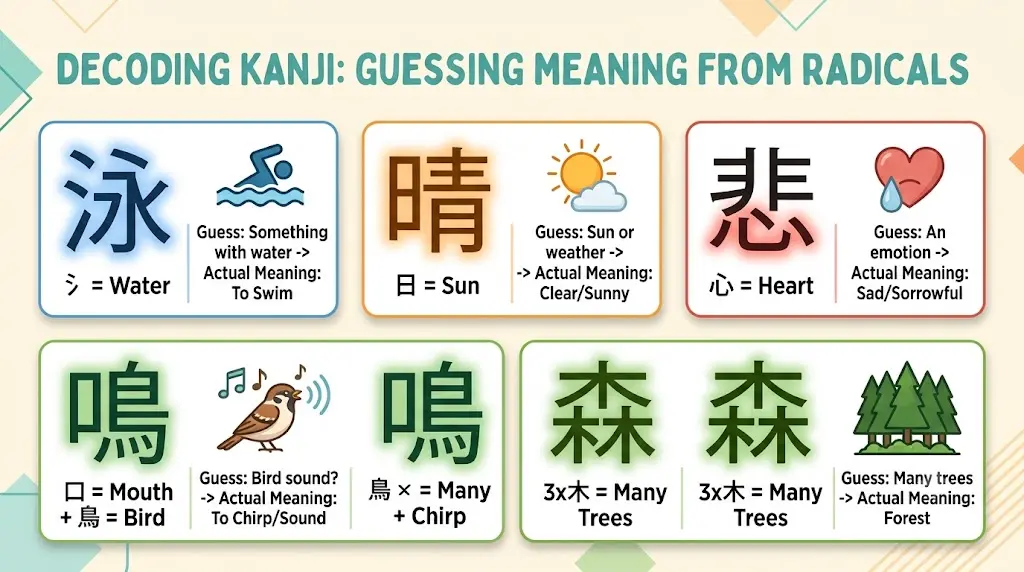
Here is the most practical skill you can develop as a kanji learner. When you see an unfamiliar kanji, ask:
“What radical do I recognize? What does that radical mean? What might this character be about?”
Examples of Radical-Based Guessing
You see: 泳
- You recognize: 氵 (water) on the left
- You guess: something to do with water
- Actual meaning: 泳 = to swim ✓
You see: 晴
- You recognize: 日 (sun) on the left
- You guess: something to do with the sun or weather
- Actual meaning: 晴 = clear, sunny ✓
You see: 悲
- You recognize: 心 (heart) at the bottom
- You guess: an emotion or feeling
- Actual meaning: 悲 = sad, sorrowful ✓
You see: 鳴
- You recognize: 鳥 (bird) on the right, 口 (mouth) on the left
- You guess: a bird making a sound?
- Actual meaning: 鳴 = to chirp, to ring, to sound ✓
You see: 森
- You recognize: three 木 (tree)
- You guess: something with many trees
- Actual meaning: 森 = forest ✓ (林 with two trees = grove)
This method isn’t perfect — some kanji radicals indicate sound rather than meaning, and some are irregular. But as a first-pass system, it works remarkably well and makes each new kanji an interesting puzzle rather than a wall of meaningless shapes.
How to Build Your Radical Anki Deck
The most efficient way to learn all 214 radicals is with a spaced repetition system. Here’s the exact setup for your radical Anki deck:
Card Format
Front:
- The radical (large: 人)
- Its variant form if it has one (亻)
Back:
- Number in the Kangxi system (9)
- Stroke count (2)
- Meaning (Person)
- Example kanji using this radical (仕, 住, 何, 信, 使)
- Brief mnemonic note (A person walking in profile)
Study Order
Don’t study radicals in numerical order (1, 2, 3…). Study them in frequency order — most useful first. Use this priority:
- Start with the 30 highest-priority radicals in the table above
- Next, add the remaining 2–4 stroke radicals
- Then 5–6 stroke radicals
- Then 7+ stroke radicals
Daily Card Target
- New cards per day: 5–10 radicals
- At 5/day: Complete all 214 in 6–7 weeks
- At 10/day: Complete in 3 weeks
Combine with JLPT N5 vocabulary study — see our JLPT N5 vocabulary guide — so you’re always seeing radicals in the context of real words.
All 214 Radicals
Want a printable, beautifully designed reference to keep at your desk or import into Anki?
Fumito Emi at reading-japanese.com has created a complete of all 214 Kangxi radicals including:
- 📌 All 214 radicals displayed large and clearly
- 📌 Organized by stroke count (1–17 strokes)
- 📌 English meaning and mnemonic note for each radical
- 📌 Color-coded by stroke group for quick reference
- 📌 Variant forms noted where relevant
- 📌 Quick reference overview table
- 📌 Study tips and FAQ section
For official kanji reference, see also the Joyo Kanji list on the Agency for Cultural Affairs website.
FAQ
❓ What are the 214 radicals called in Japanese?
They are called 部首 (bushu). 部 (bu) means “section” or “group,” and 首 (shu/kubi) means “head” or “beginning.” Together: the “section head” of a kanji group. You might also hear 偏旁 (henbo) used to describe components more broadly.
❓ Do all Japanese kanji use the Kangxi radical system?
Yes — the 214 Kangxi radicals are the standard system for indexing all kanji in Japanese dictionaries. Some modern digital dictionaries allow searching by reading or stroke, but the radical system remains the universal reference standard.
❓ Are radicals the same thing as “parts” or “components” of a kanji?
Not exactly. A kanji can have multiple visible components, but officially it has only one radical — the one used to index it in the dictionary. For example, 明 (bright) has both 日 (sun) and 月 (moon), but its dictionary radical is 日. However, for learning and memorization, it’s useful to study all components, not just the official radical.
❓ How do I know which component is the radical?
This requires some practice. Generally, the radical is the component that relates most directly to the meaning. In water-related characters (海, 泳, 河), 氵 is always the radical. In characters with 木 (tree), the tree is usually the radical. Over time, you’ll develop an intuition. Reference books and apps like Jisho.org display the official radical for every kanji.
❓ Are there more than 214 radicals?
The Kangxi system has 214, but some sources list different numbers. The Nelson Japanese-English Character Dictionary uses 186, and some simplified systems use as few as 79. For most Japanese learners, the 214 Kangxi system is the most useful because it aligns with standard dictionaries and the JLPT.
❓ Do I need to memorize all 214 radicals before studying kanji?
No — and that would actually slow you down. The best approach is to learn the most common ~50 radicals alongside your kanji study. When you encounter an unfamiliar radical, look it up in this. Over months of study, all 214 will become familiar naturally.
❓ How do radicals help with JLPT preparation?
Radicals help you guess the meaning of kanji you haven’t specifically studied — which is extremely useful in the JLPT’s reading comprehension sections. When you recognize that an unfamiliar N2 kanji has the 病 (illness) radical, you can infer it’s medically related and read the surrounding context more accurately. Our JLPT N5 vocabulary list is organized to complement your radical study.
❓ What is the best book for learning kanji radicals?
Remembering the Kanji by James Heisig is the classic Western resource for radical-based kanji memorization. For a more Japanese-school approach, Basic Kanji Book by Kano et al. is excellent. Combine either book with the resources at reading-japanese.com and an Anki deck for best results.
Related Articles
More resources from Fumito Emi at reading-japanese.com:
- 📘 Learn Hiragana — Chart & Complete Guide — Learn all 46 hiragana in one week
- 📗 Learn Katakana — Chart & Complete Guide — Learn katakana before tackling kanji
- 📙 JLPT N5 Vocabulary — Complete Study List — 800 words to study alongside your radicals
- 📕 Joyo Kanji List with Meaning — All 2,136 Joyo kanji with readings and JLPT level
- 📒 1000 Most Common Japanese Words for Anki — Build your vocabulary with the best words first
🎯 Your Radical Journey Starts with One Stroke
You’ve just read through all 214 Kangxi radicals. Most learners never do this — they try to memorize kanji one by one, without the system, and burn out somewhere around the four-hundredth character.
You now have the system.
Every kanji you learn from here is a combination of pieces you already know. 海 isn’t a random shape — it’s water (氵) plus a mother (母) plus something else, which together mean “sea.” Once you see it, you can’t unsee it.
Start with the 30 highest-priority radicals. Build your Anki deck. And come back to this reference whenever you encounter a radical you don’t recognize.
The kanji system is not your enemy. It’s a 3,000-year-old visual language, and you’re learning to read it.
214 radicals at reading-japanese.com — printable, beautifully designed, and ready for your desk or Anki deck.
Written by Fumito Emi | Japanese Language Tutor | reading-japanese.com Sources: Kangxi Dictionary (康熙字典, 1716) | Agency for Cultural Affairs Japan