
One of the things that makes Japanese so interesting is how much social information is packed into verb endings. In this lesson we move into Lesson 4 — and right from the very first dialogue we get a grammar point that’s immediately practical: the -mashou form, which lets you suggest doing something together (“let’s go”) or offer to do something for someone else (“shall I help?”).
This one dialogue — Michael working late on a project while Honda offers help — gives us three things that come up constantly in real workplace and everyday Japanese: the -mashou form for suggestions and offers, the object particle wo, and the particle kara meaning “because” or “so.” Plus some of the most essential expressions in all of Japanese — ganbatte kudasai, daijoubu desu, and the very satisfying dekimashita!
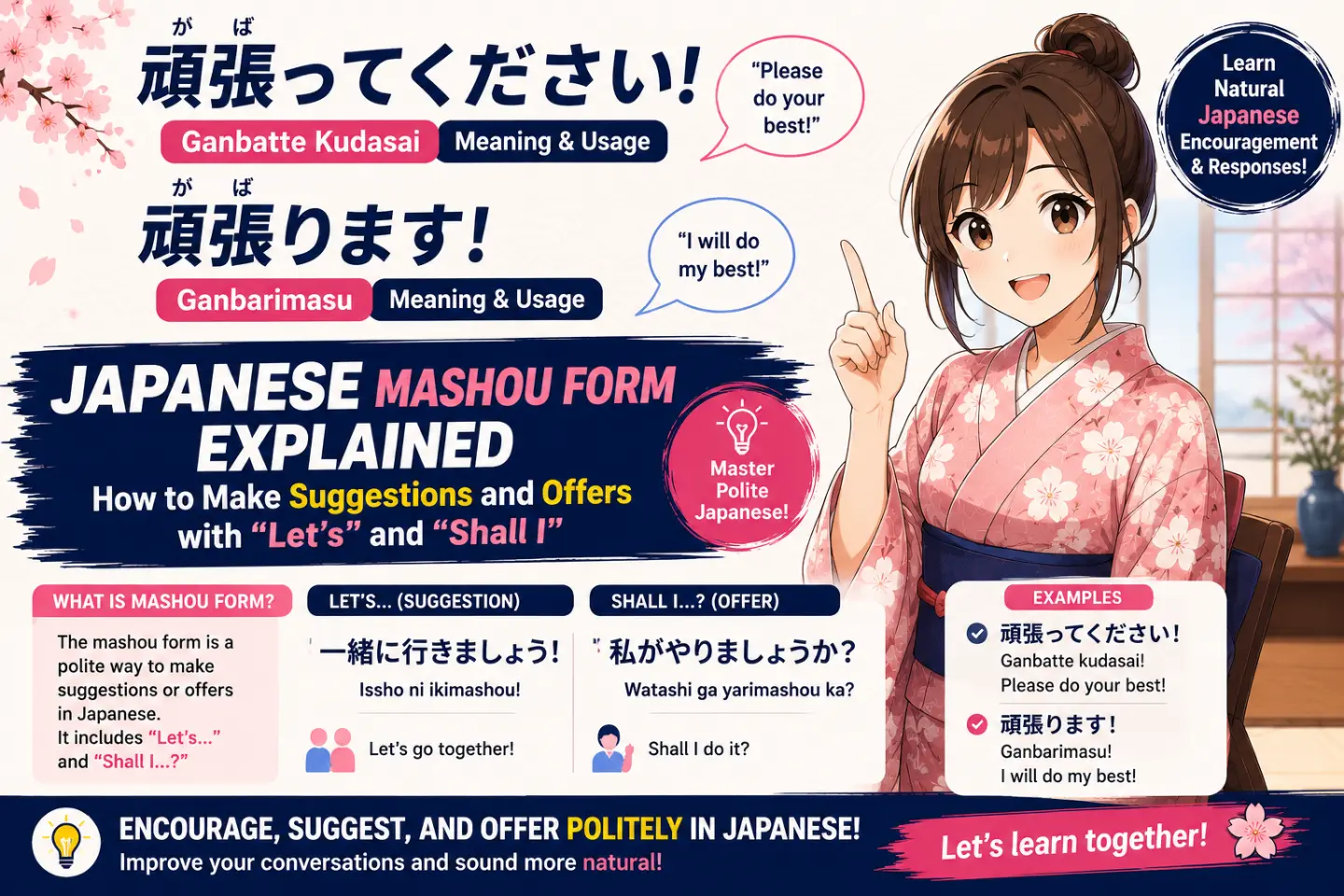
Japanese Mashou Form Explained – How to Make Suggestions and Offers with “Let’s” and “Shall I”
This lesson builds on everything from Lessons 1-3. If you haven’t been through the verb forms yet, how Japanese verbs work (masu and masen) is the right starting point. And if you want to review the full three-sentence-type picture before continuing, the Lesson 3 adjective sentences post has the complete master chart.
📌 What you’ll learn in this lesson: The -mashou form for “let’s do” and “shall I?”, how to accept and decline suggestions and offers the natural Japanese way, the object particle wo, the particle kara for “because / so”, and key expressions like ganbatte kudasai, daijoubu desu and zenbu dekimashita.
Lesson 4, Dialogue 1 – The Project Assignment
Michael is on a project team headed by Ms. Tanaka. He’s been given a big assignment and Honda notices he’s struggling. This short dialogue is packed with natural, frequently-used workplace Japanese — the kind of conversation you’d hear on any day in a Japanese office.
Honda: 大変ですね。
Taihen desu ne. — That’s a lot of work, isn’t it.
Honda: 手伝いましょうか。
Tetsudaimashou ka. — Shall I help you?
Michael: いえ、大丈夫です。
Ie, daijoubu desu. — No, I’m fine. / No thank you.
Michael: エクセルを使いますから。
Ekuseru o tsukaimasu kara. — I’ll use Excel, so… (it’s fine)
Honda: そうですか。じゃ、がんばってください。
Sou desu ka. Ja, ganbatte kudasai. — Are you sure? Well then, good luck!
Michael: はい、がんばります。
Hai, ganbarimasu. — Thanks, I’ll do my best!
[Some time later…]
Michael: 全部、できました!
Zenbu, dekimashita! — All done!
Tanaka: 速いですねえ。
Hayai desu nee! — That was fast!
Vocabulary from the Dialogue
| Romaji | Japanese | Kanji | Meaning |
|---|---|---|---|
| taihen(na) | たいへん(な) | 大変 | difficult, challenging, a lot of work |
| tetsudaimasu | てつだいます | 手伝います | help |
| tetsudaimashou ka | てつだいましょうか | 手伝いましょうか | shall I help? |
| daijoubu | だいじょうぶ | 大丈夫 | fine / okay / no problem |
| ekuseru | エクセル | — | (Microsoft) Excel |
| o / wo | を | — | object marking particle |
| tsukaimasu | つかいます | 使います | use |
| kara | から | — | because / so (gives reason) |
| ganbatte kudasai | がんばってください | — | good luck! / please do your best |
| ganbarimasu | がんばります | — | I’ll do my best / I’ll try hard |
| zenbu | ぜんぶ | 全部 | all / everything / the whole thing |
| hayai | はやい | 速い / 早い | fast / quick / early |
Additional Vocabulary – Tech Words and Why
| Romaji | Japanese | Meaning |
|---|---|---|
| osoi | おそい / 遅い | slow / late |
| dou shite | どうして | why? (casual) |
| naze | なぜ | why? (formal/written) |
| nande | なんで | why? / how come? (most casual) |
| waado | ワード | Microsoft Word |
| apuri | アプリ | app / application |
| intaanetto / netto | インターネット / ネット | internet |
| pawaapointo | パワーポイント | PowerPoint |
| fairu | ファイル | file |
| waifai | ワイファイ | Wi-Fi |
4-1-1 The Mashou Form – “Let’s Do” and “Shall I?”
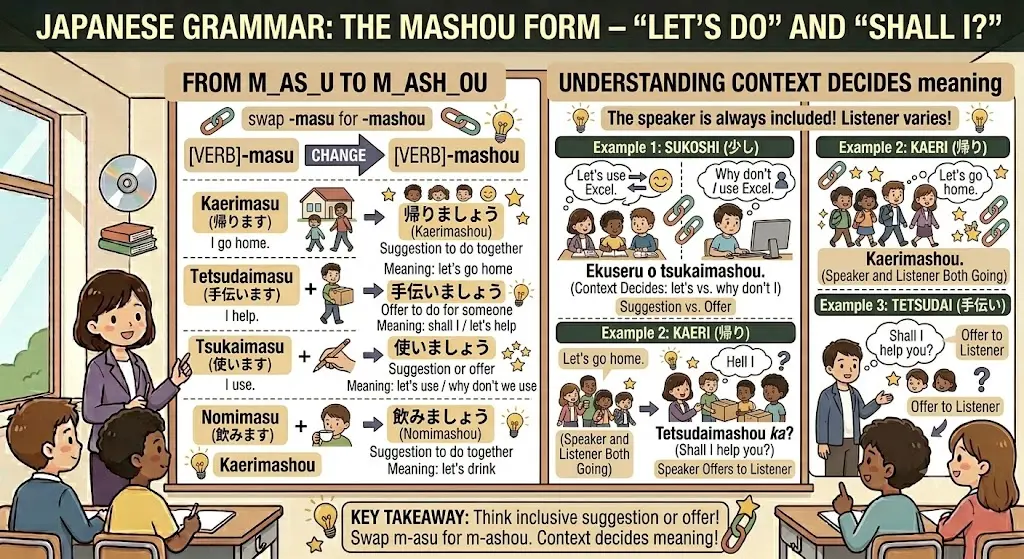
The -mashou form is one of the most useful and socially natural things you can add to your Japanese. Its formed by a simple change — swap -masu for -mashou — and it creates a verb that means either “let’s do X” or “why don’t I do X / shall I do X?” depending on context.
| -masu form | → -mashou form | Meaning change |
|---|---|---|
| 帰ります (kaerimasu) I go home | 帰りましょう (kaerimashou) let’s go home | Suggestion to do together |
| 手伝います (tetsudaimasu) I help | 手伝いましょう (tetsudaimashou) shall I / let’s | Offer to do for someone |
| 使います (tsukaimasu) I use | 使いましょう (tsukaimashou) let’s use / why don’t we use | Suggestion or offer |
| 飲みます (nomimasu) I drink | 飲みましょう (nomimashou) let’s drink | Suggestion to do together |
The speaker is always included as one of the people doing the action. But the listener may or may not be included, depending on context:
エクセルを使いましょう。
Ekuseru o tsukaimashou.
— Let’s use Excel. or Why don’t I use Excel. (context decides which)
帰りましょう。
Kaerimashou.
— Let’s go home. (speaker and listener both going)
手伝いましょうか。
Tetsudaimashou ka.
— Shall I help you? (speaker offers to do it for the listener)
Mashou vs Mashou Ka – A Small but Important Difference
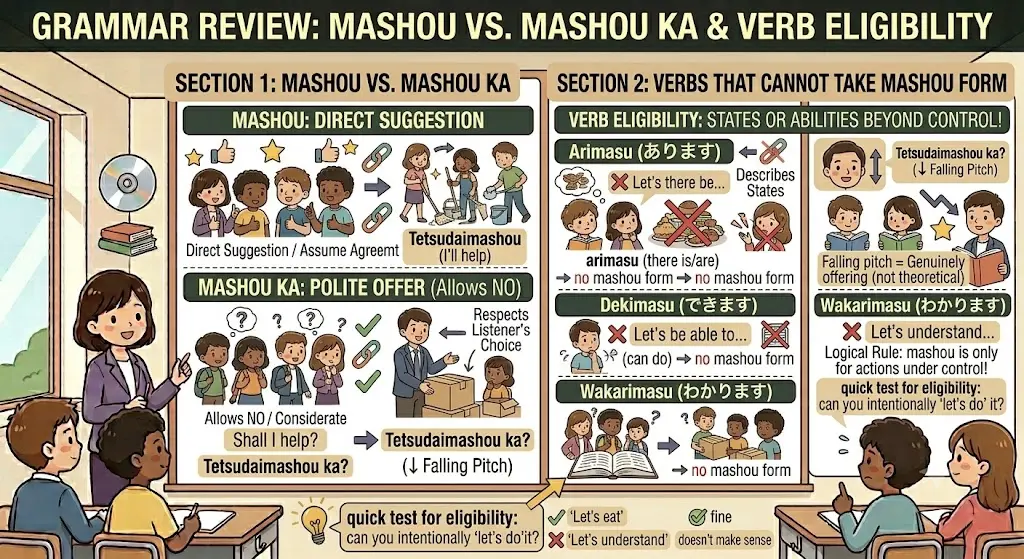
-Mashou alone is a direct suggestion — you’re putting the idea forward and assuming the listener will agree. -Mashou ka (with the question particle ka added) is more polite — because the question form allows the other person to say no. That’s why tetsudaimashou ka (shall I help?) feels more considerate than just tetsudaimashou (I’ll help) — the question form respects the listener’s choice.
⚠️ Intonation note: The question form -mashou ka typically has a falling intonation — not rising like a regular question. This is different from English where “shall I help?” rises at the end. In Japanese, the falling intonation signals that you’re genuinely offering (not just asking theoretically). If you hear someone say tetsudaimashou ka with a falling pitch, they really mean it as an offer.
Verbs That Cannot Take the Mashou Form
Not all verbs can use -mashou. The verbs arimasu (there is/are), dekimasu (can do), and wakarimasu (understand) do NOT have a mashou form. Why? Because all three describe states or abilities that are beyond one’s control — you can’t decide to “let’s there be” something or “let’s understand.” The mashou form is only for things you can actually choose to do. This is a really logical rule once you think about it.
🎌 Quick test for mashou eligibility: If you can say “let’s intentionally do X” in English and it makes sense — the mashou form probably works in Japanese too. “Let’s eat”, “let’s go”, “let’s try”, “let’s use” → all fine. “Let’s exist”, “let’s understand”, “let’s be able to” → doesn’t make sense, so mashou can’t be used.
How to Respond to Suggestions and Offers in Japanese
Knowing the mashou form is only half the job — you also need to know how to respond when someone uses it on you. The responses are different depending on whether you’re being invited to do something together or offered help.
When Someone Suggests Doing Something Together (-mashou)
✅ To accept a suggestion
そうしましょう。
Sou shimashou.
Let’s do that. / Sounds good.
🙏 To decline politely
いや、ちょっと…
Iya, chotto…
Well, umm… (trail off, as covered in Lesson 1)
When Someone Offers to Do Something for You (-mashou ka)
✅ To accept the offer
はい、お願いします。
Hai, onegai-shimasu.
Yes please. / That would be great.
🙏 To turn it down
いえ、大丈夫です。
Ie, daijoubu desu.
No thank you, I’m fine.
💡 Daijoubu desu — the most useful “no” in Japanese:Daijoubu desu (大丈夫です) literally means “it’s okay / it’s fine” and is the most natural, soft way to decline an offer in Japanese. Its much less abrupt than saying a flat iie (no), and doesn’t require the trailing-off chotto technique used for invitations. Memorise this one early — you’ll use it constantly, not just to decline offers but also to reassure people that things are alright.
4-1-2 The Object Particle Wo – Marking What the Action Is Done To
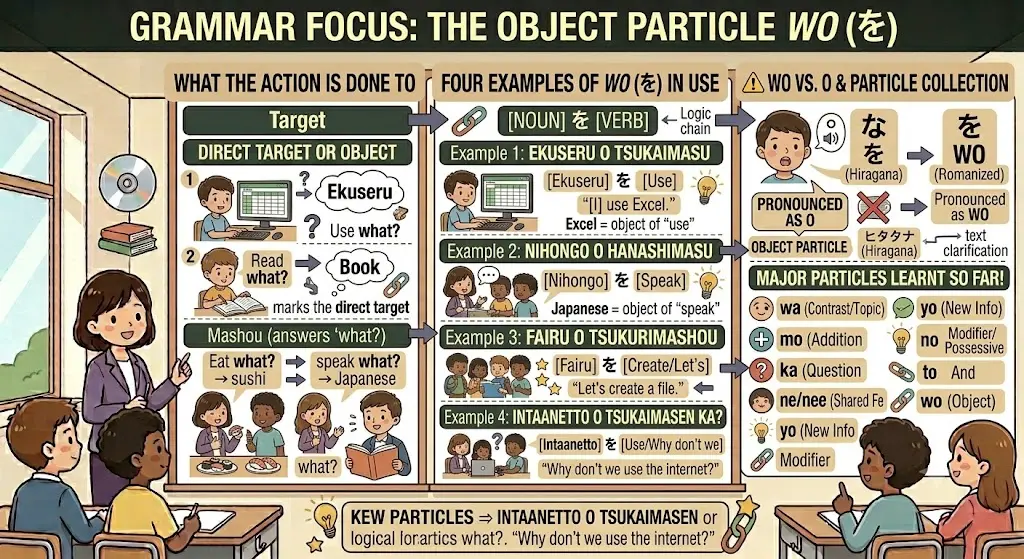
In the dialogue, Michael says Ekuseru o tsukaimasu — “I’ll use Excel.” The o (を) here is the object particle — it marks the noun that is the direct target or object of the verb’s action.
In Japanese grammar terms, this is the word that answers “what?” after the verb. “Use what?” → Excel. “Eat what?” → sushi. “Read what?” → the book. That “what” is marked by wo.
エクセルを使います。
Ekuseru o tsukaimasu.
— [I] use Excel. (Excel = object of “use”)
日本語を話します。
Nihongo o hanashimasu.
— [I] speak Japanese. (Japanese = object of “speak”)
ファイルを作りましょう。
Fairu o tsukurimashou.
— Let’s create a file. (file = object of “create”)
インターネットを使いませんか。
Intaanetto o tsukaimasen ka.
— Why don’t we use the internet?
⚠️ Wo vs o: The object particle is written as を in hiragana and romanized as wo, but it’s pronounced as simply o in modern Japanese. Most romanization systems write it as o or wo — both are correct. Don’t let the different spellings confuse you — its the same particle. Now that you know wo, here are the major particles you’ve learned so far: wa (contrast/topic), mo (addition), ka (question), ne/nee (shared feeling), yo (new info), no (modifier/possessive), to (and), wo (object). Thats a solid collection!
4-1-3 The Particle Kara – “Because” and Trailing Off
Kara (から) in this lesson means “because” or “so” — it gives a reason for something. Michael says Ekuseru o tsukaimasu kara — “I’ll use Excel, so…” — giving his reason for not needing Honda’s help.
から Kara — giving a reason
エクセルを使いますから。
Ekuseru o tsukaimasu kara.
I’ll use Excel, so… (because of that, I’m fine)
難しいですから、手伝いましょうか。
Muzukashii desu kara, tetsudaimashou ka.
It’s difficult, so shall I help?
…から — trailing off (reason implied)
Notice that in the dialogue, Michael’s sentence ends in kara with no second clause. This is intentional — he trails off after giving his reason, implying “so I don’t need help” without saying it directly. This soft, implied communication style is very natural in Japanese.
Ekuseru o tsukaimasu kara… = “I’ll use Excel, so [don’t worry about me]…”
🔑 Kara vs Kedo: You already know kedo (but) from Lesson 1 — it connects two sentences with a contrasting or softening relationship. Kara connects them with a cause-and-effect relationship. The structure is: reason/cause + kara + result/conclusion. Both can also trail off, leaving the second clause implied. This trailing technique is a key feature of indirect, considerate Japanese communication.
Ganbatte Kudasai and Ganbarimasu – One of the Most Used Exchanges in Japanese
This pair of expressions deserves its own section because you will use them constantly in Japanese life — at work, at school, before an exam, before a sports match, at the start of a big project — anywhere someone is about to tackle something challanging.
| Expression | Japanese | Meaning / When to use |
|---|---|---|
| Ganbatte kudasai | がんばってください | Good luck! / Please do your best! — said to encourage someone |
| Ganbatte | がんばって | Good luck! (casual — to friends, family, close coworkers) |
| Ganbarimasu | がんばります | I’ll do my best! — the natural response |
| Ganbatte imasu | がんばっています | I’m doing my best / trying hard (in progress) |
When Honda says ganbatte kudasai and Michael responds with hai, ganbarimasu — this is a completely natural and warm exchange. The hai at the start of Michael’s response signals acknowledgement and appreciation of the encouragement before he commits to trying hard. Its the kind of small exchange that makes Japanese workplaces feel connected and supportive.
Hayai vs Osoi and How to Use -i Adjectives in Exclamations
The dialogue ends with Tanaka’s exclamation hayai desu nee! — “that was fast!” This is a great example of how -i adjectives you learned in Lesson 3 get used in real exclamations of surprise or admiration.
| Adjective | Japanese | Kanji | Opposite |
|---|---|---|---|
| hayai | はやい | 速い (speed) / 早い (time) | おそい (osoi) — slow / late |
⚠️ Hayai has two kanji: Fast/quick (speed) is written 速い, and early (time) is written 早い — both read as hayai. In everyday speech the distinction is clear from context. When Tanaka says hayai desu nee after Michael finishes his work, she means “that was fast!” (speed) — 速い. But if someone says hayai desu nee about arriving before expected, they might mean “you’re early!” (time) — 早い. Both readings and both meanings are very common.
Why in Japanese – Dou Shite, Naze and Nande
This lesson introduces three ways to ask “why?” in Japanese — and knowing when to use each one matters because they signal very different levels of formality and emotion.
| Word | Japanese | Level | Feel |
|---|---|---|---|
| dou shite | どうして | Casual / everyday | Neutral, warm — works in most spoken situations |
| naze | なぜ | Formal / written | More serious, literary — used in writing, speeches, formal interrogation |
| nande | なんで | Most casual | Very direct, can sound demanding or frustrated if not careful |
どうして、エクセルを使いますか。
Dou shite, Ekuseru o tsukaimasu ka.
— Why are you using Excel? (casual)
なぜですか。
Naze desu ka.
— Why is that? (formal)
なんで?
Nande?
— How come? / Why?! (very casual, can sound demanding)
As a beginner, dou shite is the safest option in most spoken situations. Use naze in writing or formal speeches. Use nande carefully — its the most casual and can come accross as rude if used with the wrong person or the wrong tone.
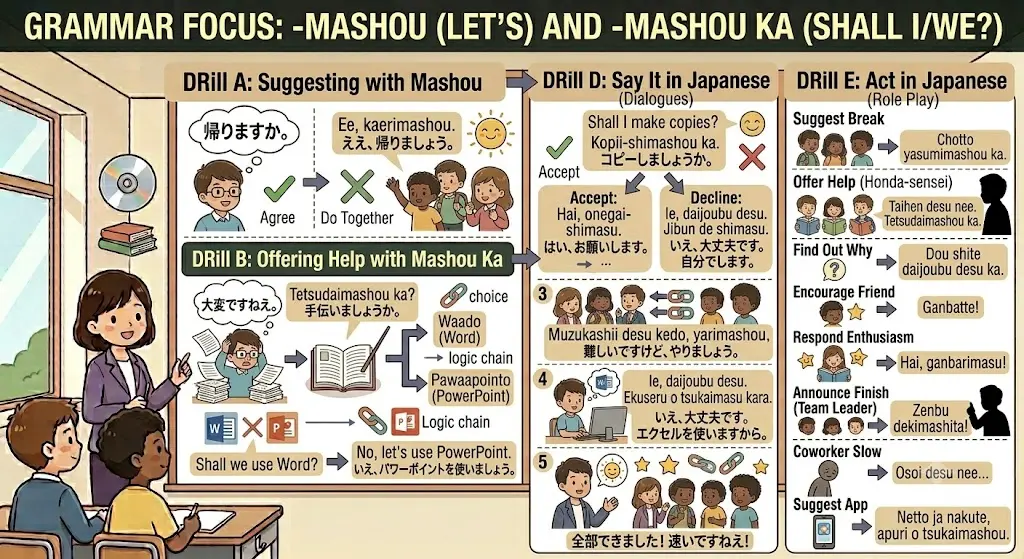
Drill A – Suggesting with Mashou
Someone asks if you will do something. Agree and suggest doing it together using -mashou.
MODEL EXCHANGES
Cue: Kaerimasu ka. — Are you going home?
帰りますか。
Response: Ee, kaerimashou. — Yes, let’s go home.
ええ、帰りましょう。
Cue: Tabemasu ka. — Are you going to eat?
食べますか。
Response: Ee, tabemashou. — Yes, let’s eat.
ええ、食べましょう。
Practice with: ikimasu ka / nomimasu ka / yasumimasuka / benkyou-shimasu ka / dekakemasu ka
Drill B – Offering Help with Mashou Ka
Someone is struggling with a task. Offer to help using tetsudaimashou ka, then change the offer to suggest using a specific tool instead.
MODEL EXCHANGES
Cue: Taihen desu nee. — That looks hard.
大変ですねえ。
Response: Tetsudaimashou ka. — Shall I help?
手伝いましょうか。
Cue: Waado o tsukaimashou ka. — Shall we use Word?
ワードを使いましょうか。
Response: Ie, Pawaapointo o tsukaimashou. — No, let’s use PowerPoint.
いえ、パワーポイントを使いましょう。
Practice with: Waifai o tsukaimashou ka → Ie, netto o tsukaimashou. / Apuri o tsukaimashou ka → Ie, fairu o tsukurimashou.
Drill C – Accepting and Declining Offers
Someone offers to do something for you. Practice both accepting and declining naturally.
MODEL EXCHANGES
Cue: Tetsudaimashou ka. — Shall I help you?
手伝いましょうか。
Accept: Hai, onegai-shimasu. / Decline: Ie, daijoubu desu.
はい、お願いします。 / いえ、大丈夫です。
Cue: Kopii-shimashou ka. — Shall I make copies?
コピーしましょうか。
Accept: Hai, onegai-shimasu. / Decline: Ie, daijoubu desu. Jibun de shimasu.
はい、お願いします。 / いえ、大丈夫です。自分でします。
Drill D – Say It in Japanese
You’re working on a presentation with Ms. Honda. Try each one yourself before checking.
- Shall we use PowerPoint?
→ Pawaapointo o tsukaimashou ka. パワーポイントを使いましょうか。 - Let’s use the internet.
→ Intaanetto o tsukaimashou. インターネットを使いましょう。 - It’s difficult but let’s try.
→ Muzukashii desu kedo, yarimashou. 難しいですけど、やりましょう。 - Shall I create the file?
→ Fairu o tsukurimashou ka. ファイルを作りましょうか。 - No, I’m fine. I’ll use Excel, so…
→ Ie, daijoubu desu. Ekuseru o tsukaimasu kara. いえ、大丈夫です。エクセルを使いますから。 - All done! That was fast, wasn’t it!
→ Zenbu dekimashita! Hayai desu nee! 全部できました!速いですねえ! - Why are you using Word? (casual)
→ Dou shite, Waado o tsukaimasu ka. どうして、ワードを使いますか。 - Because it’s easy, so…
→ Yasashii desu kara… やさしいですから…
Drill E – Act in Japanese (Role Play)
- Your group has been working long. Suggest taking a break.
→ Chotto yasumimashou ka. ちょっと休みましょうか。 - Ms. Honda looks like she has a lot of work. Offer to help her.
→ Taihen desu nee. Tetsudaimashou ka. 大変ですねえ。手伝いましょうか。 - She says she is fine. Find out why she doesn’t need help.
→ Dou shite daijoubu desu ka. どうして大丈夫ですか。 - Encourage your friend who’s about to take an exam.
→ Ganbatte! がんばって! - Someone encouraged you. Respond with enthusiasm.
→ Hai, ganbarimasu! はい、がんばります! - You’ve just finished a project. Announce it to your team leader.
→ Zenbu dekimashita! 全部できました! - Your coworker is working very slowly on a task. Mention how slow it is (to yourself or a colleague).
→ Osoi desu nee… 遅いですねえ… - Suggest to Ms. Honda that you use the app instead of the website.
→ Netto ja nakute, apuri o tsukaimashou. ネットじゃなくて、アプリを使いましょう。
🎌 On Drill E item 6 — zenbu dekimashita: This is such a satisfying sentence to say. Zenbu (全部, all/everything) + dekimashita (was completed / came into being in the past) = “everything is done!” You’ve seen dekimashita before as the past form of dekimasu (can do / is complete). When announcing the completion of any task, this is the natural and expressive way to do it in Japanese.
FAQ – Japanese Mashou Form, Kara and Ganbatte
How do you make the mashou form in Japanese?
The -mashou form is made by changing the -masu ending of a verb to -mashou. So kaerimasu (go home) becomes kaerimashou (let’s go home), tetsudaimasu (help) becomes tetsudaimashou (let’s help / shall I help?), and so on. The rule is the same for all masu-form verbs — its completely regular. The speaker is always included as one of the people doing the action.
What is the difference between mashou and mashou ka in Japanese?
-Mashou alone is a direct suggestion — “let’s do X” — and assumes the listener will agree. -Mashou ka adds the question particle and is more polite, because it gives the listener the option to say no. Tetsudaimashou = “I’ll help you” (assertive offer), while tetsudaimashou ka = “shall I help you?” (considerate offer allowing refusal). The question form also typically has a falling intonation in Japanese, unlike rising question intonation in English.
How do you say “let’s go” in Japanese?
“Let’s go” in Japanese is ikimashou (行きましょう) — the mashou form of ikimasu (go). Similarly, “let’s go home” is kaerimashou (帰りましょう), and “let’s eat” is tabemashou (食べましょう). These are all formed the same way — swap -masu for -mashou.
What does “daijoubu desu” mean in Japanese?
Daijoubu desu (大丈夫です) literally means “it’s okay” or “it’s fine.” In the context of declining an offer, ie, daijoubu desu = “no, I’m fine / no thank you.” Its the most natural and polite way to turn down an offer without being blunt. It can also be used to reassure someone that things are okay — “don’t worry, it’s fine.” One of the most useful everyday expressions in Japanese, beginners should memorise this early.
What does “ganbatte kudasai” mean in Japanese?
Ganbatte kudasai (がんばってください) means “good luck” or “please do your best.” It’s one of the most commonly used expressions of encouragement in Japan — said before exams, competitions, big tasks, or any challange. The casual form is just ganbatte (for friends and family). The standard response is hai, ganbarimasu (はい、がんばります) — “yes, I’ll do my best!” This exchange feels very warm and natural in Japanese workplaces and schools.
What does the particle kara mean in Japanese?
In this lesson, kara (から) means “because” or “so” — it gives a reason or cause. The structure is: [reason] + kara + [result/conclusion]. Often the second clause (the result) is left unsaid and only the reason with kara is stated — the listener understands the implied conclusion. This trailing kara is very common in natural Japanese conversation and reflects the indirect communication style where you give your reason and trust the listener to fill in the rest. Note that kara also means “from” in other contexts — the meaning depends on what it follows.
What is the object particle “wo” (を) in Japanese?
The particle wo (を), written as を in hiragana and pronounced as o, marks the direct object of a verb — the thing that the action is done to. Ekuseru o tsukaimasu = I use Excel (Excel = object of “use”). Nihongo o hanashimasu = I speak Japanese (Japanese = object of “speak”). It follows the noun and precedes the verb. Romanized as either o or wo depending on the system, but always pronounced as a simple o.
Which verbs cannot use the mashou form in Japanese?
Verbs that describe states or conditions beyond a person’s direct control cannot use the -mashou form. Specifically: arimasu (there is/are), dekimasu (can do / is possible), and wakarimasu (understand) do not have mashou forms. You can’t voluntarily choose to “let’s understand” or “let’s there be” something — these are states that just happen, not deliberate actions. The mashou form is only for intentional actions that you can actively choose to do.
What’s Next?
The -mashou form is one of those grammar points that instantly makes your Japanese sound more interactive and socially engaged — because you’re no longer just stating what you do, you’re inviting others to join you, offering to help, or taking initiative. That’s a significant step forward in conversational Japanese.
You’ve also now added the object particle wo to your toolkit — which means you can now mark subjects (wa, mo), modify nouns (no, kono/sono/ano), connect nouns (to), and mark objects (wo). The particle system is really taking shape.
Lesson 4 continues with more dialogue and grammar. Browse all lessons at reading-japanese.com, or continue with the Japanese numbers and money lesson if you haven’t already covered Lesson 3 fully.
頑張ってください!(Ganbatte kudasai!) — Keep going! 🎌
— Fumito フミト | reading-japanese.com
📚 Related lessons on reading-japanese.com: