
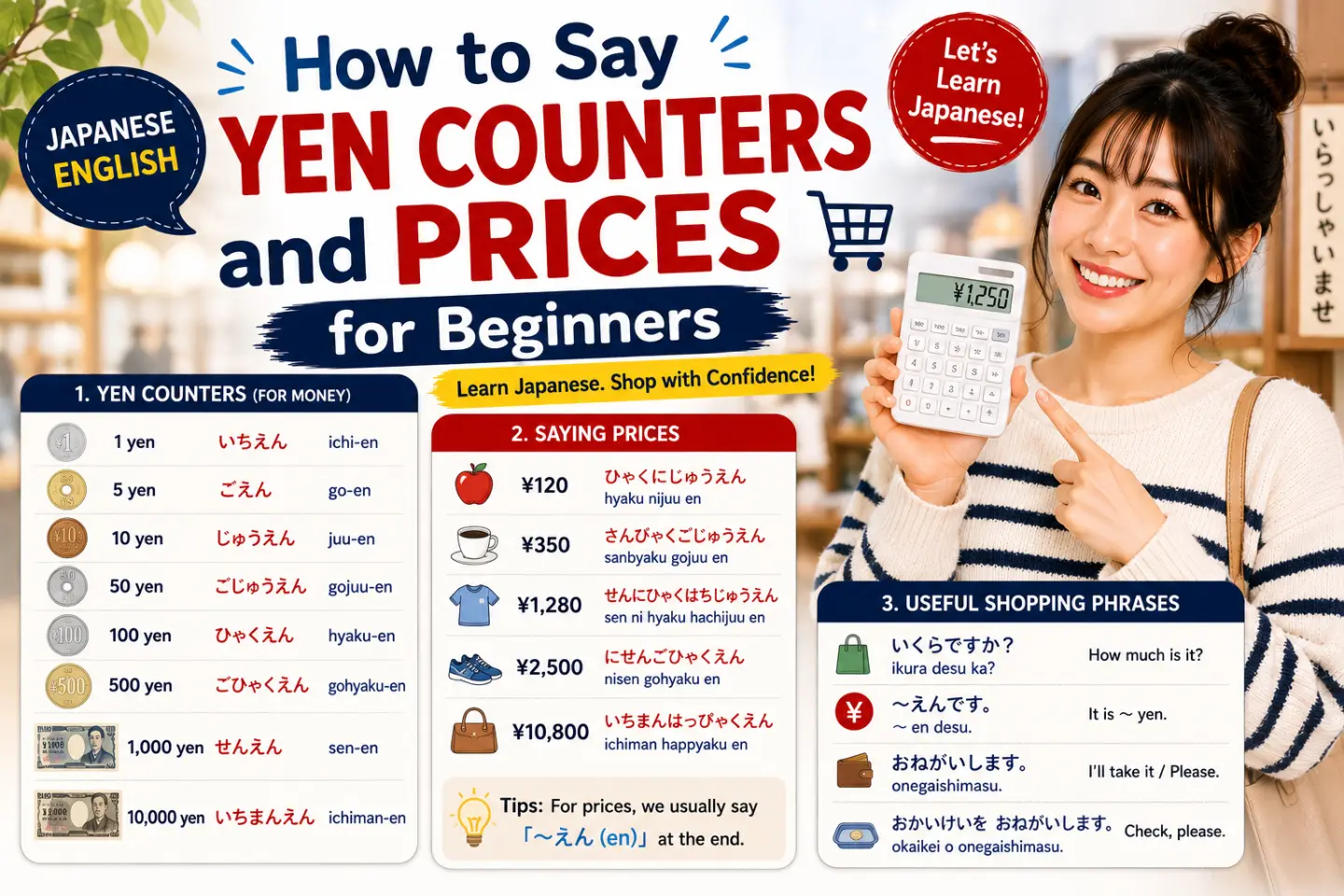
How To Say Yen Counters And Prices For Beginners in Japanese English (sen hyaku juu ichi man, sen hyaku juu ichi en)

This lesson covers Dialogue 2 from Lesson 3 — Michael finds an apartment listing and asks about the price. From this short, very practical exchange we get one of the most useful grammar points in all of Japanese: numbers, money, and classifiers — the things you genuinely cannot avoid needing the moment you go shopping, order food, or rent an apartment in Japan.
We also pick up the pronoun no (a really elegant trick for avoiding repetitive Japanese) and the sentence-particle combination ka nee (“I wonder”) which softens questions in a very natural, Japanese way.
If you haven’t read the previous Lesson 3 post yet, start with Japanese adjective sentences with takai and arimasu — the adjectives from that lesson (yasui, takai, ookii etc.) come up constantly in this one too.
📌 What you’ll learn in this lesson: How to count and say prices in Japanese yen, the classifiers -en, -doru and -ban, sound changes for hundreds and thousands, how the pronoun no avoids repeating nouns, and the soft questioning particle combo ka nee.
Dialogue 2 – Checking the Price of an Apartment
Michael: 15番は、いくらですか。
Juu-go-ban wa ikura desu ka. — How much is number 15?
Honda: 六万七千円です。
Rokuman-nanasen-en desu. — It’s ¥67,000.
Honda: 悪くないですよ。
Warukunai desu yo. — That’s not bad, you know.
Michael: もっと安いのはありませんかねえ。
Motto yasui no wa arimasen nee. — There isn’t one that’s cheaper, is there.
Honda: ちょっとむずかしいですねえ。
Chotto muzukashii desu nee. — That would be a little difficult, wouldn’t it.
Vocabulary from the Dialogue
| Romaji | Japanese | Kanji | Meaning |
|---|---|---|---|
| juugo | じゅうご | 十五 | fifteen |
| ban | ばん | 番 | ordinal number marker |
| juugo-ban | じゅうごばん | 十五番 | number fifteen |
| ikura | いくら | — | how much? |
| rokuman | ろくまん | 六万 | 60,000 |
| nanasen | ななせん | 七千 | 7,000 |
| en | えん | 円 | yen (Japanese currency) |
| warui / warukunai | わるい/わるくない | 悪い/悪くない | bad / not bad |
| motto | もっと | — | more |
| no | の | — | one(s) — pronoun replacing a noun |
| muzukashii | むずかしい | 難しい | difficult / hard |
Additional Vocabulary
| Romaji | Japanese | Meaning |
|---|---|---|
| doru | ドル | dollar |
| yasashii | やさしい | easy / kind |
3-2-1 Japanese Numbers and Classifiers – En, Doru, Ban
This is one of those grammar points that pays off immediately and constantly once you’ve learned it — because numbers are everywhere. Prices, addresses, phone numbers, dates, quantities. Lets break it down properly.
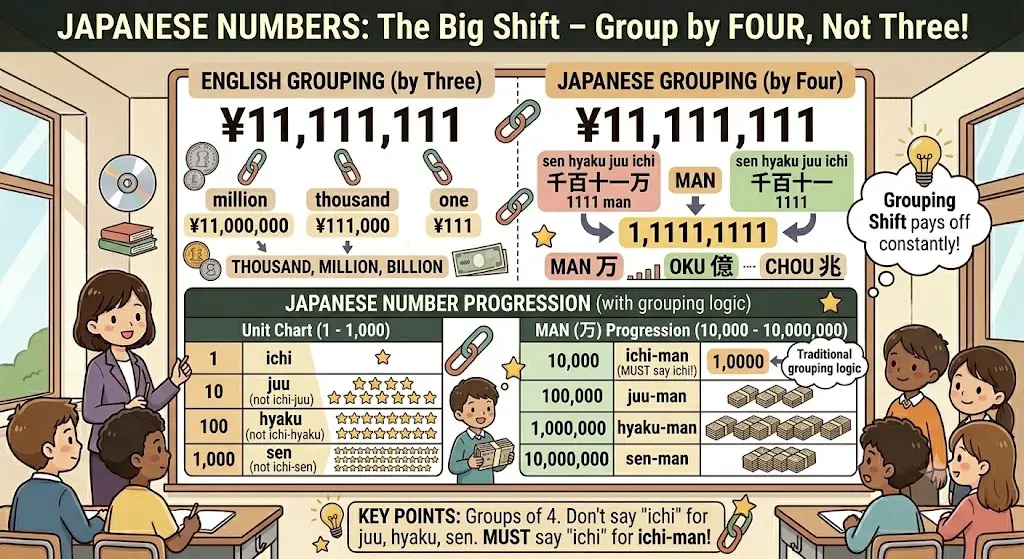
The Big Difference – Groups of Four, Not Three
In English, large numbers are grouped in sets of three: thousand, million, billion. In Japanese, large numbers are grouped in sets of four: man (万, ten-thousand), oku (億, hundred-million), chou (兆, trillion). This is one of the biggest adjustments English speakers need to make with Japanese numbers.
| Number | Japanese | Number | Japanese |
|---|---|---|---|
| 1 | ichi | 10,000 | ichi-man |
| 10 | juu | 100,000 | juu-man |
| 100 | hyaku | 1,000,000 | hyaku-man |
| 1,000 | sen | 10,000,000 | sen-man |
⚠️ 10, 100, and 1000 don’t need “ichi” — but 10,000 does: You say juu (not ichi-juu) for ten, hyaku (not ichi-hyaku) for one hundred, and sen (not ichi-sen) for one thousand. But for ten-thousand, you MUST say ichi-man — never just man alone. The rule is: you only need ichi for the last place within each four-digit group. Traditionally, Japanese numbers were even written with a comma every four places (10,000 was written as “1,0000”) rather than every three places like English.
So a number like ¥11,111,111 breaks down as: sen hyaku juu ichi man, sen hyaku juu ichi en — “1111 man, 1111 yen.” Once you see the four-digit grouping logic, big numbers in Japanese become much more manageable.
Sound Changes for Hundreds and Thousands
Some hundreds and thousands have small pronunciation shifts you need to know — these are very common and you’ll hear them constantly when shopping or checking prices.
Hundreds (hyaku) — h becomes b or p
300 = さんびゃく (sanbyaku) — h → b
600 = ろっぴゃく (roppyaku) — h → pp
800 = はっぴゃく (happyaku) — h → pp
何百 (nanbyaku) — how many hundreds?
Thousands (sen) — s becomes z or ss
3000 = さんぜん (sanzen) — s → z
8000 = はっせん (hassen) — s → ss
何千 (nanzen) — how many thousands?
The Classifier System – Why Bare Numbers Aren’t Enough
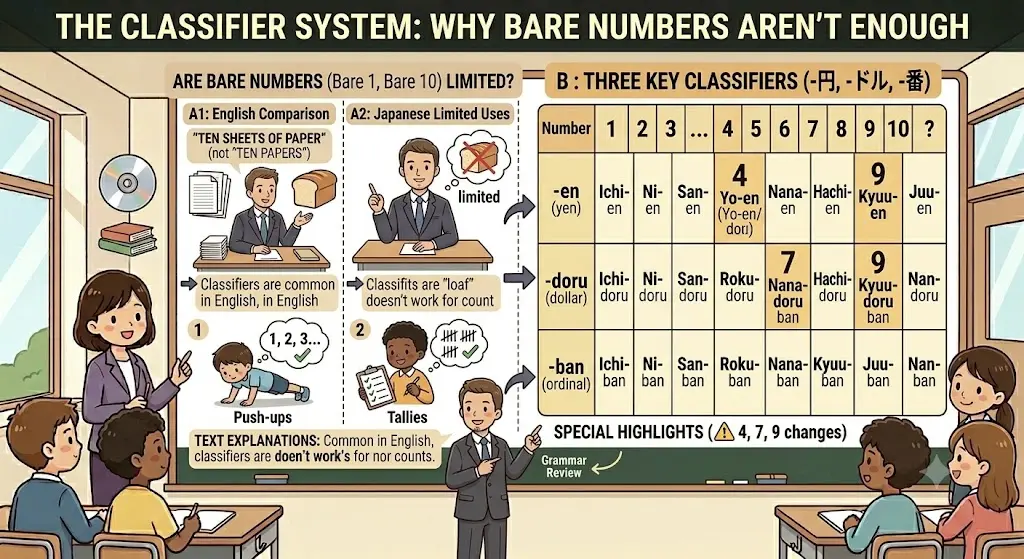
In Japanese, numbers almost always need a classifier attached — a word that tells you what’s being counted. This is similar to English phrases like “ten sheets of paper” (not “ten papers”) or “a loaf of bread.” Using a bare number alone in Japanese is quite limited — mostly for counting things like push-ups or simple tallies.
This lesson introduces three important classifiers: -en (円, for yen), -doru (ドル, for dollars), and -ban (番, for ordinal numbers — first, second, third, etc.) You’ve already met two classifiers in earlier lessons: -ji for clock time, and -nensei for school grade.
| Number | -en (yen) | -doru (dollar) | -ban (ordinal) |
|---|---|---|---|
| 1 | Ichi-en | Ichi-doru | Ichi-ban |
| 2 | Ni-en | Ni-doru | Ni-ban |
| 3 | San-en | San-doru | San-ban |
| 4 | Yo-en | Yon-doru | Yon-ban |
| 5 | Go-en | Go-doru | Go-ban |
| 6 | Roku-en | Roku-doru | Roku-ban |
| 7 | Nana-en | Nana-doru | Nana-ban |
| 8 | Hachi-en | Hachi-doru | Hachi-ban |
| 9 | Kyuu-en | Kyuu-doru | Kyuu-ban |
| 10 | Juu-en | Juu-doru | Juu-ban |
| ? | Nan-en | Nan-doru | Nan-ban |
⚠️ 4, 7, and 9 change depending on the classifier: This is one of the trickiest parts of Japanese numbers for beginners. The numbers 4, 7, and 9 have alternating forms depending on what they’re combined with:
4: yon / yo / shi — before -ji (clock time) and -en it’s yo; before -doru and -ban it’s yon
7: nana / shichi — before -ji it’s shichi; before -en, -doru, -ban it’s nana
9: kyuu / ku — before -ji it’s ku; before -en, -doru, -ban it’s kyuu
There’s no shortcut here — these alternating forms just need to be memorised per classifier as you learn each one.
Ichiban – “Number One” and “The Best”
The classifier -ban has a special bonus use. Ichi-ban (一番) literally means “number one” but is also used as an adverb meaning “most” or “best” — and interestingly, the pitch accent changes between the two meanings.
一番上手 ichiban jouzu — most skillful
一番新しい ichiban atarashii — newest
一番いい大学 ichiban ii daigaku — the best college
🔑 Ichiban as “number one” vs “best”: When used as a literal ordinal (“number one”), the pitch falls on the first syllable: iCHIban. When used as the adverb meaning “most/best,” the pitch shifts to the second part: ichiBAN. This is a subtle but real distinction native speakers make — and one more example of how pitch accent (covered back in an earlier lesson) carries real meaning in Japanese.
3-2-2 The Pronoun No – Avoiding Repetitive Nouns
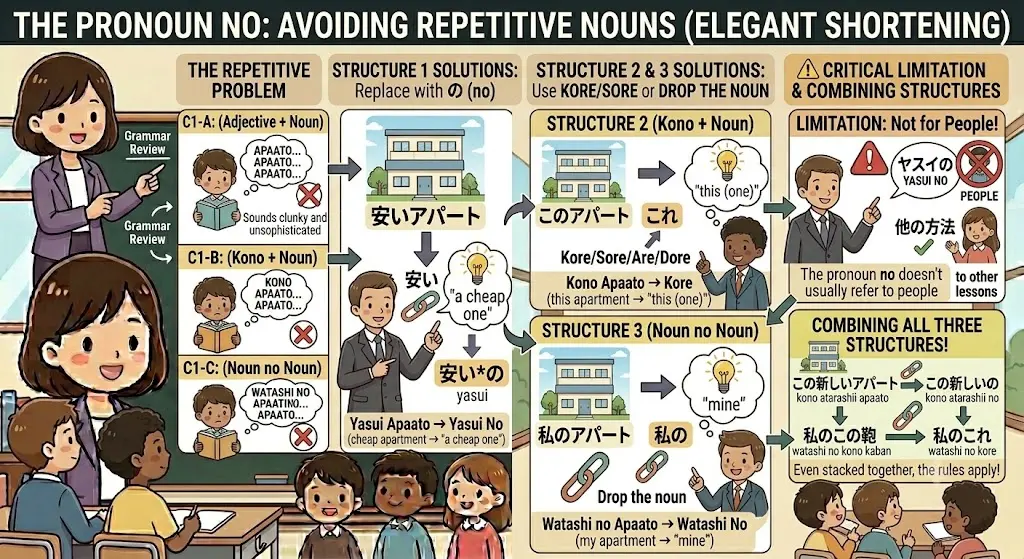
This is a wonderfully elegant piece of Japanese grammar. You’ve now learned three ways to build a noun phrase:
| Structure | Example | Meaning |
|---|---|---|
| 1. Adjective + Noun | 安いアパート (yasui apaato) | cheap apartment |
| 2. Kono + Noun | このアパート (kono apaato) | this apartment |
| 3. Noun no Noun | 私のアパート (watashi no apaato) | my apartment |
The problem: if the noun is already clear from context, repeating it every time sounds clunky and unsophisticated in Japanese — just like it would in English if you kept saying “apartment, apartment, apartment.” Japanese has a specific solution for each structure:
Structure 1 — replace noun with の (no)
安いアパート → 安いの
yasui apaato → yasui no
cheap apartment → “a cheap one”
Structure 2 — use kore/sore/are/dore
このアパート → これ
kono apaato → kore
this apartment → “this (one)”
Structure 3 — just drop the noun entirely
私のアパート → 私の
watashi no apaato → watashi no
my apartment → “mine”
⚠️ The pronoun no doesn’t usually refer to people: You can say yasui no (a cheap one) referring to an object, but you generally wouldn’t use no this way to refer to a person. For people, Japanese uses other strategies covered in later lessons. This is a small but important limitation to keep in mind.
Combining All Three Structures
These shortening rules apply even when you’ve stacked all three structures together in one noun phrase:
この新しいアパート (this new apartment) → この新しいの (this new one)
kono atarashii apaato → kono atarashii no
私のこの鞄 (this bag of mine) → 私のこれ (this one of mine)
watashi no kono kaban → watashi no kore
新しいアメリカの会社 (new American company) → 新しいアメリカの (a new American one)
atarashii Amerika no kaisha → atarashii Amerika no
3-2-3 Ka Nee – “I Wonder” and Softening Questions
Sentence particles can combine — and one of the most common, useful combinations is ka nee, which means “I wonder.” This builds directly on particles you already know: ka indicates doubt or a question, and nee indicates that you assume the listener shares the same feeling or doubt.
もっと安いのはありませんか。
Motto yasui no wa arimasen ka.
— Aren’t there cheaper ones? (asks directly for an answer)
もっと安いのはありませんかねえ。
Motto yasui no wa arimasen ka nee.
— I wonder if there are cheaper ones. (softer, doesn’t demand a response)
The difference is subtle but important. The first version is a direct question expecting an answer. The second, with ka nee added, doesn’t demand a response — because it assumes the other person shares the same wondering. The result is noticeably softer and less direct.
Ka Nee as a Polite “I Don’t Know”
Ka nee is also used when responding to a question you don’t know the answer to — its a polite, considerate way to say “I don’t know either” without sounding dismissive.
あの人、だれですか。 — Who is that person?
だれですかねえ。 — I wonder, too. (response, softly admitting you don’t know)
だれの傘ですか。 — Whose umbrella is it?
だれのですかねえ。 — I wonder whose it is, too.
💡 Why ka nee matters socially: Saying “I don’t know” too bluntly can come accross as unhelpful or dismissive in Japanese conversation. Ka nee reframes “I don’t know” as shared curiosity — “I wonder too” — which keeps the conversation warm and collaborative rather than shutting it down. This is a small grammar point with a real social payoff.
Drill A – Correcting the Price (Bigger Number)
Someone guesses a price that’s too low. Correct them with a much bigger number, expressed with emphasis.
MODEL EXCHANGES
Cue: 五円ですか。— Is it five yen?
五円ですか。
Response: いえいえ、五十円ですよ。— No no, it’s fifty yen!
いえいえ、五十円ですよ。
Cue: 二百円ですか。— Is it two hundred yen?
二百円ですか。
Response: いえいえ、二千円ですよ。— No no, it’s two thousand yen!
いえいえ、二千円ですよ。
Practice with: 三百円ですか → 三千円ですよ。/ 六百円ですか → 六千円ですよ。/ 八百円ですか → 八千円ですよ。 (watch the sound changes on these!)
Drill B – Wishing for the Opposite with Ka Nee
Someone comments that something has a quality. You agree and wish for the opposite, softened with ka nee.
MODEL EXCHANGES
Cue: 高いですねえ。— It’s expensive, isn’t it!
高いですねえ。
Response: ええ、もっと安いのはありませんねえ。— Yes, there aren’t any cheaper ones, are there.
ええ、もっと安いのはありませんねえ。
Cue: 小さいですねえ。— It’s small, isn’t it!
小さいですねえ。
Response: ええ、もっと大きいのはありませんねえ。— Yes, there aren’t any bigger ones, are there.
ええ、もっと大きいのはありませんねえ。
Practice with: 古いですねえ → もっと新しいのはありませんねえ。/ 難しいですねえ → もっとやさしいのはありませんねえ。
Drill C – Asking “Which Is the Most…?”
Someone notices everything shares a quality. Ask which one is the most extreme example using ichiban.
MODEL EXCHANGES
Cue: みんな、大きいですねえ。— They’re all big, aren’t they!
みんな、大きいですねえ。
Response: 一番大きいのは、どれですか。— Which is the biggest one?
一番大きいのは、どれですか。
Cue: みんな、古いですねえ。— They’re all old, aren’t they!
みんな、古いですねえ。
Response: 一番古いのは、どれですか。— Which is the oldest one?
一番古いのは、どれですか。
Practice with: 安いですねえ → 一番安いのは、どれですか。/ 新しいですねえ → 一番新しいのは、どれですか。
Drill D – Say It in Japanese
Part 1 – Saying Prices
- ¥650 → Roppyaku-gojuu-en. 六百五十円。
- ¥1,010 → Sen-juu-en. 千十円。
- ¥14,000 → Ichiman-yonsen-en. 一万四千円。
- ¥790,000 → Nanajuu-kyuuman-en. 七十九万円。
- ¥8,800 → Hassen-happyaku-en. 八千八百円。
- ¥3,300 → Sanzen-sanbyaku-en. 三千三百円。
- ¥1,111 → Sen-hyaku-juu-ichi-en. 千百十一円。
Part 2 – Asking Opinions at a Meeting
- A newer company → Motto atarashii kaisha wa dou desu ka. もっと新しい会社はどうですか。
- The more difficult Chinese textbook → Motto muzukashii Chuugokugo no kyoukasho wa dou desu ka. もっと難しい中国語の教科書はどうですか。
- The easiest one → Ichiban yasashii no wa dou desu ka. 一番やさしいのはどうですか。
- Cellphone #13 → Juu-san-ban no keitai wa dou desu ka. 十三番のケータイはどうですか。
- Prof. Kimura’s new course on Tue-Thur → Kimura-sensei no atarashii ka-moku no jugyou wa dou desu ka. 木村先生の新しい火木の授業はどうですか。
Drill E – Act in Japanese (Role Play)
- In a shoe store you tried on a pair that’s too small. Get the clerk’s attention and ask for a slightly bigger pair.
→ Anou, sumimasen. Motto ookii no, arimasu ka. あのう、すみません。もっと大きいの、ありますか。 - Ms. Honda misread an item’s price as ¥5,000 — it’s actually ¥50,000. Correct her nicely.
→ Anou, gosen-en ja nakute, goman-en ja nai desu ka. あのう、五千円じゃなくて、五万円じゃないですか。 - Find out today’s dollar-to-yen exchange rate.
→ Kyou no doru to en no rēto wa ikura desu ka. 今日のドルと円のレートはいくらですか。 - You’re doing homework. Exclaim that question 14 is hard, and ask if Ms. Honda gets it.
→ Juu-yon-ban, muzukashii desu nee! Honda-san, wakarimasu ka. 十四番、難しいですねえ!本田さん、わかりますか。 - You’ve been asked your opinion about an apartment. Say it’s not bad, but you wonder what the rent is.
→ Warukunai desu kedo, yachin wa ikura desu ka nee. 悪くないですけど、家賃はいくらですかねえ。 - With a partner, ask and answer how much something costs. Exchange opinions about the price.
→ Kore wa ikura desu ka. — Sanzen-en desu. — Sou desu nee, chotto takai desu nee. これはいくらですか。— 三千円です。— そうですねえ、ちょっと高いですねえ。
🎌 On Drill E item 5 — yachin (家賃, rent): This is a really useful word to add to your vocabulary if you’re apartment hunting in Japan — yachin means “rent.” Combined with ikura desu ka (how much is it?) you get yachin wa ikura desu ka — “how much is the rent?” — one of the most practically important sentences you can know when looking for a place to live.
FAQ – Japanese Numbers, Money and the Pronoun No
How do you say prices in Japanese yen?
Attach the classifier -en (円) to the number. ¥100 = hyaku-en, ¥1,000 = sen-en, ¥10,000 = ichiman-en. To ask “how much?” say ikura desu ka (いくらですか). Watch for sound changes: 300 = sanbyaku, 600 = roppyaku, 800 = happyaku, 3000 = sanzen, 8000 = hassen. Also note that 4 yen is yo-en (not yon-en or shi-en), and 7 and 9 yen are nana-en and kyuu-en.
How are large numbers counted in Japanese?
Japanese groups large numbers in sets of four digits, not three like English. Man (万) = 10,000, oku (億) = 100,000,000, chou (兆) = 1,000,000,000,000. So where English says “one million,” Japanese says hyaku-man (one hundred man, i.e. 100 × 10,000). This four-digit grouping is one of the trickiest adjustments for English speakers learning Japanese numbers, especially for numbers above 10,000.
Why do 4, 7 and 9 change in Japanese numbers?
The numbers 4, 7, and 9 each have two readings in Japanese, and which one is used depends on the classifier attached. For 4: yon, yo, or shi. Before -ji (o’clock) and -en (yen), it’s yo; before -doru (dollar) and -ban (ordinal), it’s yon. For 7: nana or shichi — shichi is used before -ji, while nana is used before -en, -doru, -ban. For 9: kyuu or ku — ku is used before -ji, while kyuu is used before -en, -doru, -ban. There’s no single rule — these alternating forms need to be learned per classifier.
What is a classifier in Japanese (counter word)?
A classifier (also called a counter) is a word attached to a number that specifies what’s being counted — similar to English “sheets of paper” or “loaves of bread.” Japanese classifiers introduced in beginner lessons include -ji (o’clock), -nensei (school grade), -en (yen), -doru (dollar), and -ban (ordinal number — first, second, etc.) Using a bare number without a classifier is unusual in Japanese except in very limited contexts like counting repetitions of an exercise.
What does “ichiban” mean in Japanese?
Ichiban (一番) literally means “number one,” using the ordinal classifier -ban. It’s also commonly used as an adverb meaning “most” or “best” — for example, ichiban ii daigaku = “the best college,” ichiban atarashii = “newest.” Interestingly, the pitch accent shifts depending on which meaning is intended — falling on the first syllable for the literal “number one” meaning, and shifting later for the “most/best” adverbial meaning.
What does the pronoun “no” mean in Japanese?
As a pronoun (different from the possessive particle no), no replaces a noun that’s already clear from context to avoid repetition — similar to “one” in English. Yasui apaato (cheap apartment) → yasui no (“a cheap one”). It typically follows an adjective and is not usually used to refer to people. This is a really useful shortcut that makes Japanese sound much less repetitive and more natural.
What does “ka nee” mean in Japanese?
Ka nee (かねえ) is a combination of two sentence particles meaning “I wonder.” Ka signals doubt or a question, and nee signals that you assume the listener shares the same doubt. Arimasen ka = “isn’t there?” (a direct question expecting an answer), while arimasen ka nee = “I wonder if there isn’t” (softer, doesn’t demand a response). It’s also used as a polite way to say “I don’t know” when responding to a question — dare desu ka nee = “I wonder too” (who is it).
How do you ask “how much is it” in Japanese?
“How much is it?” in Japanese is ikura desu ka (いくらですか). For a specific item, you can add the item before it: kore wa ikura desu ka (how much is this?), or for rent specifically, yachin wa ikura desu ka (how much is the rent?). Ikura is the standalone question word for “how much” when asking about price.
What’s Next?
You now have a genuinely practical toolkit — numbers, money, classifiers, and two elegant grammar shortcuts (the pronoun no and the softening particle combo ka nee) that will make your Japanese sound much more natural and far less repetitive.
Numbers take practice to become automatic — try counting prices you see in everyday life (online shopping, restaurant menus, anything with a yen sign) using what you’ve learned here. The sound changes for hundreds and thousands especially need repetition to feel natural.
Continue the series with Japanese adjective sentences and arimasu if you haven’t already, or browse the full lesson archive at reading-japanese.com.
頑張ってください!(Ganbatte kudasai!) — Keep going! 🎌
— Fumito フミト | reading-japanese.com
📚 Related lessons on reading-japanese.com: