
Hi everyone, Fumito here! Welcome back to reading-japanese.com.
Almost every beginner I meet tells me the same thing: “I’ve studied some Japanese, but when the moment comes, nothing comes out of my mouth.”
I understand this completely. The problem is usually not your ability. It is that you have been collecting grammar rules instead of collecting ready-made sentences. When someone speaks to you at a train station, you do not have time to build a sentence from scratch. You need phrases already sitting in your mouth, waiting.
So today I am giving you 50 of them. These are the phrases I would want in my head if I landed in Japan tomorrow knowing nothing — the ones that actually come up on day one, in shops, restaurants, stations, and conversations with new people.
Each one has the Japanese, the romaji, the meaning, and a short note from me about how it really gets used. At the end I will show you how to stretch these 50 phrases into a few hundred sentences with one simple trick.
If you have not learned the kana yet, keep my hiragana guide and katakana guide open alongside this — reading the Japanese column yourself will do far more for your pronunciation than romaji ever will.
Before You Start: Three Pronunciation Rules
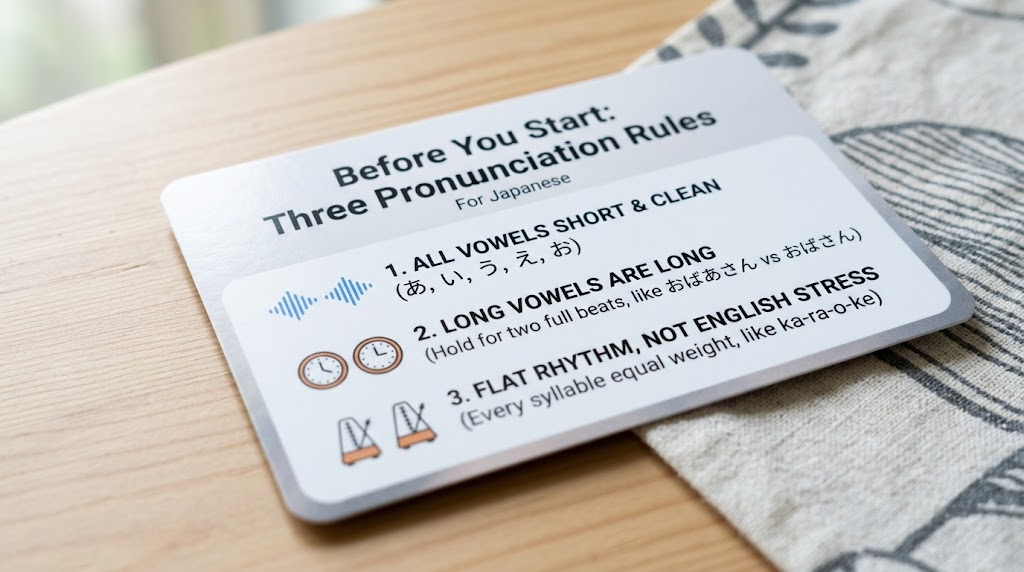
Japanese pronunciation is genuinely easier than English. But three things trip up nearly every beginner:
1. Every vowel is short and clean. あ = “ah,” い = “ee,” う = “oo,” え = “eh,” お = “oh.” No gliding, no drifting. Say them flat and short.
2. Long vowels are actually long. おばさん (obasan, aunt) and おばあさん (obāsan, grandmother) are different words. Hold the long one for two full beats. Same with おじさん and おじいさん.
3. Japanese has flat rhythm, not English stress. English speakers want to punch a syllable — ka-RA-o-ke. Japanese gives every syllable equal weight: ka-ra-o-ke. Try saying it like a metronome and it will sound instantly more natural.
Now let’s get into the phrases.
Part 1: The Eight Words You Cannot Live Without (1–8)
If you only memorize eight things from this entire article, make it these. I have watched learners get through an entire day in Tokyo on these alone.
| # | Japanese | Romaji | Meaning | Fumito’s note |
|---|---|---|---|---|
| 1 | はい | Hai | Yes | Also used as “I’m listening” — nodding along in conversation. |
| 2 | いいえ | Iie | No | In real life Japanese people soften refusals. See #6. |
| 3 | お願いします | Onegaishimasu | Please / I request this | Enormously useful. Point at something, say this, and you are understood. |
| 4 | ありがとうございます | Arigatō gozaimasu | Thank you | Drop ございます with friends. |
| 5 | すみません | Sumimasen | Excuse me / sorry / thanks | The Swiss army knife of Japanese. Calls a waiter, apologizes for bumping someone, thanks a person for trouble taken. |
| 6 | 大丈夫です | Daijōbu desu | I’m fine / it’s okay / no thank you | Learn this one carefully — it is the polite way to decline anything without saying いいえ. |
| 7 | そうです | Sō desu | That’s right | Confirms what the other person just said. |
| 8 | 違います | Chigaimasu | That’s not right | Gentle correction. Softer than shouting いいえ. |
Fumito’s tip: すみません and 大丈夫です together will carry you further than any grammar chapter. One opens a conversation, the other closes it politely.
Part 2: Introducing Yourself (9–15)
These follow はじめまして. If you want the full range of first-meeting expressions, I covered them in my list of 100 traditional Japanese greetings — here I am giving you just the core self-introduction.
| # | Japanese | Romaji | Meaning | Fumito’s note |
|---|---|---|---|---|
| 9 | 私は〜です | Watashi wa ~ desu | I am ~ | Put your name in the blank. In practice Japanese people often drop 私は entirely. |
| 10 | 名前は〜です | Namae wa ~ desu | My name is ~ | Slightly more explicit than #9. |
| 11 | 〜から来ました | ~ kara kimashita | I’m from ~ | Country or city both work: イギリスから来ました. |
| 12 | 〜歳です | ~ sai desu | I’m ~ years old | Comes up more often than you might expect. |
| 13 | 学生です / 会社員です | Gakusei desu / Kaishain desu | I’m a student / an office worker | Swap in your own job. |
| 14 | 日本語を勉強しています | Nihongo o benkyō shite imasu | I’m studying Japanese | Say this early and people will slow down for you. |
| 15 | 趣味は〜です | Shumi wa ~ desu | My hobby is ~ | The classic follow-up question in Japan. Have an answer ready. |
Notice how many of these are templates with a blank. That is the real value — you are not learning a sentence, you are learning a mould.
Part 3: Being Polite (16–22)
| # | Japanese | Romaji | Meaning | Fumito’s note |
|---|---|---|---|---|
| 16 | どういたしまして | Dō itashimashite | You’re welcome | Textbook-correct, but less frequent in casual speech than learners expect. |
| 17 | とんでもないです | Tondemonai desu | Not at all / don’t mention it | Humble and very natural when someone praises or thanks you. |
| 18 | 恐れ入りますが | Osoreirimasu ga | Excuse me, but… | An elegant opener before asking a favor of a stranger. |
| 19 | ちょっといいですか | Chotto ii desu ka | Do you have a moment? | Perfect for getting someone’s attention politely. |
| 20 | どうぞ | Dōzo | Please, go ahead / here you are | Offering a seat, a door, a dish. One word, huge range. |
| 21 | 助かりました | Tasukarimashita | You really helped me | Warmer and more specific than plain thanks. |
| 22 | 気にしないでください | Ki ni shinaide kudasai | Please don’t worry about it | Kind response when someone apologizes to you. |
Part 4: When You Don’t Understand (23–30)
This section is, in my honest opinion, the most important in the article. Beginners freeze because they have no phrase for being lost. Once you can say “please say that again,” conversations stop being frightening.
| # | Japanese | Romaji | Meaning | Fumito’s note |
|---|---|---|---|---|
| 23 | わかりません | Wakarimasen | I don’t understand | Say it early rather than nodding along. |
| 24 | わかりました | Wakarimashita | I understand / got it | Past tense, because understanding just happened. |
| 25 | 日本語が少しだけ話せます | Nihongo ga sukoshi dake hanasemasu | I speak only a little Japanese | Sets expectations kindly. |
| 26 | 英語を話せますか | Eigo o hanasemasu ka | Do you speak English? | Ask in Japanese first — it lands much better. |
| 27 | もう一度お願いします | Mō ichido onegaishimasu | Once more, please | Your single most useful repair phrase. |
| 28 | ゆっくり話してください | Yukkuri hanashite kudasai | Please speak slowly | Add すみません at the front to soften it. |
| 29 | 〜は日本語で何と言いますか | ~ wa nihongo de nan to iimasu ka | How do you say ~ in Japanese? | This phrase turns every stranger into a teacher. |
| 30 | これは何ですか | Kore wa nan desu ka | What is this? | Point and ask. Works on menus, signs, and mystery snacks. |
Fumito’s tip: Phrase #29 is the one I wish every beginner used more. Ask it once a day and you will collect vocabulary faster than any app can give it to you.
Part 5: Shopping and Money (31–37)
| # | Japanese | Romaji | Meaning | Fumito’s note |
|---|---|---|---|---|
| 31 | いくらですか | Ikura desu ka | How much is it? | Combine with これ: これはいくらですか. |
| 32 | これをください | Kore o kudasai | I’ll take this one, please | Point and say. Unbeatable. |
| 33 | 見ているだけです | Mite iru dake desu | I’m just looking | Polite way to browse without pressure. |
| 34 | カードは使えますか | Kādo wa tsukaemasu ka | Can I use a card? | Still worth asking — plenty of small shops are cash-only. |
| 35 | 袋をください | Fukuro o kudasai | Could I have a bag? | Bags are often charged now, so they will ask you. |
| 36 | 試着してもいいですか | Shichaku shite mo ii desu ka | May I try this on? | Clothing shops. |
| 37 | もっと安いのはありますか | Motto yasui no wa arimasu ka | Do you have a cheaper one? | Asking is fine; haggling is not a thing in Japan. |
Part 6: Restaurants and Food (38–44)
| # | Japanese | Romaji | Meaning | Fumito’s note |
|---|---|---|---|---|
| 38 | 〜人です | ~ nin desu | Table for ~ | 二人です (futari desu) for two people. |
| 39 | メニューをお願いします | Menyū o onegaishimasu | Menu, please | Many places have English menus if you ask. |
| 40 | おすすめは何ですか | Osusume wa nan desu ka | What do you recommend? | This question makes staff light up. Use it. |
| 41 | 〜をください | ~ o kudasai | I’ll have the ~, please | Your ordering template. |
| 42 | 美味しいです | Oishii desu | It’s delicious | Say it out loud. It is genuinely appreciated. |
| 43 | 〜が食べられません | ~ ga taberaremasen | I can’t eat ~ | Important for anything you must avoid. Say it clearly when you order, not after. |
| 44 | お会計をお願いします | Okaikei o onegaishimasu | The bill, please | In many places you pay at the front counter instead. |
Remember to open your meal with いただきます and close it with ごちそうさまでした — both are in my greetings article, and skipping them at someone’s home is the fastest way to seem rude by accident.
Part 7: Getting Around (45–50)
| # | Japanese | Romaji | Meaning | Fumito’s note |
|---|---|---|---|---|
| 45 | 〜はどこですか | ~ wa doko desu ka | Where is ~? | The single most valuable travel template in Japanese. |
| 46 | トイレはどこですか | Toire wa doko desu ka | Where is the toilet? | Yes, it deserves its own entry. |
| 47 | 駅までどうやって行きますか | Eki made dō yatte ikimasu ka | How do I get to the station? | Swap 駅 for any destination. |
| 48 | 道に迷いました | Michi ni mayoimashita | I’m lost | People will genuinely stop and help you. |
| 49 | 〜行きですか | ~ yuki desu ka | Does this go to ~? | Point at a train or bus and ask. |
| 50 | 助けてください | Tasukete kudasai | Please help me | Keep it in your pocket for real emergencies. |
The Trick: Turn 50 Phrases Into 500

Look again at the entries with a blank in them:
- 〜から来ました — I’m from ~
- 〜をください — I’ll have the ~
- 〜はどこですか — Where is ~?
- 〜は日本語で何と言いますか — How do you say ~ in Japanese?
Each of these is a template, not a sentence. Learn the shell once, and every new noun you pick up multiplies it. Ten nouns plus four templates is forty sentences, and you only memorized fourteen things.
This is how you go from “I know some words” to “I can actually say things.” Do not memorize sentences one at a time — memorize the shells and keep feeding them new words.
How to Practice These (Without Burning Out)
Here is exactly what I would do with this list:
- Pick 8 phrases, not 50. Start with Part 1. Fifty at once is how people quit.
- Say them out loud, every time. Reading silently builds recognition, not speech. Your mouth needs the reps.
- Shadow them. Find audio, play it, speak along at the same time. NHK World’s free Japanese lessons have native recordings for many of these.
- Five minutes a day beats one hour on Sunday. I explain why in my article on the 10 habits of highly effective Japanese learners.
- Use them badly, in public. Every fluent speaker you admire went through a phase of saying things wrong. It is not a detour; it is the road.
Frequently Asked Questions
How many Japanese phrases do I need for a trip to Japan? Around 20 to 30 well-chosen phrases will cover most travel situations — greetings, ordering, shopping, asking directions, and asking someone to repeat themselves. Parts 1, 4, and 7 of this list are the core.
Should I learn romaji or hiragana first? Hiragana, as early as you can manage. Romaji lets you start today, but it locks in English pronunciation habits that are hard to undo later. Most learners can read hiragana in one to two weeks.
Is Japanese hard for English speakers? Pronunciation and basic sentence patterns are comparatively easy. The writing system and politeness levels are where the real work sits. Speaking simple Japanese comes much faster than most beginners expect.
Do I need to be polite all the time? As a beginner, yes — stick to the です/ます forms used throughout this list. They are appropriate with strangers, staff, colleagues, and new friends. Casual speech is something to pick up later, from people who use it with you first.
What does “desu” actually mean? It functions roughly like “is” or “am,” and it also marks your sentence as polite. For now, treat it as the polite ending you attach to statements.
Keep Going
You now have 50 phrases and a template trick to multiply them. Next steps I would suggest:
- Learn the 100 traditional Japanese greetings so you can open and close any conversation properly
- Build your reading foundation with my 100 essential hiragana words
- Work through Lesson 1: greetings and introductions for full practice dialogues
- Aiming at the exam? Start with my JLPT N5 preparation checklist
- Studying with ADHD or dyslexia? My dedicated guide has strategies that work well with phrase lists like this one
So which phrase are you going to use first? Leave a comment and tell me — and if you are already in Japan, tell me how it went. My guess is #40, おすすめは何ですか, will get you the best meal of your trip.
Ganbatte, and I will see you in the next lesson!
— Fumito