

Hi everyone, Fumito here! Welcome back to reading-japanese.com. Today I want to talk about something a little different from grammar or vocabulary — I want to talk about you, the learner, and the habits that separate people who actually reach their Japanese goals from people who buy a textbook, read chapter one, and then… disappear.
So the question is: what do successful Japanese learners — people who set goals and actually hit them — do differently? And are you already doing some of these things?
Let’s get into the 10 habits. I will give you real, step-by-step examples for each one, and honestly, it doesn’t matter if you are studying with our lessons here on reading-japanese.com, a textbook, an app, or a podcast. These habits work no matter what tool you are using.

Habit 1: Set Small, Measurable Goals With Deadlines

This is the most important habit, so I put it first on purpose.
A lot of learners set a big, foggy goal like “I want to be fluent someday.” Then they buy a textbook, read the first chapter, and start wondering… am I even getting better? They start worrying they will never be fluent, and then they quietly give up.
Instead, set small goals you can actually measure. For example:
- Learn 100 new words this month
- Have a one-minute conversation in Japanese by the end of the month
- Finish our free hiragana words lesson by November 30th
A deadline plus a number is much more powerful than a dream.
Habit 2: Create a Routine
Your routine is what turns your goal into reality. This connects directly back to Habit 1 — if your goal is “learn 100 words this month,” break it down: that is roughly 3-4 words a day, maybe 15 minutes of study.
Now you have something concrete: 15 minutes, once a day.
Next, decide when and where you will do it. Why does this matter? Because once you set that time in your head, it becomes “Japanese time,” and you protect it. Your goals deserve first priority, even if it is just a small slot of your day.
Habit 3: Don’t Cram
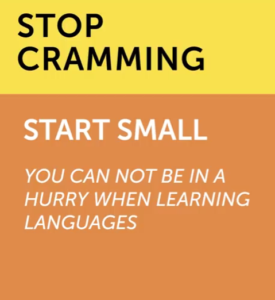
Cramming might have worked for you back in school before an exam. But learning a language is not a test you pass once — it is a marathon, not a sprint.
If you try to force five hours of study today, you will burn out fast, start resenting the process, and that is exactly how people give up on their dream of speaking Japanese.
But if you do just five to fifteen minutes a day, every day, it never feels overwhelming — and that is how you actually succeed long-term.
Habit 4: Prepare Lines and Conversations Ahead of Time
If you are like most learners, speaking is the scary part. And a big reason for that is simple: you just don’t have the words ready in your head when you need them. Preparation fixes this.
Imagine you meet someone for the first time. What do you say? “Hello, how are you? What’s your name? Where are you from? What are your hobbies?”
If you prepare these questions and answers ahead of time, you always have something ready to say. On reading-japanese.com, I always try to build lessons around exactly this kind of real, everyday exchange — the questions and answers you will actually use in conversation, like your name, where you’re from, how old you are, how your weekend was.
Another simple trick: make a list of phrases you personally want to say, and get the Japanese translation for those specific phrases. Lines like “My name is ___,” “I am from ___,” “This weekend I ___.” These are the sentences you will reuse constantly.
Habit 5: Get Into the Habit of Producing Output
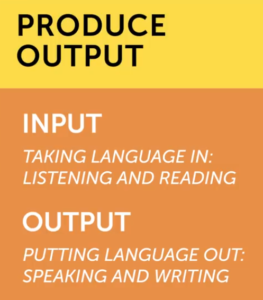
Input is language coming in — listening and reading. Output is language going out — speaking and writing.
It is very easy to just sit back and listen to lessons or watch videos all day. But listening only trains your listening. It will not, by itself, get you speaking.
So here are two easy ways to force output:
- For speaking: repeat out loud what you hear. This is called shadowing.
- For writing: copy sentences out by hand — from a dialogue, a textbook, or one of our articles here on reading-japanese.com.
Habit 6: Come Back and Review
Reading something once does not mean it stays in your brain forever. Reviewing is what turns “I saw this once” into “I know this.”
Spaced repetition flashcards are a classic tool here, and a huge number of successful learners rely on them — I actually rounded up my favorite tools for this in my best kanji learning apps guide, which covers a few spaced-repetition options.
Another simple habit: save your favorite lessons or dialogues, make a playlist, and listen to them again and again — just like you would replay a song you like. Before you know it, you will know these conversations by heart.
Habit 7: Look for Solutions
Here is something interesting that separates beginners from experienced learners: how they react when they don’t understand something.
Beginners tend to blame the tool. “This textbook is boring.” “This class doesn’t help me speak.” But if a book isn’t making you speak, is that really the book’s fault? And if a class isn’t helping and you’re not raising your hand or practicing outside of it either — whose responsibility is that?
Experienced learners get into the habit of asking, “okay, what’s the solution here?” instead of just complaining.
Habit 8: Focus on What You’re Good At

This one is about motivation. If you’re naturally a bit stronger at speaking than writing, lean into that a little. You’ll enjoy it more, which means you’ll keep doing it, which means it becomes a sustainable routine.
Building on your strengths first doesn’t mean ignoring your weak points forever — it just means giving yourself early wins so you don’t quit.
Habit 9: Don’t Procrastinate
Easier said than done, I know! A lot of procrastination comes from overthinking. You remember “I have to study today,” and suddenly it feels like a huge chore before you’ve even opened a book.
But if your goal is small and your routine is simple — just five minutes — then there’s nothing to overthink. You just… do the five minutes, and you’re done.
Habit 10: Remember, It’s a Marathon, Not a Sprint
There is no need for five-hour cram sessions that leave you exhausted. Five or ten minutes a day, consistently, is genuinely enough.
Keep this one in your back pocket for the hard days too. If you have a bad day and can’t remember some grammar point, it is not the end of your Japanese journey — it’s just a small bump in the road. Stick with short, manageable lessons and you’ll stay in the marathon for the long run.
Keep Going With These Free Resources
If any of these habits resonated with you, here are a few things on reading-japanese.com that pair well with them:
- The JLPT N5 preparation checklist — great for turning Habit 1 (small measurable goals) into an actual study plan
- The katakana guide and 100 hiragana words — perfect short daily lessons for Habit 3 (don’t cram)
- The best kanji learning apps roundup — good options for Habit 6 (spaced repetition and review)
- If you learn a little differently, my pillar article on learning Japanese with ADHD and dyslexia has some extra strategies worth reading alongside this one
Sign up for a free account on reading-japanese.com and I’ll help you build a routine that actually sticks.
Your Turn
So tell me — which of these 10 habits are you already doing, and which one do you need to start this week? Leave a comment below and let me know. And if you know someone learning Japanese who keeps starting over, share this with them — sometimes all it takes is a small, doable goal to get unstuck.
Ganbatte, and I’ll see you in the next lesson!
— Fumito