
Japanese Long Vowels, Pitch Accent and Basic Verbs for Beginners (zenzen wakarimasen meaning)

千里の道も一歩から Senri no michi mo ippo kara — “A journey of a thousand miles begins with a single step.”
If you’ve been learning Japanese for a little while and you notice that some words sound longer than others, or that the pitch of a word goes up and then suddenly drops — your not imagining it. Japanese pronunciation has some really interesting features that most beginners don’t get taught early enough, and understanding them makes a huge difference in how natural you sound.
In this lesson we’ll cover three things that don’t always get enough attention in beginner courses: long vowels, long consonants, and pitch accent. Then we’ll move into a full set of speaking drills and a short beginner dialogue from a real office situation. By the end you should have a much clearer picture of how Japanese actually sounds — and feel more confident trying it out yourself.
If you haven’t gone through the basics yet, I’d recommend reading my posts on Japanese greetings and daily phrases and how to learn hiragana and katakana before going through this one — those two cover the foundational stuff this lesson builds on.
📌 How to use this lesson: Don’t just read — say every example out loud. Exaggerate the long vowels and try to imitate the pitch patterns. That physical practice is what actually trains your mouth and ears, not just your eyes.
Japanese Long Vowels – What They Are and Why They Matter
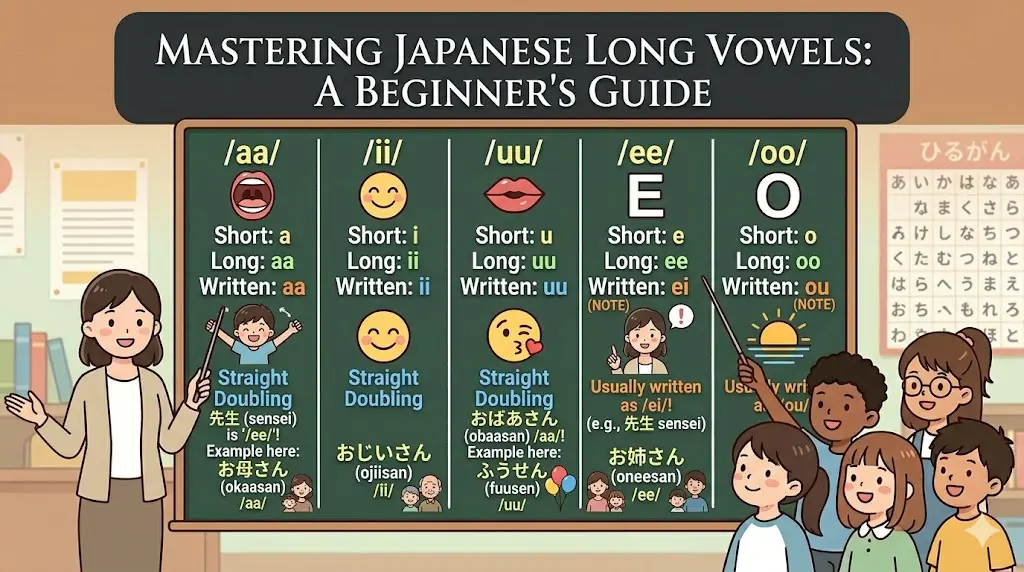
Japanese has five basic vowels: a, i, u, e, o. Each of these also has a “long” version, which simply means you hold the sound for twice the normal duration. In Japanese, vowel length is not just an accent thing — it can actually change the meaning of a word completely. This trips up a lot of beginners who aren’t paying attention to it.
There are five long vowels in Japanese: /aa/, /ii/, /uu/, /ee/, and /oo/.
| Short vowel | Long vowel | Written as (romaji) | Note |
|---|---|---|---|
| a | aa | aa | Straight doubling |
| i | ii | ii | Straight doubling |
| u | uu | uu | Straight doubling |
| e | ee | ei (e.g. 先生 sensei) | Usually written as /ei/ in Japanese |
| o | oo | ou (e.g. おはよう ohayou) | Usually written as /ou/ in Japanese |
⚠️ Watch out for /e/ and /o/: The long versions of thes two vowels are where most beginners get confused. The long /e/ sound is usually spelled ei in Japanese writing — like in sensei (先生, teacher). And the long /o/ is usually spelled ou — like in ohayou (おはよう, good morning) or doumo (どうも, thanks). Even though they’re written with two different letters, you pronounce them as one long, held vowel sound.
A classic example that shows why this matters — ojisan (おじさん) means “uncle,” but ojiisan (おじいさん) means “grandfather.” Same word, one extra held vowel, completely different meaning. This is why getting long vowels right really does matter if you want to be understood correctly!
For a deeper look at how hiragana and katakana represent these long vowel sounds in writing, check out my post on learning hiragana and katakana fast — it covers the long vowel rules in writing in more detail.
Japanese Long Consonants – The Silent Beat You Can’t Ignore
As well as long vowels, Japanese also has long consonants. This is another thing that sounds a bit strange when you first hear about it, but once you get it, it clicks pretty quickly.
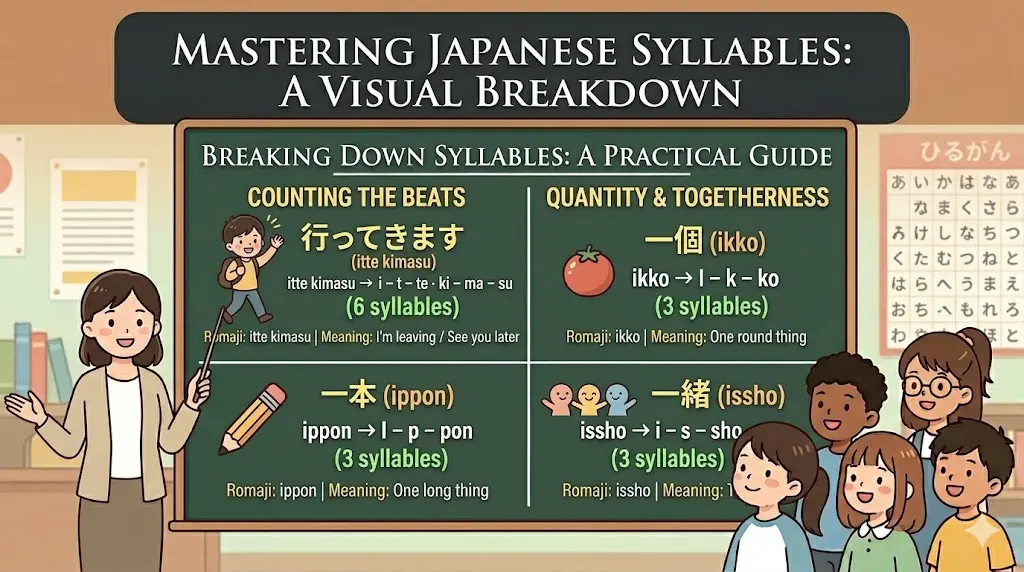
The consonants /t/, /s/, /k/, and /p/ can be “long” — meaning they take up a full syllable of time even though they produce no actual sound in that beat. Think of it like a pause that has weight and timing to it. In hiragana writing, these are represented by a small っ (small tsu).
Here are some real examples with syllable counts broken down:
| Word / Phrase | Syllable breakdown | Meaning |
|---|---|---|
| itte kimasu | i – t – te · ki – ma – su (6 syllables) | I’m leaving / See you later |
| ippon | I – p – pon (3 syllables) | One long thing (e.g. one pencil) |
| ikko | I – k – ko (3 syllables) | One round thing |
| issho | i – s – sho (3 syllables) | Together |
And the consonant /n/ is special — it can take up a whole syllable entirely on its own. The most famous example of this is konnichiwa (こんにちは), which has 5 syllables: ko – n – ni – chi – wa. That middle “n” is a syllable all by itself! This is why the Japanese ん (n) is called a “syllabic n” and why it has its own hiragana character separate from the other n sounds.
🎵 Practice tip: When you encounter a double consonant in romaji (like issho, ikko, itte), make a very brief stop before the consonant — almost like you’re hesitating for a split second. That pause is the “silent beat” of the long consonant. Clapping or tapping your finger for each syllable while you practice really helps you feel the rhythm.
Japanese Pitch Accent – How Rising and Falling Pitch Changes Meaning
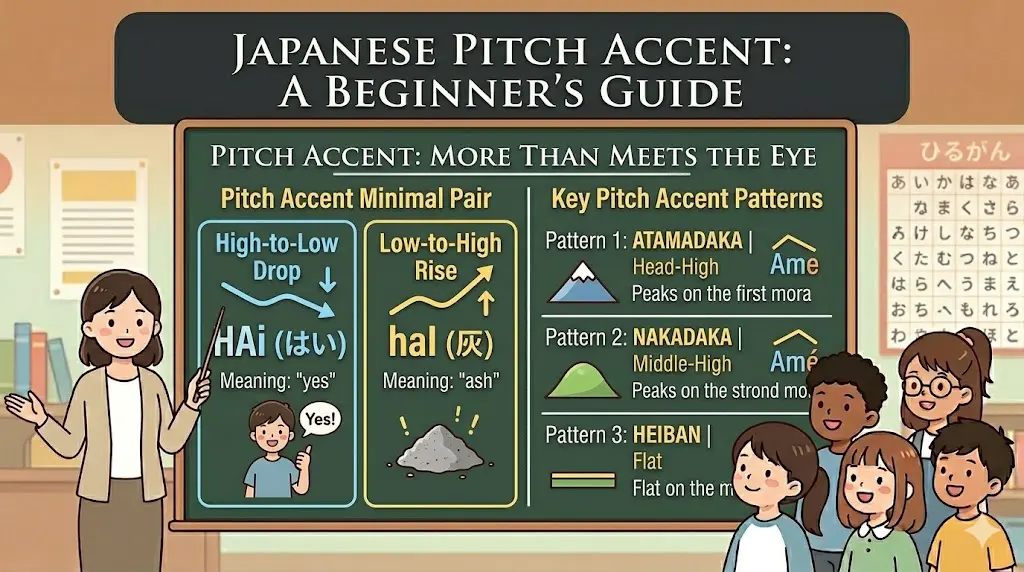
This is the part that surprises most people when they first hear about Japanese pronunciation. Unlike English, which uses loudness (stress) to distinguish words, Japanese uses pitch — the highness or lowness of your voice — to change meaning. This is called pitch accent.
English has stress accent. Compare: INsult (noun) vs inSULT (verb) — the stressed syllable is louder. Japanese instead changes which syllable is high or low in pitch.
A simple example that shows this clearly:
Pitch Accent Minimal Pair
HAi→ “yes” (falls from high to low)
haI→ “ash” (rises from low to high)
Capitalized / overlined syllable = high pitch
Same spelling, totally different meaning depending on pitch. And this isn’t just a special case — all Japanese words have a pitch pattern. Here’s a breakdown of the main patterns you’ll encounter:
Fall Pattern (starts high, drops)
JAa”well then”
DOumo”thanks”
DOuzo”go ahead”
Rise Pattern (starts low, goes high)
iIE”no”
saYONAra”goodbye”
taDAIMA”I’m home”
oHAYOU”good morning”
yoROSHIKU”nice to meet you”
Rise and Fall Pattern
aRIGAtou”thanks”
shiTSUREI-shimasu”excuse me”
suMIMASEn”sorry”
Pitch on Single-Syllable Words
When a word has only one syllable, the pitch rise or fall happens with the following word. For example:
HA desu→ “It’s a tooth.” (ha = high)
ha DEsu→ “It’s a leaf.” (ha = low, de = high)
Pitch Accent and Culture – Why It Also Matters Socially
Here’s something that most textbooks don’t mention enough — pitch in Japanese isn’t just about individual words, it also carries social meaning at the sentence level. Speaking in a higher overall pitch is generally associated with politeness and gentleness in Japanese culture. Customer service staff, receptionists, and sales people all tend to speak with a noticably higher pitch when talking to customers. Women also tend to speak at a higher pitch in professional settings.
This doesn’t mean you need to speak unnaturally high — but it does mean that how you modulate your pitch sends signals to Japanese speakers about your attitude and intention. As a general rule for beginners: bow, smile, and speak gently. That combination alone communicates a lot of goodwill even when your Japanese is still a work in progress.
💡 Pitch accent and dialects: Pitch accent patterns actually vary significantly by region in Japan. Tokyo Japanese (standard Japanese) has the patterns listed in this lesson. But Osaka and Kyoto Japanese (Kansai dialect) has completley different pitch patterns for many words — which is one of the reasons the Kansai accent sounds so distinctive to Japanese ears. Don’t worry about this as a beginner, just be aware it exists.
Speaking Drill A – Responding to Introductions
In this drill, someone tells you their name and you respond by confirming it and saying hajimemashite. This is exactly how real first introductions work in Japanese — the other person introduces themselves, and you confirm their name back as a polite gesture.
Model:
Cue: グレーです。 — Guree desu. — I’m Grey.
Response: グレーさんですか。はじめまして。 — Guree-san desu ka. Hajimemashite. — Ms. Grey? How do you do?
Practice the same response pattern with all the names below. Say your response out loud before checking:
| # | Cue (they say) | Japanese script | Your response |
|---|---|---|---|
| 1 | Jonson desu. | ジョンソンです。 | Jonson-san desu ka. Hajimemashite. |
| 2 | Yamamoto desu. | 山本です。 | Yamamoto-san desu ka. Hajimemashite. |
| 3 | Sumisu desu. | スミスです。 | Sumisu-san desu ka. Hajimemashite. |
| 4 | Yamada desu. | 山田です。 | Yamada-san desu ka. Hajimemashite. |
| 5 | Kimura desu. | 木村です。 | Kimura-san desu ka. Hajimemashite. |
| 6 | Hiru desu. | ヒルです。 | Hiru-san desu ka. Hajimemashite. |
| 7 | Suzuki desu. | 鈴木です。 | Suzuki-san desu ka. Hajimemashite. |
| 8 | Tanaka desu. | 田中です。 | Tanaka-san desu ka. Hajimemashite. |
Speaking Drill B – Say It in Japanese
Try to say each of the following in Japanese yourself first, then check the answer. If you need a refresher on any of these expressions, my full Japanese greetings guide covers every one of them in detail with dialogue examples.
- Good evening. → Konbanwa. こんばんは。
- Good morning. (to a friend) → Ohayou. おはよう。
- Good morning. (to a teacher) → Ohayou gozaimasu. おはようございます。
- Ms. Honda, good morning. → Honda-san, ohayou gozaimasu. 本田さん、おはようございます。
- Thanks. (to a friend) → Doumo. どうも。
- Thank you. (to a teacher) → Arigatou gozaimasu. ありがとうございます。
- You’re welcome! → Dou itashimashite. どういたしまして。
- Thank you very much. (for what you are about to do) → Arigatou gozaimasu. ありがとうございます。
- Thank you very much. (for what you did) → Arigatou gozaimashita. ありがとうございました。
- I’ll start eating. → Itadakimasu. いただきます。
- Well then, I’ll start eating. → Jaa, itadakimasu. じゃあ、いただきます。
- Thank you for the delicious treat. (to a family member) → Gochisousama. ごちそうさま。
- Thank you for the delicious treat. (politely) → Gochisousama deshita. ごちそうさまでした。
- Thank you very much for the delicious treat. → Doumo gochisousama deshita. どうもごちそうさまでした。
- I’m sorry. → Sumimasen. すみません。
- I’m very sorry. → Doumo sumimasen. どうもすみません。
- I’m very sorry. (for what happened) → Doumo sumimasen deshita. どうもすみませんでした。
- Please help me. / Thank you in advance. → Onegaishimasu. お願いします。
- Professor, excuse me. → Sensei, shitsurei-shimasu. 先生、失礼します。
- Good-bye. → Sayonara. さよなら。
- Well, Professor, excuse me. Good-bye. → Jaa, sensei, shitsurei-shimasu. Sayonara. じゃあ、先生、失礼します。さよなら。
- Good night! (to a friend) → Oyasumi. おやすみ。
- Good night. (politely) → Oyasuminasai. おやすみなさい。
- Good work! / Thanks for the hard work. → Otsukare-sama deshita. おつかれさまでした。
- Good work. Good night. → Otsukare-sama deshita. Oyasuminasai. おつかれさまでした。おやすみなさい。
- Thank you. I’ll have some… It was delicious. → Arigatou gozaimasu. Itadakimasu… Gochisousama deshita.
- Thank you very much. I’ll have some. → Doumo arigatou gozaimasu. Itadakimasu.
- Excuse me. (for what I am about to do) → Shitsurei-shimasu. 失礼します。
- Excuse me. (for what I did) → Shitsurei-shimashita. 失礼しました。
- How do you do? → Hajimemashite. はじめまして。
- My name is Johnson. How do you do? → Jonson desu. Hajimemashite. ジョンソンです。はじめまして。
- My name is Johnson. How do you do? Very glad to meet you. → Jonson desu. Hajimemashite. Douzo yoroshiku onegai-shimasu.
- Good morning. See you later. (heading out) → Ohayou gozaimasu. Itte kimasu. おはようございます。いってきます。
- See you later. (responding) → Itte rasshai. いってらっしゃい。
- I’m back. → Tadaima. ただいま。
- Welcome back. → Okaerinasai. おかえりなさい。
Speaking Drill C – Role Play Situations
These role play scenarios practice using everything you’ve learned so far in realistic situations. Try to do each one with a partner if you can, using proper body language and facial expressions. Bowing at the right moments is part of the communication!
- Greet your coworkers in the morning.
- Leave the office to go to a meeting outside.
- You are meeting Ms. Honda, a business associate, for the first time. Introduce yourself.
- Offer a seat to a client.
- Accept a gift from a visitor.
- Start eating lunch.
- Thank a supervisor for treating you to a meal at a restaurant.
- Hand a report to the assistant to make copies.
- Thank a coworker for making copies for you.
- Visit the office of a supervisor.
- Leave the office of a supervisor.
- Ask a coworker to pass a document to you.
- Say good-bye to a coworker who is about to go home.
- Say good-bye to coworkers as you leave the office to go home.
- Say good night to friends as you part after a night out.
- Say good-bye to coworkers as you leave an office party.
📌 Reminder: In Japanese workplace situations, the level of politeness in your language matters a lot. With supervisors and clients, always use the full polite forms — arigatou gozaimasu, shitsurei-shimasu, onegaishimasu — never the short casual versions. With close coworkers of the same level, casual forms are generally fine once you have an established relationship with them.
Lesson 1 Dialogue – New to the Office
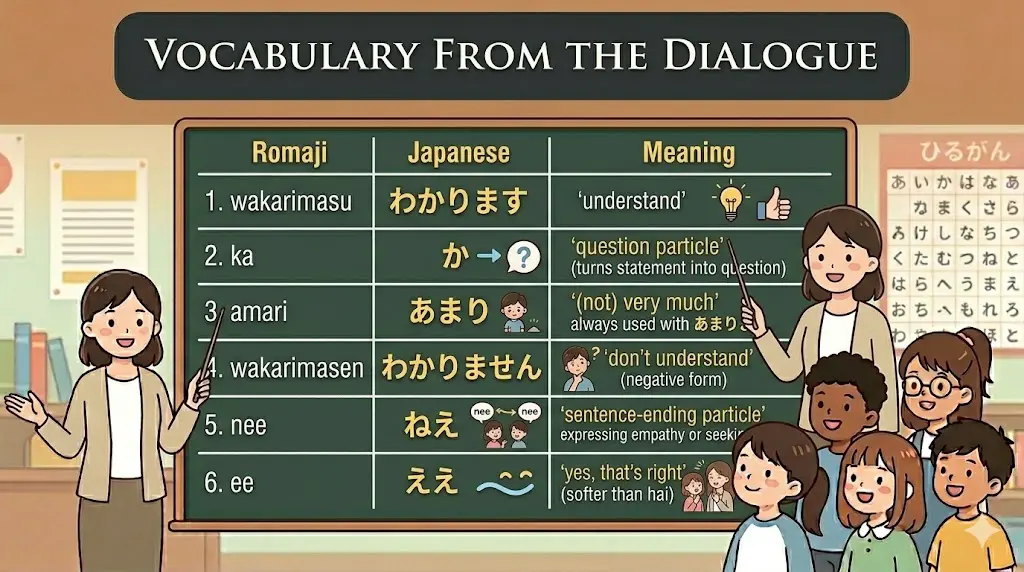
This is a real-life style dialogue between two new employees — Smith and Honda — who are working on a project report together. This kind of simple back-and-forth is exactly what you’d encounter in a real Japanese workplace on your first few days.
Practice each line out loud and add one line at a time until you can do the whole dialogue from memory.
Smith: わかりますか。 — Wakarimasu ka. — Do you understand it?
Honda: いいえ、あまりわかりませんねえ。 — Iie, amari wakarimasen nee. — No, I don’t understand very well.
Smith: わかりませんか。 — Wakarimasen ka. — You don’t?
Honda: ええ。 — Ee. — Right.
Vocabulary from the Dialogue
| Romaji | Japanese | Meaning |
|---|---|---|
| wakarimasu | わかります | understand |
| ka | か | question particle (turns statement into question) |
| amari | あまり | (not) very much — always used with a negative verb |
| wakarimasen | わかりません | don’t understand (negative form) |
| nee | ねえ | sentence-ending particle expressing empathy or seeking agreement |
| ee | ええ | yes, that’s right (softer than hai) |
💡 Wakarimasu vs Wakarimasen: This is your first example of Japanese verb conjugation. The positive form is wakarimasu (I understand) and the negative is wakarimasen (I don’t understand). You just swap the masu ending for masen. This pattern works for almost all polite-form verbs in Japanese — it’s one of the most useful things to learn early. For more on this, check out my post on Japanese verb conjugation for beginners.
Additional Vocabulary – Common Beginner Verbs
These words don’t appear in the dialogue above but are closely related and will come up very soon in your Japanese studies. Learn them alongside the dialogue vocabulary:
| Romaji | Japanese | Kanji | Meaning |
|---|---|---|---|
| zenzen | ぜんぜん | 全然 | not at all (used with negative verb) |
| yoku | よく | — | well / a lot / often |
| tokidoki | ときどき | 時々 | sometimes |
| shimasu | します | — | do / play |
| tabemasu | たべます | 食べます | eat |
| nomimasu | のみます | 飲みます | drink |
| tsukurimasu | つくります | 作ります | make |
| norimasu | のります | 乗ります | ride / get on |
📌 Using amari and zenzen correctly: Both of these words are used with negative verbs in Japanese. You can say amari wakarimasen (I don’t understand very well — partial negative) or zenzen wakarimasen (I don’t understand at all — complete negative). Using them with a positive verb is grammatically incorrect in standard Japanese. So amari wakarimasu doesn’t work — you need the negative wakarimasen to go with it.
Review Questions
These questions cover everything from this lesson and the previous greetings lesson. Try to answer each one before looking back at the content — it’s the best way to check what you’ve actually retained.
- What is the difference between ohayou and ohayou gozaimasu?
- What is the difference between arigatou gozaimasu and arigatou gozaimashita?
- What is the difference between sayonara and itte kimasu?
- Which is more polite — arigatou or doumo?
- Why can’t you attach –san or –sensei to your own name?
- What is the difference between gomen and gomen nasai? Who typically uses the latter?
- What are three different ways to use hai?
- When do you use aa? How about jaa?
- What is the Japanese equivalent for “thank you in advance” for a job you’ve just requested?
- How many Japanese expressions for “thank you” can you list? Can you describe a typical situation for each one?
- What is pitch accent? How is it different from the stress accent used in English?
- What are the five vowels in Japanese? What are the five long vowels? What are the long consonants?
FAQ – Japanese Pronunciation and Beginner Verbs
What are the long vowels in Japanese?
The five long vowels in Japanese are /aa/, /ii/, /uu/, /ee/, and /oo/. They are simply the five standard vowels held for twice the normal duration. In writing, /aa/, /ii/, and /uu/ are doubled normally, but the long /e/ is usually written as ei (like in sensei) and the long /o/ is usually written as ou (like in ohayou or doumo).
Does vowel length matter in Japanese?
Yes, it matters a lot! Long vowels can completely change the meaning of a word. For example, ojisan means “uncle” but ojiisan (with a long ii) means “grandfather.” Getting vowel length wrong can cause genuine confusion, so it’s worth practising from the very beginning.
What is pitch accent in Japanese?
Pitch accent is the way Japanese uses rises and falls in the pitch (highness or lowness) of the voice to distinguish words and meaning. Unlike English which uses loudness (stress), Japanese uses pitch. A classic example is hai — said with a falling pitch it means “yes,” but with a rising pitch the same sound means “ash.” Every Japanese word has a pitch pattern: fall, rise, or rise-and-fall.
Is Japanese pitch accent hard to learn?
For most beginners it takes time to hear and reproduce pitch patterns, but its definitely learnable with practice. The good news is that even without perfect pitch accent, native Japanese speakers will generally understand you — pitch errors rarely cause serious misunderstandings in context. That said, getting pitch accent right does make you sound more natural and is worth working on as you advance. Listening to a lot of native Japanese speech (anime, NHK news, Japanese podcasts) is probably the best way to train your ear.
What does “wakarimasu” mean in Japanese?
Wakarimasu (わかります) means “I understand” or “I know.” The negative form is wakarimasen (わかりません) meaning “I don’t understand.” This is one of the most useful phrases you can know as a beginner — you’ll use wakarimasen often when you’re starting out! A related casual phrase is wakatta (わかった) meaning “got it” or “I understand” in informal situations.
What is the difference between “ee” and “hai” in Japanese?
Both ee (ええ) and hai (はい) mean “yes” in Japanese, but they have a slightly different feel. Hai is more formal and clear — it’s what you’d say to a teacher or in a professional setting. Ee is softer and more casual, more like “yeah” or “right” in English. You’ll hear ee used a lot in natural conversation to show agreement while someone else is talking.
What does “nee” mean at the end of a Japanese sentence?
Nee (ねえ) is a sentence-ending particle in Japanese that expresses empathy, shared feeling, or a gentle request for agreement — similar to “right?” or “isn’t it?” in English. So amari wakarimasen nee is roughly “I don’t really understand… do you know what I mean?” It makes the sentence feel warmer and more conversational. You’ll hear nee and its variant ne constantly in Japanese conversation.
How do you say “I don’t understand at all” in Japanese?
You say zenzen wakarimasen (全然わかりません). Zenzen means “not at all” and it must be used with a negative verb ending (like masen). If you only partially don’t understand, use amari wakarimasen (I don’t understand very well / not that much). Both are extremely useful phrases for learners!
What’s Next?
You’ve now covered Japanese long vowels, long consonants, pitch accent, and a first office dialogue with beginner verbs. That’s actually a solid chunk of the pronunciation foundation of Japanese — most learners don’t get this far this clearly until much later in their studies.
The next natural steps from here are to start working on how Japanese sentences are actually structured — the basics of Japanese grammar. Word order in Japanese is quite different from English (it goes Subject – Object – Verb instead of Subject – Verb – Object), and understanding that early makes everything else click a lot faster.
Head over to Japanese verb conjugation for beginners to continue from where this lesson left off, or revisit the greetings and daily phrases lesson to practice the expressions from the drills above with more context and dialogue examples.
頑張ってください!(Ganbatte kudasai!) — Keep going! 🎌
— Fumito フミト | reading-japanese.com
📚 Related lessons on reading-japanese.com:
→ Japanese Greetings and Daily Phrases for Beginners→ How to Learn Hiragana and Katakana Fast→ Japanese Verb Conjugation for Beginners (masu / masen)→ How to Introduce Yourself in Japanese (Jiko Shoukai)→ Common Japanese Phrases for Travel in Japan→ Best Free Apps to Learn Japanese at Home
External resources referenced:
NHK World Japanese Lessons (Free) | Anki Flashcards | Duolingo Japanese