
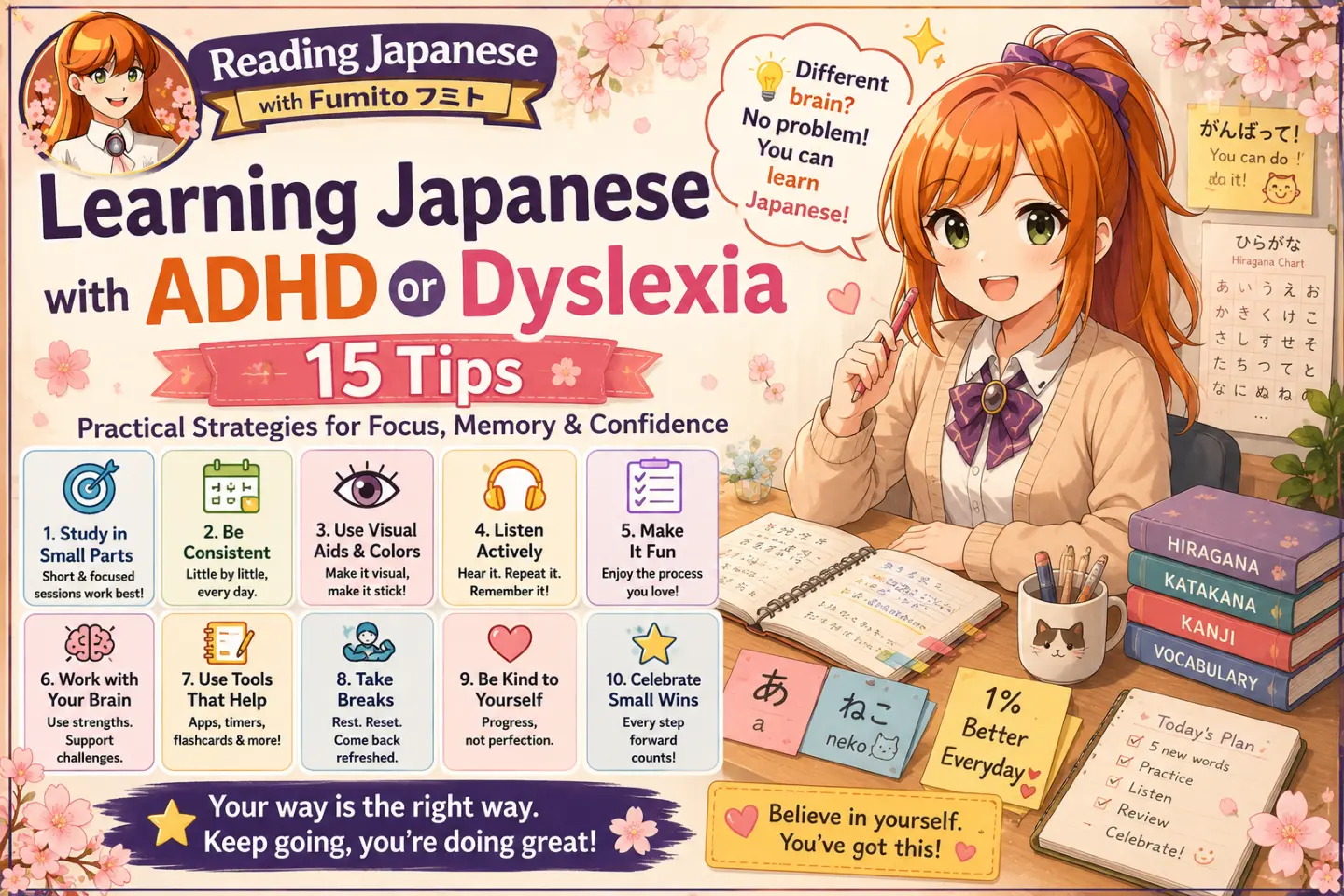

If you have ADHD or dyslexia, and you are wondering whether you can really learn Japanese, I want to say this clearly, right at start: yes, you can.
I know studying new language can feel intimidating when your brain works little differently than “traditional” classroom expects. Maybe you tried textbook before and lost focus after ten minutes. Maybe kanji looks like overwhelming wall of tiny lines to you. Maybe someone told you, directly or not directly, that language learning “just isn’t for you.”
Learning Japanese with ADHD or Dyslexia
None of this means you cannot learn Japanese. It just means usual study methods were not built with your brain in mind. In this guide, I will walk you through why Japanese can feel hard, why it can also be surprisingly manageable, and fifteen practical tips you can start using today. This article is long on purpose, because I want it to be resource you can come back to, again and again.
Let’s get started, okay?
Why Learning Japanese Can Feel Difficult
Before we talk about solutions, it helps to understand what is actually going on. Language learning asks lot from several brain systems at same time, and ADHD or dyslexia can make certain parts of this process harder.
Focus and attention. Traditional study methods often assume you can sit still and concentrate on one page for thirty minutes straight. For many people with ADHD, that is simply not how attention works. Interest and novelty drive focus much more than willpower does.
Working memory. Learning language means holding new sounds, meanings, and grammar rules in your head at same time. ADHD and dyslexia can both make working memory feel like small desk that is already full of things.
Reading speed and visual processing. Dyslexia often affects how quickly and accurately brain decodes written symbols. Japanese uses three writing systems, so this can feel like extra layer of challenge, especially with kanji.
Executive function. Planning study schedule, breaking big goal into steps, and sticking with it over weeks or months, all of this relies on executive function. This is often one of harder areas for people with ADHD.
Anxiety and overwhelm. When subject caused frustration before, it is natural to feel anxious approaching it again. That anxiety can make focus and memory even harder, and this creates frustrating cycle.
None of these challenges are reflection of your intelligence or potential. They are simply differences in how your brain manages attention, memory, and visual information. Once you understand them, you can work with your brain instead of against it.
Can People with ADHD or Dyslexia Become Fluent?
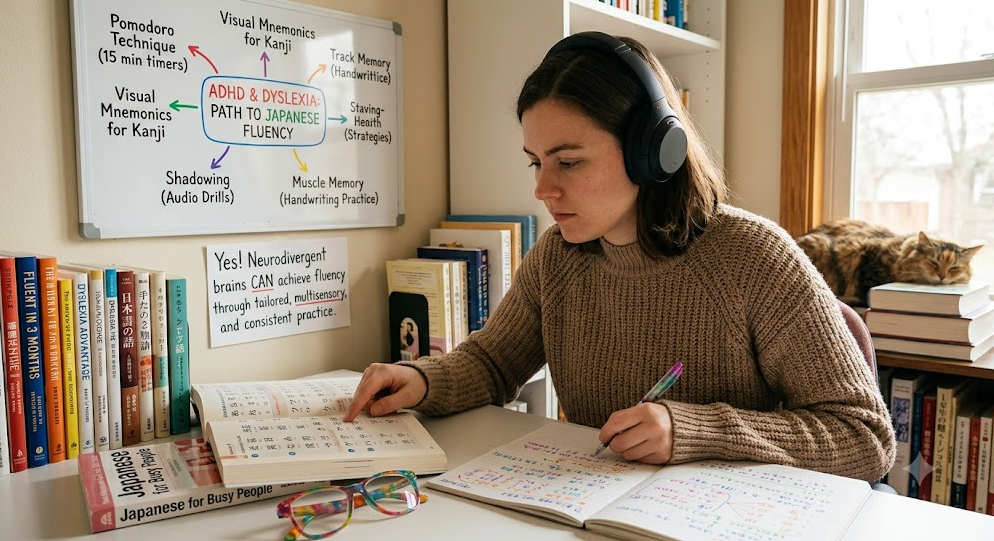
Yes. Many people with ADHD and dyslexia have learned second and third languages successfully, including Japanese. Fluency is not reserved only for people with certain kind of brain. It is built through consistent, engaged practice, using methods that fit how you personally learn best.
I want to be honest with you here, because I do not believe in making promises I cannot back up. I am not doctor, and I cannot give medical advice or claim any study method “cures” ADHD or dyslexia. What I can tell you, from years of watching learners of all kinds work through this language, is that students who struggle most are usually ones using methods that do not match how their brain works. Moment they switch to more flexible, active, multisensory techniques, things often start clicking for them.
If focus or reading challenges feel like they are affecting more than just language study, it is worth talking with doctor, therapist, or learning specialist. Professional support and language learning are not in competition with each other. They can work together, I think.
Why Japanese Can Actually Be Easier in Some Ways
Here is something that surprises lot of my students: in certain ways, Japanese is actually more predictable than English.
Phonetic pronunciation. Japanese has small, consistent set of sounds. Once you learn how character is pronounced, it is pronounced same way almost every single time. Compare this to English, where “read” can rhyme with “reed” or “red” depending on sentence.
Consistent grammar patterns. Japanese grammar follows clear, repeatable structures. Verbs conjugate in predictable ways, and once you learn one pattern, it tends to apply broadly across whole language.
Hiragana and katakana are phonetic alphabets. Unlike English spelling, which is full of exceptions, hiragana and katakana map directly to sounds. There are 46 basic characters in each set, and once they are memorized, you can read (even if you don’t understand every word yet, that is okay).
Predictable sounds mean fewer surprises. English readers with dyslexia often struggle because same letters can represent different sounds. Japanese phonetic writing removes lot of this unpredictability.
Kanji is trickier part, I will not pretend otherwise. But even kanji is often built from smaller, repeating visual components called radicals, and this means pattern-recognition strategies (something many ADHD and dyslexic learners are naturally strong at) can genuinely help you.
15 Practical Tips for Learning Japanese
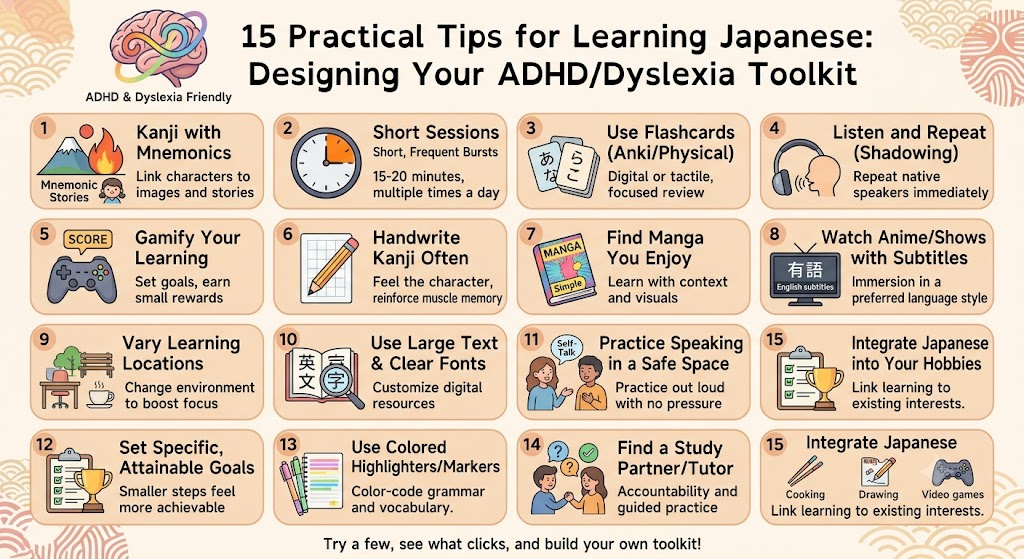
These tips are designed specifically with ADHD and dyslexia in mind. Try few of them, see what clicks for you, and build your own toolkit from there.
1. Use the Pomodoro Technique
Explanation: Study in short, timed bursts (often 15 to 25 minutes) followed by short break.
Why it works: Short sessions reduce pressure of “I have to focus for one hour,” which can feel impossible. Visible timer also creates sense of urgency that supports focus.
Real-life example: One of my students used to avoid studying because thirty minutes felt endless to her. Switching to 15-minute Pomodoro sessions made starting feel much less intimidating.
Action steps:
- Set a timer for 15–20 minutes.
- Study one specific task only (for example, five hiragana characters).
- Take a five-minute break, then decide whether to continue.
2. Try Body Doubling
Explanation: Study in presence of another person, even if they are doing something completely different from you.
Why it works: Having someone nearby, in person or on video call, can boost accountability and focus without adding pressure to perform well.
Real-life example: Some learners join online “study with me” video sessions specifically for this reason.
Action steps:
- Find a friend, study buddy, or online study room.
- Study alongside them silently for one Pomodoro session.
- Check in briefly afterward about what you each accomplished.
3. Use Spaced Repetition
Explanation: Review material at increasing intervals over time, instead of cramming everything at once.
Why it works: Spaced repetition matches how memory naturally consolidates, so it reduces working memory strain of trying to hold everything at once.
Real-life example: Student memorizing hiragana reviewed each character right before forgetting it, based on app’s schedule, rather than repeating whole chart every day.
Action steps:
- Choose a spaced repetition app.
- Add five to ten new items a day, not more.
- Trust the review schedule instead of over-reviewing everything constantly.
4. Use Anki for Vocabulary
Explanation: Anki is flashcard app built around spaced repetition.
Why it works: It automatically schedules reviews for you, so it removes executive-function burden of planning what to study yourself.
Real-life example: Students who struggle to plan their own review schedule often do well by simply opening Anki and reviewing whatever app gives them.
Action steps:
- Download Anki (or a similar app).
- Add short, simple cards with images where possible.
- Review daily, even if only for five minutes.
5. Add Visual Learning and Color Coding
Explanation: Use colors, images, and diagrams to represent grammar rules or word types.
Why it works: Visual coding creates extra memory anchors, and this is especially helpful when working memory is limited.
Real-life example: Color-coding particles (は in blue, を in red, and so on) helps many learners recognize sentence structure faster.
Action steps:
- Pick a consistent color for each grammar category.
- Highlight new vocabulary by word type.
- Create your own simple visual chart for particles.
6. Use Audio Learning and Shadowing
Explanation: Shadowing means listening to native audio and repeating it immediately, matching rhythm and pronunciation as close as you can.
Why it works: It builds listening and speaking skills at same time, without requiring you to read text, which is helpful on days when visual processing feels harder for you.
Real-life example: Learners who shadow short NHK Easy Japanese audio clips often report noticeable pronunciation improvement within few weeks.
Action steps:
- Choose a short audio clip, 30 seconds or less.
- Listen once without speaking.
- Listen again, repeating aloud in real time.
7. Practice Handwriting for Muscle Memory
Explanation: Physically writing hiragana, katakana, and kanji engages muscle memory alongside visual memory.
Why it works: Multisensory learning, using more than one sense at once, tends to strengthen recall for many learners with ADHD and dyslexia.
Real-life example: Tracing kanji stroke order by hand, rather than just looking at it, often helps students remember character shape more reliably.
Action steps:
- Use grid paper or a kanji practice sheet.
- Write each new character five to ten times.
- Say the sound aloud as you write it.
8. Use Habit Stacking
Explanation: Attach new study habit to existing daily habit you already have.
Why it works: Habit stacking reduces need to “remember” to study, which supports weaker executive function.
Real-life example: One student reviews five Anki cards every morning while her coffee is brewing. It never gets forgotten because it is tied to something automatic already.
Action steps:
- Pick one habit you already do every day.
- Attach a two-minute Japanese task right after it.
- Keep the task tiny so it’s easy to repeat.
9. Study During Your High-Energy Periods
Explanation: Identify time of day when your focus is naturally strongest, and schedule study then.
Why it works: ADHD attention often fluctuates throughout the day. Working with your natural rhythm, instead of against it, makes study far more effective.
Real-life example: Some learners focus best right after waking up; others do better in evening. There is no universally “correct” time for everyone.
Action steps:
- Track your focus levels for a few days.
- Schedule your main study session during your best window.
- Save easier review tasks for lower-energy times.
10. Reduce Distractions Intentionally
Explanation: Set up your study space to minimize interruptions before you start.
Why it works: Reducing external distractions lowers effort needed to maintain focus, and this conserves mental energy for actual learning.
Real-life example: Turning on phone “do not disturb” mode and closing extra browser tabs before opening lesson can make noticeable difference.
Action steps:
- Silence notifications before starting.
- Keep only the app or book you’re using visible.
- Use noise-canceling headphones or background instrumental music if it helps you.
11. Break Big Goals into Small Tasks
Explanation: Instead of “learn hiragana,” aim for “learn five characters today” only.
Why it works: Large, vague goals feel overwhelming and are easy to postpone. Small, specific goals are much easier to start and finish.
Real-life example: Student who felt stuck staring at full hiragana chart made steady progress once he focused on just one row (five characters) per session.
Action steps:
- Write down one specific task for today’s session.
- Make it small enough to finish in 15–20 minutes.
- Check it off when done, and notice that feeling of completion.
12. Celebrate Progress, Not Just Perfection
Explanation: Acknowledge small wins along the way, instead of waiting for fluency to feel proud of yourself.
Why it works: Motivation for ADHD brains often responds better to frequent small rewards than to distant, abstract goals.
Real-life example: Some learners keep simple checklist or streak tracker just to see visible proof of their progress.
Action steps:
- Keep a small log of what you learned each day.
- Reward yourself after finishing a study session, even simply.
- Look back weekly to see how far you’ve come.
13. Review Consistently, Not Intensely
Explanation: Short, regular review sessions beat occasional long cramming sessions, every time.
Why it works: Consistency builds long-term memory more reliably, and it avoids burnout that comes from marathon study sessions.
Real-life example: Ten minutes a day, five days a week, tends to outperform one two-hour session on the weekend.
Action steps:
- Set a small daily minimum, like ten minutes.
- Prioritize showing up over studying “enough.”
- Let review sessions be short and low-pressure.
14. Approach Kanji Through Radicals and Stories
Explanation: Break kanji into smaller visual components (radicals) and build memorable story or image around them.
Why it works: This turns abstract shape into meaningful picture, which is much easier to recall than memorizing strokes by rote.
Real-life example: Kanji for “forest” (森) is simply kanji for “tree” written three times, easy visual story once you notice it.
Action steps:
- Look up the radicals inside a new kanji.
- Create a short mental image or story connecting them.
- Write the kanji while repeating your story aloud.
15. Use Grammar Patterns Instead of Memorizing Rules
Explanation: Learn grammar through repeated example sentences, rather than abstract rule explanations.
Why it works: Pattern recognition, seeing same structure used many times, tends to stick better than memorizing rule in abstract way.
Real-life example: Instead of memorizing definition of te-form, students often absorb it faster by hearing and repeating ten example sentences that use it.
Action steps:
- Find five to ten example sentences using a new grammar point.
- Read or listen to them aloud several times.
- Try creating one new sentence of your own using the same pattern.
Hiragana, Katakana, Kanji, Grammar, and Vocabulary Study Tips
Here is quick reference for applying these strategies to specific study areas.
Hiragana: Learn five characters at a time, use color coding, and practice handwriting every day.
Katakana: Since katakana often represents foreign loanwords, connect each character to word you already know in English.
Kanji: Use radicals, stories, and spaced repetition together, rather than rote copying alone.
Grammar: Learn through example sentences and shadowing, not just rule memorization.
Vocabulary: Use Anki with images attached to each card, and review daily in short bursts.
Listening Practice
Listening builds real comprehension, and it doesn’t require strong reading skills, which makes it great starting point for many dyslexic learners. Start with short, beginner-friendly audio, and don’t worry about understanding every word first time. Focus on catching overall meaning first, and let details fill in over time.
Speaking Practice
Speaking out loud, even alone, reinforces pronunciation and memory. Shadowing is one of best tools for this. If speaking with another person feels intimidating for you, start by talking to yourself, describing your day in simple Japanese sentences, before moving on to conversation with partner or tutor.
Recommended Apps
Anki: Excellent for spaced repetition vocabulary review. Interface can feel little plain at first, but its scheduling system is hard to beat.
Duolingo: Friendly, game-like, and good for building daily habit. It’s less thorough on grammar explanations, so it works best alongside other resources.
Renshuu: Offers wide variety of quizzes and games covering vocabulary, grammar, and kanji, which suits learners who need variety to stay engaged.
Bunpro: Focused specifically on grammar, using spaced repetition similar to Anki. Great for learners who want structured grammar practice.
NHK Easy Japanese: Real news articles written in simplified Japanese with furigana. Useful for reading and listening practice once you have basic vocabulary already.
YouTube: Huge range of free lessons, shadowing videos, and native content. Quality varies a lot, so look for channels that explain things clearly and at manageable pace.
Weekly Study Schedule
Here is sample schedule you can adjust to fit your energy levels and free time.
- Monday: 15 minutes Anki review + 10 minutes hiragana or kanji writing practice.
- Tuesday: 15 minutes shadowing audio practice.
- Wednesday: 15 minutes grammar pattern review (Bunpro or example sentences).
- Thursday: 15 minutes Anki review + 10 minutes NHK Easy Japanese reading.
- Friday: 15 minutes speaking practice (self-talk or conversation partner).
- Saturday: Light review day, revisit anything that felt hard this week.
- Sunday: Rest, or optional fun exposure like Japanese show with subtitles.
This schedule totals under two hours a week. You can always do more, of course, but this baseline keeps things sustainable for most people.
Common Mistakes to Avoid
- Trying to study for long, unbroken stretches instead of short sessions.
- Attempting to learn all three writing systems at same pace and same time.
- Comparing your progress to other learners instead of your own past self.
- Skipping review sessions because “I already know this one.”
- Giving up completely after one bad study session instead of adjusting method.
- Relying only on passive activities like watching anime without active practice.
Advice for Parents
If your child has ADHD or dyslexia and wants to learn Japanese, your encouragement matters more than perfect technique, believe me. Keep sessions short, celebrate small wins, and avoid comparing their pace to other students. Ask them what feels hard, and be willing to try different tools together. If reading or focus challenges seem to affect more than just language learning, conversation with teacher or specialist can help identify useful accommodations.
Advice for Teachers
Flexibility is your most valuable tool, I think. Offer multiple ways for students to show their understanding, such as speaking, writing, or drawing. Break lessons into shorter segments with movement breaks between. Use color coding and visual aids generously. Most important thing: separate effort and understanding from speed. Student who needs more time to read kanji is not “behind”; maybe they simply process visual information differently, that’s all.
Motivation
I will be honest with you: there will be days when studying feels hard, and that is completely normal, with or without ADHD or dyslexia. What matters is not never struggling. It’s coming back to it, even in small ways, again and again.
Every learner I worked with who made real progress, they did it through consistency, not perfection. Five minutes of practice on hard day still counts. Messy handwritten kanji still counts too. Progress in this language, like any skill, is built one small session at a time.
You don’t need “typical” brain to learn Japanese. You need methods that work with brain you actually have, and little patience with yourself along the way.
Conclusion
Learning Japanese with ADHD or dyslexia comes with real challenges, but none of them make language out of reach for you. With shorter sessions, multisensory techniques, spaced repetition, and study plan that respects how your brain actually works, steady progress is absolutely possible.
Start small. Pick one tip from this guide and try it this week. Then another next week. Over time, these small, consistent efforts add up to real fluency.
I am rooting for you, always.
— Fumito Emi
Frequently Asked Questions
1. Can someone with ADHD really learn a difficult language like Japanese? Yes. ADHD affects attention and executive function, not intelligence or language-learning potential. Many people with ADHD successfully learn Japanese and other languages by using study methods suited to their attention style, such as short sessions, spaced repetition, and multisensory practice. Key is consistency over long, unbroken study sessions, which tend to be harder to sustain for this type of learner. With right structure, ADHD doesn’t have to be barrier to fluency.
2. Is dyslexia a barrier to learning Japanese? Not necessarily, no. Some dyslexic learners actually find Japanese’s phonetic writing systems, hiragana and katakana, more predictable than English spelling. Kanji can be more challenging because of its visual complexity, but breaking characters into radicals and using multisensory techniques like handwriting and storytelling can help a lot. Every learner is different, so it’s worth trying different approaches to find what works best for you personally.
3. How long does it take to learn Japanese with ADHD or dyslexia? Timelines vary widely between individual learners, this is true regardless of ADHD or dyslexia. Progress depends on consistency, study methods, and available time, rather than some fixed timeline. Many learners see noticeable progress in basic reading and conversation within several months of regular, short study sessions. Focusing on steady weekly habits, rather than specific deadline, tends to lead to better long-term results.
4. Should I learn hiragana, katakana, and kanji at the same time? It’s usually easier to start with hiragana first, since it is foundation for reading Japanese. Once you are comfortable with hiragana, move on to katakana, then begin kanji little by little. Trying to learn all three at once can be overwhelming, especially with working memory challenges. Staged approach lets you build confidence in one system before adding another layer of complexity on top.
5. What is the best app for learning Japanese with ADHD? There isn’t one single “best” app, but Anki is especially useful because its spaced repetition system removes need to plan your own review schedule. Renshuu is helpful for learners who need variety to stay engaged, since it offers many different activity types. Best app is, in the end, one you will actually open and use consistently, not the “perfect” one.
6. How can I stay focused while studying Japanese? Short, timed study sessions using Pomodoro technique can make focus feel much more manageable. Reducing visual and audio distractions before you start also helps conserve mental energy. Body doubling, studying alongside another person even silently, can boost accountability too. Experiment with a few methods to find combination that keeps you engaged longest.
7. Is it normal to forget words quickly when learning Japanese? Yes, forgetting is normal part of learning any language, especially with working memory challenges. Spaced repetition tools like Anki are specifically designed to bring words back for review right before you’re likely to forget them. Rather than being discouraging, forgetting and re-learning is actually part of how long-term memory gets built, so don’t worry too much about it.
8. Can I learn Japanese without being able to read well? Yes, listening and speaking practice can happen independently of reading. Shadowing audio and practicing conversation build real comprehension and speaking skills, without requiring strong reading ability first. Reading skills, including kanji recognition, can be developed gradually alongside listening and speaking, at whatever pace feels manageable for you.
9. What if I get overwhelmed by kanji? Overwhelm with kanji is very common, even among learners without dyslexia, so you are not alone in this. Breaking kanji into radicals and building small stories around them can turn abstract shape into something memorable. Learning manageable number of new kanji per week, rather than trying to master hundreds at once, also helps prevent burnout.
10. Do I need to study every day to make progress? Daily study isn’t strictly required, but consistency matters more than intensity does. Short, regular sessions, even ten minutes, several times a week tend to produce better long-term retention than occasional long sessions. Habit stacking, attaching study to existing daily routine, can make consistency easier to maintain over time.
11. Are there Japanese tutors who specialize in ADHD or dyslexia? Some tutors have experience working with neurodivergent learners, though availability varies quite a lot. When looking for tutor, it can help to ask directly about their experience with flexible pacing, multisensory teaching, and shorter lesson structures. Good tutor should be willing to adjust their methods based on what works for you.
12. Can Duolingo alone teach me Japanese if I have ADHD? Duolingo is helpful tool for building daily habit and reinforcing vocabulary through short, game-like exercises. However, it offers limited grammar explanation by itself, so pairing it with resource like Bunpro or structured lesson series tends to give more well-rounded progress. Think of it as one tool among several, not complete solution on its own.
13. How do I know if my study method is actually working? Track small, specific indicators of progress, such as number of hiragana you can read without hesitation, or how many example sentences you can understand. Keeping simple log or streak tracker can make gradual progress visible, which is especially motivating when improvement feels slow day to day. If method consistently feels frustrating after several honest attempts, it’s worth trying different approach instead.
14. Should I get an official ADHD or dyslexia diagnosis before starting? That is personal decision best made with qualified professional, and it isn’t required to start learning Japanese. If reading, attention, or memory challenges are affecting multiple areas of your life, not just language study, speaking with doctor or learning specialist can help you access accommodations and strategies. Language learning and professional support can happen at same time, no problem.
15. What’s the single most important tip for learning Japanese with ADHD or dyslexia? Consistency in short, manageable sessions matters more than any single technique, I believe. Find methods that fit how your brain naturally works, whether that’s visual, audio, or hands-on learning, and build small, sustainable routine around them. Progress made in small steps, repeated regularly, adds up to real fluency over time, little by little.