
Learn Katakana from scratch with this complete beginner’s guide. Covers every character, stroke order, pronunciation, and examples. Start reading Japanese today!
If you’ve ever looked at a Japanese menu, a manga title, or a product label and noticed those sharp, angular symbols sitting alongside the rounder ones — you’ve already seen Katakana.
Katakana (片仮名) is one of the three writing systems used in the Japanese language. Unlike kanji, which has thousands of complex characters, Katakana has just 46 basic characters. That means it’s very learnable — even if you’ve never studied Japanese before.
The Complete Katakana Guide for Beginners (2026)
In this guide, you’ll learn exactly what Katakana is, why Japanese uses it, and how every single character sounds. You’ll also see the full Katakana chart, stroke order guidance, common word examples, and the key differences between Katakana and Hiragana.
Whether you’re learning Japanese for travel, anime, business, or just for fun — understanding Katakana is a foundational step. And it’s more exciting than you might think. Many Katakana words are actually English words written in Japanese sounds, so you already “know” hundreds of them without realizing it.
Let’s get started.
What Is Katakana?
Katakana is a Japanese syllabary — a set of characters where each symbol represents a syllable sound, not a single letter. It contains 46 core characters, each one representing a distinct sound in the Japanese phonetic system.
The Japanese writing system uses three scripts together:
- Hiragana — the main phonetic script for native Japanese words and grammar
- Katakana — the phonetic script primarily used for foreign words, loanwords, and emphasis
- Kanji — Chinese-derived logographic characters representing whole words or concepts
Katakana characters are visually angular and sharp compared to the softer, rounder shapes of Hiragana. If you’ve seen Japanese text before, you may have noticed two clearly different styles of symbols. The more pointed ones are almost always Katakana.
Every Katakana character has a direct Hiragana equivalent in terms of sound. For example, the sound “ka” written in Hiragana is か, and in Katakana it’s カ. Same sound — different symbol.
A Short History of Katakana
Katakana developed in Japan during the 9th century, in the early Heian period. Buddhist monks created it as a shorthand reading aid for Chinese texts. They took small parts of kanji characters and used them to represent syllable sounds.
For example, the Katakana character ア (a) comes from a simplified version of the kanji 阿. Over time, this shorthand became a standardized writing system.
Historically, Katakana was used in official and scholarly documents. Today its role has shifted primarily to foreign loan words, scientific terminology, and stylistic purposes — but its origins as a reader’s tool make it particularly logical and regular in structure.
When Is Katakana Used?
Understanding when Katakana is used will help you recognize it immediately in real Japanese text.
1. Foreign Loanwords (Gairaigo)
This is the most common use. When Japanese borrows a word from another language — usually English — it writes it in Katakana. These borrowed words are called gairaigo (外来語), meaning “words from abroad.”
Examples:
- コーヒー (kōhī) — coffee
- テレビ (terebi) — television
- パソコン (pasokon) — personal computer
2. Foreign Names and Place Names
Any name that doesn’t originate in Japan is typically written in Katakana. If your name is foreign, it will appear in Katakana on official forms, business cards, and documents.
3. Onomatopoeia
Japanese uses a lot of sound-effect words. While many are written in Hiragana, Katakana is often used for stronger, more dramatic sounds in manga and anime.
4. Scientific and Technical Terms
Biology, chemistry, and medical fields frequently use Katakana for Latin-based or foreign-origin technical terminology — animal names, plant species, and chemical compounds.
5. Emphasis and Style
Writers sometimes use Katakana for emphasis, similar to how English uses italics or bold text. It creates a visual pop in advertising, packaging, and media.
6. Slang and Internet Language
In casual written Japanese, some slang words and internet terms are written in Katakana for stylistic effect.
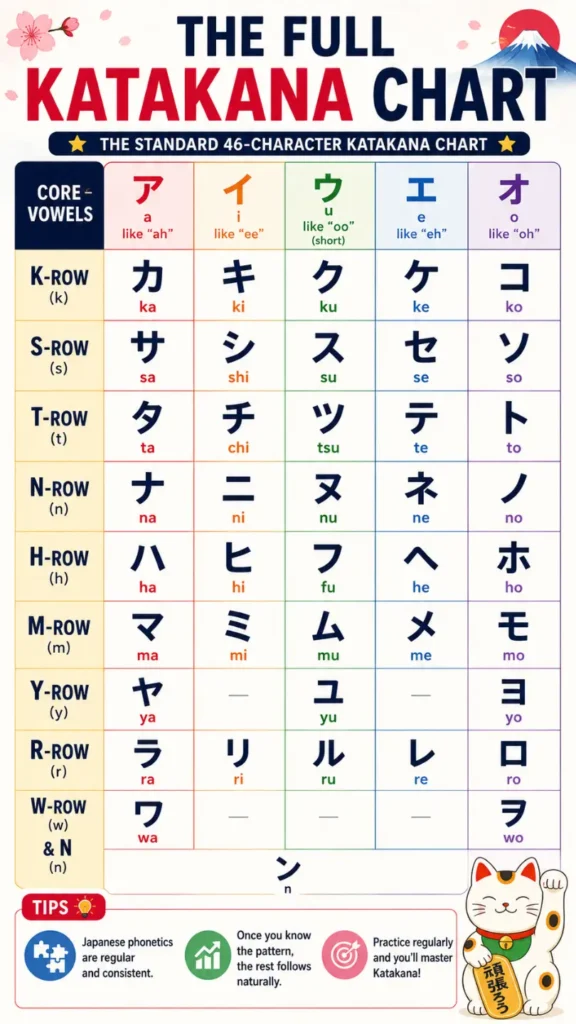
The Full Katakana Chart
This is the standard 46-character Katakana chart, organized by vowel columns and consonant rows. Japanese phonetics are regular and consistent — once you know the pattern, the rest follows naturally.
Core Vowels
| Character | Romaji | Sound |
|---|---|---|
| ア | a | like “ah” |
| イ | i | like “ee” |
| ウ | u | like “oo” (short) |
| エ | e | like “eh” |
| オ | o | like “oh” |
K-Row
| Character | Romaji |
|---|---|
| カ | ka |
| キ | ki |
| ク | ku |
| ケ | ke |
| コ | ko |
S-Row
| Character | Romaji |
|---|---|
| サ | sa |
| シ | shi |
| ス | su |
| セ | se |
| ソ | so |
T-Row
| Character | Romaji |
|---|---|
| タ | ta |
| チ | chi |
| ツ | tsu |
| テ | te |
| ト | to |
N-Row
| Character | Romaji |
|---|---|
| ナ | na |
| ニ | ni |
| ヌ | nu |
| ネ | ne |
| ノ | no |
H-Row
| Character | Romaji |
|---|---|
| ハ | ha |
| ヒ | hi |
| フ | fu |
| ヘ | he |
| ホ | ho |
M-Row
| Character | Romaji |
|---|---|
| マ | ma |
| ミ | mi |
| ム | mu |
| メ | me |
| モ | mo |
Y-Row
| Character | Romaji |
|---|---|
| ヤ | ya |
| ユ | yu |
| ヨ | yo |
R-Row
| Character | Romaji |
|---|---|
| ラ | ra |
| リ | ri |
| ル | ru |
| レ | re |
| ロ | ro |
W-Row and N
| Character | Romaji |
|---|---|
| ワ | wa |
| ヲ | wo |
| ン | n |
Katakana Pronunciation Guide
Japanese pronunciation is far more regular than English. Each Katakana character represents exactly one syllable sound, and that sound never changes based on surrounding letters.
The Five Vowel Sounds
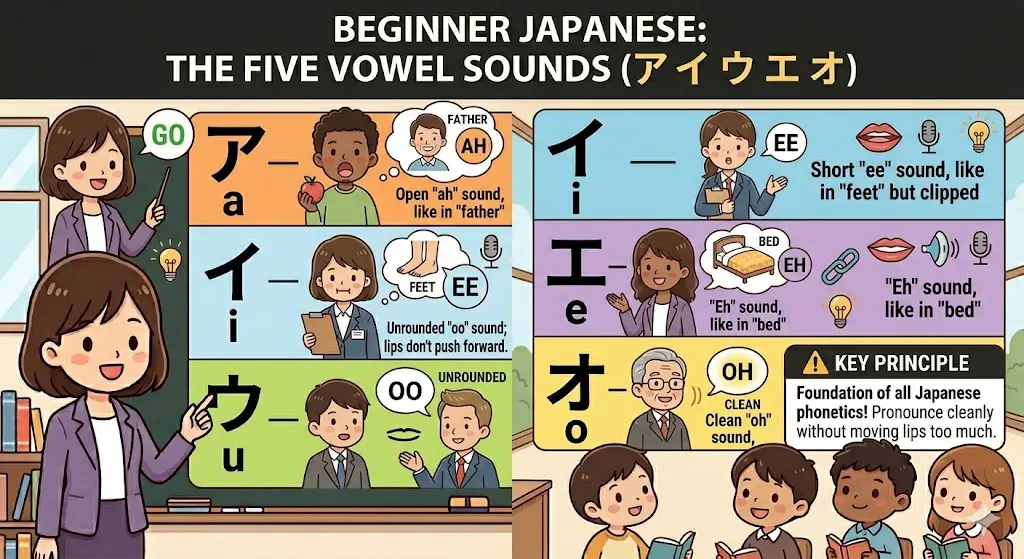
These are the foundation of all Japanese phonetics:
- ア (a) — Open “ah” sound, like in “father”
- イ (i) — Short “ee” sound, like in “feet” but clipped
- ウ (u) — Unrounded “oo” sound; lips don’t push forward, unlike English “oo”
- エ (e) — “Eh” sound, like in “bed”
- オ (o) — Clean “oh” sound, no diphthong
These five vowels combine with consonants to form every other sound in the chart.
Sounds That Differ From English
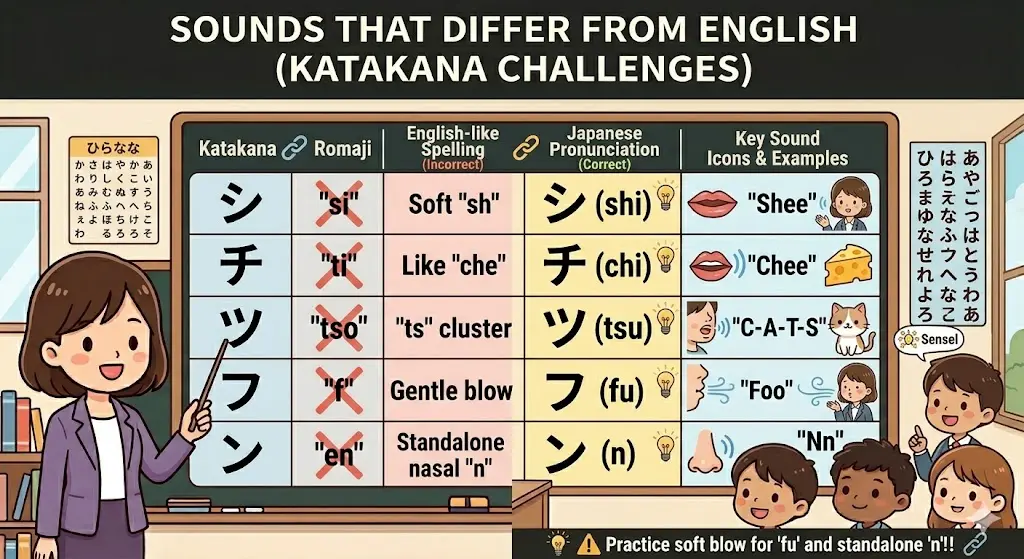
A few Katakana sounds trip up beginners:
- シ (shi) — Not “si.” It’s a soft “sh” sound: “shee”
- チ (chi) — Not “ti.” It sounds like “chee,” like the beginning of “cheese”
- ツ (tsu) — A consonant cluster: “ts” as in “cats” plus “u.” So “tsoo” (with a clipped u)
- フ (fu) — Not quite the English “f.” The lips barely touch; it’s almost like blowing gently
- ン (n) — A standalone nasal “n” sound. It doesn’t combine with a vowel
Special Sound Notes
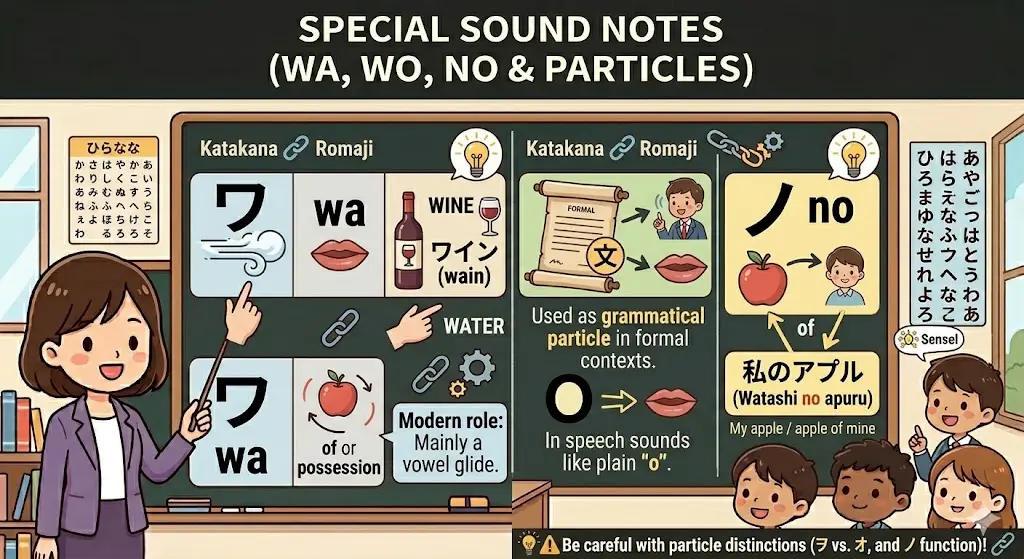
- ワ (wa) — A “w” glide followed by the “a” vowel. In modern Japanese, ワ is mainly used in its vowel role in words like ワイン (wain, wine)
- ヲ (wo) — Almost exclusively used as a grammatical particle in formal contexts; in speech it usually sounds like a plain “o”
- ノ (no) — Clear “no” sound, same as the English word. In Japanese it’s also a grammatical particle meaning “of” or indicating possession
How to Write Katakana: Stroke Order
Stroke order matters in Japanese writing. It affects the flow and look of your handwriting, especially as you get faster. Every Katakana character follows the general rules of top-to-bottom and left-to-right.
Here are some important stroke order notes for individual characters:
ア (a)
Write the short horizontal stroke first (upper left), then the longer diagonal stroke from upper center down and right.
イ (i)
Two strokes: first the diagonal left-leaning stroke, then the longer vertical stroke.
ウ (u)
A short horizontal stroke at top, then the curved body below.
エ (e)
Three strokes: top horizontal, then vertical center, then bottom horizontal.
カ (ka)
Two strokes: a horizontal bar, then the vertical stroke with a hook.
キ (ki)
Four strokes, starting with two short horizontal bars, then the longer horizontal, then the vertical center.
ク (ku)
Two strokes in a curved form, going right and down.
ツ (tsu)
Three short diagonal strokes on the left, then a longer curved stroke.
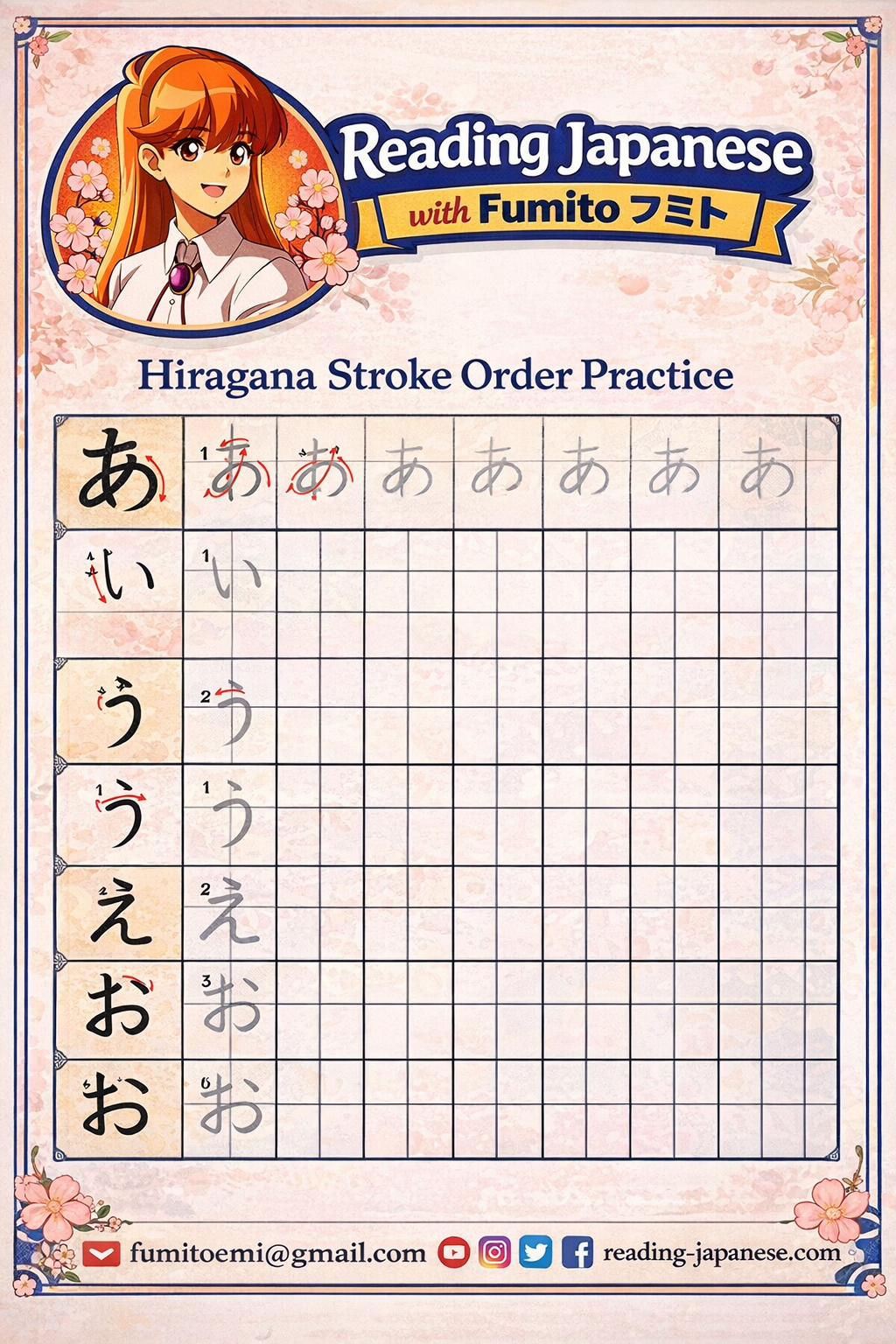
Practice tip: Download a printable Katakana worksheet and trace each character slowly. Repetition with correct stroke order builds muscle memory faster than you think.
Dakuten and Handakuten: Voiced Sounds
Katakana has a clever system for creating new sounds by modifying existing characters with small marks.
Dakuten (゛) — The Voiced Mark
Adding two small strokes (dakuten) to certain Katakana characters makes them voiced:
| Base | Romaji | + Dakuten | Romaji |
|---|---|---|---|
| カ | ka | ガ | ga |
| キ | ki | ギ | gi |
| ク | ku | グ | gu |
| ケ | ke | ゲ | ge |
| コ | ko | ゴ | go |
| サ | sa | ザ | za |
| シ | shi | ジ | ji |
| ス | su | ズ | zu |
| セ | se | ゼ | ze |
| ソ | so | ゾ | zo |
| タ | ta | ダ | da |
| チ | chi | ヂ | ji |
| ツ | tsu | ヅ | zu |
| テ | te | デ | de |
| ト | to | ド | do |
| ハ | ha | バ | ba |
| ヒ | hi | ビ | bi |
| フ | fu | ブ | bu |
| ヘ | he | ベ | be |
| ホ | ho | ボ | bo |
Handakuten (゜) — The Semi-Voiced Mark
A small circle added to the H-row characters creates P sounds:
| Base | Romaji | + Handakuten | Romaji |
|---|---|---|---|
| ハ | ha | パ | pa |
| ヒ | hi | ピ | pi |
| フ | fu | プ | pu |
| ヘ | he | ペ | pe |
| ホ | ho | ポ | po |
So with dakuten and handakuten, your 46 core characters expand to cover many more sounds.
Small Characters: Small Tsu, Ya, Yu, Yo
Some Katakana characters appear in a smaller size. These small characters have special grammatical and phonetic functions.
Small Tsu (ッ)
The small tsu in Katakana (ッ) is one of the most important characters to recognize. It doesn’t make a sound on its own. Instead, it doubles the consonant that follows it.
Think of it as a brief pause or a tightened stop before the next syllable.
Examples:
- ベッド (beddo) — bed
- カップ (kappu) — cup
- キット (kitto) — kit
In these words, the ッ signals that you should briefly hold the sound before releasing the next consonant. This is the katakana double consonant pattern.
Small Ya (ャ), Yu (ュ), Yo (ョ)
These small versions of ヤ, ユ, ヨ combine with certain consonant characters to create new blended sounds. This is explained in the combination sounds section below.
Katakana Combination Sounds
Combination characters (yōon) are created by placing a small ャ, ュ, or ョ after a consonant character from the i-column.
Common Combinations
| Combination | Romaji | Example Word |
|---|---|---|
| キャ | kya | キャラクター (kyarakutā) — character |
| キュ | kyu | キュート (kyūto) — cute |
| キョ | kyo | — |
| シャ | sha | シャワー (shawā) — shower |
| シュ | shu | シュート (shūto) — shoot |
| ショ | sho | ショッピング (shoppingu) — shopping |
| チャ | cha | チャンネル (channeru) — channel |
| チュ | chu | — |
| チョ | cho | チョコレート (chokoreeto) — chocolate |
| ニャ | nya | — |
| ヒャ | hya | — |
| ミャ | mya | — |
| リャ | rya | — |
| ギャ | gya | ギャップ (gyappu) — gap |
| ジャ | ja | ジャケット (jaketto) — jacket |
| ビャ | bya | — |
| ピャ | pya | — |
These katakana combinations are essential for reading foreign loanwords accurately, since many English sounds require blended syllables.
Long Vowels in Katakana
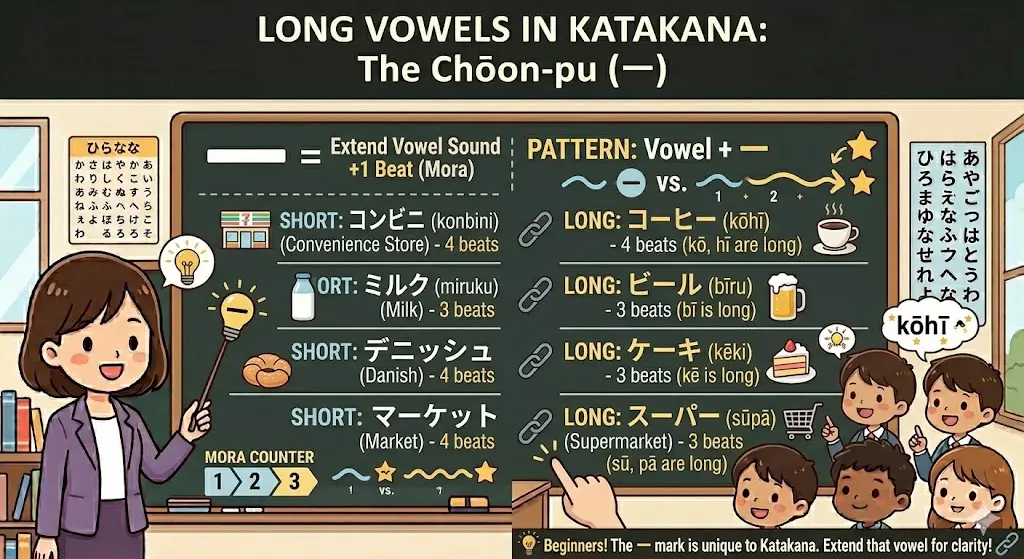
A key feature of Katakana — and one that’s unique to it compared to Hiragana — is the use of a long vowel mark called the chōon-pu (ー).
This horizontal dash tells you to extend the preceding vowel sound for an extra beat.
Examples:
- コーヒー (kōhī) — coffee (the “o” and “i” are both long)
- ビール (bīru) — beer
- ケーキ (kēki) — cake
- スーパー (sūpā) — supermarket
Without the long vowel mark, these words would sound short and clipped. With it, you hold the vowel for one extra mora (rhythmic beat).
This ー mark is specific to Katakana. Hiragana handles long vowels differently by adding an extra vowel character.
Double Consonants in Katakana
As introduced in the small tsu section, katakana double consonants are written using the small ッ before the consonant being doubled.
Common examples:
| Katakana | Romaji | English |
|---|---|---|
| ベッド | beddo | bed |
| カップ | kappu | cup |
| バッグ | baggu | bag |
| ネット | netto | net / internet |
| ホット | hotto | hot |
| セット | setto | set |
The small ッ creates a momentary stop in the voice — a geminate consonant — that gives the word a distinct rhythm.
Katakana Words and Examples
Here is a practical selection of common Japanese words in Katakana with their meanings. Many of these are everyday loanwords from English.
| Japanese Word (Katakana) | Romaji | English Meaning |
|---|---|---|
| アイスクリーム | aisukurīmu | ice cream |
| オレンジ | orenji | orange |
| バナナ | banana | banana |
| ピザ | piza | pizza |
| ハンバーガー | hanbāgā | hamburger |
| テレビ | terebi | television |
| ラジオ | rajio | radio |
| カメラ | kamera | camera |
| コンピューター | konpyūtā | computer |
| インターネット | intānetto | internet |
| スマートフォン | sumātofon | smartphone |
| エアコン | eakon | air conditioner |
| バス | basu | bus |
| タクシー | takushī | taxi |
| ホテル | hoteru | hotel |
| レストラン | resutoran | restaurant |
| スーパー | sūpā | supermarket |
| デパート | depāto | department store |
Notice how many of these are clearly recognizable once you know how English sounds map to Japanese syllables.
Names in Katakana
Your Name in Katakana
If your name isn’t Japanese in origin, it will be written in Katakana in Japan. This is one of the most fun parts of learning the script — figuring out your own name in Katakana.
The process involves matching each syllable of your name to the closest Japanese sound available.
| English Name | Katakana | Romaji |
|---|---|---|
| Michael | マイケル | Maikeru |
| Sarah | サラ | Sara |
| David | デイビッド | Deibiddo |
| Emma | エマ | Ema |
| James | ジェームズ | Jēmuzu |
| Emily | エミリー | Emirī |
Some sounds in English don’t exist in Japanese, so substitutions are made. For example:
- The English “L” becomes ル or ラ etc. (the R sounds)
- The English “V” becomes バ, ビ, ブ etc. (the B sounds)
- Long vowels get the ー mark
Anime Names in Katakana
In anime, character names are often written in Katakana — especially for non-Japanese characters. Some iconic examples:
- ナルト (Naruto)
- サスケ (Sasuke) — though originally kanji, often seen in Katakana
- エレン (Eren, from Attack on Titan)
- レム (Rem, from Re:Zero)
Anime name in Katakana searches are among the most popular ways beginners start practicing the script — and it’s a great method.
Dragon in Katakana
One popular search is how to write dragon in Katakana.
The word “dragon” in Japanese can be written several ways, but in Katakana (as a foreign loanword):
ドラゴン (doragon)
Breaking it down:
- ド (do)
- ラ (ra)
- ゴ (go)
- ン (n)
The native Japanese word for dragon is 竜 or 龍 (ryū), written in kanji. But in games, anime, and fantasy contexts, ドラゴン is extremely common.
English to Katakana
How Loanwords Work
When Japanese borrows an English word, it converts that word’s sounds into the closest available Japanese syllables. This process is called transliteration, not translation.
The resulting words are called katakana loanwords or gairaigo.
Some key rules:
- Every syllable must end in a vowel (except ン)
- Consonant clusters get vowels inserted between them
- “R” and “L” both become the Japanese R sound (ラ行)
- Long vowels get the ー mark
- Final consonants get a vowel added: “bed” → ベッド (beddo)
Katakana Translator
While this guide teaches you the underlying system, a katakana translator tool can help you quickly check how a word converts. Just remember: automatic converters can sometimes be inconsistent — learning the rules yourself gives you much better understanding.
Katakana vs Hiragana: Key Differences
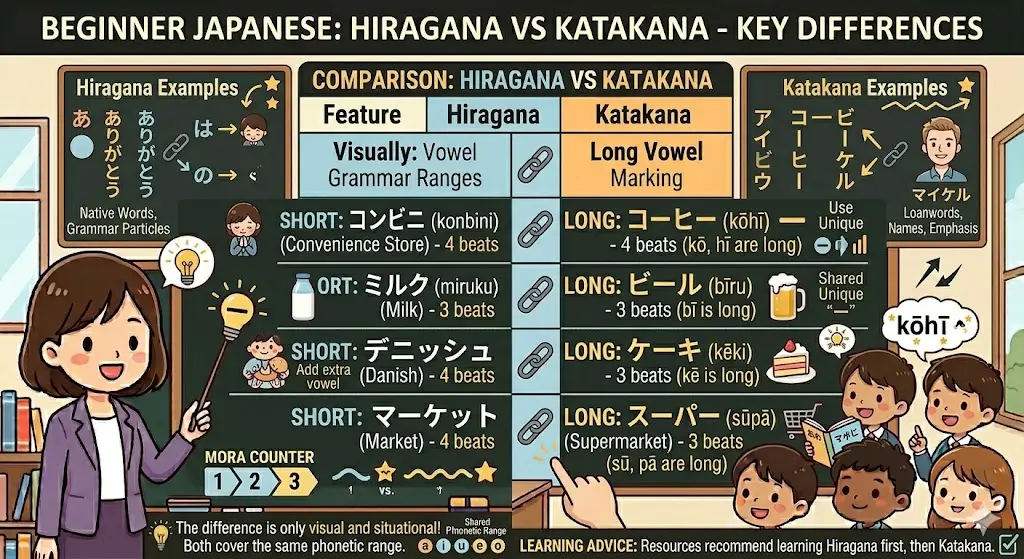
This is one of the most common questions beginners ask. Here’s a clear comparison:
| Feature | Hiragana | Katakana |
|---|---|---|
| Visual style | Rounded, curved | Angular, sharp |
| Primary use | Native Japanese words, grammar particles, verb endings | Foreign loanwords, foreign names, emphasis |
| Number of basic characters | 46 | 46 |
| Long vowel marking | Add an extra vowel character | Use ー |
| Difficulty | Slightly easier to learn first | Slightly harder visually |
| Appearance in text | Very common throughout | Common in specific contexts |
The difference between Hiragana and Katakana is not about sound — both cover the same phonetic range. The difference is entirely about what kind of word is being written.
Most Japanese learning resources recommend learning Hiragana first, then Katakana. If you’ve already started on Hiragana, check out our Hiragana chart guide and Hiragana practice sheets on Reading-Japanese.com.
Common Mistakes Beginners Make
1. Confusing Similar-Looking Characters
Some Katakana pairs look very close and trip up beginners constantly:
| Pair | Characters | Tip |
|---|---|---|
| ン vs ソ | n vs so | ン has a diagonal stroke going up-right; ソ’s strokes go down |
| シ vs ツ | shi vs tsu | シ has strokes going right on a diagonal; ツ points more upward |
| ノ vs メ | no vs me | ノ is a single stroke; メ has a crossing stroke |
| ワ vs ク | wa vs ku | ワ is wider; ク curves differently |
2. Skipping Long Vowel Marks
Beginners often forget the ー mark or don’t hold the vowel long enough. This matters in Japanese — a short “o” and a long “o” can mean different things.
3. Forgetting Small ッ Changes Meaning
Accidentally leaving out or misplacing the small tsu changes the word. ベド (bedo) and ベッド (beddo) sound different — and only one means “bed.”
4. Reading Every Character Too Slowly
Katakana is meant to be read fluidly as units, not letter by letter. Once you recognize the patterns, try to read whole words at once.
5. Confusing Katakana Loanwords With Their English Origins
The Japanese pronunciation follows Japanese phonology, not English. コーヒー doesn’t sound like “coffee” in English — it sounds like kōhī. Keep that distinction clear.
Beginner Tips for Learning Katakana
1. Learn in Groups, Not All at Once
Study one row at a time: the A-row first, then K, S, T, and so on. Overwhelming yourself with all 46 at once leads to confusion.
2. Use Association Mnemonics
Some characters visually resemble things:
- ヘ (he) looks like a roof
- ト (to) looks like a post with a nail
- カ (ka) has a hook shape
Create your own associations — whatever sticks in your memory.
3. Read Real Katakana Immediately
Don’t wait until you’ve “finished” studying. Start reading food packaging, menus, or product labels from day one. Even recognizing one word is satisfying and motivating.
4. Practice Writing by Hand
Typing is useful, but handwriting encodes the shapes in your memory differently. Use a Katakana tracing sheet to practice stroke order with repetition.
5. Make It Personal
Find Katakana words that matter to you — your name, your favorite food, your city. Personal relevance makes memorization stick.
6. Use Spaced Repetition
Apps like Anki use spaced repetition science to show you characters right before you’d forget them. This is efficient and well-proven for learning new alphabets.
7. Review Regularly
Ten minutes daily beats two hours once a week. Consistency beats intensity for script learning.
Katakana Writing Practice and Resources
Getting fluent with Katakana takes practice. Here’s what helps:
Katakana Tracing Sheets
A printable Katakana worksheet lets you trace each character while learning stroke order. Tracing activates motor memory — a powerful learning method for writing systems.
You can find Katakana practice PDFs and tracing sheets on Reading-Japanese.com designed specifically for beginners.
Katakana Chart Printable
Keep a printable Katakana chart on your desk or study wall for quick reference. Having the full chart visible helps your eyes become familiar with the shapes passively throughout the day.
Our full Katakana chart on Reading-Japanese.com is formatted for easy printing and study.
Online Practice
Websites like Jisho.org (a trusted Japanese dictionary) let you look up Katakana words and hear their pronunciation. The NHK World Pronunciation Guide offers audio resources for Japanese pronunciation.
Writing Practice Order
For Katakana writing practice, this order works well for beginners:
- Trace each row with a Katakana tracing sheet
- Write each character 5–10 times from memory
- Write full Katakana words from the example list
- Write your own name in Katakana
- Try reading product labels or menus and write down what you see
For related beginner guides on the site, check out the Japanese pronunciation guide and Learn Japanese basics sections on Reading-Japanese.com.
Katakana Symbols: The Complete Sound Reference
Here is a quick reference for all Katakana characters including voiced, semi-voiced, and combination sounds organized for study:
Basic + Dakuten + Handakuten Summary
| Base | Base Sound | + ゛ | Voiced Sound | + ゜ | Semi-Voiced |
|---|---|---|---|---|---|
| カ | ka | ガ | ga | — | — |
| サ | sa | ザ | za | — | — |
| タ | ta | ダ | da | — | — |
| ハ | ha | バ | ba | パ | pa |
This full system gives you over 70 distinct syllable sounds from just 46 core characters — a very efficient system.
FAQ
What is Katakana?
Katakana is one of three Japanese writing systems. It’s a syllabary with 46 characters, each representing a sound. It’s mainly used for foreign loanwords, foreign names, onomatopoeia, and emphasis in Japanese text.
How is Katakana different from Hiragana?
Both cover the same sounds. Hiragana is rounder and used for native Japanese words and grammar. Katakana is more angular and used mainly for foreign words, names, and stylistic emphasis.
How long does it take to learn Katakana?
Most beginners can learn to recognize all 46 Katakana characters in one to two weeks with daily practice of 10–15 minutes. Reading fluency takes longer — usually a few more weeks of exposure.
Is Katakana harder than Hiragana?
Most learners find Katakana slightly harder because the characters look more similar to each other. Hiragana’s rounder shapes are often easier to distinguish. Learning Hiragana first is typically recommended.
What is the small tsu in Katakana?
The small tsu (ッ) doubles the consonant that follows it. It creates a short pause before the next sound. For example, ベッド (beddo) uses ッ to double the “d” sound, giving the word for “bed.”
What does ワ (wa) mean in Katakana?
ワ represents the syllable “wa” in Japanese. As a Katakana character, it appears in loanwords like ワイン (wain, wine). In Hiragana, は (wa) serves as a grammatical subject particle.
What does ノ (no) mean in Katakana?
ノ represents the syllable “no.” In Japanese grammar, の (no) is also a particle meaning “of” or indicating possession. For example, 日本のテレビ means “Japan’s television.”
What does ツ (tsu) mean in Katakana?
ツ represents the syllable “tsu.” It appears in words like ツアー (tsuā, tour). The small version ッ functions as a double consonant marker.
How do I write my name in Katakana?
Break your name into syllables, then find the closest Japanese sounds for each. English sounds without a direct equivalent get the nearest substitute. Online tools and charts can help you verify the result.
What does ス (su) mean in Katakana?
ス represents the syllable “su.” It appears frequently in loanwords like スポーツ (supōtsu, sports) and スーパー (sūpā, supermarket).
What does ア (a) mean in Katakana?
ア represents the vowel sound “a” (as in “father”). It’s the first character in the Katakana syllabary and appears in countless loanwords like アイス (aisu, ice) and アメリカ (Amerika, America).
What is dragon in Katakana?
Dragon as a loanword is written ドラゴン (doragon) in Katakana. The native Japanese word for dragon, 竜 (ryū), is written in kanji.
Why does Japanese use Katakana instead of kanji for foreign words?
Katakana is phonetic — it transcribes sounds directly. Foreign words don’t have established kanji equivalents, so using Katakana to capture the pronunciation is the practical and intuitive solution.
Can I read Japanese without knowing Katakana?
You’d struggle. Katakana appears constantly in everyday text — menus, signs, product names, and technology vocabulary. Learning both Hiragana and Katakana is the essential first step for reading Japanese.
What are Katakana combination sounds?
Combination sounds (yōon) are made by pairing an “i-column” character with a small ャ, ュ, or ョ. For example, キャ (kya), シャ (sha), and チョ (cho). These are essential for representing sounds found in foreign loanwords.
Conclusion
Katakana might look intimidating at first, but it’s one of the most learnable parts of the Japanese language. With just 46 core characters and a regular, predictable sound system, you can go from complete beginner to confidently reading Katakana words in a matter of weeks.
Here’s a quick recap of what you’ve learned:
- Katakana is a Japanese phonetic script with 46 characters
- It’s mainly used for foreign loanwords, names, emphasis, and scientific terms
- Every character represents one syllable sound
- Dakuten and handakuten expand the sound range
- Small ッ doubles consonants; small ャ ュ ョ create combination sounds
- The ー mark extends vowels in loanwords
- Many Katakana words are English words you already know
The best next step? Start writing your own name in Katakana right now. Then grab a printable Katakana chart and practice sheet from Reading-Japanese.com.
Ready to go further? Explore our full library of beginner Japanese lessons — from Hiragana practice to Japanese numbers and Japanese days of the week. Every step you take brings you closer to reading real Japanese.
You’ve got this. 頑張って!(Ganbatte! — Do your best!)