Learning Japanese can sometimes feel like studying for an exam that never ends.
First, you have to learn hiragana. Then katakana. Then hundreds of vocabulary words. Then grammar. Then kanji. And just when you think you are making progress, you discover that knowing a Japanese word on a flashcard does not necessarily mean you can use it naturally in a conversation.
That is exactly why games such as Wagotabi: A Japanese Journey are interesting for Japanese learners.
Wagotabi: A Japanese Journey – Can You Really Learn Japanese by Playing?
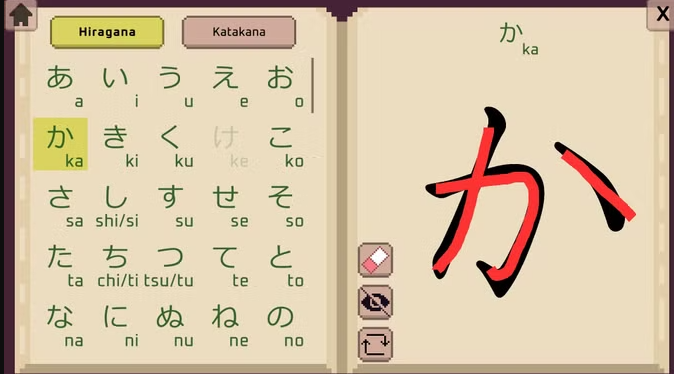
Instead of presenting Japanese as a long list of vocabulary and grammar exercises, Wagotabi turns Japanese learning into an adventure. You explore Japan, interact with characters, complete quests, solve language-based challenges, and gradually learn Japanese as you progress.
According to the developers, Wagotabi is designed for learners starting from zero and introduces vocabulary, grammar, hiragana, katakana, and kanji progressively rather than overwhelming beginners with everything at once.
As a Japanese tutor, I find this approach particularly interesting because one of the biggest problems beginners face is not simply understanding Japanese—it is staying motivated long enough to use what they learn.
So, what exactly is Wagotabi: A Japanese Journey, how does it work, and is it worth trying if you want to learn Japanese?
Let’s take a closer look.
What Is Wagotabi: A Japanese Journey?
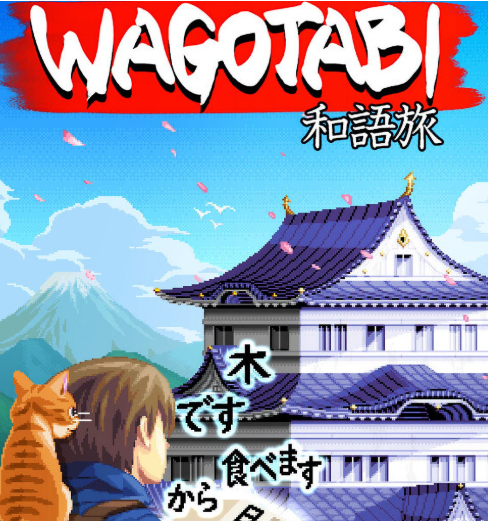
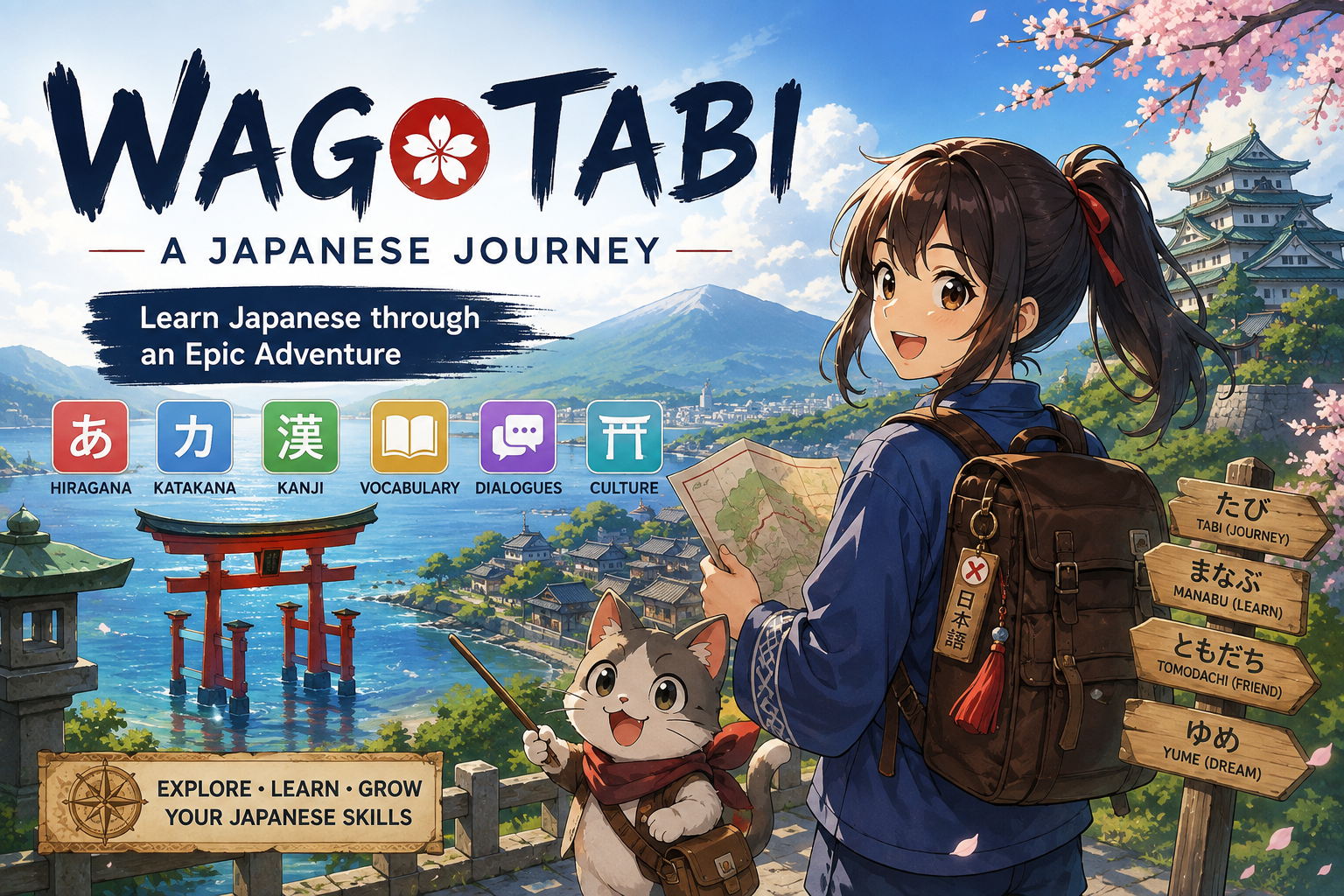
Wagotabi: A Japanese Journey is an educational RPG designed specifically for learning Japanese.
Rather than being a traditional language-learning app with isolated exercises, Wagotabi puts Japanese inside an adventure game.
You explore a world based on real Japanese geography, interact with local characters, complete quests, encounter puzzles, and use Japanese to make progress. The game gradually introduces language concepts as you need them.
The name itself is connected to Japanese.
Wagotabi is written as 和語旅.
- 和語(わご / wago) refers to Japanese language or Japanese-origin vocabulary.
- 旅(たび / tabi) means journey or travel.
Together, 和語旅 (Wagotabi) represents a journey through the Japanese language. The developers specifically explain the name as connecting Japanese language with the idea of travel.
And that description fits the concept very well.
Instead of simply telling you to memorize 20 new words today, Wagotabi attempts to give those words a reason to exist within the game world.
That distinction is important.
How Does Wagotabi Teach Japanese?
The basic idea behind Wagotabi is simple:
Learn something, then use it immediately.
This is different from memorizing a vocabulary list and hoping you remember the words several weeks later.
The Wagotabi method emphasizes useful kana, useful words and concepts, manageable lessons, contextual repetition, and gradually increasing Japanese immersion.
For example, rather than requiring a complete beginner to memorize every hiragana and katakana character before doing anything interesting, the game introduces kana according to the vocabulary the learner is about to encounter.
The developers describe the early lessons as deliberately small, with only a few words or concepts at a time.
That can be especially useful for beginners who feel overwhelmed by the idea of learning Japanese.
Hiragana and Katakana
Hiragana and katakana are introduced progressively.
This is a very beginner-friendly idea because Japanese learners often encounter the famous kana charts and immediately see dozens of unfamiliar symbols.
Wagotabi takes a different approach: learn characters in connection with words.
For example, instead of seeing a character as an isolated symbol that must be memorized, you encounter it as part of something you actually need to understand.
That gives the character a context.
Of course, I would still recommend learning hiragana and katakana systematically alongside the game. A game can make practice more enjoyable, but knowing the complete kana systems will eventually make your Japanese reading much easier.
If you’re starting from zero, you can use my Hiragana Chart and Katakana Chart resources here at Reading Japanese with Fumito as companions to your Wagotabi study.
What About Kanji?
Kanji is one of the biggest challenges for Japanese learners.
There are thousands of characters in Japanese, and beginners often make the mistake of trying to memorize huge lists before they understand how kanji actually works in vocabulary.
Wagotabi attempts to make kanji more manageable by introducing characters through words and situations.
The game includes kanji practice, stroke-order activities, a Kanjidex, comparisons between similar kanji, and opportunities to encounter readings in vocabulary rather than simply presenting readings as an enormous list.
This is an important principle for beginners:
Don’t only learn what a kanji looks like. Learn how it behaves inside real Japanese words.
For example, learning a kanji together with vocabulary gives you more information than memorizing a single English translation.
You begin to notice:
- its pronunciation in a particular word
- its meaning
- how it combines with other kanji
- how it appears in sentences
- how native Japanese speakers actually use it
That contextual approach can make kanji feel less abstract.
Wagotabi Uses Real Japan as Its Setting
One of the most interesting aspects of Wagotabi: A Japanese Journey is that the game is not set in a completely fictional language-learning world.
Its adventure is based on Japan’s real geography, cities, prefectures, culture, and local references. The developers say they intentionally focused entirely on Japan to create a deeper sense of linguistic, geographical, and cultural immersion.
This creates an interesting combination:
Japanese learning + RPG + travel + Japanese culture.
If you enjoy Japan beyond the language itself, this can make the learning process more engaging.
The first chapter of the adventure is set in Kagawa Prefecture, and the developers have worked with local tourism organizations and received official recognition connected to the region.
That attention to geography is useful because language doesn’t exist separately from culture.
When you learn Japanese, you eventually encounter words and expressions connected to food, transportation, locations, social situations, daily routines, and cultural practices.
A game built around traveling through Japan has a natural opportunity to connect those elements.
What Can You Learn in Wagotabi?
Wagotabi currently focuses heavily on beginner Japanese.
The official website currently lists more than:
- 400 carefully selected words and grammar points
- 195+ kanji
- 600+ example sentences
- 2,600+ voiced Japanese dialogues
- 350+ unique NPCs
The developers also state that more than 300 teachers across more than 60 countries have reviewed the game.
The exact content will continue to change as the game is updated, so these numbers should be treated as a snapshot rather than permanent limits.
The Google Play listing also describes the game as beginning at the JLPT N5 level and says its vocabulary and grammar follow a graded approach.
That makes Wagotabi particularly relevant to learners who are currently working toward beginner Japanese or JLPT N5.
Is Wagotabi Good for Complete Beginners?
Yes, the game is specifically designed to be accessible to people starting Japanese from scratch.
The official materials state that no previous Japanese knowledge is required.
However, there is an important distinction between being suitable for beginners and being the only resource a beginner needs.
I would not recommend relying on one game for your entire Japanese education.
Instead, think of Wagotabi as one part of your Japanese learning system.
For example:
Wagotabi
→ motivation and contextual practice
Hiragana/Katakana study
→ reading foundation
Grammar lessons
→ understanding sentence structure
Kanji study
→ reading development
Listening practice
→ real-world comprehension
Speaking practice
→ active communication
This combination is much stronger than expecting a single app or textbook to teach everything.
Wagotabi’s Spaced Repetition System
Another useful feature is its built-in SRS, or Spaced Repetition System.
Spaced repetition is a learning technique where information is reviewed at strategically timed intervals so that you encounter difficult material more frequently.
Wagotabi uses this system to help learners focus on words they struggle to remember. The official feature list also describes smart tests with multiple question types.
This matters because simply seeing a Japanese word once is not enough.
Imagine learning:
食べる(たべる / taberu) — to eat
If you see it once, you may recognize it.
If you encounter it again tomorrow, you strengthen the memory.
If you use it inside a sentence, you understand its context.
If you hear it spoken, you connect the sound to the written form.
If you later have to produce it yourself, your active recall improves.
That is much closer to how useful language knowledge develops.
Wagotabi Is More Than Vocabulary Flashcards
One of the biggest differences between Wagotabi and a traditional vocabulary app is the game structure.
The game includes:
- quests
- NPC interactions
- puzzles
- mini-games
- boss fights
- Japanese dialogue
- grammar explanations
- conjugation practice
- kana and kanji activities
- an interactive dictionary
- progress tracking
- a Kanjidex
- Japanese voice acting
These features are integrated into the adventure rather than being completely separate from it.
That is important because motivation is a major part of language learning.
You can have the best Japanese textbook in the world sitting on your desk.
But if you never open it, it cannot teach you anything.
A game can sometimes solve a different problem: getting you to practice consistently.
Does Wagotabi Teach Real Japanese?
The goal is not simply to teach random Japanese phrases.
The developers say the vocabulary and grammar concepts are selected with practical use in mind and are introduced in situations such as asking for directions, ordering food, expressing preferences, and interacting with people.
This is particularly useful for travelers.
Imagine preparing for a trip to Japan.
You don’t only need to know dictionary definitions. You need to recognize useful language when it appears in context.
You might eventually need Japanese for:
- restaurants
- shops
- stations
- hotels
- introductions
- directions
- everyday conversations
- reading signs
- understanding simple questions
Learning language through situations can help connect vocabulary with real-world purposes.
Does Wagotabi Replace a Japanese Textbook?
No—and I don’t think it should.
As a Japanese tutor, I would use Wagotabi as a supplementary learning tool, especially for learners who struggle with motivation.
A structured textbook can explain grammar systematically.
For example, you may need a clear explanation of:
- particles
- verb conjugation
- adjective conjugation
- sentence patterns
- polite and casual Japanese
- past and negative forms
A game can introduce these concepts naturally, but a dedicated grammar lesson can still provide the deeper explanation you need.
The best approach is therefore not:
“Wagotabi OR textbook.”
It is:
“Wagotabi + structured Japanese study.”
Wagotabi for JLPT N5 Learners
If your current goal is JLPT N5, Wagotabi may be particularly interesting.
The game starts with beginner-level material and progressively introduces vocabulary and grammar. The developers say the current objective is to expand toward the full N5 content across five prefectures.
But remember that passing JLPT N5 requires more than recognizing a few words while playing a game.
You should also practice:
Vocabulary
Build a core beginner vocabulary and review it regularly.
Hiragana and Katakana
You should be able to read kana comfortably rather than decoding every character one by one.
Kanji
Learn common beginner kanji and, importantly, the vocabulary in which they appear.
Grammar
Understand the major N5 sentence patterns.
Reading
Practice short Japanese sentences and passages.
Listening
Listen to Japanese at a beginner-friendly speed.
Wagotabi can fit nicely into this routine because it gives you another environment in which to encounter the language.
Wagotabi for People Who Hate Memorization
This may actually be one of the strongest reasons to try it.
Some learners genuinely enjoy flashcards.
Others don’t.
If you are the second type, studying Japanese can become frustrating very quickly.
You open an app.
You see 20 words.
You memorize them.
Tomorrow, another 20 words appear.
After several weeks, Japanese starts feeling like an endless spreadsheet.
Wagotabi attempts to make learning feel more like progression through an adventure.
You are not simply learning Japanese because the next page says “Lesson 14.”
You are learning because you need language knowledge to continue the journey.
That psychological difference can be surprisingly important.
Wagotabi on Steam, Android, and iOS
Wagotabi is available across multiple platforms.
The game launched on Steam on August 13, 2025, and the Steam listing identifies it as an educational RPG focused on learning Japanese from the ground up.
It is also available on mobile.
The Google Play listing currently shows Wagotabi: Learn Japanese and describes it as a beginner-friendly Japanese-learning game.
The App Store listing also offers Wagotabi for iPhone and iPad.
There is also a demo available through itch.io, allowing learners to experience the early part of the adventure.
Because platform availability, pricing, and content can change, I recommend checking the official store listing before purchasing.
Is Wagotabi Worth Trying?
If you are learning Japanese and enjoy games, I think Wagotabi is an especially interesting concept.
Its biggest strength is not that it magically makes Japanese easy.
It doesn’t.
Japanese is still Japanese.
You still need to learn vocabulary, grammar, kana, kanji, listening, reading, and eventually speaking.
The strength of Wagotabi is that it attempts to make those activities feel connected to something meaningful.
You learn a word.
Then you use it.
You encounter a character.
Then you communicate with them.
You learn kanji.
Then you see it in vocabulary.
You learn grammar.
Then you encounter it in a situation.
That contextual connection is one of the things I like most about the concept.
What I Like About Wagotabi
Here are the biggest strengths I see from a Japanese-learning perspective.
1. It Makes Japanese Learning More Interactive
Instead of completing isolated exercises, you participate in an adventure.
2. It Is Designed for Beginners
You don’t need to already know Japanese to start.
3. It Uses Context
Words and grammar are designed to be used in the game rather than simply memorized.
4. It Introduces Kanji Gradually
Rather than throwing an enormous kanji list at beginners, the game introduces kanji through vocabulary and activities.
5. It Uses Real Japanese Locations
The adventure is connected to real Japanese geography and culture.
6. It Includes Japanese Audio
Thousands of voiced dialogues give learners opportunities to connect written Japanese with pronunciation.
7. It Encourages Consistent Practice
The RPG structure, quests, challenges, progress tracking, and mini-games can give learners a reason to return.
What Wagotabi Cannot Do for You
It is also important to keep expectations realistic.
Wagotabi cannot replace actual communication with Japanese speakers.
It cannot instantly make you fluent.
And completing an RPG does not automatically mean you can hold a 30-minute conversation in Japanese.
You still need exposure to different voices, natural conversations, unfamiliar vocabulary, grammar explanations, and real communication.
I would especially recommend adding listening and speaking practice once you have built a beginner foundation.
Think of Wagotabi as a bridge between studying Japanese and using Japanese.
A Japanese Tutor’s Suggested Wagotabi Study Routine
If I were helping a beginner incorporate Wagotabi into a weekly Japanese routine, I would keep it simple.
Monday
Play Wagotabi for 20–30 minutes.
Write down five new Japanese words you encountered.
Tuesday
Review those five words.
Practice reading them aloud.
Wednesday
Continue the Wagotabi adventure.
Pay attention to one grammar pattern.
Thursday
Review the grammar pattern separately.
Create three simple Japanese sentences.
Friday
Play again.
Try to understand the dialogue before looking at the translation.
Saturday
Review kana, kanji, vocabulary, and grammar from the week.
Sunday
Take a lighter day.
Play Wagotabi for enjoyment and see how much Japanese you can recognize without deliberately studying.
This is much more sustainable than trying to study Japanese for three hours once every two weeks.
Final Verdict: Wagotabi: A Japanese Journey
Wagotabi: A Japanese Journey is an unusual approach to Japanese learning because it doesn’t simply add game-like points and badges to traditional exercises.
It is built as an actual RPG adventure where Japanese is part of the gameplay.
That makes the concept particularly appealing to beginners who find traditional language-learning methods repetitive or difficult to maintain.
The game progressively introduces hiragana, katakana, vocabulary, grammar, kanji, dialogues, and practical situations. It also uses real Japanese geography and culture to create a stronger sense of immersion.
For someone studying JLPT N5, preparing for a trip to Japan, interested in Japanese culture, or simply looking for a more enjoyable way to practice, Wagotabi is worth investigating.
But I would not make it your entire Japanese-learning plan.
Use it alongside structured grammar study, reading practice, listening, vocabulary review, and eventually speaking.
That combination gives you the best of both worlds:
structured learning when you need explanations + Wagotabi when you need motivation and context.
And perhaps that is the most interesting thing about Wagotabi.
Learning Japanese doesn’t always have to feel like studying.
Sometimes, it can feel like going on a journey.
Frequently Asked Questions About Wagotabi: A Japanese Journey
What is Wagotabi: A Japanese Journey?
Wagotabi: A Japanese Journey is an educational RPG that teaches Japanese through an adventure set in real Japanese locations. Players learn vocabulary, grammar, hiragana, katakana, and kanji while exploring the game world, interacting with characters, completing quests, and solving language-related challenges.
Is Wagotabi good for beginners?
Yes. Wagotabi is designed for learners starting from zero and does not require previous Japanese knowledge. Its lessons progressively introduce language concepts rather than requiring beginners to learn everything at once.
Can Wagotabi help me learn hiragana?
Yes. Hiragana is introduced progressively as part of the game’s learning system. Wagotabi also includes kana-related mini-games and writing practice.
Does Wagotabi teach katakana?
Yes. Katakana is part of the Japanese writing system taught through the game, alongside hiragana and kanji.
Does Wagotabi teach kanji?
Yes. Wagotabi includes kanji learning, writing and stroke-order activities, a Kanjidex, and vocabulary-based kanji learning.
Is Wagotabi useful for JLPT N5?
It can be a useful supplementary resource for JLPT N5 learners because the game begins with beginner-level Japanese and introduces vocabulary and grammar progressively. However, learners preparing specifically for the JLPT should also use dedicated grammar, vocabulary, reading, and listening practice.
Is Wagotabi available on Steam?
Yes. Wagotabi: A Japanese Journey was released on Steam on August 13, 2025.
Is Wagotabi available on Android?
Yes. Wagotabi: Learn Japanese is available through Google Play.
Is Wagotabi available on iPhone and iPad?
Yes. Wagotabi is available through Apple’s App Store for iPhone and iPad.
Can I play Wagotabi offline?
The developers’ FAQ states that the game can be used offline, with internet required only for certain features such as in-game feedback and leaderboards.
Does Wagotabi replace a Japanese textbook?
Not completely. Wagotabi can provide contextual practice and motivation, but a structured Japanese course or textbook can still be valuable for systematically learning grammar, vocabulary, reading, and other skills.
Where can I learn more about Wagotabi?
The official Wagotabi website contains information about the game’s learning method, features, content, and development.
Start Your Japanese Journey
If you’re currently learning Japanese, don’t worry about mastering everything at once.
Start with hiragana.
Learn a few useful words.
Understand a few basic grammar patterns.
Practice reading.
Listen to Japanese.
Then use what you know.
Whether your Japanese journey takes you through a textbook, a classroom, anime, conversations with native speakers, or an RPG such as Wagotabi: A Japanese Journey, the most important thing is to keep moving forward.
一歩ずつ、日本語を学びましょう。
Ichi-ho zutsu, Nihongo o manabimashou.
Let’s learn Japanese one step at a time.
— Fumito Emi
Japanese Tutor, Reading Japanese with Fumito フミト