

This is the complete review post for Lesson 2 — covering all the grammar points from the four dialogues, two practical application scenarios, and the full drill tape scripts in Japanese for self-study and speaking practice.
Lesson 2 introduced a lot of new ground. From noun sentences with desu and deshita, to telling time and days of the week, to the no particle, echo questions, borrowed foreign words, self-introductions, and the particle to — its a dense lesson with real everyday payoff. This review brings it all together in one place.
Japanese Lesson 2 Grammar Review – Desu Deshita Noun Sentences, No Particle and Full Drill Scripts
Before going through this, make sure you’ve read all four Lesson 2 dialogues and grammar posts:
- Lesson 2 Dialogue 1 – Desu, Telling Time, Weather and Hesitation Noises
- Lesson 2 Dialogue 3 – Kono Sono Ano Dono and Echo Questions
- Lesson 2 Dialogue 4 – Days of the Week, Deshita and Particle To
📌 How to use this review: Try to answer each grammar question yourself before reading the answer. Then work through the practical application scenarios out loud — they simulate real workplace and academic situations. Finally use the drill scripts with a partner or as a self-test: cover the response and produce it yourself before checking.
Grammar Review – Questions and Answers
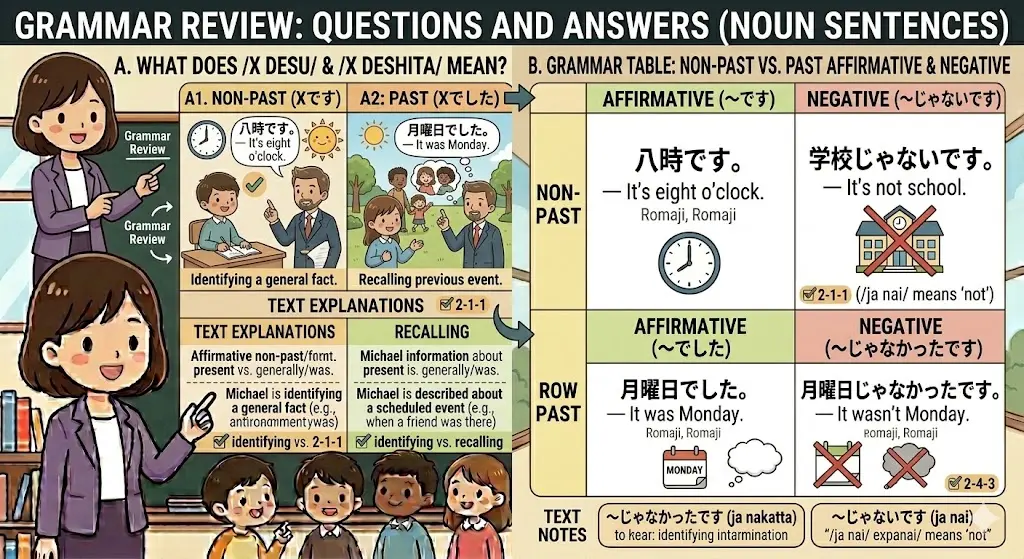
AWhat does /X desu/ mean? How about /X deshita/?2-1-1, 2-4-3
X desu (Xです) means “is X” — the affirmative non-past form of a noun sentence. It identifies or describes something in the present or generally. X deshita (Xでした) means “was X” — the affirmative past form. It describes what something was, or is used to recall information about a scheduled event.
| Affirmative | Negative | |
|---|---|---|
| Non-past | 〜です (desu) 八時です。— It’s eight o’clock. | 〜じゃないです (ja nai desu) 学校じゃないです。— It’s not school. |
| Past | 〜でした (deshita) 月曜日でした。— It was Monday. | 〜じゃなかったです (ja nakatta desu) 月曜日じゃなかったです。— It wasn’t Monday. |
B For noun sentences, what is the non-past negative? How about the past negative?2-1-1, 2-4-3
Non-past negative: X ja nai desu (Xじゃないです) — “is not X.” Past negative: X ja nakatta desu (Xじゃなかったです) — “was not X.” A critical point: never use deshita in the past negative. The correct form is always ja nakatta desu, not ja nai deshita.
C How is a clock time expressed? How about the days of the week?2-1-2, 2-4-1
Clock time: attach -ji (時) to the number — ichi-ji, ni-ji, san-ji… For half past, add -han (半) after the hour — san-ji-han = 3:30. Two irregular readings: 4 o’clock = yo-ji (not shi-ji), 9 o’clock = ku-ji (not kyuu-ji).
Days of the week: attach -youbi (曜日) to the element. Monday = getsu-youbi (月曜日), Tuesday = ka-youbi (火曜日), Wednesday = sui-youbi (水曜日), Thursday = moku-youbi (木曜日), Friday = kin-youbi (金曜日), Saturday = do-youbi (土曜日), Sunday = nichi-youbi (日曜日). Each day has three formality variants — the longer, the more formal.
D How do you ask what time it is in Japanese? How about what day of the week today is?2-1-1, 2-4-1
今、何時ですか。 Ima, nan-ji desu ka. — What time is it now?
今日は何曜日ですか。 Kyou wa nan-youbi desu ka. — What day of the week is today?
Note that ima (now) is commonly included when asking the time in Japanese — more so than in English. And nan-youbi asks for the day of the week only — not the date of the month, which requires a different question word.
E Give two examples of Japanese hesitation noises. What is the difference between them? How are they used?2-1-3
| Word | Japanese | Function | When NOT to use |
|---|---|---|---|
| Anou | あのう | All-purpose hesitation. Gets attention, softens statements, buys thinking time. | No restriction — works in almost any situation |
| Etto | えっと | Specifically signals you’re searching for the right answer or word. | Don’t use when asked something you should know (e.g. your own name) |
Japanese speakers also elongate vowels (imaaa, anooo) and insert desu ne between chunks of speech as additional ways to slow down and soften conversation — all part of the same indirect communication style.
F Which is the main noun in the noun phrase /X no Y/ — X or Y?2-2-1
Y is the main noun. In the pattern X no Y, X modifies Y — X tells us something about Y (whose it is, what type it is, where it’s from, etc.). For example: Tookyoo-daigaku no Satou-sensei — Y is Satou-sensei (the main noun), X is Tookyoo-daigaku (the modifier — where she’s from). Kyou no sukejuuru — Y is sukejuuru (the main noun), X is kyou (today — the modifier).
G What is the relationship between the two nouns in /X no Y/?2-2-1
The relationship is flexible and depends on context. X can indicate: possession (“my bag” — watashi no baggu), affiliation (“the teacher from that company” — kaisha no sensei), type or category (“a Japanese textbook” — nihongo no kyoukasho), time reference (“today’s schedule” — kyou no sukejuuru), or origin (“a person from University of Tokyo” — Tookyoo-daigaku no kata). The exact interpretation always depends on context — X no Y is much more flexible than English possessive structures.
H What three changes may happen when a foreign word is borrowed into Japanese?2-2-2
- Sound changes — the word is adapted to fit Japanese syllable structure. Sounds that don’t exist in Japanese are substituted with the closest equivalent (e.g. “schedule” → sukejuuru)
- Written in katakana — all foreign loanwords are written in the katakana script, not hiragana or kanji
- Meaning may shift — the meaning of the borrowed word can narrow, broaden, or change compared to the original language (e.g. arubaito from German “Arbeit” means specifically part-time/student work in Japanese, not work in general)
I What is the ritual expression used at the beginning of a self-introduction? How is it closed? When do you bow?2-2-3
Opening: Hajimemashite (はじめまして) — “How do you do / nice to meet you for the first time.” You bow when you say this.
Closing: Douzo yoroshiku onegaishimasu (どうぞよろしくお願いします) — “Please treat me well / nice to meet you.” You bow again at the end. In Japanese introductions, confirming the other person’s name back as a question (X-san desu ka) is also customary and polite. The whole introduction involves bowing at both the opening and the close.
J What is the difference between sore and sono?2-3-2
Sore (それ) is an independent noun — it stands alone and means “that thing (near you).” Sono (その) is an incomplete element — it cannot stand alone and must be followed by a noun. Sono kaban = “that bag (near you).” In English, “that” can do both jobs, but in Japanese they are completely different words. The same distinction applies across the whole ko-so-a-do series: kore/kono, sore/sono, are/ano, dore/dono.
K What is an echo question? How do you use it?2-3-1
An echo question repeats back all or part of what the other person just said, as a question, to check clarification. In Japanese they occur much more frequently than in English — used not just for clarification but also to slow the pace of conversation, soften the tone, and show engagement. The most common echo questions repeat the topic noun from the previous sentence. You cannot echo a descriptive word or category — only the thing being discussed.
これ、スマホですか。 — Is this a smartphone?
これですか。はい。 ✅ — This? Yes. (echoes the topic noun kore)
スマホですか。はい。 ❌ — Do you mean a smartphone? (cannot echo the descriptor)
L How is “E?” used?2-4 vocabulary
E? (え?) is used to express surprise or to signal that you didn’t hear or couldn’t believe what was just said. In the dialogue, Honda says E? when Michael says the appointment was on Monday — she’s surprised because she thought it was Tuesday. It can mean “What?!”, “Oh?”, “Really?”, or simply “Pardon?” depending on tone and context. Its one of those short, instinctive responses that makes Japanese conversation sound natural, similar to “huh?” in English.
M What is the difference in meaning between these two sentences?2-4-3
1. 日本人じゃなかったです。
Nihonjin ja nakatta desu. — (He/She/It) was not Japanese.
2. 日本人じゃなかったですか。
Nihonjin ja nakatta desu ka. — Wasn’t (he/she/it) Japanese?
The only difference is the question particle ka at the end — but the meaning changes significantly. Sentence 1 is a statement: “it was not Japanese.” Sentence 2 is a question — used either to express uncertainty (“I thought it was Japanese, wasn’t it?”) or to politely correct someone who said it wasn’t Japanese when you believe it was. This past negative question form is a powerful and frequently used pattern in Japanese conversation.
N What does the particle to “and” combine?2-4-2
The particle to (と) connects nouns or noun phrases only. Unlike English “and” which can connect adjectives, verbs, or even sentences, Japanese to is restricted to nouns. Doyou to nichiyou (Saturday and Sunday), kami to pen (paper and pen). There is no pause between the noun and to when speaking. You can connect more than two nouns, but in natural adult speech more than three or four at a time is unusual.
Practical Application – Part A: HR Office Scenario
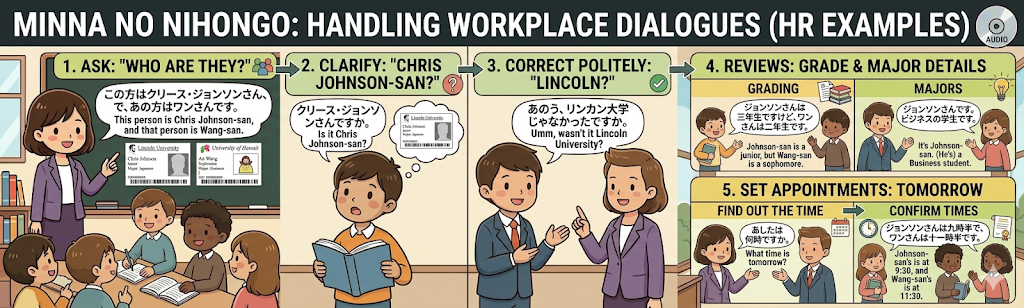
You work in the HR office of a company. Use the grammar from Lesson 2 to handle each situation below. Try producing the Japanese yourself before checking.
- You’ve been asked who the students are.
→ Kono kata wa Kuriisu Jonson-san de, ano kata wa Wan-san desu. この方はクリース・ジョンソンさんで、あの方はワンさんです。 - Your supervisor asks you to call someone. Ask if she means Chris Johnson.
→ Kuriisu Jonson-san desu ka. クリース・ジョンソンさんですか。 - Your supervisor says Ms. Wang went to Lincoln University. Correct him politely.
→ Anou, Rinkan-daigaku ja nakatta desu ka. あのう、リンカン大学じゃなかったですか。 - You’ve been asked if both Johnson and Wang are juniors.
→ Jonson-san wa sannensee desu kedo, Wan-san wa ninnensee desu. ジョンソンさんは三年生ですけど、ワンさんは二年生です。 - You’ve been asked who is studying Business.
→ Jonson-san desu. Bijinesu no gakusei desu. ジョンソンさんです。ビジネスの学生です。 - Your supervisor asks you to set up appointments with them tomorrow. Find out what time he has in mind.
→ Ashita wa nan-ji desu ka. あしたは何時ですか。 - Inform the supervisor — Johnson’s appointment is at 9:30 and Wang’s is at 11:30.
→ Jonson-san wa ku-ji-han de, Wan-san wa juu-ichi-ji-han desu. ジョンソンさんは九時半で、ワンさんは十一時半です。
🎌 Practice tip for Part A: Notice how several of these answers use kedo (but) and de to connect two noun sentences — a natural way to give compound information in Japanese. Also notice the polite correction in item 3 — anou at the start softens the correction, and the negative question form ja nakatta desu ka makes it a gentle suggestion rather than a blunt contradiction.
Practical Application – Part B: Conference Flyer Scenario
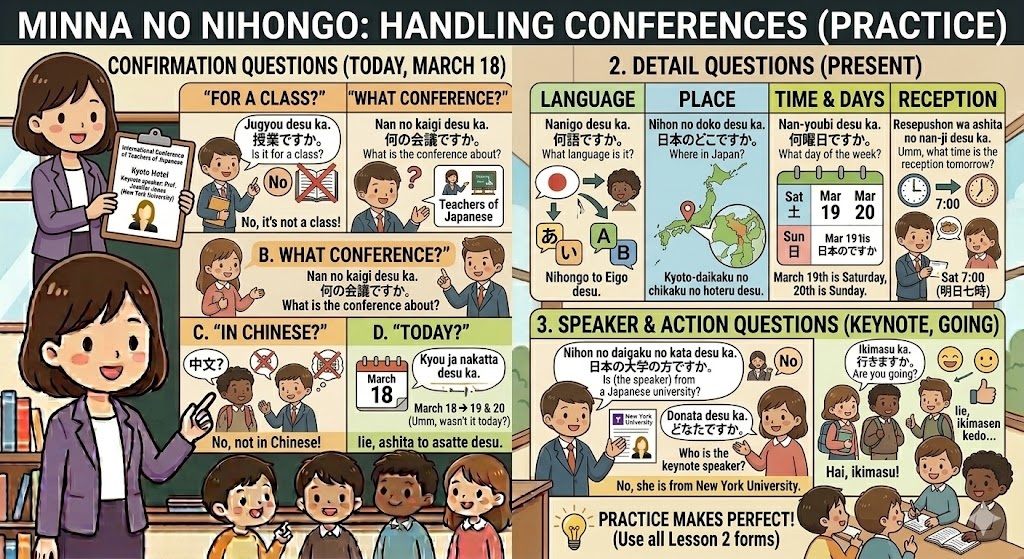
Its March 18th today. Your supervisor is holding a flyer about an upcoming conference. Use everything from Lesson 2 to ask and answer the questions below.
- Ask if the flyer is for a class. → Jugyou desu ka. 授業ですか。
- Ask what the conference is about. → Nan no kaigi desu ka. 何の会議ですか。
- Ask if it will be conducted in Chinese. → Chuugokugo desu ka. 中国語ですか。
- Ask what language it is. → Nanigo desu ka. 何語ですか。
- Ask where in Japan it will be held. → Nihon no doko desu ka. 日本のどこですか。
- Ask when it is. → Itsu desu ka. いつですか。
- Ask if it is today (March 18th). → Kyou desu ka. 今日ですか。
- Ask what days of the week the dates are. → Nan-youbi desu ka. 何曜日ですか。
- Hear your supervisor talking about the keynote speaker. Ask if it’s Prof. Honda. → Honda-sensei desu ka. 本田先生ですか。
- Ask who the keynote speaker is. → Donata desu ka. どなたですか。
- Ask if the keynote speaker is from a Japanese university. → Nihon no daigaku no kata desu ka. 日本の大学の方ですか。
- Ask your co-worker if he is going. → Ikimasu ka. 行きますか。
- Answer the questions above based on the flyer contents. (practice in pairs — one asks, one answers)
- The event is over. Now ask and answer all questions above using past forms — deshita, ja nakatta desu ka, ikimashita ka etc.
💡 On item 14 — using past forms after the event: This is where all the grammar from Lesson 2 really comes together. When the event is over, every noun sentence switches from desu / ja nai desu to deshita / ja nakatta desu, and every verb switches from masu / masen to mashita / masen deshita. Practicing this switchover in one connected scenario — same questions, different time frame — is one of the most effective ways to cement all these forms at once.
Drill Tape Scripts – All Four Dialogues in Japanese
Below are the full cue-and-response scripts for all four dialogues from Lesson 2, written in Japanese (kanji and hiragana). Cover the response side and try to produce the answer yourself. Say every response out loud — reading alone won’t build the speaking habit.
💡 Drill tips: Say each response out loud 2-3 times until it flows without hesitation. Work through all the practice cues under each model before moving to the next drill. If any response doesn’t come immediately, go back to the relevant grammar post and review, then return to the drill.
DIALOGUE 1 DRILLS
DRILL A – Correcting the time with iya
Model cue: 今、九時ですか。
Response: いや、十時ですよ。
Model cue: 今、三時ですか。
Response: いや、四時ですよ。
PRACTICE CUES — produce the response (always the next hour or corrected time):
1. 今、七時ですか。 → いや、八時ですよ。
2. 今、四時ですか。 → いや、五時ですよ。
3. 今、八時ですか。 → いや、九時ですよ。
4. 今、十時ですか。 → いや、十一時ですよ。
5. 今、一時半ですか。 → いや、二時ですよ。
6. 今、六時半ですか。 → いや、七時ですよ。
DRILL B – Denying noun sentences with ja nai desu
Model cue: 今日は、バイトですか。
Response: いえ、バイトじゃないです。
Model cue: 今日は、雨ですか。
Response: いえ、雨じゃないです。
PRACTICE CUES:
会社ですか。 → いえ、会社じゃないです。
1. 買い物ですか。 → いえ、買い物じゃないです。
2. 雪ですか。 → いえ、雪じゃないです。
3. 練習ですか。 → いえ、練習じゃないです。
4. 散歩ですか。 → いえ、散歩じゃないです。
5. 休みですか。 → いえ、休みじゃないです。
DIALOGUE 2 DRILLS
DRILL A – Identifying country of company with no
Model cue: アメリカですか。
Response: はい、アメリカの会社です。
Model cue: フランスですか。
Response: はい、フランスの会社です。
PRACTICE CUES:
1. イギリスですか。 → はい、イギリスの会社です。
2. ロシアですか。 → はい、ロシアの会社です。
3. ドイツですか。 → はい、ドイツの会社です。
4. 韓国ですか。 → はい、韓国の会社です。
5. 中国ですか。 → はい、中国の会社です。
DRILL B – Denying nationality, confirming Japanese
Model cue: 先生は、アメリカ人ですか。
Response: いえ、アメリカ人じゃないです。日本人です。
Model cue: 先生は、フランス人ですか。
Response: いえ、フランス人じゃないです。日本人です。
PRACTICE CUES:
1. 中国人ですか。 → いえ、中国人じゃないです。日本人です。
2. イタリア人ですか。 → いえ、イタリア人じゃないです。日本人です。
3. 台湾人ですか。 → いえ、台湾人じゃないです。日本人です。
4. インド人ですか。 → いえ、インド人じゃないです。日本人です。
5. ロシア人ですか。 → いえ、ロシア人じゃないです。日本人です。
DIALOGUE 3 DRILLS
DRILL A – Echo question with language name
Model cue: フランス語、わかりますか。
Response: フランス語ですか。いえ、わかりません。
Model cue: 中国語、わかりますか。
Response: 中国語ですか。いえ、わかりません。
PRACTICE CUES:
1. ロシア語、わかりますか。 → ロシア語ですか。いえ、わかりません。
2. アラビア語、わかりますか。 → アラビア語ですか。いえ、わかりません。
3. スペイン語、わかりますか。 → スペイン語ですか。いえ、わかりません。
4. フランス語、わかりますか。 → フランス語ですか。いえ、わかりません。
5. 韓国語、わかりますか。 → 韓国語ですか。いえ、わかりません。
DRILL B – Echo question with kono / ano
Model cue: これ、だれのケータイですか。
Response: このケータイですか。わかりませんねえ。
Model cue: あれ、どこの会社ですか。
Response: あの会社ですか。わかりませんねえ。
PRACTICE CUES:
1. これ、何の本ですか。 → この本ですか。わかりませんねえ。
2. あれ、どこのパソコンですか。 → あのパソコンですか。わかりませんねえ。
3. あれ、だれの傘ですか。 → あの傘ですか。わかりませんねえ。
4. これ、何時のバイトですか。 → このバイトですか。わかりませんねえ。
5. それ、どなたの鞄ですか。 → その鞄ですか。わかりませんねえ。
DIALOGUE 4 DRILLS
DRILL A – Correcting the day of the week
Model cue: 今日は、月曜日ですね。
Response: え?火曜日じゃないですか。
Model cue: 今日は、木曜日ですね。
Response: え?金曜日じゃないですか。
PRACTICE CUES:
1. 今日は、水曜日ですね。 → え?木曜日じゃないですか。
2. 今日は、日曜日ですね。 → え?月曜日じゃないですか。
3. 今日は、金曜日ですね。 → え?土曜日じゃないですか。
4. 今日は、火曜日ですね。 → え?水曜日じゃないですか。
5. 今日は、土曜日ですね。 → え?日曜日じゃないですか。
DRILL B – Past tense confirmation with ja nakatta desu ka
Model cue: きのうは雨でしたね。
Response: ええ、雨じゃなかったですか。
Model cue: 試験は月曜でしたね。
Response: ええ、月曜じゃなかったですか。
PRACTICE CUES:
1. 会議は、イギリスでしたね。 → ええ、イギリスじゃなかったですか。
2. アポは、水曜日でしたね。 → ええ、水曜日じゃなかったですか。
3. おとといは、会社でしたね。 → ええ、会社じゃなかったですか。
4. あの留学生は、韓国人でしたね。 → ええ、韓国人じゃなかったですか。
5. あれは、日本語の教科書でしたね。 → ええ、日本語の教科書じゃなかったですか。
FAQ – Japanese Lesson 2 Grammar Review
What is the difference between desu and deshita in Japanese?
Desu (です) is the non-past affirmative form of a noun sentence — it means “is X.” Deshita (でした) is the past affirmative form — it means “was X.” So getsuyoubi desu = “it’s Monday,” while getsuyoubi deshita = “it was Monday.” Deshita is also used when recalling information about a scheduled future event — “the meeting was tomorrow, right?” — which is a uniquely Japanese usage that surprises most English speakers.
What is the past negative form of desu in Japanese?
The past negative form is ja nakatta desu (じゃなかったです) — meaning “was not X.” For example, getsuyoubi ja nakatta desu = “it wasn’t Monday.” Critical rule: do NOT use deshita in the negative past. The correct form is always ja nakatta desu, never ja nai deshita. As a question — ja nakatta desu ka — it’s used to express surprise or politely correct someone.
What is the no particle in Japanese and how does it work?
The particle no (の) connects two nouns where X modifies Y — X no Y. Y is always the main noun, X tells us something about it. It can express possession (watashi no kaban = my bag), affiliation (daigaku no sensei = a university professor), type (nihongo no kyoukasho = a Japanese language textbook), time (kyou no sukejuuru = today’s schedule), or origin. The interpretation always depends on context — no is much more flexible than English’s possessive apostrophe.
What is the difference between sono and sore in Japanese?
Sore (それ) is an independent noun — “that thing (near you)” — it stands alone. Sono (その) cannot stand alone; it must be followed by a noun — “that [noun] near you.” So you can say sore wa nan desu ka (what is that?) but for a specific object you say sono kaban wa nan desu ka (what is that bag?). This distinction between the set 1 nouns (kore/sore/are/dore) and the set 2 modifiers (kono/sono/ano/dono) is one of the most important things to understand about the ko-so-a-do system.
What are the days of the week in Japanese?
Sunday = nichiyoubi (日曜日 — sun day), Monday = getsuyoubi (月曜日 — moon day), Tuesday = kayoubi (火曜日 — fire day), Wednesday = suiyoubi (水曜日 — water day), Thursday = mokuyoubi (木曜日 — wood day), Friday = kinyoubi (金曜日 — gold day), Saturday = doyoubi (土曜日 — earth day). To ask “what day is today?” say kyou wa nan-youbi desu ka. Common abbreviations: getsu-sui-kin (Mon-Wed-Fri), ka-moku (Tue-Thu), do-nichi (Sat-Sun).
What happens to foreign words when they’re borrowed into Japanese?
Three main changes happen: the sounds are adapted to fit Japanese syllable structure (substituting sounds that don’t exist in Japanese), the word is written in katakana, and the meaning may shift — narrowing, broadening, or changing compared to the original language. For example, “appointment” becomes apo (アポ) in Japanese — shortened and adapted. “Schedule” becomes sukejuuru (スケジュール). Borrowed English verbs are turned into nouns first, then the shimasu pattern is attached to make them Japanese verbs.
How is the particle “to” used in Japanese?
The particle to (と) means “and” but connects nouns or noun phrases only — not verbs, adjectives, or sentences. Doyou to nichiyou (Saturday and Sunday), Jonson-san to Wan-san (Mr. Johnson and Ms. Wang), kami to pen (paper and pen). There’s no pause between the noun and to when speaking — they flow together. In English you can pause before “and” but in Japanese you can’t do this with to.
What is an echo question in Japanese and why is it used so much?
An echo question repeats back part of what the other person just said, as a question, to clarify or acknowledge. In Japanese they’re used far more frequently than in English — not just for clarification but also to slow the pace of conversation, soften the tone, show engagement, and buy thinking time. The most common echo questions repeat the topic noun. You can echo kore (this) but not a descriptor like sumaho (smartphone). Echo questions reflect Japan’s preference for indirect, considerate communication.
You’ve Completed Lesson 2
Finishing this review means you’ve covered the complete content of Lesson 2 — four dialogues, all grammar points, practical applications in real workplace and academic scenarios, and all drill scripts in Japanese. Here’s a quick recap of everything Lesson 2 covered:
- Noun sentences — desu (is X), ja nai desu (is not X), deshita (was X), ja nakatta desu (was not X)
- Telling time — ji (hours), han (half past), yo-ji and ku-ji as irregular readings
- Days of the week — youbi system, three formality levels, common abbreviations
- Hesitation noises — anou (general) vs etto (searching for an answer)
- The no particle — X no Y where Y is the main noun
- How foreign words are borrowed into Japanese — sound changes, katakana, meaning shift
- Self-introduction ritual — hajimemashite, douzo yoroshiku, bowing
- Ko-so-a-do series set 2 — kono / sono / ano / dono (must be followed by a noun)
- Echo questions — repeat the topic noun, not the descriptor
- The particle to — connects nouns only, no pause between noun and to
- Past forms for recalling scheduled events — kaigi wa ashita deshita ne
- Language names in Japanese — add -go to country name
All Lesson 2 posts and the complete lesson series are at reading-japanese.com.
頑張ってください!(Ganbatte kudasai!) — Keep going! 🎌
— Fumito フミト | reading-japanese.com