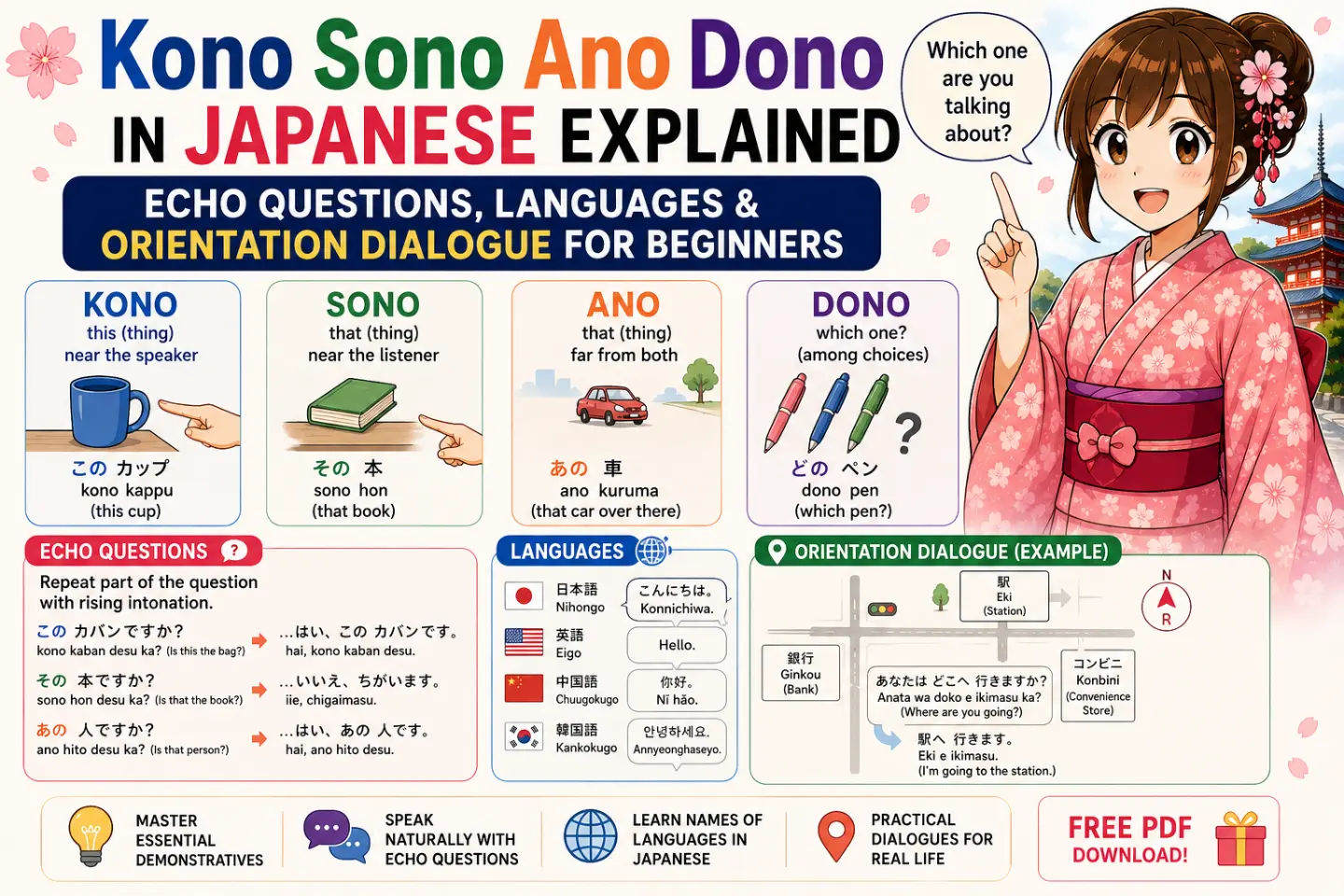
Kono Sono Ano Dono in Japanese Explained – Echo Questions, Languages and Orientation Dialogue for Beginners

In this lesson we continue through Lesson 2 with Dialogue 3 — an orientation scene for new employees where Michael meets a staff member and then spots a well-known professor across the room. Its a natural, realistic slice of Japanese workplace and social life.
From this one dialogue we pick up three things that will come up constantly in real Japanese conversation: echo questions (one of the most distinctive features of Japanese communication), the kono / sono / ano / dono series (the second set of the ko-so-a-do pointing system), and a full list of language names in Japanese. We also get some really useful social phrases — like how to accept a compliment on your Japanese in a natural, humble way.
If your just starting Lesson 2, begin with the first Lesson 2 post on desu, telling time, and weather vocabulary. And if you haven’t covered Lesson 1 yet, the Lesson 1 grammar review is a good starting point for the whole series.
📌 What you’ll learn in this lesson: How echo questions work in Japanese (and when they’re used beyond just clarification), the difference between kore/sore/are and kono/sono/ano, how to say language names in Japanese, polite vocabulary for people and names, and the humble response to compliments on your Japanese.
Dialogue 3 – New Employee Orientation
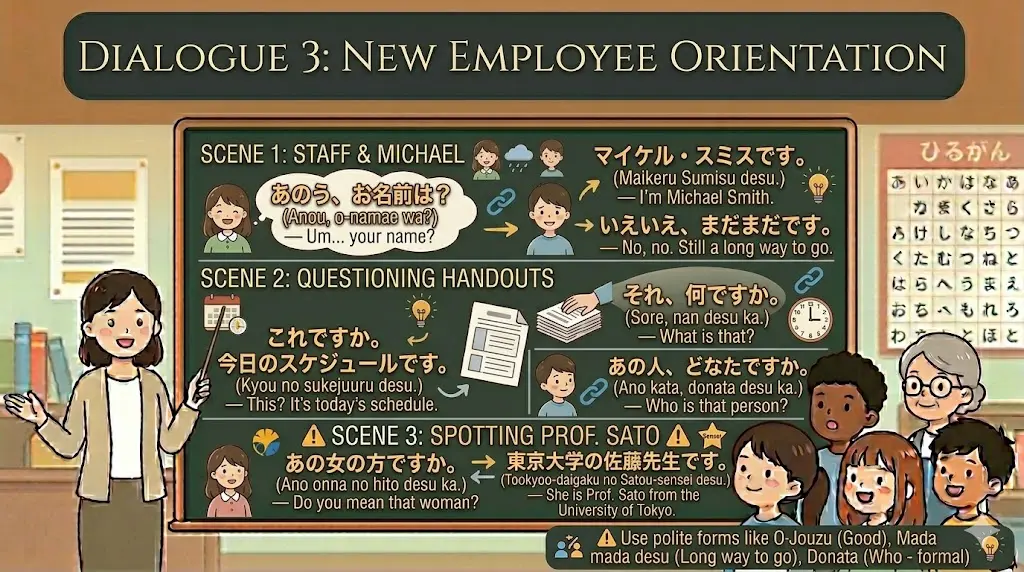
Michael Smith is attending an orientation for new employees. He meets a staff member, asks about some handouts on the table, and then spots a notable figure across the room. This dialogue is packed with useful, practical Japanese for professional and social settings.
[Staff member approaches Michael]
Staff: あのう、お名前は?
Anou, o-namae wa? — Um… (what is) your name?
Michael: マイケル・スミスです。
Maikeru Sumisu desu. — I’m Michael Smith.
Staff: 日本語、お上手ですねえ。
Nihongo, o-jouzu desu nee. — Your Japanese is good!
Michael: いえいえ、まだまだです。
Ie ie, mada mada desu. — No, no. Still a long way to go.
[Michael sees handouts on the table]
Michael: それ、何ですか。
Sore, nan desu ka. — What is that?
Staff: これですか。今日のスケジュールです。
Kore desu ka. Kyou no sukejuuru desu. — This? It’s today’s schedule.
[Michael spots someone across the room]
Michael: あの人、どなたですか。
Ano kata, donata desu ka. — Who is that person?
Staff: あの女の方ですか。
Ano onna no hito desu ka. — Do you mean that woman?
Staff: 東京大学の佐藤先生です。
Tookyoo-daigaku no Satou-sensei desu. — She is Prof. Sato from the University of Tokyo.
Vocabulary from the Dialogue
| Romaji | Japanese | Kanji | Meaning |
|---|---|---|---|
| namae / onamae | なまえ/おなまえ | 名前 | name / name (polite) |
| nihongo | にほんご | 日本語 | Japanese language |
| jouzu / ojouzu | じょうず/おじょうず | 上手 | good at something / skillful (polite) |
| mada mada | まだまだ | — | not there yet / still a long way to go |
| nan | なん | 何 | what |
| sukejuuru | スケジュール | — | schedule |
| ano X | あの X | — | that X (away from both speaker and listener) |
| hito | ひと | 人 | person |
| kata | かた | 方 | person (polite) |
| donata | どなた | — | who? (polite form of dare) |
| onna | おんな | 女 | female / woman |
| Tookyoo-daigaku | とうきょうだいがく | 東京大学 | University of Tokyo |
Additional Vocabulary
| Romaji | Japanese | Kanji | Meaning |
|---|---|---|---|
| otoko | おとこ | 男 | male / man |
| heta | へた | 下手 | poor at something / not skillful |
| keitai | けいたい / ケータイ | — | cellphone |
| sumaho | スマホ | — | smartphone |
| pasokon | パソコン | — | computer / laptop |
| baggu | バッグ | — | bag |
| kaban | かばん | 鞄 | briefcase / leather bag |
| kasa | かさ | 傘 | umbrella |
Language Names in Japanese – How to Say English, Chinese, French and More
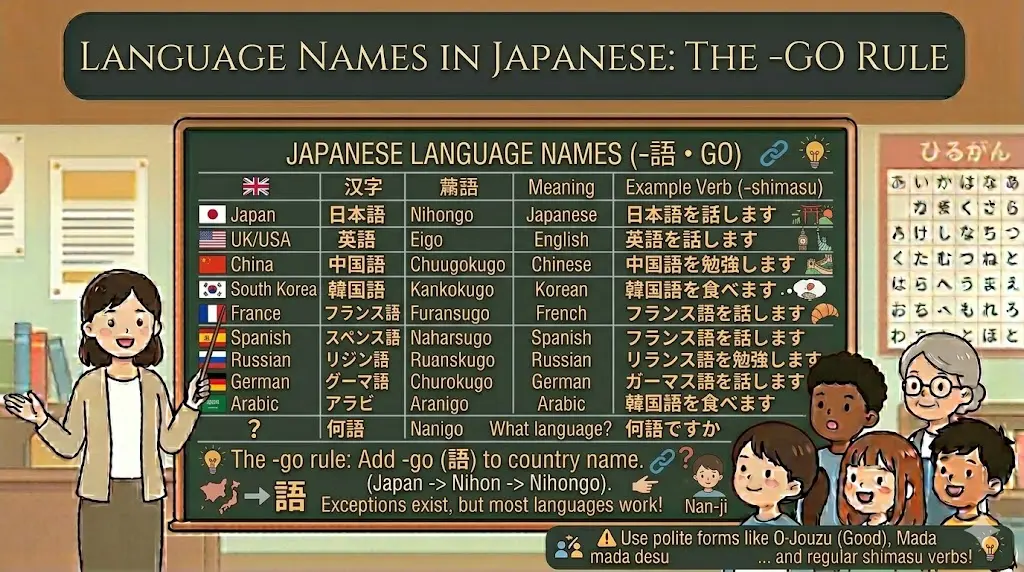
This is one of those vocabulary sets that’s immediately useful — especially in an orientation or introduction context where people talk about what languages they speak. The rule in Japanese is simple: add -go (語) to the country name to get the language name. There are a few exceptions, but the pattern works for most languages.
日本語NihongoJapanese
英語EigoEnglish
中国語ChuugokugoChinese
韓国語KankokugoKorean
フランス語FuransugoFrench
スペイン語SupeingoSpanish
ロシア語RosiagoRussian
イタリア語ItariagoItalian
ドイツ語DoitsugoGerman
ベトナム語BetonamugoVietnamese
アラビア語ArabiagoArabic
何語NanigoWhat language?
💡 The -go rule: To say the name of a language in Japanese, take the country name and add -go (語). Japan → Nihon → Nihongo. France → Furansu → Furansugo. China → Chuugoku → Chuugokugo. To ask “what language?” say nanigo (何語) — using the same question word pattern as nan-ji (what time?) from the previous lesson.
2-3-1 Echo Questions – How and Why Japanese Speakers Echo Back
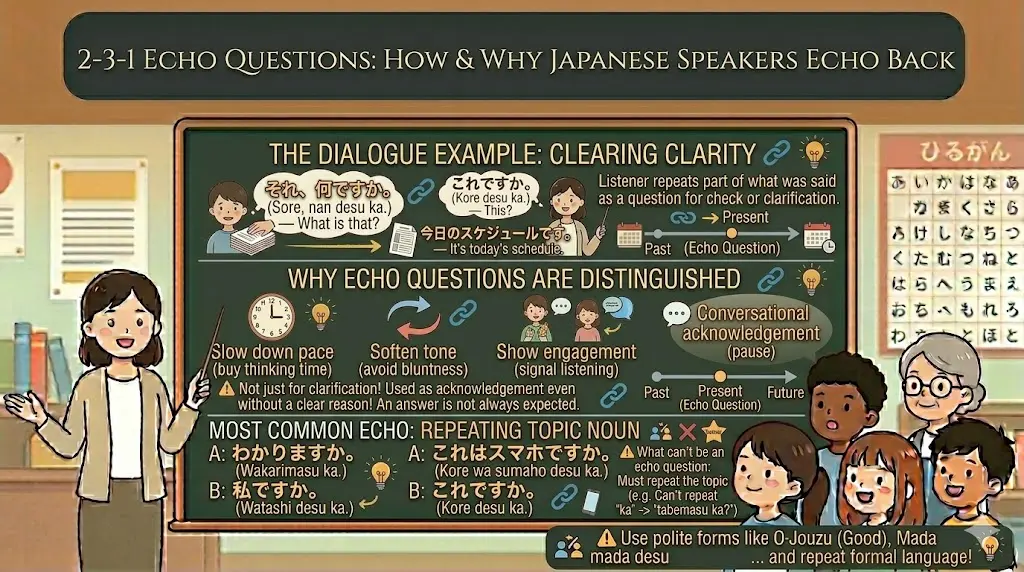
This is one of the most interesting and distinctively Japanese features of conversation — and something that a lot of learners don’t expect at first. In Japanese, when someone says something that’s slightly unclear or when the context might not be obvious, the listener often echoes back part of what was said as a question to check or clarify.
In the dialogue, when Michael asks sore, nan desu ka (what is that?), the staff member responds with an echo question: kore desu ka (this?) — checking that she’s the right person to answer and pointing to the right thing, before giving the full answer.
Michael:それ、何ですか。What is that?
Staff:これですか。今日のスケジュールです。This? It’s today’s schedule.
Echo questions occur more frequently in Japanese than in English — and not just for clarification. They’re also used to:
- Slow down the pace of conversation — buying a moment to think before answering
- Soften the tone — avoiding a direct, blunt response
- Show engagement — signalling that you’re listening and processing
Even when there’s no real need for clarification, Japanese speakers may use an echo question. In those cases, an answer to the echo question itself isn’t necessarily expected — it’s more of a conversational pause and acknowledgement.
The most common echo questions repeat the topic noun from the previous sentence — often a noun that was left unsaid or was marked by wa.
A:わかりますか。Do you understand?
B:私ですか。いや、あまり…Do you mean me? Not really…
A:これはスマホですか。Is this a smartphone?
B:これですか。はい。This? Yes.
⚠️ What can’t be an echo question: An echo question repeats the topic noun — the person or thing being discussed. It does NOT repeat a descriptive word or category. In the example above, you can echo kore (this — the thing) but you cannot echo sumaho (smartphone — the description). So sumaho desu ka? (do you mean a smartphone?) is not a valid echo question in this context. Watch out for this — its a common mistake for learners who are new to the pattern.
2-3-2 Kono, Sono, Ano, Dono – The Ko-So-A-Do Series Set 2
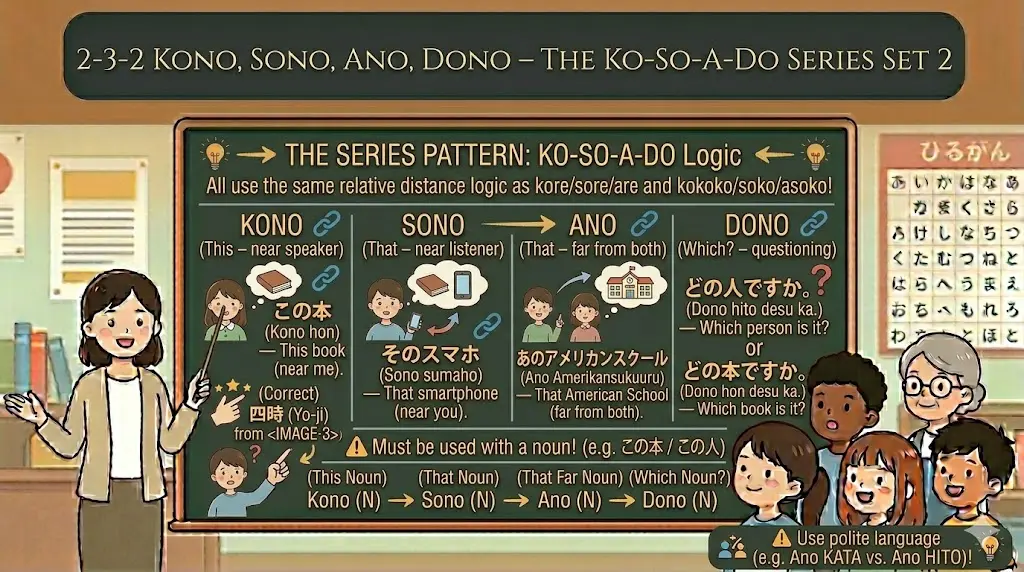
In Lesson 1 you learned the first set of the ko-so-a-do pointing system — kore, sore, are, dore — which are independent nouns meaning “this thing,” “that thing near you,” “that thing over there,” and “which one?” If you need a refresher on those, see my post on kore, sore, are and the ko-so-a-do system.
Now we add the second set: kono, sono, ano, dono. These follow the same ko-so-a-do distance logic (near speaker / near listener / away from both / question word), but with one key difference — they are not independent nouns. They must be followed by another noun.
SET 1 — Independent nouns (kore/sore/are/dore)
| これ kore | this (thing) |
| それ sore | that (thing near you) |
| あれ are | that (thing over there) |
| どれ dore | which one? |
SET 2 — Must be followed by a noun (kono/sono/ano/dono)
| この kono | this [noun] |
| その sono | that [noun] near you |
| あの ano | that [noun] over there |
| どの dono | which [noun]? |
The difference is clear when you see them used together:
これ kore — this (stands alone)
この会社 kono kaisha — this company (kono + noun)
この日本の会社 kono nihon no kaisha — this Japanese company (kono + modified noun)
あの人 ano hito — that person (over there)
あの女の方 ano onna no kata — that woman (over there) — polite
その鞄 sono kaban — that bag (near you)
どの鞄 dono kaban — which bag?
🎌 Important — kono/sono/ano/dono cannot stand alone: You can say kore wa kaisha desu (this is a company) — because kore is a complete noun. But you cannot say kono wa kaisha desu — because kono is incomplete without a following noun. It must be kono kaisha (this company). In English, “this” can function both ways — “this” and “this company” are both grammatical. In Japanese, the two forms are completley separate words. This distinction between set 1 and set 2 is one of the cleaner and more logical rules in Japanese grammar once you see it clearly.
Polite Words for People – Hito vs Kata, Dare vs Donata
This dialogue also introduces an important pair of vocabulary contrasts — casual vs polite words for referring to people and asking who someone is:
| Casual | Polite | Meaning |
|---|---|---|
| ひと (hito) | かた (kata) | person |
| だれ (dare) | どなた (donata) | who? |
In the dialogue, Michael uses donata (polite) to ask who the professor is — appropriate in a formal orientation setting. The staff member uses kata (polite) to refer to the professor. In casual conversation between friends you’d use dare and hito. In professional or formal situations, donata and kata are more appropriate.
How to Respond to Compliments on Your Japanese
One of the most practically useful phrases from this lesson is the humble response to being told your Japanese is good. In Japan, accepting compliments directly is considered a bit immodest — the expected and natural response is to deflect and be humble.
Staff:日本語、お上手ですねえ。Your Japanese is (so) good!
Michael:いえいえ、まだまだです。No, no — still a long way to go.
Ie ie, mada mada desu is the standard humble response to compliments on language ability in Japan. Every Japanese learner should have this phrase memorised and ready — because you WILL be complimented on your Japanese, even at very early stages, and a natural humble response makes a great impression.
🔑 Cultural note on compliments: In Japanese social settings, accepting a compliment directly (saying “thank you, yes I am good at Japanese!”) can come accross as arrogant. The culturally appropriate response is modesty — ie ie, mada mada desu (no no, I’m still not there yet) or something similar. This reflects the broader Japanese cultural value of humility (謙遜, kenson) in social interactions. Its not false modesty — its a genuine part of how Japanese people build good social relationships.
Drill A – Echo Question with Language Names
Someone asks if you understand a language. You echo back the language as a question, then give a negative response.
MODEL EXCHANGES
Cue: Furansugo, wakarimasu ka. — Do you understand French?
フランス語、わかりますか。
Response: Furansugo desu ka. Ie, wakarimasen. — French? No, I don’t.
フランス語ですか。いえ、わかりません。
Cue: Chuugokugo, wakarimasu ka. — Do you understand Chinese?
中国語、わかりますか。
Response: Chuugokugo desu ka. Ie, wakarimasen. — Chinese? No, I don’t.
中国語ですか。いえ、わかりません。
Practice with: Eigo, wakarimasu ka / Kankokugo, wakarimasu ka / Doitsugo, wakarimasu ka
Drill B – Echo Question with Kono / Ano
Someone asks about a specific object. Use an echo question with kono or ano before answering that you don’t know.
MODEL EXCHANGES
Cue: Kore, dare no keitai desu ka. — Whose cellphone is this?
これ、だれのケータイですか。
Response: Kono keitai desu ka. Wakarimasen nee. — This cellphone? I don’t know.
このケータイですか。わかりませんねえ。
Cue: Are, doko no kaisha desu ka. — Where is that company from?
あれ、どこの会社ですか。
Response: Ano kaisha desu ka. Wakarimasen nee. — That company? I don’t know.
あの会社ですか。わかりませんねえ。
Practice with: kono sumaho / ano kaban / sono kasa / kono pasokon
Drill C – Say It in Japanese
Ms. Honda has asked you what is in the bag. Respond to each situation using kono, sono, ano, and dono as appropriate.
- Which bag is it?
→ Dono baggu desu ka. どのバッグですか。 - Do you mean this bag? It’s my smartphone.
→ Kono baggu desu ka. Watashi no sumaho desu. このバッグですか。わたしのスマホです。 - Do you mean that bag over there? Isn’t it Mr. Oda’s laptop?
→ Ano baggu desu ka. Oda-san no pasokon ja nai desu ka. あのバッグですか。小田さんのパソコンじゃないですか。 - This is my friend’s umbrella.
→ Kore wa tomodachi no kasa desu. これはともだちのかさです。 - I don’t know. It’s not my bag.
→ Wakarimasen. Watashi no baggu ja nai desu. わかりません。わたしのバッグじゃないです。
Drill D – Act in Japanese (Role Play)
These situations practice the vocabulary and grammar from this lesson in realistic settings. Use appropriate polite language where the situation calls for it — especially for formal situations like receptions and orientations.
- You are at a reception. Approach another guest and ask his name.
→ Anou, o-namae wa? あのう、お名前は? - You spotted Prof. Sato at the reception. Ask a staff member if that woman is in fact Prof. Sato.
→ Ano onna no kata, Satou-sensei desu ka. あの女の方、佐藤先生ですか。 - Ms. Honda is carrying a big bag. Ask what’s in it.
→ Sono baggu, nan desu ka. そのバッグ、何ですか。 - You’ve just heard someone’s name. Check if that is a name for a man.
→ Otoko no kata no namae desu ka. 男の方の名前ですか。 - Someone has mistaken your bag for hers. Point out her mistake and get your bag back.
→ Anou, kore wa watashi no baggu desu. Sono baggu ja nai desu ka. あのう、これはわたしのバッグです。そのバッグじゃないですか。 - At a party you’ve been complimented on your Japanese skills. Be humble and respond.
→ Ie ie, mada mada desu. いえいえ、まだまだです。
💡 On Drill D item 5 — correcting someone about a bag: Notice how starting with anou makes the correction much gentler. Without it, pointing out someone’s mistake can sound blunt and confrontational. With anou at the start, its softer and more socially considerate. This is exactly the kind of situation where hesitation noises really earn their place in Japanese communication.
FAQ – Kono Sono Ano Dono, Echo Questions and Language Names
What is the difference between kore and kono in Japanese?
Kore (これ) is an independent noun meaning “this” — it stands alone as the subject or object of a sentence. Kono (この) cannot stand alone — it must be followed by a noun. Kore wa kaisha desu = “this is a company” (kore stands alone). Kono kaisha = “this company” (kono + noun). In English, “this” can do both jobs, but in Japanese the two forms are completley different words. The same distinction applies to sore/sono, are/ano, and dore/dono.
What is the ko-so-a-do series in Japanese?
The ko-so-a-do series is a system of related Japanese words for pointing at things based on their distance from the speaker and listener. Ko- words (kore, kono, koko…) = near the speaker. So- words (sore, sono, soko…) = near the listener. A- words (are, ano, asoko…) = away from both. Do- words (dore, dono, doko…) = question words (which? where?). There are multiple sets in the series — the first set (kore/sore/are/dore) are independent nouns, and the second set (kono/sono/ano/dono) are incomplete elements that must be followed by a noun.
What are echo questions in Japanese?
Echo questions are when a Japanese speaker echoes back all or part of what the other person just said as a question. They are used for clarification (“do you mean this?”), to slow down the conversation, to soften the tone, or simply to show engagement. Echo questions are far more frequent in Japanese than in English because of the cultural preference for indirect, non-confrontational communication. The most common echo questions repeat the topic noun from the previous sentence — not a descriptive word.
How do you say language names in Japanese?
Most language names in Japanese are formed by taking the country name and adding -go (語). Japanese = nihongo (日本語), English = eigo (英語), Chinese = chuugokugo (中国語), French = furansugo (フランス語), Korean = kankokugo (韓国語), Spanish = supeingo (スペイン語), German = doitsugo (ドイツ語). To ask “what language?” say nanigo (何語).
What does “mada mada desu” mean in Japanese?
Mada mada desu (まだまだです) means “I still have a long way to go” or “not there yet.” It is the standard humble response when someone compliments your Japanese language ability. In Japanese culture, accepting compliments directly is considered immodest, so deflecting with ie ie, mada mada desu (no no, I’m still not there yet) is the socially expected and natural response. Every Japanese learner should have this phrase ready — you’ll definitely need it!
What does “jouzu” mean in Japanese?
Jouzu (上手) means “good at something” or “skillful.” Its used to describe someone’s ability in a skill — nihongo ga jouzu desu = “your Japanese is good.” The polite form with the o- prefix is ojouzu (お上手), used when complimenting someone else. The opposite of jouzu is heta (下手) which means “poor at something” or “not skillful.” Be careful — calling yourself jouzu sounds arrogant; heta desu or mada mada desu is more appropriate when talking about your own skills.
What is the difference between hito and kata in Japanese?
Both hito (人) and kata (方) mean “person” in Japanese, but kata is the polite form. Use hito in casual conversation and kata when speaking politely about someone — especially someone senior, a client, a professor, or a stranger. Similarly, dare (だれ) and donata (どなた) both mean “who?” — with donata being the polite form to use in formal situations.
How do you ask “what is that?” in Japanese?
To ask “what is that?” use sore, nan desu ka (それ、何ですか) — for something near the listener. For something away from both of you: are, nan desu ka (あれ、何ですか). For something near you: kore, nan desu ka (これ、何ですか). When combined with the kono/sono/ano set: sono baggu, nan desu ka = “what’s in that bag?” or “what is that bag?” The question word for “what” is nan (何) before desu, and nani (何) in other positions.
What’s Next?
You’ve now covered the second set of the ko-so-a-do series (kono/sono/ano/dono), how echo questions work and why Japanese speakers use them so much, all the major language names, and polite vs casual vocabulary for referring to people. That’s a lot of ground covered in one dialogue!
The next step in Lesson 2 builds on the no particle — you saw it briefly in this lesson with Tookyoo-daigaku no Satou-sensei (Professor Sato of the University of Tokyo) and kyou no sukejuuru (today’s schedule). The no particle connects nouns and shows possession and attribution — its one of the most versatile and frequently used particles in Japanese.
In the meantime, practice the drills from this lesson out loud and try building your own sentences using kono / sono / ano with the object vocabulary from this lesson — kono kaban, sono keitai, ano sumaho. You can find all the lessons in this series at reading-japanese.com.
頑張ってください!(Ganbatte kudasai!) — Keep going! 🎌
— Fumito フミト | reading-japanese.com
📚 Related lessons on reading-japanese.com: