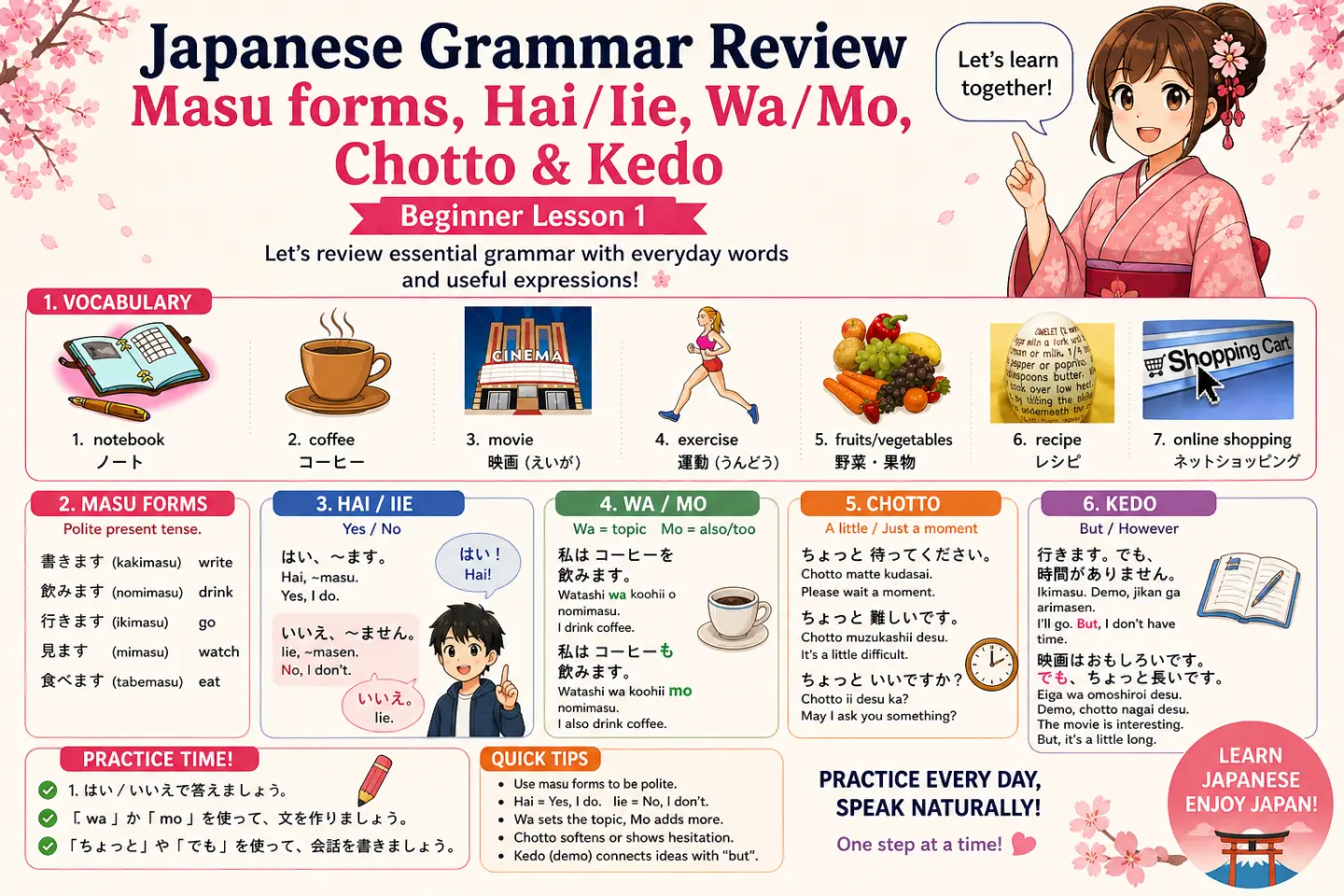

This post is the full review and drill reference for everything covered in Lesson 1 of this beginner Japanese series. If you’ve been working through the dialogues and grammar notes, this is where it all comes together — a complete grammar review with answers, a practical application section using a real scenario, and the full drill tape script for all four dialogues in kanji and hiragana.
This makes the post useful in two ways. First, as a self-check — work through the grammar review questions yourself before reading the answers. Second, as a drill reference — the full tape scripts at the bottom give you all the cue-and-response pairs in Japanese so you can practice listening and speaking without looking at romanized text.
Japanese Lesson 1 Grammar Review – Verb Forms, Particles, Drills and Practical Application
Everything in this review comes from the four lessons already covered in this series. If you want to go back to any grammar point in detail before testing yourself, here are the direct links:
- Lesson 1 Grammar – Masu, Masen, Hai, Iie and Sentence Particles
- Lesson 1 Grammar – Kore Sore Are, Particles Wa and Mo, Kedo
- Lesson 1 Grammar – Invitations, Chotto, Aizuchi and Particle Yo
- Lesson 1 Grammar – Japanese Past Tense and Compound Verbs with Shimasu
📌 How to use this review: Try answering each grammar question yourself before reading the answer. Then work through the practical application section out loud. Finally, use the drill tape scripts at the bottom with audio (if you have access to it) or with a study partner — one person reads the cue, the other gives the response.
Grammar Review – Questions and Answers
These questions cover every major grammar point from Lesson 1. The lesson reference number is shown in brackets so you can go back and review any point in full detail if needed.
AWhat endings does a Japanese verb have?1-1-1
Japanese formal verbs end in -masu (affirmative non-past), -masen (negative non-past), -mashita (affirmative past), and -masen deshita (negative past). All four of these are the polite/formal forms used in everyday conversation with people you’re not very close to. Other endings exist for casual and written speech, but these four are the foundation for beginners.
BFor verbs, what marks the non-past affirmative? The negative?1-1-1
| Affirmative | Negative | |
|---|---|---|
| Non-past | 〜ます (-masu) tabemasu — eat / will eat | 〜ません (-masen) tabemasen — don’t eat / won’t eat |
| Past | 〜ました (-mashita) tabemashita — ate | 〜ませんでした (-masen deshita) tabemasen deshita — didn’t eat |
CWhat does Non-Past mean?1-1-1
Non-past covers two things: actions performed regularly as a habit, and actions that will be performed in the future. It does not refer to something happening right now at this moment. So tabemasu means “I eat (in general)” or “I will eat” — not “I am eating right now.” That ongoing present meaning requires a different verb form which is introduced in a later lesson.
DFor verbs, what marks the past affirmative? The negative?1-4-1
Past affirmative is marked by -mashita (ました). Past negative is marked by -masen deshita (ませんでした). For example: ikimashita (went), ikimasen deshita (didn’t go). These endings are completely regular across all formal verbs — no exceptions.
EWhat does iie mean? How different is it from “no” in English?1-1-2
Iie (いいえ) means “what you said is incorrect” — regardless of whether the question was positive or negative. This is different from English where “no” simply denies the positive. In Japanese, if someone asks “you don’t understand, right?” and you DO understand, you say iie (because their statement is wrong) and then confirm with a positive verb. In English you’d say “yes” in that same situation. This reversal with negative questions is one of the most common points of confusion for English-speaking beginners.
FWhere does a subject occur in a Japanese sentence? An adverb?1-2-1, 1-1-4
The standard word order in Japanese is: Time – Subject – Object – Adverb – Verb. The subject comes before the object and adverb. The adverb comes directly before the verb. The verb always comes at the very end of the sentence. The subject is often dropped entirely when it’s already clear from context — overusing it (especially watashi) is one of the most common beginner mistakes.
GWhat is the difference between sore and are?1-2-2
Sore (それ) refers to something close to the listener — or something the listener just mentioned. Are (あれ) refers to something away from both the speaker and the listener — or something both people already know about. English only has two pointing words (this / that), so the three-way Japanese system — kore (near me), sore (near you), are (away from both) — takes a little adjustment. The sore/are distinction is the one that trips up English speakers most often.
HWhere does a sentence particle occur? Give three examples with their meanings.1-1-3, 1-3-5
Sentence particles attach to the very end of a sentence. Three key examples:
| Particle | Japanese | Function |
|---|---|---|
| ka | か | Turns a statement into a question |
| ne / nee | ね/ねえ | Indicates shared feeling or seeks agreement (“right?” / “isn’t it?”) |
| yo | よ | Indicates new information or corrects / assures the listener |
IHow do you invite someone to do something in Japanese?1-3-1
Use a negative question — verb stem + masen ka. For example: ikimasen ka (won’t you go? / shall we go?), tabemasen ka (won’t you have some?), renshuu-shimasen ka (shall we practice?). This negative question form sounds softer and more considerate than a direct positive question. When accepting, respond with arigatou gozaimasu or ee, ikimasu. When declining politely, use chotto… and trail off slowly.
JIn the phrase “Are wa?” what does wa mean?1-2-4
Here wa (は) is functioning as the contrast marker. In the question are wa?, it singles out “that” and asks “how about that one?” — implying a contrast with something else already under discussion. When wa attaches to a noun with question intonation, it becomes “how about X?” This is not a yes/no question — it invites a fuller reaction or opinion about that specific thing.
KWhat is the difference in meaning among these three sentences?1-2-4, 1-2-5
No particle
あした やすみます。
Ashita yasumimasu.
Tomorrow I will rest. (neutral — just stating a fact)
は Wa — contrast
あしたは やすみます。
Ashita wa yasumimasu.
Tomorrow I will rest. (but other days may be different)
も Mo — addition
あしたも やすみます。
Ashita mo yasumimasu.
Tomorrow I will rest too. (in addition to other days)
LWhat is a compound verb? Give three examples.1-4-2
A compound verb is formed by taking an action noun and adding shimasu to it. Many Japanese nouns that describe actions work in this pattern, and English loanwords follow the same structure when borrowed into Japanese. Three examples:
| Noun | Compound verb | Meaning |
|---|---|---|
| renshuu (practice) | れんしゅうします | to practice |
| benkyou (study) | べんきょうします | to study |
| meeru (email) | メールします | to email / text |
MHow is chotto used?1-3-2
Chotto (ちょっと) literally means “a little” but functions as a social impact-softener in conversation. Main uses: to get someone’s attention, to show humility when accepting something offered (ja, chotto itadakimasu), to soften a request (chotto onegaishimasu), to indicate you don’t know something (chotto wakarimasen), and most importantly — to politely decline an invitation without saying a direct “no.” When declining, say chotto… slowly and trail off, elongating the vowels to signal polite regret.
NHow is sou desu ka used?1-3-3
Sou desu ka (そうですか) is an aizuchi expression — a short verbal feedback phrase used while listening. It means “is that so?” or “I see” and signals that you’ve received and are processing new information from the other person. It keeps the conversation flowing and shows you’re engaged. Combined with a small nod and aa at the start (aa, sou desu ka), it’s one of the most natural and frequently used expressions in Japanese conversation.
OHow is kedo used?1-2-3
Kedo (けど) means “but” and connects two sentences — the second typically contrasting with or following on from the first. Example: kaimasu kedo, tsukaimasen (I’ll buy it, but I won’t use it). The second sentence is often left unsaid when the meaning is already obvious or when the speaker is being polite and leaving space for the other person to respond. Ga (が) carries the same meaning but is more formal — more common in writing and formal speech.
PWhat caution is given regarding addressing the person you are talking to?1-3-4
Several important cautions. First — avoid the word anata (you) if you know the person’s name or title; use their name + san or appropriate title instead. Second — be conservative with forms of address. Start with last name + san or a title like sensei. Switch to more casual forms only when requested, and usually that switch is initiated by the superior in the relationship. Third — don’t overuse personal pronouns like watashi. Japanese drops the subject when it’s clear from context, and overusing watashi is one of the most common and obvious mistakes made by foreign learners.
Practical Application – Going Away Party Scenario
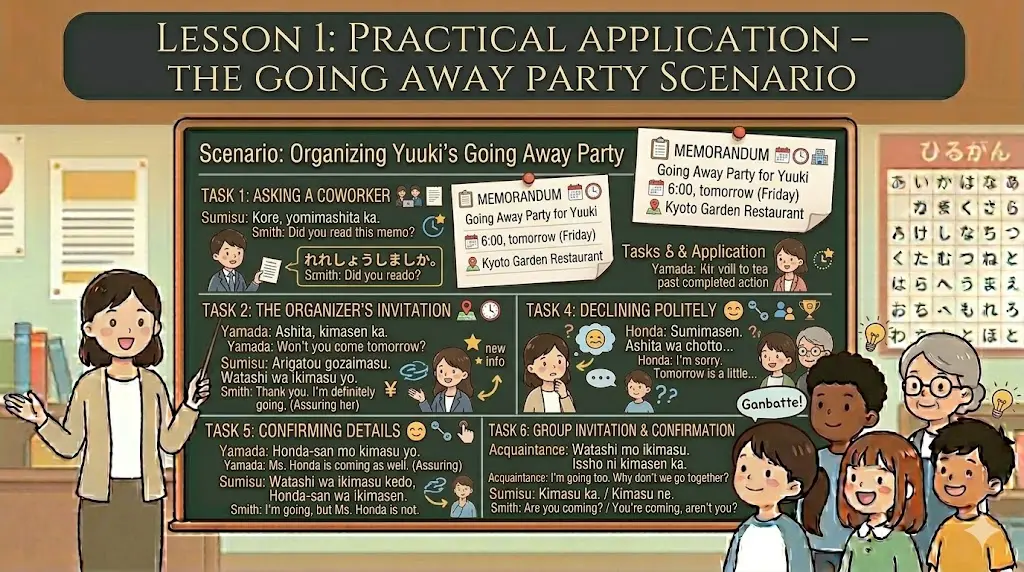
This section puts everything from Lesson 1 together in one real-life situation. Look at the memorandum below, then work through each task in Japanese. Try to produce the Japanese yourself before checking.
📋 Memorandum
Going Away Party for Yuuki
6:00, tomorrow (Friday)
Kyoto Garden Restaurant
- Ask a coworker if she read this memo.
→ Kore, yomimashita ka. これ、よみましたか。 - As an organizer, invite an acquaintance to come to the event tomorrow.
→ Ashita, kimasen ka. あした、きませんか。 - You’ve been invited by an organizer. Thank her and tell her you’re coming.
→ Arigatou gozaimasu. Watashi wa ikimasu yo. ありがとうございます。わたしは行きますよ。 - Apologize and turn down the invitation politely.
→ Sumimasen. Ashita wa chotto… すみません。あしたはちょっと、、、 - As an organizer, tell an acquaintance that Ms. Honda is coming as well.
→ Honda-san mo kimasu yo. 本田さんもきますよ。 - Tell an organizer that you are going but Ms. Honda is not.
→ Watashi wa ikimasu kedo, Honda-san wa ikimasen. わたしは行きますけど、本田さんは行きません。 - You are going to the event. Invite an acquaintance to come with you as well.
→ Watashi mo ikimasu. Issho ni kimasen ka. わたしも行きます。いっしょにきませんか。 - Confirm that he is coming.
→ Kimasu ka. / Kimasu ne. きますか。/きますね。
🎌 Practice tip: For the party scenario, try doing all eight items back-to-back as a mini role-play with a partner. Assign one person as the event organizer and the other as the invitee, and switch roles halfway through. This kind of connected roleplay — where the sentences follow each other in a real sequence — is much closer to how Japanese is actually used than isolated drill sentences.
Drill Tape Scripts – All Four Dialogues in Japanese
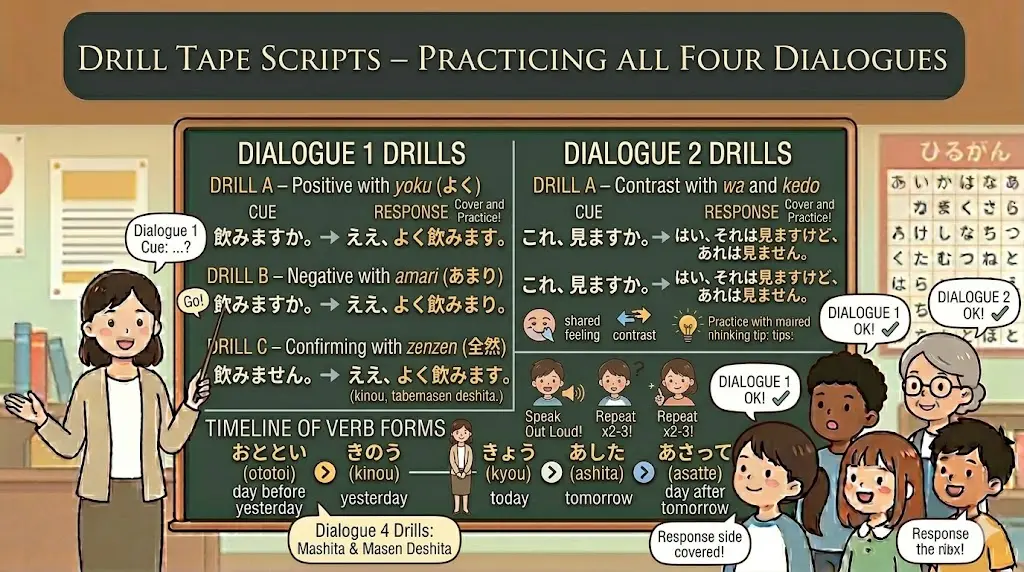
Below are the full cue-and-response scripts for all four dialogues from Lesson 1, written in Japanese (kanji and hiragana). Use these for listening and speaking practice — cover the response side and try to produce the answer yourself before uncovering it. If you have a study partner, one person reads the cues and the other gives the responses.
💡 Drill tips: Say every response out loud — don’t just read them in your head. Repeat each exchange 2-3 times until it flows naturally. Speed and smoothness come with repetition. If a response doesn’t come immediately, that’s the gap the drill is exposing — go back to that grammar point and review.
DIALOGUE 1 DRILLS
DRILL A – Positive response with yoku (よく)
Model cue: しますか。
Response: ええ、よくします。
Model cue: 食べますか。
Response: ええ、よく食べます。
PRACTICE CUES — give the response for each:
1. 飲みますか。 → ええ、よく飲みます。
2. 買いますか。 → ええ、よく買います。
3. 作りますか。 → ええ、よく作ります。
4. 食べますか。 → ええ、よく食べます。
DRILL B – Negative response with amari (あまり)
Model cue: しますか。
Response: いいえ、あまりしませんねえ。
Model cue: 食べますか。
Response: いいえ、あまり食べませんねえ。
PRACTICE CUES:
1. 乗りますか。 → いいえ、あまり乗りませんねえ。
2. 食べますか。 → いいえ、あまり食べませんねえ。
3. 作りますか。 → いいえ、あまり作りませんねえ。
4. 飲みますか。 → いいえ、あまり飲みませんねえ。
DRILL C – Confirming negative with zenzen (全然)
Model cue: しませんか。
Response: ええ、全然しませんねえ。
Model cue: 食べませんか。
Response: ええ、全然食べませんねえ。
PRACTICE CUES:
1. 飲みませんか。 → ええ、全然飲みませんねえ。
2. 買いませんか。 → ええ、全然買いませんねえ。
3. 作りませんか。 → ええ、全然作りませんねえ。
4. わかりませんか。 → ええ、全然わかりませんねえ。
DIALOGUE 2 DRILLS
DRILL A – Contrast with wa and kedo
Model cue: これ、見ますか。
Response: はい、それは見ますけど、あれは見ません。
Model cue: これ、しますか。
Response: はい、それはしますけど、あれはしません。
PRACTICE CUES:
1. これ、聞きますか。 → はい、それは聞きますけど、あれは聞きません。
2. これ、作りますか。 → はい、それは作りますけど、あれは作りません。
3. これ、書きますか。 → はい、それは書きますけど、あれは書きません。
4. これ、読みますか。 → はい、それは読みますけど、あれは読みません。
DRILL B – I do but Ms. Honda doesn’t
Model cue: 見ますか。
Response: 私は見ますけど、本田さんは、見ませんねえ。
Model cue: しますか。
Response: 私はしますけど、本田さんは、しませんねえ。
PRACTICE CUES:
1. 食べますか。 → 私は食べますけど、本田さんは、食べませんねえ。
2. 話しますか。 → 私は話しますけど、本田さんは、話しませんねえ。
3. 作りますか。 → 私は作りますけど、本田さんは、作りませんねえ。
4. 飲みますか。 → 私は飲みますけど、本田さんは、飲みませんねえ。
DRILL C – Addition with mo
Model cue: 見ますよ。
Response: これも見ますか。
Model cue: しますよ。
Response: これもしますか。
PRACTICE CUES:
1. 聞きますよ。 → これも聞きますか。
2. 書きますよ。 → これも書きますか。
3. 読みますよ。 → これも読みますか。
4. 使いますよ。 → これも使いますか。
DRILL D – Me too, every day
Model cue: 見ますよ。
Response: ああ、私も毎日見ますよ。
Model cue: しますよ。
Response: ああ、私も毎日しますよ。
PRACTICE CUES:
1. 聞きますよ。 → ああ、私も毎日聞きますよ。
2. 書きますよ。 → ああ、私も毎日書きますよ。
3. 読みますよ。 → ああ、私も毎日読みますよ。
4. 乗りますよ。 → ああ、私も毎日乗りますよ。
DIALOGUE 3 DRILLS
DRILL A – Confirming and inviting Ms. Honda
Model cue: 行きますか。
Response: はい、行きます。本田さんも行きませんか。
Model cue: しますか。
Response: はい、します。本田さんもしませんか。
PRACTICE CUES:
1. 出かけますか。 → はい、出かけます。本田さんも出かけませんか。
2. 帰りますか。 → はい、帰ります。本田さんも帰りませんか。
3. 読みますか。 → はい、読みます。本田さんも読みませんか。
4. 買いますか。 → はい、買います。本田さんも買いませんか。
DRILL B – Sou desu ka, me too
Model cue: 行きますよ。
Response: ああ、そうですか。じゃあ、私も行きます。
Model cue: しますよ。
Response: ああ、そうですか。じゃあ、私もします。
PRACTICE CUES:
1. 聞きますよ。 → ああ、そうですか。じゃあ、私も聞きます。
2. 会いますよ。 → ああ、そうですか。じゃあ、私も会います。
3. 書きますよ。 → ああ、そうですか。じゃあ、私も書きます。
4. 飲みますよ。 → ああ、そうですか。じゃあ、私も飲みます。
DIALOGUE 4 DRILLS
DRILL A – Chotto + masen ka invitation
Model cue: 練習しますか。
Response: ええ、ちょっと練習しませんか。
Model cue: 買いますか。
Response: ええ、ちょっと買いませんか。
PRACTICE CUES:
1. 勉強しますか。 → ええ、ちょっと勉強しませんか。
2. コピーしますか。 → ええ、ちょっとコピーしませんか。
3. 休みますか。 → ええ、ちょっと休みませんか。
4. メールしますか。 → ええ、ちょっとメールしませんか。
DRILL B – Past tense contrast: kinou vs ototoi
Model cue: 休みましたね。
Response: きのうは、休みましたけど、おとといは休みませんでした。
Model cue: 行きましたね。
Response: きのうは行きましたけど、おとといは行きませんでした。
PRACTICE CUES:
1. 出かけましたね。 → きのうは出かけましたけど、おとといは出かけませんでした。
2. 作りましたね。 → きのうは作りましたけど、おとといは作りませんでした。
3. 電話しましたね。 → きのうは電話しましたけど、おとといは電話しませんでした。
4. 来ましたね。 → きのうは来ましたけど、おとといは来ませんでした。
FAQ – Japanese Lesson 1 Grammar Review
What are the four verb forms in Japanese formal speech?
The four formal verb forms are: non-past affirmative (-masu), non-past negative (-masen), past affirmative (-mashita), and past negative (-masen deshita). These four forms cover the vast majority of what beginners need to express in polite Japanese conversation. They are completely regular — once you know one verb, you know all four of its formal forms automatically.
What is the Japanese word order in a sentence?
Standard Japanese word order is Time – Subject – Object – Adverb – Verb. The verb always comes at the end. The subject is frequently omitted when clear from context. Noun order before the verb is relatively flexible — moving a noun earlier in the sentence gives it more emphasis or focus. This is quite different from English (Subject – Verb – Object) and is one of the first structural things beginners need to adjust to.
What is the difference between wa and mo in Japanese?
Wa (は) is a contrast marker — it singles out a noun and implies that other things may be different. Mo (も) is an addition marker — it includes a noun in a group, meaning “also” or “too” (with affirmative verbs) or “either/neither” (with negative verbs). The simplest way to remember it: wa = spotlight (separates), mo = plus sign (includes).
What is the difference between ne and yo in Japanese?
Ne (ね) is used for shared information — it assumes the listener already knows or agrees, like “right?” or “don’t you think?” Yo (よ) is used for new information — telling the listener something they may not know, or correcting / assuring them. Using the wrong one can send the wrong social signal, so its worth paying attention to which one native speakers use in which situations.
How do you say “I understand” and “I understood” in Japanese?
Wakarimasu (わかります) = I understand (non-past — general/habitual). Wakarimashita (わかりました) = I understood / got it (past — used to confirm you’ve received and accepted information or an instruction). Wakarimasen (わかりません) = I don’t understand. Wakarimasen deshita (わかりませんでした) = I didn’t understand. In practice, wakarimashita is the one you’ll use most often in response to instructions at work or school.
What is the difference between kore, sore, and are in Japanese?
Kore (これ) = this — something near the speaker. Sore (それ) = that — something near the listener or just mentioned by the listener. Are (あれ) = that over there — something away from both speaker and listener, or something both already know about. Dore (どれ) = which one? This three-way system (ko-so-a-do) is one of the foundational structures in Japanese and extends to places, types, ways, and more in later lessons.
What does “sou desu ka” mean in Japanese?
Sou desu ka (そうですか) means “I see,” “is that so?” or “really?” It’s an aizuchi — a listener feedback expression that signals you’ve received and are processing new information. It keeps the conversation flowing naturally and shows you’re engaged. Its not really asking a question — its more of an acknowledgement. One of the most frequently used phrases in Japanese conversation.
How do you politely decline an invitation in Japanese?
Don’t say iie (no) directly — that can feel blunt in Japanese social situations. The polite way is to use chotto and trail off: kyou wa chotto… (today is a little bit…) spoken slowly with elongated vowels. This signals hesitation and polite regret without a direct refusal. The other person will understand immediately. Adding sumimasen (sorry) makes it even softer.
You’ve Completed Lesson 1
Working through this review means you’ve covered the full content of Lesson 1 — four dialogues, sixteen grammar points, multiple drill sets, and a practical application scenario. That’s a solid foundation in everyday Japanese conversation.
Here’s a quick recap of everything Lesson 1 covered:
- All four formal verb forms — masu, masen, mashita, masen deshita
- How hai and iie work (different from English yes/no)
- Japanese word order — Time, Subject, Object, Adverb, Verb
- Ko-so-a-do series — kore, sore, are, dore
- Particles ka (question), ne/nee (shared feeling), yo (new information)
- Particle wa (contrast) and mo (addition)
- Kedo (but) for connecting sentences
- Inviting with negative questions — masen ka
- Chotto as a social softener and polite refusal
- Aizuchi — sou desu ka, aa, hai, nee as listener feedback
- Watashi vs boku and how to address people in Japanese
- Compound verbs — noun + shimasu
- Time words — kinou, ototoi, ashita, asatte, mainichi
When you’re ready to move on, Lesson 2 will build on all of this — expanding sentence structure, introducing nouns and the particle no, and moving into more complex real-life situations. You can find all upcoming lessons as they’re published at reading-japanese.com.
頑張ってください!(Ganbatte kudasai!) — Keep going! 🎌
— Fumito フミト | reading-japanese.com
📚 All Lesson 1 posts on reading-japanese.com:
- How to learn Japanese FAST? Tips from a native speaker 🇯🇵📚✨🌎✈️
- What books to buy if you wanna learn japanese language 📚
- 10 Best Japanese Learning Books in 2026 (Honest Reviews)
- 4 Ways to Stay Motivated When Learning Japanese by Fumito Emi
- 100 Traditional Japanese Greetings and When to Use Them
External resources:
NHK World Japanese Lessons (Free) | Jisho Japanese Dictionary | Anki Flashcards | JapanesePod101