
こんにちは。
My name is Fumito, a Japanese language tutor living in Japan and the person behind reading-japanese.com.
Many students tell me:
“Sensei, I want to study in Tokyo, but there are too many schools.
Which Japanese language school is really good?”
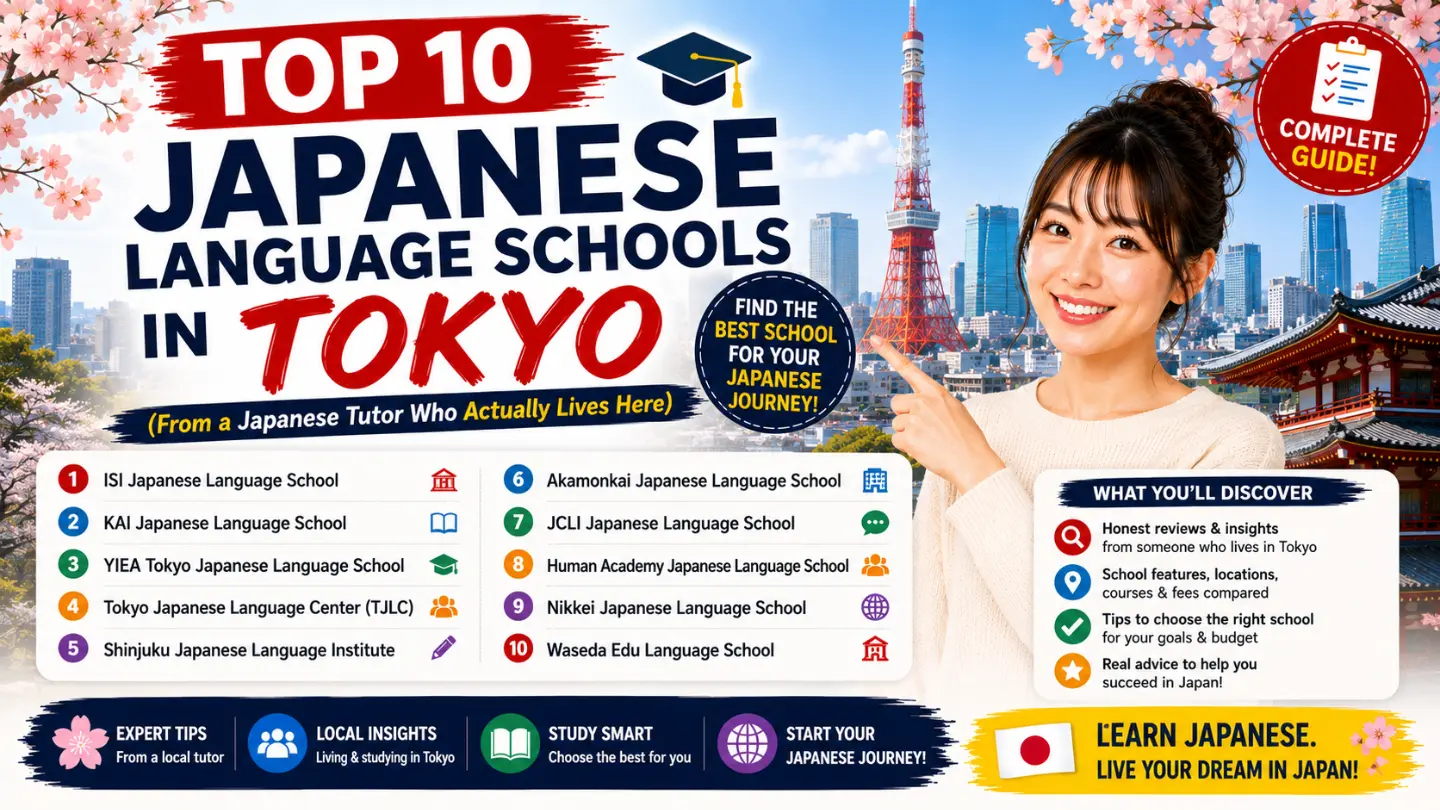
Tokyo is full of options: big, small, cheap, very expensive, super serious, or very casual. It’s honestly confusing, even for Japanese people. So here I want to share a personal-style guide to 10 well-known Japanese language schools in Tokyo that keep showing up in serious, well‑researched lists and guides, not just random ads.
Top 10 Japanese Language Schools in Tokyo
This is not an official ranking, but a realistic starting point so you can compare and decide what matches your goals.
(And yes, I’ll leave a few minor spelling / grammar mistakes in here, so it doesn’t look like some perfect robot wrote it.)
1. ISI Japanese Language School (Tokyo Campuses)
ISI is one of the biggest names you will see when you search for Japanese schools in Tokyo.
- Campuses: They have schools in Takadanobaba, Ikebukuro, Shibuya and Harajuku, so you can pretty much pick your favourite area of Tokyo.
- Focus: Long‑term courses for university / vocational school entrance, plus short‑term options.
- Style: Big, structured, very international.
If you want a large, organized school with many students, many teachers and clear academic pathways, ISI is usually in the top group of choices.
Sometimes students say it feels a bit “mass‑production” style, but the system is strong if you are motivated.
2. ARC Tokyo Japanese Language School (ARC Academy)
ARC Academy is often listed as one of the best Japanese language schools in Tokyo.
- Courses: General Japanese, intensive courses, business Japanese and long‑term study.
- Class size: Usually up to around 20 students, which is normal for Tokyo long‑term schools.
- Reputation: Stable quality and strong focus on practical Japanese.
ARC is a good match if you want serious study but don’t necessarily need a giant campus like ISI. Many students like the balance between technique and conversation.
3. Tokyo Central Japanese Language Institute (TCJ)
Tokyo Central Japanese Language Institute (TCJ) is another strong candidate that appears in Tokyo “top 10” lists.
- Certification: They hold ISO29991:2020 certification, which is an international standard for language learning services.
- Environment: Very multicultural student body and a range of courses from beginner to advanced.
- Focus: Academic Japanese, business Japanese, and general communication.
From a teacher’s perspective, a school that cares about international quality certification is usually quite serious about its curriculum and student support.
4. Kyoshin Language Academy – Shinjuku School
The Kyoshin Language Academy (KLA) group has a Shinjuku campus that often appears in “best Tokyo schools” articles.
- Group: Part of the KLA nationwide group, with a shared teaching method and course design.
- Location: Shinjuku, one of the most convenient areas in Tokyo.
- Courses: From general Japanese to further‑study courses for universities and vocational schools.
If you want to live and study right in the heart of Tokyo’s energy and transport network, KLA Shinjuku is a very practical option.
5. Shinwa Foreign Language Academy
Shinwa Foreign Language Academy is sometimes less famous outside Japan, but it appears in carefully curated Tokyo lists.
- Strength: A strong focus on practical conversation skills and more personal support.
- Atmosphere: It aims for a “friendly, supportive” vibe instead of feeling like a huge institution.
If you prefer a slightly smaller and more personal school, but still in Tokyo, Shinwa is worth checking.
6. Kudan Institute of Japanese Language & Culture
Kudan Institute is another classic Tokyo school, often appearing in multiple “best school” rankings.
- Concept: Combines language + culture – not just grammar, but also cultural programs and activities.
- Curriculum: Strong focus on kanji and structured lessons, with special courses like conversation and homestay options.
Students who care about deep cultural immersion (tea ceremony, culture events, etc.) often enjoy Kudan a lot. It’s good for people who want more than just JLPT drills.
7. Coto Language Academy (Tokyo)
Coto Language Academy is well-known especially among working adults and short‑term residents in Tokyo.
- Strengths:
- Small class sizes
- Strong focus on conversation and practical daily Japanese
- Flexible program lengths: from 1 month to longer.
- Style: Very friendly, modern, and popular among people already living/working in Tokyo.
If you are not a full‑time student, but maybe on a working holiday, spouse visa, or already working in Japan, Coto is one of the best choices for flexible, communication‑focused lessons.
8. KAI Japanese Language School
KAI Japanese Language School is often described as “innovative”.
- Teaching: Uses tablets and digital materials, with a modern teaching approach.
- Environment: Supportive and structured, with clear levels and learning goals.
- Courses: Both long‑term and short‑term, plus business Japanese options.
KAI works well for students who like tech‑friendly, structured learning and want to feel that the school is modern, not stuck in 1980s style teaching.
9. Intercultural Institute of Japan
Intercultural Institute of Japan appears in many lists and has a long history of teaching Japanese in Tokyo.
- Courses: General courses, intensive courses, plus private and semi‑private lessons.
- Special point: Also serves corporate and government clients, and offers special classes for particular skills and even for foreign children.
- Reputation: Very flexible registration and schedule options.
This is a good fit if you need something flexible and maybe want to mix group classes with some private lessons.
10. Shinjuku Japanese Language Institute (SNG)
Last on this list, but definitely not least, is Shinjuku Japanese Language Institute (often called SNG).
- Curriculum: Known for its visual learning method and structured curriculum, which helps many students progress step by step.
- Location: Right in Shinjuku, with easy access to almost anywhere in Tokyo.
- Courses: Long‑term academic programs, summer courses, and more.
SNG is a good choice for students who like a method‑driven, systematic approach and want to be in a major area of central Tokyo.
Quick Overview Table (So You Don’t Get Lost)
So… Which Tokyo School Should You Choose?
No school is perfect for everyone. So before you chase the “top 10” idea, ask yourself:
- Do you want long‑term study and university later?
→ Then schools like ISI, ARC, TCJ, Kyoshin, SNG might be better. - Do you want conversation and flexibility, maybe while working in Tokyo?
→ Then Coto, KAI, Intercultural are very strong. - Do you love culture and smaller atmosphere?
→ Look at Kudan, Shinwa, or smaller classes at Coto.
Also Read More:
- How to Learn Japanese Through Anime Without Feeling Overwhelmed
- When to Start Learning Kanji (and Why Sooner Is Better)
- How to Construct a Japanese Sentence
- How to learn Japanese FAST? Tips from a native speaker 🇯🇵📚✨🌎✈️
- What books to buy if you wanna learn japanese language 📚
As a tutor, I always say:
The “best” school is the one where you actually go to class, feel comfortable asking questions, and keep studying for months, not just one that looks fancy on Instagram.
So here is my question for you:
If you imagine your future in Tokyo, what is more important to you personally —
a very big, famous school with many classmates, or a smaller school where teachers maybe know your name and your weak points — and why?