
Read Japanese Like Your Favorite Anime Hero – With Fumito フミト!
Kon’nichiwa friends! 😊
My name is Fumito Emi (フミト 絵美) — native Japanese speaker, JLPT coach, and someone who still apologize for my English sometimes! Ha! But you know what? My passion for hiragana stroke order practice PDF is VERY strong, so please bear with me, okay?
Let me tell you small story. When I first take JLPT exam many years ago in Bangladesh, I study vocabulary, I study grammar, I think I am ready. But my writing — oh no. My strokes are messy, my characters look like… how to say… like earthquake happen on my paper. The examiner, I can still see her face. She tilt her head and say nothing. I fail that section.
That day change everything for me.
Now more than 1,000 students have learned from my method. My student Priya from Dhaka, she write beautifully now. My student Ravi from Chittagong, he pass JLPT N5 writing section with no problem. All because of one thing — correct stroke order, practiced every single day with the right worksheets.
Today I share with you my FREE hiragana stroke order practice PDF — 25 pages, anime examples, audio QR codes, JLPT mock grids, and everything in between! You print, you practice 10 minutes every day, and in 7 days you write like pro. I promise you this!
This hiragana stroke order practice PDF is for absolute beginners, JLPT N5 students, kids, adults, anime lovers — everyone! Let us begin, ne? 🌸
Why Stroke Order Matters (Even If You Can Read!)
Many students ask me: “Fumito-sensei, I can already read hiragana on my phone screen, why I need to learn stroke order?” Oh my friend, this question I hear so many times! Let me explain why the hiragana stroke order practice PDF is not just nice-to-have — it is absolutely necessary.
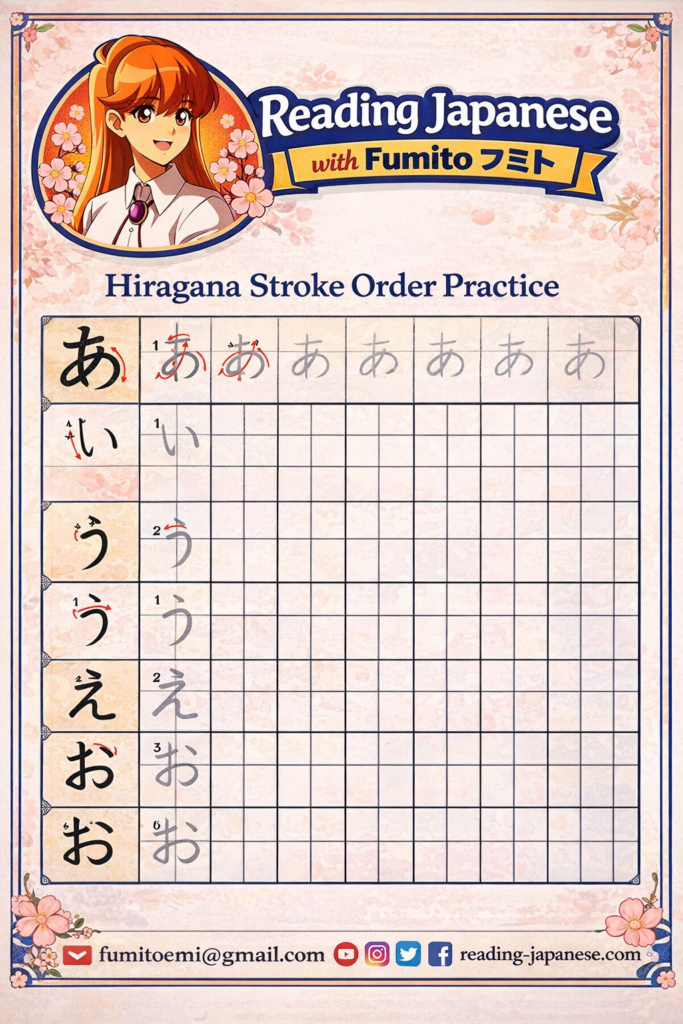
First, muscle memory is everything in writing. When you write the correct stroke order again and again, your hand begin to remember without your brain telling it. Scientists call this procedural memory — same thing that happen when you ride bicycle. You don’t think “now I balance, now I pedal” — your body just knows. Same with hiragana! When you use hiragana stroke order practice PDF regularly, your hand will write あ in correct 3 strokes automatically. No thinking needed. This speed is very important during JLPT exam when time is short.
Second, JLPT graders are very strict about writing quality. Many students don’t know this, but messy strokes that come from wrong stroke order look different from correctly ordered strokes. Characters written backwards or with wrong direction have subtle wrongness — the ink pressure is different, the balance is off, the flow breaks. An experienced grader see this immediately. My student Sarah, lovely girl from Sylhet, she write か wrong for literally three months. The horizontal stroke she was doing after the vertical, not before. Her か looked almost right to untrained eye, but to any Japanese reader it look strange. One day I show her correct order with my hiragana stroke order practice PDF drill sheet, and she say “oh! It look ALIVE now!” Yes! Correct stroke order make characters look alive and natural.
Third, anime subtitles and handwritten signs use naturally flowing hiragana. When characters in your favorite anime write on a whiteboard or send a letter, they write with natural stroke flow. If your stroke order is wrong, you cannot reproduce that beautiful handwritten style. You will always write stiff, mechanical hiragana that look like you are fighting the pen. The hiragana stroke order practice PDF I made include actual anime sentence tracing — so you practice writing the same phrases your anime heroes write!
Fourth — and this one surprise many people — correct stroke order help you RECOGNIZE characters faster. When you write in correct order, your brain build a motion map of each character. Later when you read quickly, your brain trace that motion map and recognize character almost instantly. Wrong stroke order create wrong motion map and slow down your reading too!
I also want share story from my class last year. One student, let us call him Ahmed, he was very frustrated. He tell me: “Sensei, I study every day but my hiragana still ugly.” I ask him to write つ for me. He write it in two strokes going upward. I show him my hiragana stroke order practice PDF page for つ — one stroke, going right and curving down. His eyes go so wide! He say “I never knew!” Next day he message me: “Sensei! My whole notebook look different now!” This is power of correct stroke order, my friends. 😊
The Ultimate Hiragana Stroke Order Chart (With Secrets!)
Here is the complete reference for all 46 basic hiragana characters. I include the most common mistake I see from my students — and my personal fix for each one! Use this alongside your hiragana stroke order practice PDF worksheets:
| Character | No. of Strokes | Direction | Common Mistake | Fumito’s Fix |
|---|---|---|---|---|
| あ (a) | 3 | Left curve → body → sweep | Too stiff, no curve | Think smiling cat face! 😺 |
| い (i) | 2 | Left down → right curve | Both strokes same length | Right stroke must be shorter + curved |
| う (u) | 2 | Small hook top → body curve | Forgetting tiny top hook | That hook is the nose of う! |
| え (e) | 4 | Horizontal → vertical → left sweep → hook | Losing final small hook | Count 4 strokes — never 3! |
| お (o) | 3 | Horizontal → vertical → crossing sweep | Last sweep wrong direction | Sweep goes LEFT, not right! |
| か (ka) | 3 | Vertical → horizontal → bottom kick | Missing the kick stroke | The kick is what makes it か! |
| き (ki) | 4 | Top horizontal → 2nd horizontal → left curve → right leg | Only 3 strokes written | き is ALWAYS 4 strokes! |
| く (ku) | 1 | One sharp angle stroke | Rounding the angle | Sharp V-bend, not a curve! |
| け (ke) | 3 | Vertical → top arm → right leg | Arm and leg same size | Arm is shorter than leg! |
| こ (ko) | 2 | Top horizontal → bottom curve | Making it one stroke | Always two separate strokes! |
| さ (sa) | 3 | Top horizontal → middle curve → small hook | Forgetting the bottom hook | Hook hangs left, not right! |
| し (shi) | 1 | Downward curve with hook right | Hooking left like a cane | Hook swings RIGHT — like fishing! |
| す (su) | 2 | Loop body → small cross tail | Making the tail too long | Tail is tiny — don’t exaggerate! |
| せ (se) | 3 | Vertical left → horizontal arm → right curve | Losing the vertical line | Left vertical is the spine! |
| そ (so) | 1 | Zigzag curve going right | Breaking into 2 strokes | One continuous fluid stroke only! |
| た (ta) | 4 | Cross top → curved body → left hook → right foot | Only 3 strokes | た has 4 — count carefully! |
| ち (chi) | 2 | Top curve left → main loop | Loop too small | Loop must be generous and round! |
| つ (tsu) | 1 | Rightward sweep curving down | Two strokes going upward | ONE stroke, right to left-down! |
| て (te) | 1 | Horizontal then curve down with hook | Forgetting the hook | The hook is what separates て from ー! |
| と (to) | 2 | Vertical body → small poke right | Making the poke too big | Tiny poke only — don’t overdo! |
| な (na) | 4 | Cross → curve left → loop → sweep | Losing the loop | Loop is the heart of な! |
| に (ni) | 3 | Short top → long vertical → horizontal base | Making all lines equal length | Long vertical dominates! |
| ぬ (nu) | 2 | Left curve → big loop crossing left | Not crossing back over | Must cross own line — like tying knot! |
| ね (ne) | 2 | Left curve → loop with tail | Tail going wrong direction | Tail sweeps LEFT and curls! |
| の (no) | 1 | Circle with opening at top right | Closing the circle | の is OPEN at top — never close it! |
| は (ha) | 3 | Vertical → middle bump → right loop | Loop too flat | Loop must be tall and round! |
| ひ (hi) | 1 | Curved loop open on left | Closing the loop | Left side stays OPEN always! |
| ふ (fu) | 4 | Top dot → left arm → right arm → bottom hook | Only 3 strokes | ふ has 4 — top dot is first stroke! |
| へ (he) | 1 | One angled mountain stroke | Making it too flat | Sharp peak in middle! |
| ほ (ho) | 4 | Vertical → horizontal → left loop → right hook | Losing the right hook | Right hook is separate 4th stroke! |
| ま (ma) | 3 | Horizontal → vertical cross → bottom loop | Loop sitting wrong | Loop hangs below the cross! |
| み (mi) | 2 | Left curve hook → looping S-curve | Not completing the S | Full S must curve back left! |
| む (mu) | 3 | Horizontal base → body → top horn | Horn pointing wrong way | Horn points RIGHT and UP! |
| め (me) | 2 | Left curve → loop crossing right | Not crossing | Must cross own stroke — like め tying knot! |
| も (mo) | 3 | Horizontal → horizontal → curve through | Curve not passing through lines | Curve MUST pass through both horizontals! |
| や (ya) | 3 | Left diagonal → main curve → bottom horizontal | Bottom stroke not horizontal | Bottom is flat horizontal only! |
| ゆ (yu) | 2 | Left curve → main rectangular loop | Loop too round | ゆ loop is more rectangular than round! |
| よ (yo) | 2 | Short horizontal → main body curve | First stroke too long | First stroke is SHORT — just a small arm! |
| ら (ra) | 2 | Short hook → long looping curve | Loop too tight | Loop must sweep wide and free! |
| り (ri) | 2 | Left short stroke → right long curve | Both strokes equal length | Left is always shorter than right! |
| る (ru) | 1 | Downward curve into tight loop | Not closing the loop | Loop at bottom must close fully! |
| れ (re) | 2 | Left vertical curve → looping S with tail | Tail not curling left | Tail must curl left at end! |
| ろ (ro) | 1 | Open square curve — no closing stroke | Closing the bottom | Bottom stays OPEN — like ro rolling away! |
| わ (wa) | 2 | Left curve → right loop body | Making it look like れ | わ loop is tighter and more upright! |
| を (wo) | 3 | Top horizontal → horizontal-curve combo → vertical hook | Only 2 strokes | を has 3 distinct strokes! |
| ん (n) | 1 | Rightward curve with hook ending | Hooking wrong direction | Hook curves RIGHT then LEFT at end! |
Print this table alongside your hiragana stroke order practice PDF and keep it on your desk every study session! This is your lifeline. 🗒️
Free Hiragana Stroke Order Practice PDF Breakdown
Okay, now the exciting part! Let me tell you exactly what is inside this hiragana stroke order practice PDF because I design every single page myself with years of teaching experience. This is not random worksheet you find on internet — this is carefully structured program!
Pages 1–5: The A-Line Worksheets (あいうえお)
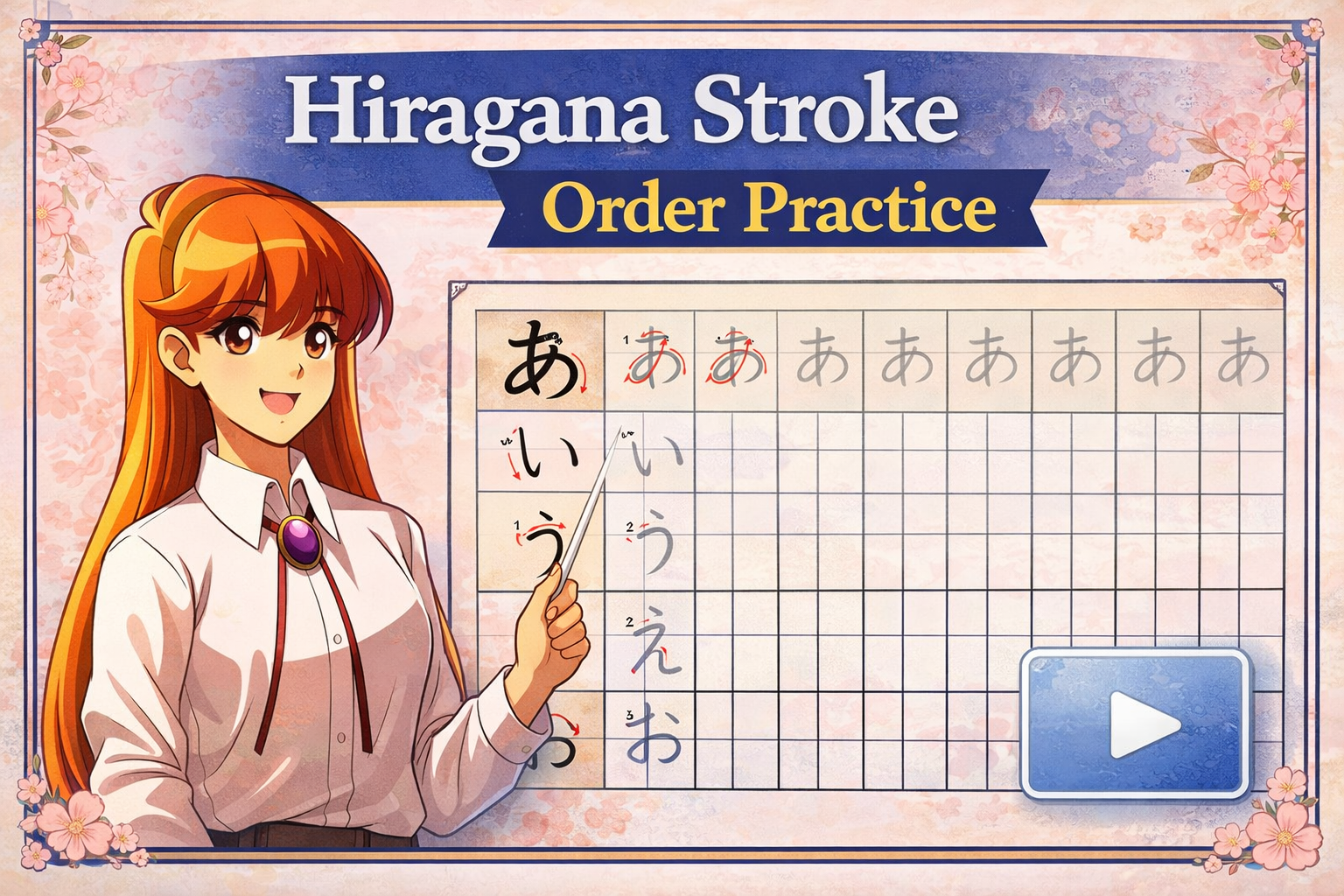
Each page is dedicated to one vowel. You get 20 tracing lines showing the character with numbered stroke arrows, then 20 blank practice grids for your own writing. I also include a “mistake spotter” box at the bottom of each page — common wrong versions of the character so you can check if your mistake is already listed! At the right margin, I write small encouragement notes in both Japanese and English. These pages are where every student begin, and they are the foundation of your entire hiragana journey. Download the hiragana stroke order practice PDF and start here on Day 1!
Pages 6–10: K-Line Worksheets (かきくけこ) + Audio QR Codes
These five pages follow same format as vowel pages but I add something special — QR codes in the corner! You scan with your phone and it take you to short audio clip of native Japanese speaker (me!) saying each character clearly. This connect your hand muscle memory to your ear memory at same time. Neuroscience research show multi-sensory learning create much stronger memory traces. Also Page 8 (く) include special one-stroke challenge — can you write perfect く in one smooth movement without lifting pen? My students love this challenge!
Pages 11–15: Speed Drills + Error Checker
Now we move to building speed. These pages are timed drill sheets — you set your phone timer for 60 seconds and write as many perfect characters as you can fit in the grid. Each page has an error checker legend on the side showing 4 most common wrong versions of each character. You circle any of your characters that match the wrong versions. This self-correction system is very important because many students don’t know they are making mistake until they compare. This section of hiragana stroke order practice PDF is what my advanced students say changed their writing the most!
Pages 16–20: Anime Sentence Tracing
This is my personal favorite section and students always tell me this is what make practice actually fun! I choose five iconic short sentences from popular anime — naturally written in hiragana and hiragana-heavy text — and format them as beautiful tracing exercises. For example: かっこいいです (kakkoii desu — “he is so cool!”), なんですか (nan desu ka — “what is that?”), and more. You trace the sentence as it was handwritten by native speaker, so you feel the natural flow and rhythm of real Japanese writing. After tracing, blank line below for your own attempt. These pages make hiragana stroke order practice PDF feel like fan activity, not homework!
Pages 21–25: JLPT Mock Grids + Progress Tracker
Final section is the most serious — and most important for exam students! These pages recreate actual JLPT N5 writing grid format with proper box sizing. You practice writing under exam conditions: specific box size, no tracing, just memory and muscle. Page 25 is your personal progress tracker — a table where you fill your score for each character group each week. Seeing your own improvement on paper is extremely motivating! This part of hiragana stroke order practice PDF has helped many of my students feel confident on exam day.
7-Day Stroke Order Challenge (Anime Edition!)
Ready for the challenge? Here is your complete 7-day plan using the hiragana stroke order practice PDF! Follow this exactly and you will be amazed at day 7. 🌟
Day 1 — A-Line: The Foundation Open Pages 1–5 of your hiragana stroke order practice PDF. Write あいうえお with tracing first, then freehand. Do this while watching a slow, romantic anime like Fruits Basket or Your Lie in April — the calm mood help your hand relax. Target: write each vowel 50 times correctly. Check your work against the error spotter box. Before sleep, write あい on paper 10 more times from pure memory.
Day 2 — K-Line: Enter Naruto! Pages 6–7 (か and き). Scan the QR audio code and repeat the sound as you write. Practice sentence: なると くん、かっこいい!(Naruto-kun, kakkoii! — Naruto is so cool!) Write this sentence 10 times. Notice how knowing か makes the sentence feel real! Use the audio clip 3 times for each character before writing. This day usually when students first feel “I am writing REAL Japanese!” feeling!
Day 3 — S-Line + One-Stroke Mastery Pages 8–10 and さしすせそ. The famous し vs つ trap — these two characters confuse SO many beginners! Today focus extra on し (hooks RIGHT) and compare to つ (one rightward sweep). I include a special comparison drill page in the PDF just for this pair. Watch any Studio Ghibli movie today — pause when you see hiragana on screen and try to read it!
Day 4 — T-Line + Speed Introduction Pages 11–12. Start your first 60-second speed drill. Don’t worry about number yet — just focus on correct stroke order at moderate speed. Practice sentence: てがみを かいて ください(tegami wo kaite kudasai — please write a letter). This sentence contains three T-line characters and feel very satisfying to write smoothly!
Day 5 — N, H, M Lines Pages 13–14. These rows contain some of my favorite characters — の, の, は, ほ. Watch a slice-of-life anime (I recommend Barakamon — it is LITERALLY about calligraphy!) and pause during any writing scenes. By Day 5, most students report their freehand writing feel much more natural. This is the muscle memory beginning to form!
Day 6 — Y, R, W Lines + Anime Sentence Tracing Pages 15–20. Today is reward day — you reach the anime tracing section! After drilling や、ゆ、よ、ら、り、る、れ、ろ、わ、を、ん, spend the rest of your session tracing the anime sentences on Pages 16–20. Feel the flow. Feel how all strokes connect into natural Japanese handwriting. Take photo of your best traced sentence and save it — you will want to compare to Day 1 later!
Day 7 — JLPT Mock Test + Full Review Pages 21–25. This is your exam simulation day! Set a proper timer. No tracing, no reference chart — pure memory and muscle memory. Write all 46 characters in JLPT grid format. Then check against the chart. Use your Page 25 progress tracker to record your score. Most students completing all 7 days of this hiragana stroke order practice PDF program can write 40–46 characters correctly from memory. You worked hard — celebrate with your favorite anime episode! 🎉
Printable Worksheets Preview (か行 Example)
Let me describe what the か行 (K-line) pages look like in the hiragana stroke order practice PDF so you know exactly what to expect before downloading!
か (ka) — 3 Strokes: The worksheet show large character at top left with numbered red arrows: Arrow 1 points down-left for the vertical stroke, Arrow 2 points right for the horizontal arm, Arrow 3 shows the diagonal kick going down-right. Below this are 6 traced versions getting progressively lighter, then 14 empty grids for your own writing. My personal note on this page: “Start from TOP LEFT, not top right! Common mistake — I see it every day!”
き (ki) — 4 Strokes: This page include special warning box in yellow: “き has FOUR strokes! Many students write 3 and wonder why it looks wrong.” The stroke diagram is extra large for き because the 4-stroke pattern is tricky to see at small size. I also include a before/after comparison — messy 3-stroke き versus clean 4-stroke き. The difference is immediately obvious.
く (ku) — 1 Stroke: The single-stroke characters get special treatment — the entire page is built around the 60-second one-stroke challenge. How many perfect く can you fit? My personal record is 47 in one minute. Can you beat Fumito-sensei? 😄
Audio + Video Stroke Guides (Free!)
The hiragana stroke order practice PDF is even more powerful when you combine it with audio and video! Here are my recommended free resources:
For audio pronunciation while you practice, I recommend the NHK World Hiragana lessons at nhk.or.jp — completely free, made by Japan’s national broadcaster, native speaker audio for every character. This is the official gold standard.
For video stroke order guides, search YouTube for “hiragana stroke order native speaker write” and look for videos where you can see an actual hand writing in real time — not just animated arrows. Watching a human hand move is very different from watching animation! I personally recommend watching stroke videos at 0.5x speed first, then normal speed.
One very important video tip from me: watch especially videos that compare し vs つ and ぬ vs め. These four characters cause the most confusion and I have seen students mix them up even after months of study. The hiragana stroke order practice PDF include a dedicated comparison drill for all four, but seeing them written in video first is very helpful preparation.
Also — and this is my secret tip — record yourself writing on your phone camera, then watch it back. Most students are very surprised to see which strokes they actually do versus which strokes they think they do! 🎥
For a comprehensive external stroke guide, I recommend Tofugu’s hiragana stroke order resource at tofugu.com/japanese/hiragana as additional reference. Please note this is external site — their approach is slightly different from mine but the stroke order information is accurate and the illustrations are beautiful.
Top 10 Stroke Order Mistakes Beginners Make
After teaching for many years and reviewing thousands of student worksheets, I see same mistakes again and again. Here are the top 10 — check yourself honestly!
1. し vs つ — The Most Dangerous Confusion し hooks RIGHT at bottom. つ sweeps from left to right in one big curve. These look similar to beginners but native speakers see them as completely different. In my hiragana stroke order practice PDF, Page 12 is entirely dedicated to drilling these two side by side. My student — let me call her Nadia — she cried actual tears over つ once. She was writing it as two upward strokes for weeks. One session with the comparison drill in the PDF and she fixed it in one day. One day! 😊
2. Writing ん as n or m ん is one stroke — a rightward curve that hooks left at the end. Many students write it like an English ‘n’ or ‘m’. It should look like a flowing river curve, not a printed letter.
3. Giving お three wrong strokes The third stroke of お crosses from right to LEFT, not left to right. Most students instinctively go wrong direction. The crossing sweep must go leftward! Check your hiragana stroke order practice PDF Page 5 for the arrow direction carefully.
4. Making の a closed circle の is an OPEN character — the top right never closes. Many beginners close it and it starts to look like a bubble. Open top-right, always!
5. Writing ふ with 3 strokes instead of 4 The small dot at the TOP of ふ is its own first stroke. Students skip it constantly. ふ = 4 strokes. The top dot is stroke 1. Period.
6. Flat peak on へ へ is one stroke — a sharp mountain peak. Students make it too flat and it starts to look like a speed bump. Sharp angle in center!
7. Wrong loop direction on ぬ and め Both ぬ and め must cross back over their own stroke in a loop. Students draw the loop without crossing, and the character loses its identity completely.
8. Closing ろ at bottom ろ is an open character — it does not close at bottom. Think of it as a road that keeps going. Close it and it becomes a strange box shape.
9. Making つ two strokes I know I mention this in #1 but it deserves second mention because I see it so much! つ = ONE stroke. One! No exceptions.
10. Making the final hook on ん go right instead of left The ending hook on ん curls LEFT. Not right, not down — left. Many students curl it right and it starts to look like a different character entirely.
Pro Tips from Fumito’s Notebook 📓
These are the tips I share only with my private students — and now with you, my dear blog friends! 🥰
Pencil grip Japanese style. Hold your pencil slightly more vertical than typical English grip — closer to 70-80 degrees from paper rather than 45 degrees. This give you more control for the fine hooks and curves in hiragana. I notice immediately when student switch to this grip — their characters become more balanced.
The rice paper trick. Traditional Japanese calligraphy students practice on rice paper (washi) because it is slightly more resistant than regular paper — your pen cannot slide carelessly, you must be intentional with each stroke. If you cannot find rice paper, even slightly textured drawing paper give similar benefit. The resistance build control!
Anime OST while tracing — retention multiplies! This sound strange but there is real reason behind it — emotional memory is the strongest kind of memory. When you associate your hiragana practice with music you love from your favorite anime, the emotional connection to that music strengthen the memory of what you practiced during it. I always play Studio Ghibli soundtracks during my own study sessions. My students who try this method report much faster retention compared to silent study. 🎵
Write on white board first. If you are nervous about committing to paper, use small whiteboard for first practice of each new character. The larger movements on whiteboard actually train your hand movement better than tiny paper grids, and you can erase and try again freely.
Review your oldest characters regularly. Many students drill new characters and forget old ones. In my hiragana stroke order practice PDF, Page 25 progress tracker help you see which characters you haven’t reviewed recently. Never let any character go cold!
JLPT N5 Writing Test Secrets
If you are preparing for JLPT N5 specifically, this section is extremely important. Please read carefully!
The JLPT writing grids have specific box sizes — approximately 1cm x 1cm squares. If you only ever practice on large paper, small grid writing will feel very different on exam day. The hiragana stroke order practice PDF Pages 21–25 use exact JLPT grid sizing so your hand is trained for the actual exam dimensions.
Time management is critical. JLPT writing sections are timed and students who hesitate on stroke order waste precious seconds. When you achieve true automaticity through regular practice with the hiragana stroke order practice PDF, you stop thinking about strokes and just write. This is the goal.
Grid filling rules that many students don’t know: one character per box, strokes should not touch the grid lines, the character should sit centered in the box with a small margin on all sides. Characters that overflow the box or crowd one side look unprofessional and can cost you points.
The characters that lose the most points in JLPT grading based on my experience teaching N5 students: け (students make the arm and leg same size), ぬ (students miss the loop-crossing), む (students point the horn wrong direction), ふ (students write 3 strokes instead of 4), and を (students write 2 strokes instead of 3). All five of these characters have dedicated practice pages in the hiragana stroke order practice PDF. Please do not skip them!
One more secret: examiners are human and they notice effort. Clean, well-proportioned hiragana that show you practiced seriously make positive impression even if one or two characters are not perfect. Sloppy characters that show you never cared about stroke order make negative impression even if technically readable. Your messy け really does lose you points — not just in marking but in the invisible impression score too!
FAQ: Hiragana Stroke Order Questions
1. “Do I really need perfect strokes for JLPT?” Yes — for the writing section, absolutely yes. For reading-only sections, not strictly necessary. But here is the thing: correct stroke order help your reading too, as I explain earlier. And the writing section score can make difference between pass and fail. So please practice with the hiragana stroke order practice PDF even if you think you only need reading skills!
2. “Is the free PDF download safe?” One hundred percent virus-free and safe to download! The hiragana stroke order practice PDF is a clean PDF file — no executable, no software, no hidden programs. I create it myself in my own computer and I check it every time before sharing. Thousands of students download already with zero problems. You can trust it completely.
3. “Does this work for kids?” Ages 10 and up love the anime pages especially! I also teach younger children, but for ages below 10 I usually recommend larger practice grids and simpler worksheets first. For ages 10 and above, the hiragana stroke order practice PDF is perfectly appropriate and the anime sentence tracing pages make it genuinely exciting for younger learners.
4. “How long should I practice each day?” My honest recommendation is 10–15 focused minutes daily is far better than one long 2-hour session once per week. Muscle memory build through repetition over time — it cannot be rushed by cramming. Consistent daily practice with the hiragana stroke order practice PDF is the only real path to beautiful automatic writing.
5. “What if I already know hiragana but my writing is messy?” This is actually the most common situation! Many students can read hiragana perfectly but their handwriting was never properly trained. Go back to Day 1 of the 7-day challenge in the hiragana stroke order practice PDF even if you feel you know the characters. You will be surprised what bad habits you discover and fix!
Download Your Free PDF Now! 📥
After reading all of this, you deserve your reward! The complete hiragana stroke order practice PDF — all 25 pages — is completely free for my blog friends.
Enter your email on the download page to receive the hiragana stroke order practice PDF directly in your inbox! I also send you my weekly Japanese study tips newsletter — always free, always helpful, and you can unsubscribe any time!
Download Password: fumito2026
The hiragana stroke order practice PDF includes all 25 worksheet pages, the complete stroke order chart, the 7-day anime challenge calendar, audio QR codes for every character row, JLPT N5 mock grids, and the progress tracker. Everything you need, all in one free download!
If download page not working on your device, please email me directly at fumitoemi@gmail.com and I send you the hiragana stroke order practice PDF attachment personally. I always reply within 24 hours! 😊
Next up: Check out my [Katakana Stroke Order PDF Guide] — foreign words and anime sound effects await you! Once you finish hiragana, katakana is your next exciting step!
You can also visit my Complete Hiragana Reading Guide, my [JLPT N5 Preparation Checklist], and my [Day 2 Deep Dive: K-Line Mastery] for more free resources!
Arigatou gozaimasu! ありがとうございます!
Did you download the hiragana stroke order practice PDF? Please comment below: “Downloaded!” and tell me which character you are most excited to practice! I read every single comment and reply to each one personally. Your progress makes my heart so happy! 🌸
See you in next post, Japanese friends. Gambatte kudasai — do your best! 頑張ってください!
About the Author: Native Japanese speaker Fumito Emi (フミト 絵美), JLPT coach helping students for many years. English still improving — sorry for any strange sentences! But kanji and hiragana passion is very very strong! Teaching from Bangladesh with love for all Japanese learners worldwide. Contact: fumitoemi@gmail.com