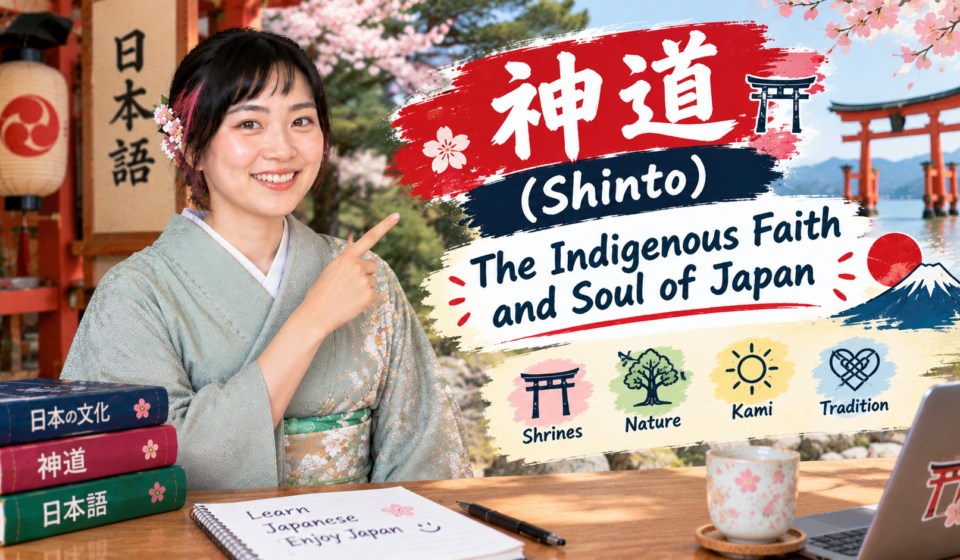

Shinto is the indigenous faith of the Japanese people and it is as old as Japan itself. Today it remains Japan’s major religion alongside Buddhism and Christianity. Most people who have any interest in Japanese culture are aware of this, but how many people actually know the intricacies that make up Shinto and its beliefs? In this post I hope to convey a bit more on what Shinto is all about and where the beliefs came from and what makes it what it is today. But don’t worry, this won’t be too terribly boring – we’ll try and make things fun
What is Shinto?
The customs and values of Shinto are inseparable from those of Japanese culture. Many Japanese activities have their roots in Shinto. Elements of Shinto can be found in ikebana, traditional architecture, and even sumo wrestling. Also, a lot of Japanese pop culture, especially anime and manga, draws from Shinto for inspiration.
Shinto doesn’t really have a founder or sacred scriptures or anything like that though. Religious propaganda and preaching are not common here either. This is one of the things that sets Shinto apart from most of the popular religions today. Shinto is deeply rooted in the Japanese people and their traditions, so practices like conversion don’t exactly go along with what Shinto is.
Since Shinto is very Japanese by nature and does not try to press others to join them, the percentage of Shinto followers living in this world is very small, with pretty much all of them residing in Japan. I think that’s nice though. Shinto is inherently Japanese, and its just another one of those things that you can really only get the full experience and understand while in Japan.
Instead of sacred texts, Shinto bases most of its beliefs on four ancient books. These books are the Kojiki (Record of Ancient Matters) which is the foundation to written Shinto history, the Shoku Nihongi and its Nihon Shoki (Continuing Chronicles of Japan), the Rikkokushi (Six National Histories), and the Jinnō Shōtōki (a study of Shinto and Japanese politics and history).
Shinto beliefs
Shinto is all about the kami. Kami (sacred spirits) are the “gods” in Shinto. They take the form of many things such as animals, plants, lakes, and rivers. As such, Shinto is a form of animism. Humans become kami after they die and are honored as ancestral kami with some families actually having little shrines in their homes. The Goddess Amaterasu is widely considered to be Shinto’s most famous kami and she was even the star of her very own video game, Ōkami (see above).
There are no real absolutes in Shinto – everything is kind of grey. They don’t believe in absolute right or wrong and they acknowledge that nobody is perfect. They view humans as fundamentally good, with the evils in the world being caused by troublesome and devilish kami. As such, the purpose of most Shinto rituals is to keep away evil spirits. This is achieved by purification, prayers, and offerings. It sounds like a pretty laid back religion to me. I like that.
Shinto teaches that people should want their sins cleansed for one’s own peace, not because sinning is inherently wrong. It’s natural. Shinto does have some freaky beliefs too though. Those who die holding a grudge strong enough to keep them attached to the physical world will become evil, revenge seeking kami, as seen in The Grudge and many other Japanese horror movies. So, Shinto has its easygoing ups as well as its terrifying downs.
Shinto Rituals
Purification rituals are an essential part of Shinto. New buildings constructed in Japan are frequently blessed by a Shinto priest during the groundbreaking ceremony, and many Japanese cars are blessed at some point in their assembly. Many Japanese businesses built outside Japan often get Shinto rites performed on them as well.
Both men and women can become Shinto priests, and they’re even allowed to marry and have children. Some even live on site with the shrine they’re in charge of. Priests are aided by young women known as miko during Shinto rituals and performances. Miko wear white kimono, must be unmarried, and are often daughters of the Shinto priests.
Followers of Shinto can seek support from kami in many different ways. They can pray at the shrines in their homes or visit a local public shrine. There are also millions upon millions of little charms and talismans available to give people good health, good grades, good business, and more.
A large number of Japanese wedding ceremonies today Shinto ceremonies. I think Christian weddings are up there too though. Death on the other hand is considered a source of impurity, so Japan lets the Buddhists deal with all that. Because of this there really aren’t any Shinto cemeteries, just shrines.