JLPT N5 Exam Pattern Explained: Sections, Timing, Scoring & What to Expect in 2026

So you have decided to take the JLPT N5. Good. This is the right move.
The Japanese Language Proficiency Test N5 (JLPT N5) is the entry-level certification in the world’s most widely recognized Japanese language exam system. It prove that you can understand and use basic Japanese — the kind used in everyday greetings, simple conversations, short written texts, and basic listening situations.
But before you can pass it, you need to understand it.
Most beginners waste weeks studying the wrong things because they never properly understand the JLPT N5 exam pattern — how many sections there are, how much time each section gets, what question types appear, and exactly how scoring works. This guide by Japanese tutor Fumito Emi at reading-japanese.com will give you the clearest, most complete breakdown available.
By the time you finish reading, you will know exactly what to expect on exam day — and more importantly, exactly what to study.
📚 Table of Contents
- What Is the JLPT N5?
- JLPT N5 Exam Pattern — Quick Overview
- Section 1: Language Knowledge — Vocabulary (言語知識・文字語彙)
- Section 2: Language Knowledge — Grammar & Reading (言語知識・文法・読解)
- Section 3: Listening (聴解)
- JLPT N5 Scoring System Explained
- How to Pass Each Section — What to Study
- JLPT N5 Exam Day — What to Expect
- Common Mistakes That Cost Students the Pass
- JLPT N5 vs N4 — What Comes Next?
- FAQ
- Related Articles
What Is the JLPT N5?
The Japanese Language Proficiency Test (日本語能力試験, Nihongo Nōryoku Shiken) is administered by the Japan Foundation and Japan Educational Exchanges and Services (JEES). It is one of the most recognized ways to certify Japanese language skills globally.
The test has five levels — N1 (hardest) to N5 (easiest). N5 is where every beginner’s certification journey starts.
What does JLPT N5 test?
The N5 is not a test of speaking or writing.The test does not include a speaking or writing component; instead, it relies solely on multiple-choice questions and comprehension exercises.
It tests three things:
- Whether you can read basic Japanese — hiragana, katakana, and about 100 kanji
- Whether you understand basic grammar — verb conjugation, particles, sentence structure
- Whether you can listen to and understand simple spoken Japanese
In practical terms, N5 level means you can introduce yourself, understand simple signs and menus, follow basic instructions, and hold a beginner-level conversation.
Who should take JLPT N5?
Absolute beginners with 3–6 months of study, learners who know hiragana, katakana, and around 100 kanji, and those who understand basic greetings and simple sentences.
Before you sit for N5, make sure you have solid hiragana and katakana. If not, study them first — use our free hiragana chart and katakana chart. The exam assumes you can already read both syllabaries.
When is the JLPT held?
The JLPT is generally held twice a year, in July and December, across various cities worldwide.Registration typically opens a few months before each test date. Always check the official JLPT website for current dates and your country’s registration deadlines.
JLPT N5 Exam Pattern — Quick Overview
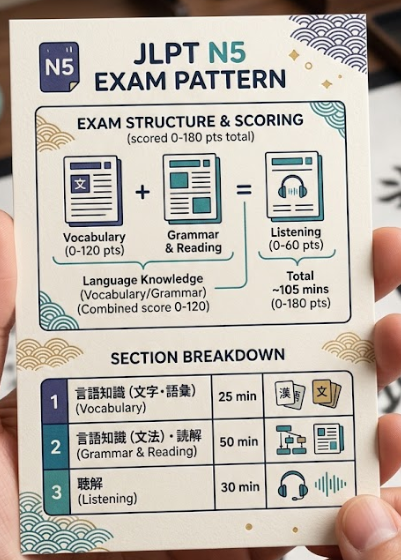
Before we break down each section, here is the complete picture at a glance.
For N5, there are two scoring sections: “Language Knowledge (Vocabulary/Grammar) + Reading” combined (scored 0–120), and Listening (scored 0–60), making a total of 0–180.
However, the exam is delivered in three separate test booklets — Vocabulary, Grammar & Reading, and Listening.
| Section | Japanese Name | Time | Max Score |
|---|---|---|---|
| Language Knowledge (Vocabulary) | 言語知識(文字・語彙) | 25 minutes | Combined |
| Language Knowledge (Grammar) + Reading | 言語知識(文法)・読解 | 50 minutes | 0–120 pts |
| Listening | 聴解 | 30 minutes | 0–60 pts |
| Total | ~105 minutes | 0–180 pts |
N5 has 3 sections (Vocabulary; Grammar+Reading; Listening) and runs approximately 90 minutes total. Including instructions and breaks between sections, the full test day is closer to 105 minutes of active testing.
No negative marking. All questions are multiple-choice with four answer options. If you are unsure, always guess — you lose nothing by doing so.
Section 1: Language Knowledge — Vocabulary
Time: 25 minutes | Scored together with Grammar & Reading (0–120 combined)
This is a 25-minute sprint designed to test your knowledge of basic vocabulary and kanji. It is a dense section that requires quick thinking.
This section has four question types. Each one tests a different aspect of your vocabulary knowledge. Understanding each type before exam day means no surprises.
Question Type 1 — Kanji Reading (漢字読み)
You are shown a word written in kanji and must choose the correct reading (in hiragana) from four options.
Example: 山 — which reading is correct? a. さん b. やま c. かわ d. うみ (Answer: b. やま — yama)
You might see the kanji for “day” (日) and have to select its reading, 「ひ」 (hi) or 「にち」 (nichi).
Fumito’s tip: Do not just memorize the kanji in a list. Learn them as part of a word. Learn the kanji for “day” (日) in the context of 「毎日」 (mainichi – every day) or 「日本」 (nihon – Japan). This contextual learning makes a huge difference.
Question Type 2 — Word Notation (表記)
This is the reverse of the above. You are given a word written in hiragana (or katakana) and must choose the correct kanji from four options.
Example: やま — which kanji is correct? a. 川 b. 田 c. 山 d. 土 (Answer: c. 山 — mountain)
This task requires learners to convert given hiragana (e.g., “やま”) into the correct kanji (“山”, “mountain”) or katakana.
What this tests: Your ability to recognize kanji visually — not just their readings. Many N5 kanji look similar (土 vs 士, 日 vs 目). Train your eye as well as your memory.
Question Type 3 — Contextual Usage (文脈規定)
A sentence with a blank space. You choose the word that fits the context correctly.
Example: わたしは まいにち ___ を のみます。 a. みず b. あめ c. かぜ d. でんしゃ (Answer: a. みず — water)
Learners are required to select the word that appropriately fits the context of a sentence. For example: 朝、顔を( ) → 洗います (“In the morning, I ( ) my face.” → “wash”).
What this tests: Whether you understand words well enough to use them correctly, not just recognize them in isolation. Because the JLPT doesn’t test speaking, memorizing vocabulary lists isn’t enough — you must also understand how these words are used naturally in sentences. For instance, recognizing that きれい means both “beautiful” and “clean,” depending on context, is just as important as knowing its dictionary meaning.
Question Type 4 — Synonyms / Paraphrasing (言い換え類義)
An underlined word in a sentence. You choose the word or phrase that is closest in meaning.
Example: この くだものは とても おおきい。 a. ちいさい b. たかい c. おおきな d. やすい (Answer: c. おおきな)
This question type rewards learners who study vocabulary deeply — not just the definition, but synonyms, related forms, and natural usage.
N5 Vocabulary — What You Need to Know
The vocabulary section tests around 800 vocabulary words (e.g., 食べる – to eat, 大きい – big) and 100+ essential kanji (e.g., 日 – sun/day, 人 – person).
The 100 essential N5 kanji include basic characters like:
| Kanji | Reading | Meaning |
|---|---|---|
| 日 | nichi / hi | Day / Sun |
| 人 | jin / hito | Person |
| 月 | getsu / tsuki | Moon / Month |
| 水 | sui / mizu | Water |
| 山 | san / yama | Mountain |
| 大 | dai / oo | Big / Large |
| 小 | shou / chii | Small |
| 食 | shoku / ta | Eat / Food |
| 学 | gaku / mana | Study |
| 国 | koku / kuni | Country |
For the complete list of N5 vocabulary with romaji and example sentences, see our JLPT N5 vocabulary guide.
Section 2: Language Knowledge — Grammar & Reading
Time: 50 minutes | Scored together with Vocabulary (0–120 combined)
This is the longest and most demanding section. It tests both grammar knowledge and reading comprehension in a single 50-minute block.
Grammar Question Types
Grammar Type 1 — Sentence Grammar (文の文法1)
A sentence with one blank. You choose the correct grammar form, particle, or ending.
Example: わたし___ にほんごを べんきょうします。 a. を b. が c. は d. で (Answer: c. は — topic marker)
Particle Usage questions fill in the correct particle (は、が、を、に, etc.). For example: わたし___にほんごをべんきょうします。(Answer: は)
Key grammar points tested at N5 level:
| Grammar Point | Example | Meaning |
|---|---|---|
| です / ます forms | 食べます | Polite verb ending |
| は (topic marker) | 私は学生です | I am a student |
| が (subject marker) | 猫がいます | There is a cat |
| を (object marker) | 本を読む | Read a book |
| に (direction/time) | 学校に行く | Go to school |
| で (location/means) | バスで行く | Go by bus |
| Verb て-form | 食べて | Eating / and then |
| ない form | 食べない | Don’t eat |
| Past tense (~た) | 食べた | Ate |
| Negative past (~なかった) | 食べなかった | Did not eat |
| ~たい | 食べたい | Want to eat |
| ~ています | 食べています | Is eating / am eating |
Knowing the difference between たべます (eat), たべました (ate), and たべません (don’t eat) is crucial to grasping the flow of conversation and comprehension passage.
Grammar Type 2 — Sentence Composition (文の文法2)
Four words are given in scrambled order. You must arrange them into a correct sentence and identify which word goes in a marked position.
Example: わたしは ___ ___ ★ ___ です。 Words: [毎日, 学校, に, 行きます]
This question type tests whether you understand Japanese sentence structure — the order of subject, topic, time, place, object, and verb.
Fumito’s tip: Japanese sentence structure is broadly Subject → Topic → Time → Place → Object → Verb. 私は毎日学校に行きます (I go to school every day). Practice writing original sentences more than memorizing answers.
Grammar Type 3 — Text Grammar (文章の文法)
A short passage with blanks. You choose the correct grammar form for each blank from four options. This bridges grammar and reading comprehension.
Reading Question Types
The reading component of this section tests comprehension of short, simple Japanese texts.
Reading Type 1 — Short Passage Comprehension (内容理解・短文)
A very short text (1–3 sentences) followed by one question about its content.
Example text: 今日は 月曜日です。わたしは 学校に 行きます。 Question: 今日は なんようびですか?
This tests basic kanji recognition and sentence comprehension in a real-context setting.
Reading Type 2 — Mid-length Passage (内容理解・中文)
A slightly longer text (a short paragraph) followed by 2–3 questions. Topics include:
- Simple daily schedules
- Short letters or messages
- Basic descriptions of people or places
Example topic: A short note from a Japanese friend about weekend plans. Questions ask what day something happens, who goes where, or what a word means in context.
Reading Type 3 — Information Retrieval (情報検索)
A simple practical document — a schedule, timetable, notice, advertisement, or simple form — with questions asking you to extract specific information.
Example: A cinema schedule. Questions ask what time a film starts on Saturday, or which film is available in the evening.
This is the most practical of the reading tasks. It directly mirrors real-life situations you’ll encounter in Japan. Practice reading menus, signs, and schedules in Japanese.
Grammar & Reading — What the Examiners Really Want
The examiners are not testing whether you can recite grammar rules. The N5 isn’t a test of memorization; it’s a test of fundamental comprehension. It’s designed to answer one simple question: “Can you understand and use basic Japanese in everyday, familiar situations?”
For the grammar section, focus on:
- The 50 most important N5 grammar patterns
- All particles — は、が、を、に、で、と、も、の、か、ね
- Verb conjugations in plain form, ます form, て form, and ない form
- い-adjective and な-adjective conjugation
For reading, focus on:
- Reading short texts without furigana on N5-level kanji
- Understanding the gist of a paragraph quickly
- Identifying specific information (time, place, person, action)
Section 3: Listening
Time: 30 minutes | Score: 0–60 points
The Listening section is a 30-minute block that comes after a short break. For many students, this is the most daunting part of the exam. Unlike the other sections, you can’t go back and re-read a question.
All listening questions are played on audio. You hear the question, see the answer options, and must choose your answer before the next question plays. The audio does not repeat.
Listening Question Types
Listening Type 1 — Task-Based Listening (課題理解)
You hear a conversation and must identify what action will be taken next, or what the characters decide to do.
Example scenario: A man and woman discuss where to meet. They mention several places before agreeing on one. Question: Where will they meet?
This tests whether you can follow a simple conversation to its conclusion and understand the final decision.
Listening Type 2 — Point Listening (ポイント理解)
You hear a short conversation and must identify a specific piece of information — a time, location, price, or name.
Example: A woman calls a restaurant. The conversation includes several times before the reservation is made. Question: What time is the reservation?
Fumito’s tip: Before the conversation begins, look at the answer choices (numbers, times, place names). Pre-reading the options tells you what kind of information to listen for, which dramatically improves accuracy.
Listening Type 3 — Verbal Expression (発話表現)
An illustration is shown. A narrator describes the situation. You must choose which spoken phrase fits the situation from three short audio options.
Example: You see a picture of someone handing a gift to another person. Which phrase do you say? a. ありがとうございます b. どうぞ c. すみません
This tests natural, functional Japanese — the kind used in social situations, not just grammar rules.
Listening Type 4 — Immediate Response (即時応答)
A short statement or question is spoken. You choose the most natural response from three audio options.
Example: 「今日、映画に行きませんか?」 a. 「はい、行きます。」 b. 「いいえ、映画です。」 c. 「また映画?」 (Answer: a)
This question type is very quick — each exchange is 5–10 seconds. It rewards learners who have internalized natural Japanese conversational patterns, not just grammar rules.
Listening — What Fumito Recommends
The listening section is the one most students prepare for last — and that is a mistake. Listening comprehension takes the most time to develop, so start early.
Effective practice methods:
- Listen to simple Japanese podcasts or beginner audio content daily
- Watch anime or J-dramas with Japanese subtitles (not English)
- Practice JLPT N5 listening mock tests under timed conditions
- Shadow native speakers — repeat immediately after hearing a sentence
- Use apps like Anki with audio fields for every vocabulary card
The listening in the N5 exam is slow-paced, clear Japanese conversations used in daily life.It is not rapid natural speech. However, if you only ever study from text, even slow speech can feel overwhelming. Start immersion early.
JLPT N5 Scoring System Explained
Total Score Structure
For N5, there are two scoring sections: “Language Knowledge (Vocabulary/Grammar) + Reading” (combined) scored 0–120, and Listening scored 0–60, making a total of 0–180. Pass/fail decision is based on both total score and minimum score in each scoring section. Even if total is above threshold, a low score in any required section leads to fail.
| Scoring Section | Score Range |
|---|---|
| Language Knowledge (Vocabulary + Grammar) + Reading | 0–120 points |
| Listening | 0–60 points |
| Total | 0–180 points |
Passing Score
To pass the JLPT N5, you need to achieve a total score of at least 80 points. Additionally, there are sectional minimum scores you must meet: 38 points for the Language Knowledge + Reading section combined, and 19 points for the Listening section.
To pass JLPT N5, you must meet both of these conditions:
| Condition | Requirement |
|---|---|
| Total score | Minimum 80 out of 180 |
| Language Knowledge + Reading section | Minimum 38 out of 120 |
| Listening section | Minimum 19 out of 60 |
Critical warning: If you miss a test section (e.g., skip Listening), you automatically fail and receive no scores — even if other sections were completed.
Many students score well in vocabulary and grammar but fail the listening minimum. They are surprised when they fail overall despite having a strong total score. Sectional minimums are real. Do not neglect any section.
How Scoring Works (Scaled Scores)
The JLPT score is calculated using a scaled score system, not a raw percentage. This means you can’t determine your score by simply counting correct answers. Instead, your performance is converted based on question difficulty and comparison with all test-takers.
In plain terms: two students with the same number of correct answers might get different scaled scores if one test was slightly harder. The system accounts for this. You cannot calculate your exact score from practice tests — but strong consistent performance across all sections is what matters.
What You Receive After the Exam
Official score reports include section-wise scaled scores, total scaled score, and sometimes “reference information” (for correct answer distribution/percentile band) rather than raw mark count. The JLPT awards a Certificate of Proficiency and Score Report to all examinees. Successful candidates get the certificate; even unsuccessful ones get the score report.
Results are typically released a few months after the exam. You can securely view your scores online via the official JLPT website with your registration number and a password to log in. Official score reports are also mailed to candidates a few weeks after the online results are published.
How to Pass Each Section — What to Study
For the Vocabulary Section (25 minutes)
Focus on these areas in this order of priority:
1. Learn all hiragana and katakana perfectly. There are no furigana training wheels in the exam. See our hiragana chart and katakana chart if you need to review.
2. Learn the ~100 N5 kanji. Focus on meaning, reading (both on’yomi and kun’yomi where relevant), and how each kanji appears in common words. Our 214 kanji radicals guide makes kanji learning dramatically faster.
3. Build vocabulary in context, not from lists. The JLPT N5 vocabulary section does not give you a list of words and ask you to translate them. Instead, questions test your ability to read a word in context and pick its correct meaning, or read a sentence with a blank and choose the right word to fill it.
Use our JLPT N5 vocabulary list — all 800 words with example sentences and Anki-ready formatting.
For the Grammar & Reading Section (50 minutes)
1. Master the particle system. Particles (は、が、を、に、で、と、も、の、か) are tested constantly. Learn each particle’s core function and practice it in sentences, not just in charts.
2. Learn all main verb conjugations. Dictionary form → ます form → て form → ない form → past tense. These are the foundation of almost every grammar question.
3. Practice reading short texts every day. Even just three minutes of reading simple Japanese — menus, signs, short articles — builds the reading speed you need for the 50-minute section.
4. For sentence composition questions — learn word order. Japanese sentence structure: [Topic は] [Time] [Place に/で] [Object を] [Verb]. Understanding this pattern makes scrambled-sentence questions much easier.
For the Listening Section (30 minutes)
1. Start listening practice from day one — not the week before the exam. This is the most important tip. Listening comprehension cannot be crammed. It develops over months of regular exposure.
2. Practice with the pre-reading strategy. Before each listening question begins, you have a few seconds to look at the answer choices. Use this time. Identify what type of information you are listening for.
3. Do not panic if you miss a question. The next question is coming regardless. Move on. Students who dwell on a missed question lose the next one too.
4. Listen to natural Japanese daily. Even 10 minutes of Japanese audio per day builds your ear. The exam audio is slow and clear — daily listening will make it feel easy.
JLPT N5 Exam Day — What to Expect
Knowing the exam pattern is one thing. Knowing what exam day itself looks like removes another layer of anxiety.
Before the Exam
- Bring your admission ticket and a valid photo ID
- Bring pencils (not pens) and an eraser — JLPT answer sheets are scanned, fill them carefully
- Arrive at least 30 minutes before your check-in time
- No prerequisites or eligibility criteria for the JLPT N5. Anyone who is a non-native Japanese speaker can take the test, regardless of age, nationality, or educational background.
The Exam Order
The test sections are administered in this fixed order:
- Language Knowledge (Vocabulary) — 25 minutes
- Short break
- Language Knowledge (Grammar) + Reading — 50 minutes
- Short break
- Listening — 30 minutes
The Answer Sheet
All answers are marked on a bubble-sheet (マークシート). You choose A, B, C, or D (or 1, 2, 3, 4) for each question. Marks must be clean and dark. Do not fold or tear the sheet.
No Going Back
Once a section ends, you cannot return to it. Manage your time within each section. If you are stuck on a question, guess and move on — never leave an answer blank.
Common Mistakes That Cost Students the Pass
After years of teaching Japanese, these are the mistakes Fumito sees most often in N5 preparation:
Mistake 1: Studying Only Vocabulary, Ignoring Listening
The listening section is worth 0–60 points and has its own minimum of 19. Students who only study kanji and grammar lists often scrape through the knowledge section but fail listening. Balance your study from the start.
Mistake 2: Memorizing Grammar Rules Without Using Them
When preparing for the grammar and reading section, do not just focus on the rules. Try to apply them. Write your own simple sentences. Read every sign, every label, and every short piece of Japanese text you can find.
Rules in a table are inert. Rules you’ve used in sentences are yours.
Mistake 3: Skipping Hiragana and Katakana Review
Many students assume they know kana well enough. They discover on exam day that they cannot read katakana quickly under time pressure, or confuse similar hiragana characters (ぬ vs め, わ vs ね). Spend one week reviewing both writing systems perfectly. Use our hiragana chart and katakana chart.
Mistake 4: Not Doing Timed Practice Tests
Knowing the material is not the same as performing under exam conditions. Timed practice reveals where you are too slow, which section drains your energy, and which question types you are weak on. Do at least three full timed mock tests before exam day.
Mistake 5: Ignoring the Sectional Minimum
Students think: “I only need 80 total — I’ll make up for weak listening with strong grammar.” This does not work. It is essential to meet both the overall and sectional pass marks to succeed. Meeting the minimum in every section is non-negotiable.
Mistake 6: Not Learning Kanji in Context
For N5, focus on the most common reading for each kanji. For example, for 食, you must know the kunyomi た (ta) as in 食べる (taberu – to eat) and the onyomi ショク (shoku) as in 食堂 (shokudou – cafeteria).
Kanji studied in isolation are fragile. Kanji studied inside words are durable.
JLPT N5 vs N4 — What Comes Next?
Passing N5 is a genuine achievement — celebrate it. But it is also a foundation, not a destination.
| Level | Vocabulary | Kanji | What You Can Do |
|---|---|---|---|
| N5 | ~800 words | ~100 | Basic greetings, simple sentences, short texts |
| N4 | ~1,500 words | ~300 | Basic conversation, simple reading and listening |
| N3 | ~3,000 words | ~650 | Read simple articles, follow most TV content |
| N2 | ~6,000 words | ~1,000 | Near-professional level, most newspapers |
| N1 | ~10,000 words | ~2,000+ | Full fluency, literary and technical texts |
After N5, the next target is JLPT N4. N4 roughly doubles your vocabulary requirement and introduces more complex grammar patterns, longer reading passages, and faster listening audio. Many learners move from N5 to N4 in 6–12 months of consistent study.
The gap between N5 and conversational fluency is still significant — but every level crossed makes real Japanese communication more accessible.
FAQ
❓ What is the JLPT N5 exam pattern?
The JLPT N5 exam has three sections: Language Knowledge (Vocabulary), Language Knowledge (Grammar) + Reading, and Listening. The exam consists of three sections with approximately 105 questions and takes about 105 minutes to complete, with each section allotted a specific amount of time.Total score is 0–180, and the passing score is 80 with sectional minimums.
❓ How many questions are in the JLPT N5?
The JLPT N5 exam has approximately 100 questions, divided across three sections: Language Knowledge (Vocabulary), Language Knowledge (Grammar) & Reading, and Listening.
❓ What is the passing score for JLPT N5?
N5 requires a minimum total score of 80 out of 180, with at least 19 points in each scoring section.Specifically: 38+ points in Language Knowledge + Reading, and 19+ points in Listening.
❓ Is the JLPT N5 hard for beginners?
It is designed for beginners. With 3–6 months of consistent study, most learners can pass N5. The key is balanced preparation — vocabulary, grammar, reading, and listening all need attention. The exam is straightforward in structure; the challenge is time pressure and the listening minimum.
❓ Does the JLPT N5 test speaking or writing?
The test does not include a speaking or writing component; instead, it relies solely on multiple-choice questions and comprehension exercises. Everything is multiple choice — four options per question, no negative marking.
❓ Can I take the JLPT N5 with no Japanese study experience?
Not realistically. You need at least a solid foundation in hiragana, katakana, around 100 kanji, 800 vocabulary words, and basic grammar patterns. Most learners need 3–6 months of regular study to be competitive. Start with our hiragana chart and JLPT N5 vocabulary list.
❓ Is the JLPT offered online?
Currently, the JLPT is paper-based only. There is no fully online proctored version recognized by the official JLPT body. Tests are held in test centers around the world.
❓ How long are JLPT N5 results valid?
JLPT certificates do not expire. Once you pass N5, that certification remains valid for life. However, some organizations or institutions may prefer more recent certification when considering JLPT scores for employment or academic purposes.
❓ Where can I find official JLPT N5 sample questions?
The Japan Foundation releases official sample questions at jlpt.jp. These are the closest thing to the real exam questions. Always practice with official materials alongside commercial test-prep books.
❓ What is the best study material for JLPT N5?
Popular choices include Genki I (textbook), Minna no Nihongo I (textbook), the Nihongo So-matome N5 series (JLPT-specific), and Japanese From Zero! Book 1. For vocabulary, use our JLPT N5 word list. For kanji, use our 214 radicals guide. For systematic review, use Anki.
❓ What comes after JLPT N5?
JLPT N4 — which requires approximately 1,500 words, 300 kanji, and more complex grammar. Most learners take N4 within 6–12 months of passing N5 with consistent daily study.
Related Articles
Continue building your Japanese foundation with these free guides from Fumito Emi at reading-japanese.com:
- 📘 Learn Hiragana — Free Chart & Complete Guide — Essential before any JLPT preparation
- 📗 Learn Katakana — Free Chart & Complete Guide — The second writing system you need
- 📙 JLPT N5 Vocabulary — Complete 800-Word Study List — Every word you need for the vocabulary section
- 📕 1000 Most Common Japanese Words for Anki — Build beyond N5 toward N4
- 📒 214 Kanji Radicals PDF — Free Download — Learn kanji faster with the radical system
- 📓 Joyo Kanji List with Meaning — The complete 2,136 kanji reference
🎯 You Now Know Exactly What to Expect
The JLPT N5 exam pattern is not mysterious. Three sections, ~105 minutes, 0–180 points, pass at 80 with sectional minimums.
What separates students who pass from students who do not is not talent. It is preparation that covers all sections equally — vocabulary, grammar, reading, and listening — practiced consistently and under timed conditions.
Start with hiragana. Build your vocabulary with context. Learn grammar through sentences, not tables. Listen to Japanese every day, starting now.
The exam is designed for beginners. You are exactly who it was built for.
🔗 Start your JLPT N5 preparation today — visit reading-japanese.com/jlpt-n5-words for the complete free vocabulary list, and check the official JLPT website for exam dates and registration in your country.
Written by Fumito Emi | Japanese Language Tutor | reading-japanese.com Sources: Japan Foundation — JLPT Official | Test data current as of 2025