
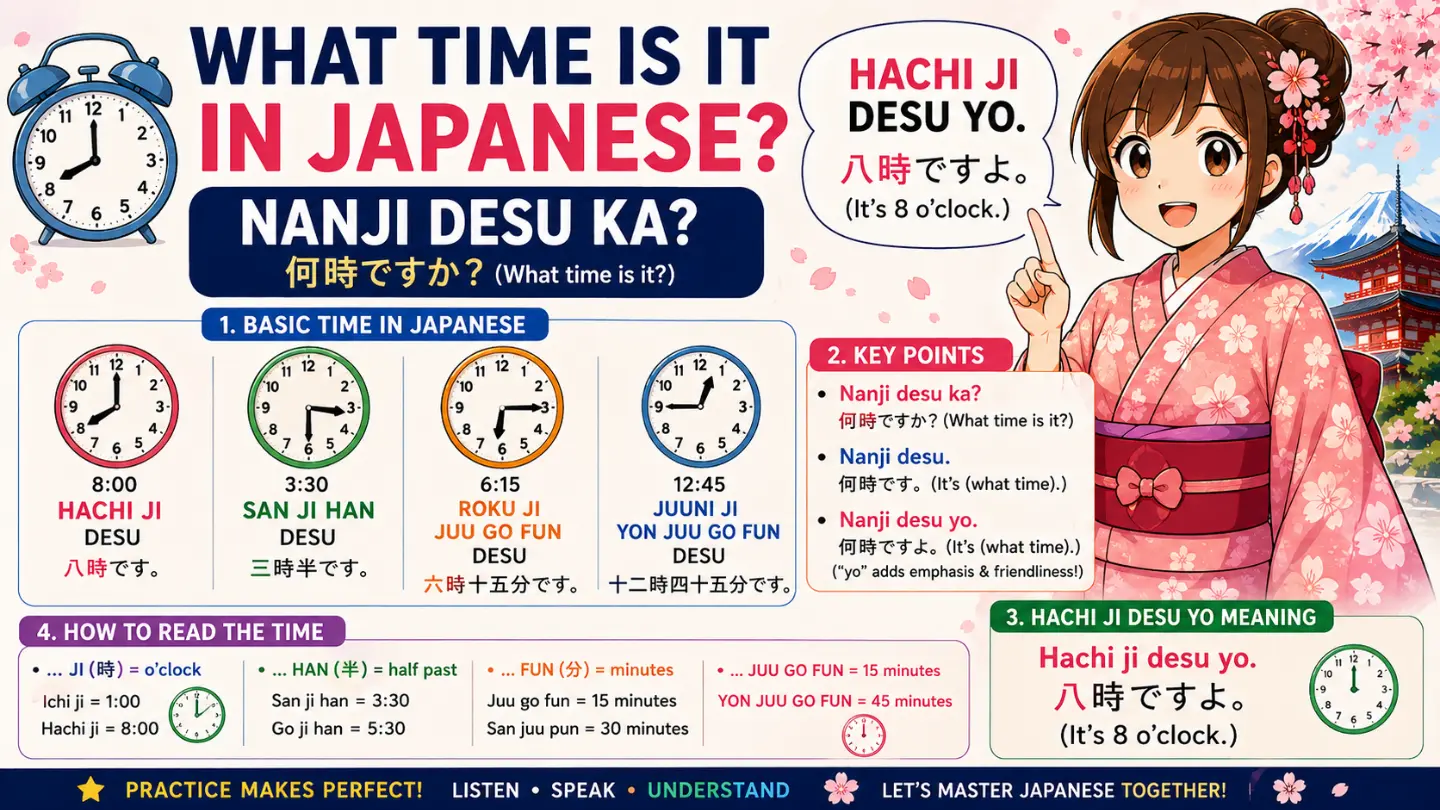

Welcome to Lesson 2 of this beginner Japanese series. In Lesson 1 we covered verb forms, particles, pointing words, What time is it in Japanese and invitations. Now we move into a different type of sentence structure — noun sentences — which are used to identify, describe, and talk about what things are.
This lesson is built around a morning dialogue between Emily, an exchange student staying with a Japanese host family, and a neighbour she meets outside. From this simple exchange we get three grammar points that are essential for everyday conversation: how to tell time in Japanese, how noun sentences work with desu and ja nai desu, and how hesitation noises like anou and etto function in natural Japanese speech.
This is also where Japanese weather vocabulary comes in for the first time — another everyday topic you’ll need very quickly when talking with Japanese speakers or homestay families.
If you haven’t finished Lesson 1 yet, start with how Japanese verbs work (masu and masen) and work through to the Lesson 1 grammar review before continuing here.
How to Tell Time in Japanese and Use Desu – Lesson 2 Beginner Grammar with Weather and Daily Vocabulary
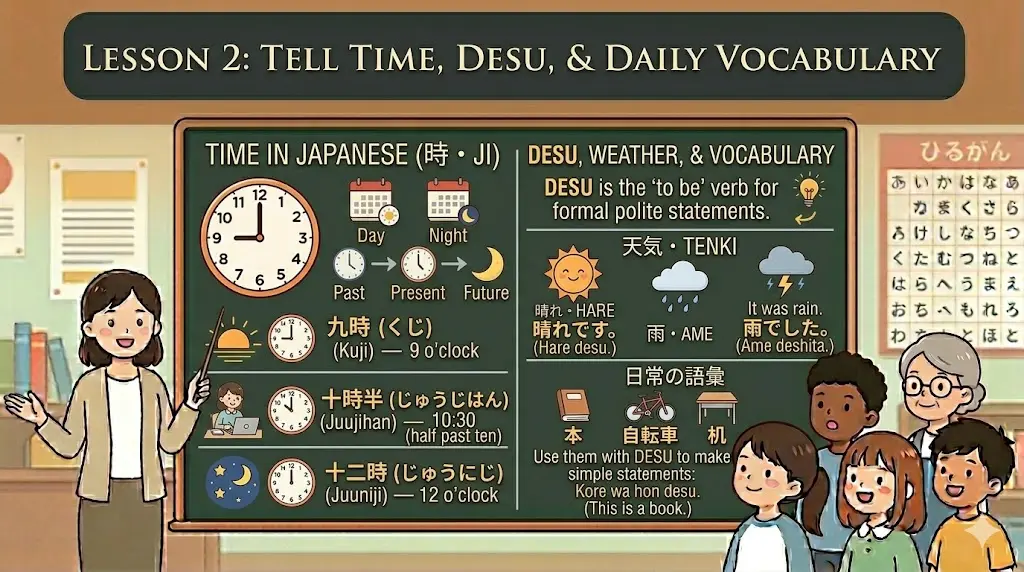
📌 What you’ll learn in this lesson: Noun sentences with desu / ja nai desu, how to tell time in Japanese (ichi-ji, ni-ji… + han for half past), Japanese weather words and daily life vocabulary, and how anou and etto work as hesitation noises in conversation.
Lesson 2, Dialogue 1 – A Morning Exchange
Emily is an exchange student living with the Yamamoto family in Japan. This scene takes place in the morning as she’s heading out — first inside the house, then outside where she bumps into a neighbour, Mr. Tanaka. This kind of light morning small talk is something you’ll need very early as a Japanese learner, whether you’re visiting Japan, doing a homestay, or just chatting with Japanese friends.
[Inside the Yamamoto house — Emily is heading out]
Emily: あのう、今、何時ですか。
Anou, ima nan-ji desu ka. — Um, what time is it now?
Yamamoto: えっと、八時ですよ。
Etto… hachi-ji desu yo. — Let’s see… it’s eight o’clock.
Emily: じゃ、行ってきます。
Ja, itte kimasu. — Well, see you later.
[Outside — Emily meets Mr. Tanaka, a neighbour]
Emily: いいお天気ですねえ。
Ii otenki desu nee. — It’s a beautiful day, isn’t it?
Tanaka: あ、エミリーさん。学校ですか。
A, Emily-san, gakkou desu ka. — Oh, Emily. Are you going to school?
Emily: いえ、今日は、学校じゃないです。アルバイトです。
Ie, kyou wa gakkou ja nai desu. Arubaito desu. — No, not school today. I’m working (part-time job).
Vocabulary from the Dialogue
| Romaji | Japanese | Kanji | Meaning |
|---|---|---|---|
| anou | あのう | — | um… (hesitation noise) |
| ima | いま | 今 | now |
| nan-ji | なんじ | 何時 | what time? |
| desu | です | — | is X (noun sentence affirmative) |
| etto | えっと | — | let’s see… (hesitation when searching for answer) |
| hachi-ji | はちじ | 八時 | eight o’clock |
| ii | いい | — | good |
| o- | お〜 | — | politeness prefix |
| tenki / otenki | てんき/おてんき | 天気 | weather / weather (polite) |
| gakkou | がっこう | 学校 | school |
| ja nai desu | じゃないです | — | is not X (noun sentence negative) |
| arubaito / baito | アルバイト/バイト | — | part-time job (from German “Arbeit”) |
Additional Vocabulary – Weather and Daily Life
| Romaji | Japanese | Kanji | Meaning |
|---|---|---|---|
| han | 〜はん | 半 | half (past the hour) |
| ame | あめ | 雨 | rain |
| yuki | ゆき | 雪 | snow |
| atsui | あつい | 暑い | hot |
| samui | さむい | 寒い | cold |
| shigoto | しごと | 仕事 | work / job |
| kaisha | かいしゃ | 会社 | company / work (the place) |
| kaimono | かいもの | 買い物 | shopping |
| sanpo | さんぽ | 散歩 | walk / taking a walk |
| yasumi | やすみ | 休み | time off / absence / (store) closed |
2-1-1 Noun Sentences – Desu and Ja Nai Desu
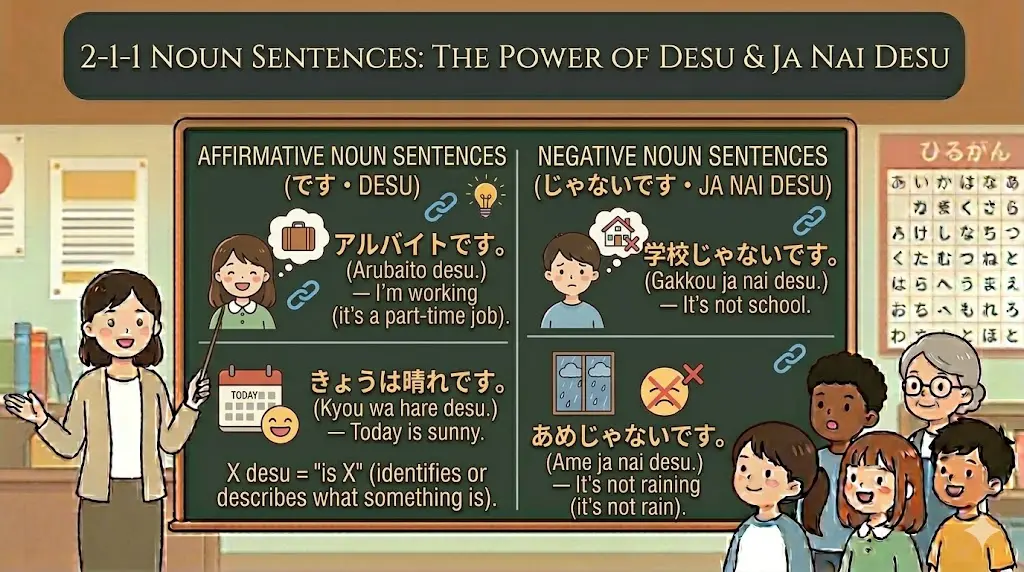
In Lesson 1 all the sentences were built around verbs (tabemasu, ikimasu, etc.). In Lesson 2 we introduce a completely different sentence structure — the noun sentence. Instead of describing an action, these sentences identify or describe what something is.
The structure is simple:
✅ Affirmative — X desu
X です = “is X”
アルバイトです。
Arubaito desu.
I’m working (it’s a part-time job).
❌ Negative — X ja nai desu
X じゃないです = “is not X”
学校じゃないです。
Gakkou ja nai desu.
It’s not school.
Both forms are non-past and formal — just like masu / masen from Lesson 1. Here are more examples:
あめですよ。 Ame desu yo. — It’s raining. (lit. It’s rain.)
これは学校ですか。 Kore wa gakkou desu ka. — Is this a school?
本田さんじゃないですか。 Honda-san ja nai desu ka. — Aren’t you Ms. Honda?
Using Negative Questions with Desu
Just like in Lesson 1 where negative questions work as invitations, negative noun sentences as questions also have special uses. They can express uncertainty or politely correct someone.
1. To show uncertainty:
Someone asks: 今、何時ですか。— What time is it?
四時じゃないですか。 Yo-ji ja nai desu ka. — Isn’t it four? (I think it might be four…)
2. To politely correct someone:
Someone says: 三時ですよ。— It’s three.
あのう、四時じゃないですか。 Anou, yo-ji ja nai desu ka. — Umm, isn’t it four? (gently correcting)
⚠️ Important — X wa Y desu is more flexible than it looks: The sentence Honda-san wa shigoto desu doesn’t literally mean “Ms. Honda IS work.” The Japanese X wa Y desu structure is much more open and contextual than English “X is Y.” It can mean she’s at work, work is her priority, her plan is to work, she loves her job — depending on context. Always consider the situation when interpreting these sentences, not just the literal translation.
2-1-2 How to Tell Time in Japanese – Ji and Han
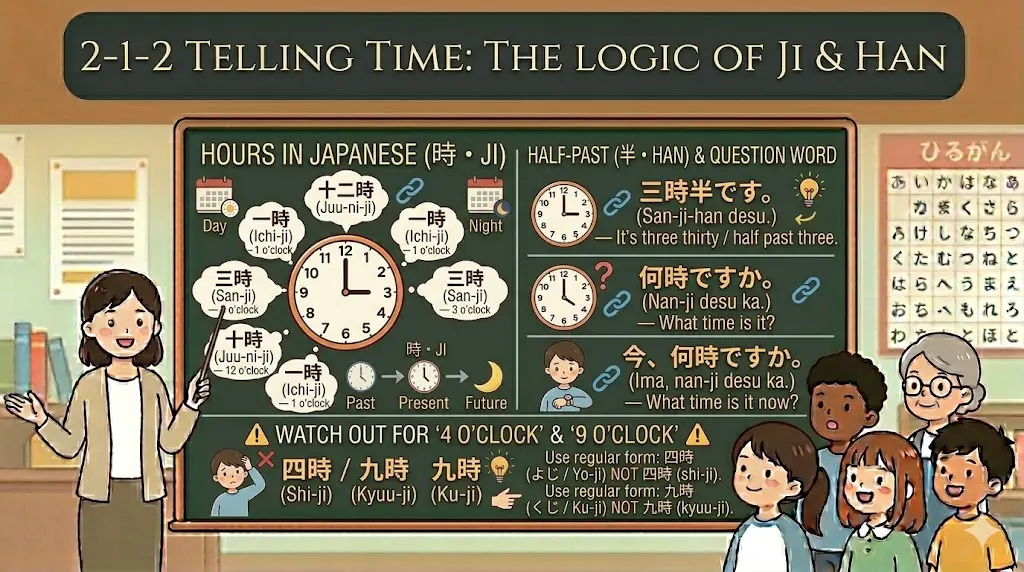
Telling the time in Japanese is very regular and easy to learn. Hours are formed by attaching -ji (時) to the number. To say “half past,” you add -han (半) after the hour.
Here are all twelve hours plus the question word and half-hour form:
一時Ichi-ji1 o’clock
二時Ni-ji2 o’clock
三時San-ji3 o’clock
四時Yo-ji4 o’clock
五時Go-ji5 o’clock
六時Roku-ji6 o’clock
七時Shichi-ji7 o’clock
八時Hachi-ji8 o’clock
九時Ku-ji9 o’clock
十時Juu-ji10 o’clock
十一時Juu-ichi-ji11 o’clock
十二時Juu-ni-ji12 o’clock
零時Rei-ji12 o’clock (midnight / 0:00)
何時Nan-jiWhat time?
〜時半〜ji-hanHalf past (e.g. 一時半 = 1:30)
今、何時ですか。 Ima, nan-ji desu ka. — What time is it now?
八時です。 Hachi-ji desu. — It’s eight o’clock.
三時半です。 San-ji-han desu. — It’s three thirty / half past three.
一時半ですか。 Ichi-ji-han desu ka. — Is it one thirty?
⚠️ Watch out for “4 o’clock”: Four o’clock in Japanese is yo-ji (よじ) — NOT shi-ji. The number four has two readings in Japanese (shi and yon/yo) and in time-telling, yo is used. Similarly, nine o’clock is ku-ji — not kyuu-ji. These are the two irregular readings to remember for clock time.
💡 Japanese time vs English time: In Japanese, when asking what time it is, ima (now) is commonly added — ima, nan-ji desu ka. This is more natural in Japanese than the English “what time is it?” which doesn’t usually include “now.” Keeping this small difference in mind helps your Japanese sound more authentic from early on.
2-1-3 Hesitation Noises – Anou and Etto
This grammar point is deceptively important. In Japanese conversation, silence can feel awkward, and jumping straight into a response can sound too blunt or mechanical. Hesitation noises are the natural way Japanese speakers fill that space — and using them correctly makes you sound much more natural.
あのう Anou
The all-purpose hesitation noise.
Used for any kind of hesitation — including to get someone’s attention, soften what you’re about to say, or buy time while you think.
Similar to English “um” or “excuse me.”
Anou, ima nan-ji desu ka.
Um, what time is it now?
えっと Etto
Used when searching for an answer.
Specifically signals that you’re thinking and looking for the right word or information. Not used to get attention.
Similar to English “let me see…” or “hmm…”
Etto… hachi-ji desu yo.
Let’s see… it’s eight o’clock.
⚠️ Anou vs Etto — when NOT to use etto: If someone asks your name, you’d use anou (to soften / get attention) but not etto — because you’re not “searching for the answer.” You know your name. Etto is specifically for when you’re genuinely thinking and searching. Using etto in the wrong place can imply you don’t know something you should know.
Beyond just these two words, there are other ways Japanese speakers slow down and soften their speech. These are all natural features of real Japanese conversation:
- Elongating the last vowel of a word — imaaa, anooo, shigotooo
- Inserting desu ne between chunks of words as a pause filler
いまあ、あのお、本田さんはあ、しごとおですよ。
Imaaa, anooo, Honda-san waaa, shigotooo desu.
— Honda is at work now. (spoken slowly with elongated vowels)
あしたですね、あのおですね、ぜんぶですね、つくります。
Ashita desu ne, anoo desu ne, zenbu desu ne, tsukurimasu.
— I’ll make all of it tomorrow. (with desu ne fillers)
🔑 Cultural note: Japanese communication values indirectness and avoiding confrontation. Hesitation noises, elongated vowels, and filler phrases like desu ne are all ways of “beating around the bush” — which in Japanese conversation is not a bad thing at all. It keeps the atmosphere soft and considerate. When you start using these naturally, your Japanese will feel much less like textbook speech and much more like how real people actually talk.
Japanese Weather Expressions for Beginners
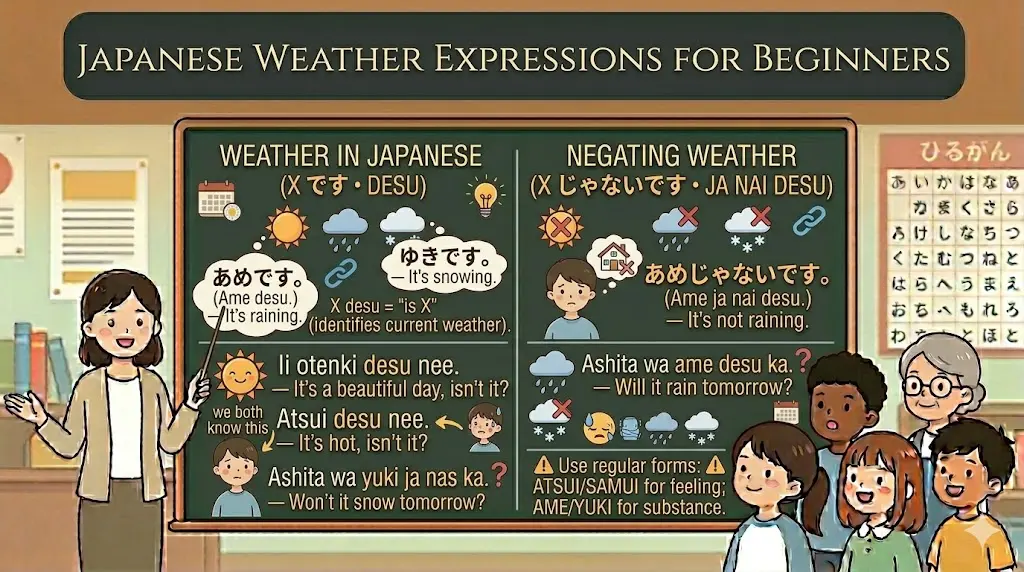
Weather small talk is one of the first things you need in any language — and Japanese is no exception. The noun sentence pattern (X desu) makes weather phrases very simple to construct.
| Expression | Japanese | Meaning |
|---|---|---|
| Ii otenki desu nee. | いいお天気ですねえ。 | It’s a beautiful day, isn’t it? |
| Ame desu. | あめです。 | It’s raining. (lit. It’s rain.) |
| Yuki desu. | ゆきです。 | It’s snowing. (lit. It’s snow.) |
| Atsui desu nee. | あついですねえ。 | It’s hot, isn’t it? |
| Samui desu nee. | さむいですねえ。 | It’s cold, isn’t it? |
| Ashita wa ame desu ka. | あしたはあめですか。 | Will it rain tomorrow? |
| Ashita wa yuki ja nai desu ka. | あしたはゆきじゃないですか。 | Won’t it snow tomorrow? |
🎌 Weather and the o- politeness prefix: You’ll notice tenki (weather) becomes otenki with the polite o- prefix attached. This is a very common pattern in Japanese — adding o- to certain nouns makes them sound more polite and refined. You’ve already seen it with onegaishimasu (o + negai) and otenki is another example. Not all words take o-, but when they do, it adds a layer of politeness appropriate for talking to neighbours, superiors, or people you don’t know well.
Drill A – Time and Noun Sentence Correction Drills
In this drill someone asks if it’s a specific time or situation. You correct them using iya or ie and give the right answer.
MODEL EXCHANGES
Cue: Ima ku-ji desu ka. — Is it nine o’clock?
今、九時ですか。
Response: Iya, juu-ji desu yo. — No, it’s ten.
いや、十時ですよ。
Cue: Ima san-ji desu ka. — Is it three o’clock?
今、三時ですか。
Response: Iya, yo-ji desu yo. — No, it’s four.
いや、四時ですよ。
Cue: Kyou wa baito desu ka. — Are you working today?
今日はバイトですか。
Response: Ie, baito ja nai desu. — No, I’m not.
いえ、バイトじゃないです。
Cue: Kyou wa ame desu ka. — Is it raining today?
今日はあめですか。
Response: Ie, ame ja nai desu. — No, it isn’t.
いえ、あめじゃないです。
Drill B – Say It in Japanese
You are heading out in the morning. Mrs. Yamamoto asks if you’re going to work. Reply to each situation in Japanese.
- Yes, I’m going to the company. Excuse me, what time is it?
→ Ee, kaisha desu. Anou, ima nan-ji desu ka. ええ、会社です。あのう、今、何時ですか。 - No, today is my day off. I’m going shopping.
→ Ie, kyou wa yasumi desu. Kaimono desu. いえ、今日はやすみです。買い物です。 - No, I’m not going to work today. I’m just going out.
→ Ie, kyou wa shigoto ja nai desu. Chotto dekakemasu. いえ、今日は仕事じゃないです。ちょっとでかけます。 - Yes, I’m going to work (side job). I’m not returning today. I’ll be back the day after tomorrow. See you later.
→ Ee, baito desu. Kyou wa kaerimasen. Asatte kaerimasu. Itte kimasu. ええ、バイトです。今日は帰りません。あさって帰ります。行ってきます。 - No, I’m just taking a little walk. It’s a beautiful day! Won’t you come, too?
→ Ie, chotto sanpo desu. Ii otenki desu nee! Issho ni kimasen ka. いえ、ちょっとさんぽです。いいお天気ですねえ!いっしょにきませんか。
Drill C – Act in Japanese (Role Play)
Use everything from this lesson — desu / ja nai desu, time expressions, weather vocabulary, hesitation noises, and the invitation patterns from Lesson 1 — in these realistic situations.
- Greet a neighbour in the morning. Mention how cold it is. Ask if it’s going to snow tomorrow.
→ Ohayou gozaimasu. Samui desu nee. Ashita wa yuki desu ka. おはようございます。さむいですねえ。あしたはゆきですか。 - Ms. Honda is heading out. Check if she’s going shopping. Warn her it will rain today.
→ Honda-san, kaimono desu ka. Kyou wa ame desu yo. 本田さん、買い物ですか。今日はあめですよ。 - You’ve been asked if it’s your day off today. Tell Ms. Yamamoto yes it is, but you’ll study.
→ Ee, yasumi desu. Demo, benkyou-shimasu. ええ、やすみです。でも、べんきょうします。 - A supervisor is looking for Mr. Yamada. Let her know he is absent today but will come tomorrow.
→ Kyou wa yasumi desu. Ashita kimasu yo. 今日はやすみです。あしたきますよ。 - Someone has mistaken you for Mr/s. Smith. Correct him. Use hesitation noises to avoid bluntness.
→ Anou… Sumisu-san ja nai desu. [your name] desu. あのう、スミスさんじゃないです。〇〇です。 - You’ve been invited to join a neighbourhood soccer team. Find out what time practice is every day.
→ Mainichi, renshuu wa nan-ji desu ka. 毎日、れんしゅうは何時ですか。 - You found an error in the schedule. Politely point out this is not 3:00 and should be 3:30.
→ Anou, san-ji ja nai desu ka. San-ji-han ja nai desu ka. あのう、三時じゃないですか。三時半じゃないですか。
💡 On Drill C item 5 — correcting someone politely: Notice how anou at the start immediately softens the correction. Without it, Sumisu-san ja nai desu (I’m not Smith) can sound quite blunt and even a bit rude. With anou at the front, it becomes gentle and considerate. This is exactly what hesitation noises are for in Japanese — and this kind of softening is expected and appreciated in social situations.
FAQ – Telling Time in Japanese, Desu and Hesitation Noises
How do you tell time in Japanese?
Hours in Japanese are formed by attaching -ji (時) to the number: ichi-ji (1 o’clock), ni-ji (2 o’clock), san-ji (3 o’clock), and so on. To ask “what time is it?” say ima, nan-ji desu ka (今、何時ですか). To say “half past,” add -han (半) after the hour — san-ji-han = 3:30. Two important irregular readings to remember: 4 o’clock is yo-ji (not shi-ji) and 9 o’clock is ku-ji (not kyuu-ji).
What does “desu” mean in Japanese?
Desu (です) is the formal, non-past noun sentence ending. It means “is X” — used to identify or describe what something is. Hachi-ji desu = it’s eight o’clock. Arubaito desu = I’m working (it’s a part-time job). Gakkou desu ka = is it school? The negative form is ja nai desu (じゃないです) — meaning “is not X.” Gakkou ja nai desu = it’s not school.
What is the difference between desu and masu in Japanese?
Desu ends noun sentences — sentences that say what something IS. Masu ends verb sentences — sentences that say what someone DOES. So baito desu = “it’s a part-time job” (noun sentence), while baito-shimasu = “I work a part-time job” (verb sentence). Both are formal and non-past. Both are essential for beginner Japanese — noun sentences with desu are introduced in Lesson 2, while verb sentences with masu were covered in Lesson 1.
What does “ja nai desu” mean in Japanese?
Ja nai desu (じゃないです) is the negative form of a noun sentence — it means “is not X.” Gakkou ja nai desu = it’s not school. Ame ja nai desu = it’s not raining. You can also form a negative question with it — yo-ji ja nai desu ka = “isn’t it four o’clock?” — which is used either to express uncertainty or to politely correct someone.
What does “anou” mean in Japanese?
Anou (あのう) is a versatile Japanese hesitation noise — similar to “um” or “excuse me” in English. It’s used to get someone’s attention, soften what you’re about to say, or buy time while thinking. Unlike etto, it’s not specifically for searching for an answer — its more of a general opener or social cushion. You can use it before almost any sentence to make it sound less blunt or more considerate.
What is the difference between anou and etto in Japanese?
Anou (あのう) is the all-purpose hesitation noise — for attention-getting, softening statements, or general hesitation. Etto (えっと) is specifically used when you’re searching for the right answer or word — like “let me think…” or “let me see…” If someone asks your name, you use anou to soften the response, but NOT etto — because using etto would imply you’re not sure of your own name. This subtle distinction matters for sounding natural in Japanese.
How do you say “what time is it?” in Japanese?
The standard way to ask the time in Japanese is ima, nan-ji desu ka (今、何時ですか) — literally “now, what time is it?” The word ima (now) is commonly included in Japanese, which is slightly different from English where “what time is it?” doesn’t usually include “now.” To soften the question when asking a stranger or superior, start with anou — anou, ima nan-ji desu ka — which is more natural and polite.
What does “arubaito” mean in Japanese?
Arubaito (アルバイト) or its shorter form baito (バイト) refers to part-time work — typically the kind of side job or part-time employment that students do. It’s borrowed from the German word “Arbeit” (work). This is a great example of how foreign words are absorbed into Japanese — converted into katakana and used with Japanese grammar. The compound verb form is baito-shimasu (to do a part-time job).
What’s Next?
You’ve now started Lesson 2 with the fundamental noun sentence structure — X desu / X ja nai desu — and added time-telling, weather vocabulary, daily life nouns, and hesitation noises to your toolkit. These combine very naturally with the verb patterns from Lesson 1 to create much more complete and realistic conversations.
The next step in Lesson 2 is learning how to talk about places, locations, and people — using ni, de, and other location particles that expand what you can say about where things are and where actions happen.
In the meantime, go back to the Lesson 1 grammar review and try combining noun sentences with verb sentences — for example: kyou wa yasumi desu. Demo, benkyou-shimasu. (Today is my day off. But I’ll study.) — that kind of connected speech is exactly what real Japanese sounds like.
頑張ってください!(Ganbatte kudasai!) — Keep going! 🎌
— Fumito フミト | reading-japanese.com
📚 Related lessons on reading-japanese.com: