
One of the most satisfying moments in learning Japanese is when you realise how regular and predictable the verb forms are. In this lesson we take the masu / masen pattern you already know and extend it into the past tense — which turns out to be just as simple.
We’re working through Dialogue 4 from Lesson 1, where Mr. Smith and Ms. Honda are preparing a PowerPoint presentation together at work. From this short exchange we get two grammar points that dramatically expand what you can say: Japanese past tense verbs (mashita and masen deshita), and compound verbs with shimasu — a pattern that lets you turn hundreds of nouns into verbs instantly.
Japanese Past Tense Verbs Explained – Mashita, Masen Deshita and Compound Verbs with Shimasu
This lesson builds directly on the previous posts in this series. If you haven’t been through how Japanese verbs work (masu and masen) and invitations, chotto and particle yo yet, those are worth reading first before continuing here.
📌 What you’ll learn in this lesson: How to talk about things that already happened in Japanese, how to form negative past sentences, the full four-form verb chart, and how shimasu compound verbs work — including borrowed English words turned into Japanese verbs.
Dialogue 4 – Preparing a Presentation
Mr. Smith and Ms. Honda are getting ready for an upcoming presentation. This is the kind of brief, practical exchange that happens constantly in Japanese workplaces — short, efficient, and built on the foundations of everything covered so far.
Honda: あれ、できましたか。
Are, dekimashita ka. — Is that done? (lit. Did that come to be?)
Smith: ええ、昨日、作りました。
Ee, kinou tsukurimashita. — Yes, I made it yesterday.
Honda: ちょっと練習しませんか。
Chotto renshuu-shimasen ka. — Shall we practice a little?
Smith: はい、わかりました。
Hai, wakarimashita. — Sure, okay. (lit. I understood / got it)
📌 Notice wakarimashita: You learned wakarimasu (I understand) in an earlier lesson. Here it appears in the past form — wakarimashita — which is the standard way to say “got it” or “understood” in Japanese. It’s used to confirm that you’ve received and accepted an instruction or piece of information. You’ll hear and use this one constantly in workplaces and classrooms.
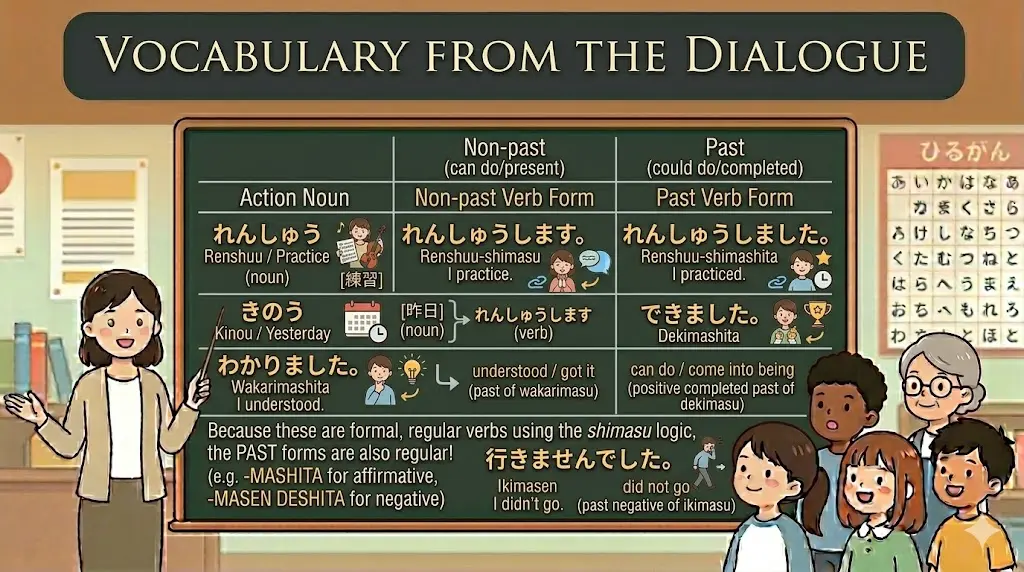
Vocabulary from the Dialogue
| Romaji | Japanese | Kanji | Meaning |
|---|---|---|---|
| dekimasu | できます | — | can do / come into being |
| dekimashita | できました | — | could do / came into being / is done (past) |
| kinou | きのう | 昨日 | yesterday |
| renshuu | れんしゅう | 練習 | practice (noun) |
| renshuu-shimasu | れんしゅうします | 練習します | practice (verb) |
| wakarimashita | わかりました | — | understood / got it (past of wakarimasu) |
Additional Vocabulary – Shimasu Compound Verbs
| Noun | Japanese | Verb form | Meaning |
|---|---|---|---|
| benkyou | べんきょう / 勉強 | べんきょうします | study |
| meeru | メール | メールします | email / text |
| kopii | コピー | コピーします | copy / make a copy |
| denwa | でんわ / 電話 | でんわします | make a phone call |
| unten | うんてん / 運転 | うんてんします | drive |
| ototoi | おととい | — | the day before yesterday (time word) |
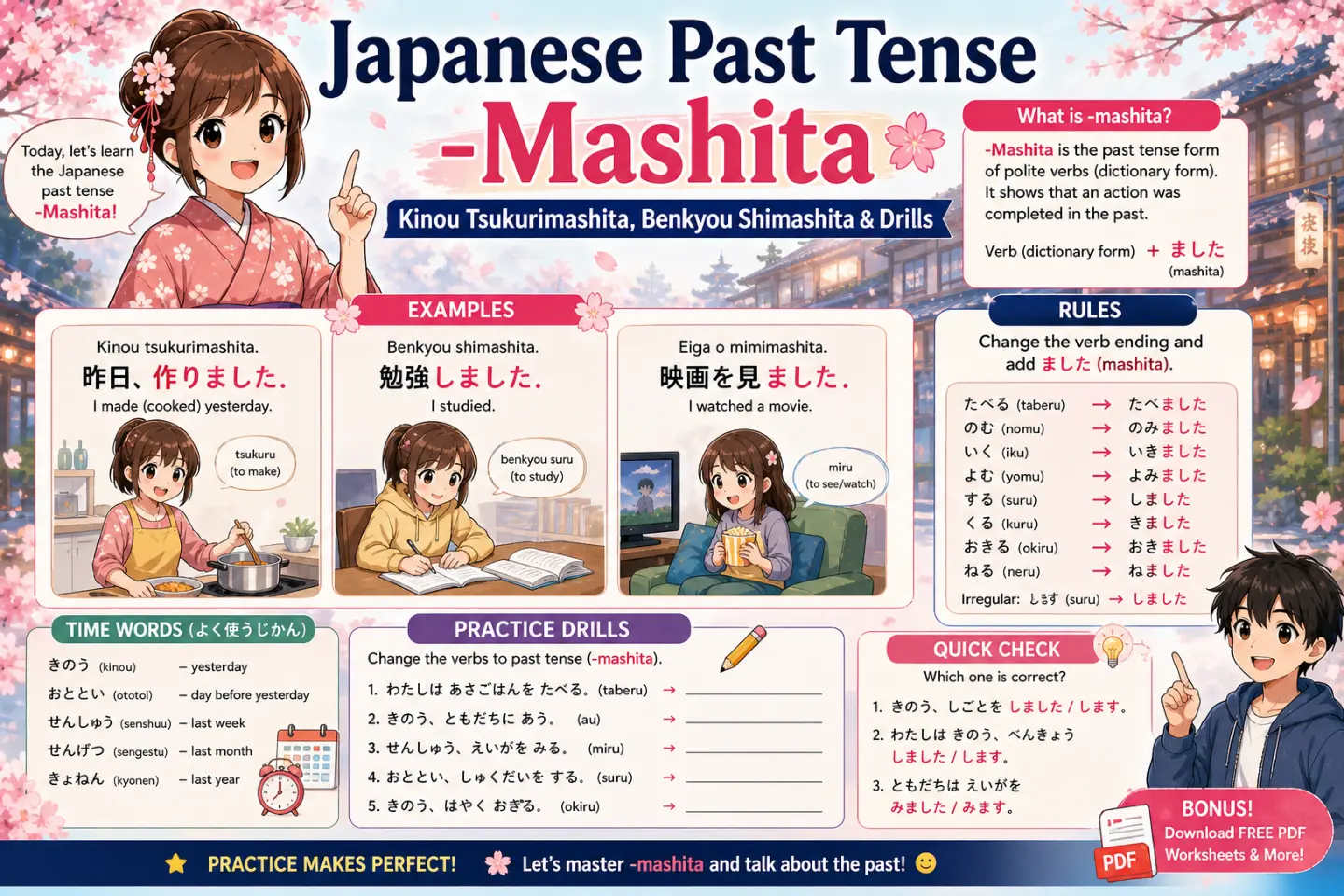
1-4-1 Japanese Past Tense – Mashita and Masen Deshita
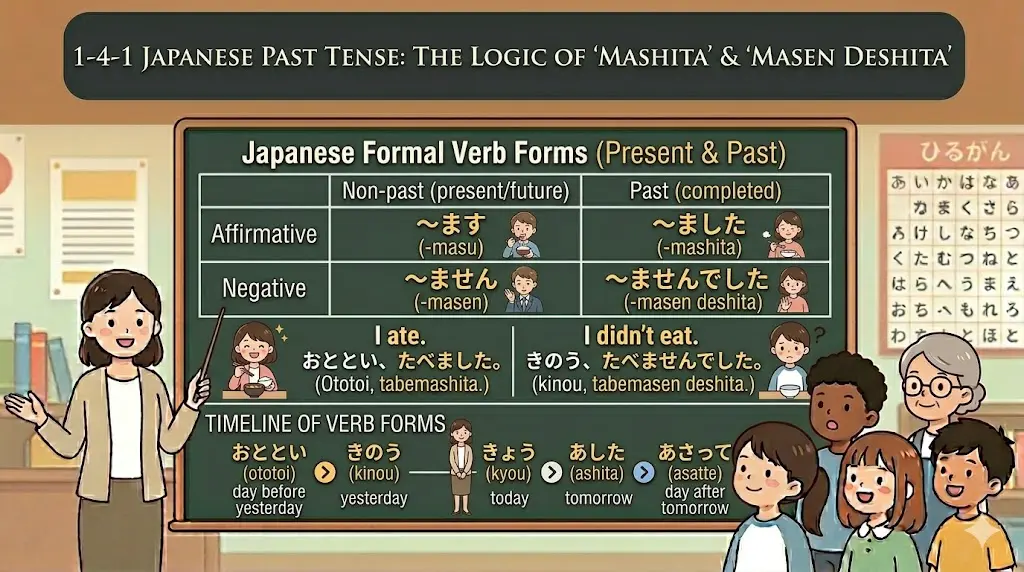
The good news about Japanese past tense is that it follows the exact same logic as the non-past forms you already know — you just swap the endings. There’s no irregular conjugation to memorize for these formal forms, which makes Japanese past tense surprisingly easy once you get the pattern.
Here is the complete four-form chart for Japanese formal verbs:
| Affirmative | Negative | |
|---|---|---|
| Non-past present habit / future | 〜ます (-masu) tabemasu — I eat / I will eat | 〜ません (-masen) tabemasen — I don’t eat / won’t eat |
| Past completed action | 〜ました (-mashita) tabemashita — I ate | 〜ませんでした (-masen deshita) tabemasen deshita — I didn’t eat |
Here’s how that same pattern looks applied to several different verbs:
行きました。 Ikimashita. — I went.
行きませんでした。 Ikimasen deshita. — I didn’t go.
作りました。 Tsukurimashita. — I made it.
作りませんでした。 Tsukurimasen deshita. — I didn’t make it.
わかりました。 Wakarimashita. — I understood / got it.
わかりませんでした。 Wakarimasen deshita. — I didn’t understand.
The timeline of Japanese verb forms looks like this:
おととい
ototoi
day before yesterday
きのう
kinou
yesterday
きょう
kyou
today
あした
ashita
tomorrow
あさって
asatte
day after tomorrow
| Time word | Japanese | Kanji | Used with |
|---|---|---|---|
| ototoi | おととい | — | past verb (mashita / masen deshita) |
| kinou | きのう | 昨日 | past verb (mashita / masen deshita) |
| kyou | きょう | 今日 | either form depending on context |
| ashita | あした | — | non-past verb (masu / masen) |
| asatte | あさって | — | non-past verb (masu / masen) |
| mainichi | まいにち | 毎日 | non-past verb (habitual) |
🎌 Why is mashita easier than English past tense? In English, past tense is often irregular — go → went, eat → ate, make → made. In the formal Japanese verb system, the past tense is completley regular. You always swap masu → mashita and masen → masen deshita. Every single time. No exceptions for these formal forms. Once you know the non-past form of a verb, you automatically know the past form too.
1-4-2 Compound Verbs – Noun + Shimasu in Japanese
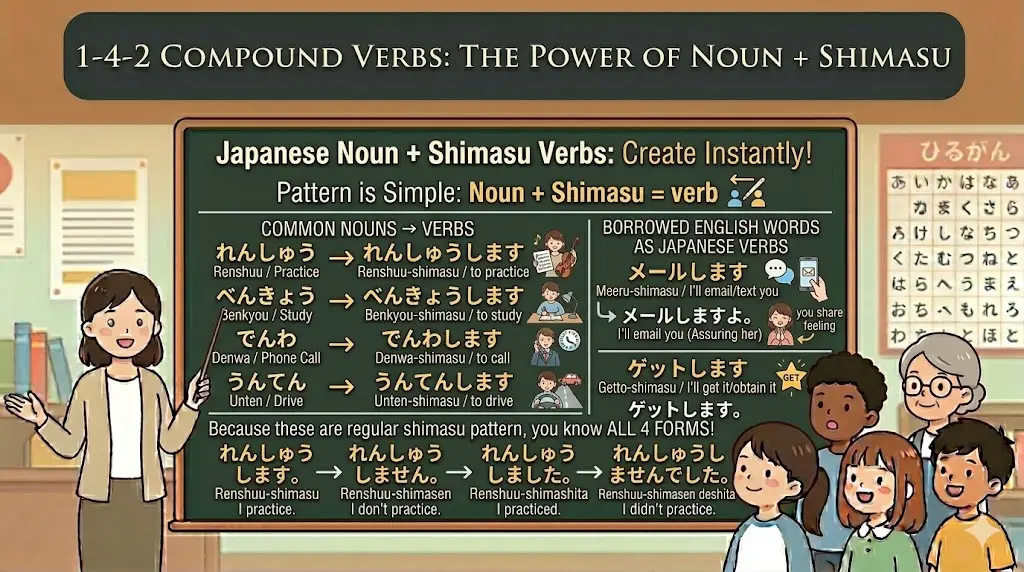
This grammar point is one of the most productive and useful things in the whole Japanese language for beginners. Once you understand it, you can instantly create dozens of new verbs.
The pattern is simple: Noun + shimasu = verb. When a noun describes an action — like “practice,” “study,” “email,” “copy,” “drive” — you just attach shimasu to it and it becomes a Japanese verb.
れんしゅうれんしゅうしますpractice → to practice
べんきょうべんきょうしますstudy → to study
でんわでんわしますphone call → to call
メールメールしますemail → to email / text
コピーコピーしますcopy → to copy / make a copy
うんてんうんてんしますdrive → to drive
Because these are all regular verbs using the shimasu pattern, you already know all four of their forms without memorising anything new:
れんしゅうします。 Renshuu-shimasu. — I practice. / I will practice.
れんしゅうしません。 Renshuu-shimasen. — I don’t practice.
れんしゅうしました。 Renshuu-shimashita. — I practiced.
れんしゅうしませんでした。 Renshuu-shimasen deshita. — I didn’t practice.
Borrowed English Words as Japanese Verbs
Here’s where it gets really interesting — when English verbs are borrowed into Japanese, they’re converted into nouns (written in katakana) and then the shimasu pattern is attached. This means even very modern, tech-related actions become Japanese verbs this way.
メールします。 Meeru-shimasu yo. — I’ll email (or text) you.
Getto-shimasu. — I’ll get it. / I’ll obtain it.
Appuroodo-shimasu. — I’ll upload it.
🔑 Important: Even though these words come from English, make sure you pronounce them the Japanese way — using Japanese syllable sounds, not English pronunciation. Meeru is not “mail” — its two syllables: me-e-ru. Kopii is ko-pi-i. Your English intuition for how these words sound can actually work against you here, so be conscious about switching to Japanese pronunciation each time.
For more on how loanwords work in Japanese and how katakana is used to write them, check out my post on learning hiragana and katakana — there’s a section on English loanwords in katakana that directly connects to this grammar point.
Drill A – Using Masen Ka with Chotto
Someone asks if you’ll do something. You confirm you will and suggest doing it together using a chotto + negative question invitation.
MODEL EXCHANGES
Cue: Renshuu-shimasu ka. — Will you practice?
れんしゅうしますか。
Response: Ee, chotto renshuu-shimasen ka. — Yes, why don’t we practice a little?
ええ、ちょっとれんしゅうしませんか。
Cue: Kaimasu ka. — Will you buy it?
かいますか。
Response: Ee, chotto kaimasen ka. — Yes, why don’t we buy a little?
ええ、ちょっとかいませんか。
Practice with: benkyou-shimasu ka / denwa-shimasu ka / renshuu-shimasu ka / dekakemasu ka
Drill B – Contrasting Past with Kinou and Ototoi
Someone makes an assumption about what you did yesterday using ne. You confirm yesterday but deny the day before.
MODEL EXCHANGES
Cue: Yasumimashita ne. — You were absent, right?
やすみましたね。
Response: Kinou wa yasumimashita kedo, ototoi wa yasumimasen deshita.
きのうはやすみましたけど、おとといはやすみませんでした。
I was absent yesterday, but I wasn’t the day before yesterday.
Cue: Ikimashita ne. — You went, right?
いきましたね。
Response: Kinou wa ikimashita kedo, ototoi wa ikimasen deshita.
きのうはいきましたけど、おとといはいきませんでした。
I went yesterday, but I didn’t the day before yesterday.
Practice with: kaimashita ne / benkyou-shimashita ne / tsukurimashita ne / yomimashita ne
Drill C – Say It in Japanese
You’ve been asked about your plans for this weekend. Try each one yourself before checking the answer.
- I’ll study. → Benkyou-shimasu. べんきょうします。
- Why don’t we talk tomorrow? → Ashita, hanashimasen ka. あした、はなしませんか。
- I emailed you yesterday. Didn’t you read it? → Kinou, meeru-shimashita. Yomimasen deshita ka. きのう、メールしました。よみませんでしたか。
- I don’t know, but why don’t we go out? → Wakarimasen kedo, dekakemasen ka. わかりませんけど、でかけませんか。
- I’ll just take a break, but how about you, Mr. Yamada? → Chotto yasumimasu kedo, Yamada-san wa? ちょっとやすみますけど、山田さんは?
Drill D – Act in Japanese (Role Play)
These situations practice past tense, compound verbs, and invitations all in realistic workplace and everyday contexts. Try each one out loud.
- You’ve just finished writing a report. Announce that it’s done. → Dekimashita. できました。
- You’ve just given an intern some instructions. Check if he understood. → Wakarimashita ka. わかりましたか。
- As you part, let Ms. Honda know you’ll email her. → Meeru-shimasu yo. メールしますよ。
- A classmate is late showing up. Suggest that someone call her. → Denwa-shimasen ka. でんわしませんか。
- While driving, you see Ms. Honda walking. Offer her a ride. → Honda-san, norimasen ka. 本田さん、のりませんか。
- Ms. Honda is looking for something. Ask if she didn’t buy it yesterday. → Kinou, kaimasen deshita ka. きのう、かいませんでしたか。
💡 On Drill D item 1 — dekimashita: This is one of the most satisfying words to use in a Japanese workplace. Dekimashita! (できました!) means “it’s done!” or “I finished it!” — it literally means “it came into being.” You can use it to announce that any task is complete, whether it’s a report, a presentation, an email, or a project. Its short, punchy, and very natural.
FAQ – Japanese Past Tense and Shimasu Compound Verbs
How do you form the past tense in Japanese?
In Japanese formal speech, the past tense is formed by changing the verb ending. For affirmative past, you change -masu to -mashita. For negative past, you change -masen to -masen deshita. So for example, ikimasu (I go / will go) becomes ikimashita (I went), and ikimasen (I don’t go) becomes ikimasen deshita (I didn’t go). This pattern is completely regular for all formal verbs — there are no irregular forms to memorize in the polite masu style.
What is the difference between masu and mashita in Japanese?
Masu (ます) is the non-past affirmative form — it covers present habits and future actions. Mashita (ました) is the past affirmative form — it describes a completed action. So tabemasu means “I eat” or “I’ll eat,” while tabemashita means “I ate.” The only change is the ending: masu → mashita. Everything before the ending stays exactly the same.
What does “wakarimashita” mean in Japanese?
Wakarimashita (わかりました) is the past form of wakarimasu (I understand). It means “I understood” or more naturally in English — “got it,” “I see,” or “understood.” In Japanese workplaces and classrooms, wakarimashita is the standard response to confirm that you’ve received and accepted an instruction. It’s much more natural in this context than just saying hai (yes).
What does “dekimashita” mean in Japanese?
Dekimashita (できました) comes from dekimasu, which means “can do” or “come into being.” Dekimashita means “it’s done,” “I finished,” or “it was completed.” You’ll use it constantly in work and study situations to announce that a task is complete. Dekimasu ka (non-past) can also mean “can you do it?” or “is it possible?”
What are compound verbs in Japanese (shimasu verbs)?
Compound verbs in Japanese are formed by taking a noun that describes an action and adding shimasu to it. For example, renshuu (practice, noun) + shimasu = renshuu-shimasu (to practice). Benkyou (study) + shimasu = benkyou-shimasu (to study). Denwa (phone call) + shimasu = denwa-shimasu (to make a phone call). These compound verbs all follow the same four-form conjugation pattern as any other masu verb, making them very easy to use once you know the base noun.
How do English words become Japanese verbs?
When English verbs are borrowed into Japanese, they’re first converted into katakana nouns, then the shimasu pattern is attached. So “email” becomes meeru (メール) and then meeru-shimasu (メールします — to email / text). “Upload” becomes appuroodo and then appuroodo-shimasu. “Get” becomes getto and then getto-shimasu. The important thing to remember is that even though these words come from English, you need to pronounce them using Japanese syllable sounds — not English pronunciation.
What is the negative past form in Japanese?
The negative past form in Japanese is -masen deshita (ませんでした). You take the negative non-past ending -masen and add deshita to make it past. For example: ikimasen (don’t go) → ikimasen deshita (didn’t go). Tabemasen (don’t eat) → tabemasen deshita (didn’t eat). Wakarimasen (don’t understand) → wakarimasen deshita (didn’t understand). This form is used both in statements (“I didn’t go”) and questions (“Didn’t you read it?”).
What is the word for “yesterday” in Japanese?
“Yesterday” in Japanese is kinou (きのう / 昨日). Related time words: ototoi (おととい) = the day before yesterday, kyou (きょう / 今日) = today, ashita (あした) = tomorrow, asatte (あさって) = the day after tomorrow, mainichi (まいにち / 毎日) = every day. Time words go at the beginning of a Japanese sentence (before the subject), and they can be used with wa to create contrast — like kinou wa ikimashita kedo, ototoi wa ikimasen deshita (I went yesterday, but I didn’t the day before).
What’s Next?
You now have the complete four-form Japanese verb chart — non-past affirmative, non-past negative, past affirmative, past negative. That’s the entire foundation of formal Japanese verb conjugation in one simple table. You can now talk about things you do, things you don’t do, things you did, and things you didn’t do — which covers the vast majority of basic conversational needs.
Combined with the shimasu compound verbs from this lesson, you’ve added a whole range of new actions to your vocabulary without having to memorize complex new verb forms.
Head over to Japanese verb conjugation for beginners for a full overview of how this system expands in later lessons, or go back to the invitations and chotto lesson to practice combining the new past forms with the invitation patterns you already know — sentences like kinou renshuu-shimashita kedo, ashita mo shimasen ka (I practiced yesterday — shall we do it tomorrow too?) start becoming very natural!
頑張ってください!(Ganbatte kudasai!) — Keep going! 🎌
— Fumito フミト | reading-japanese.com
📚 Related lessons on reading-japanese.com: