
千里の道も一歩から
Senri no michi mo ippo kara
“A journey of a thousand miles begins with a single step.” — Lao Tzu
If your just starting to learn Japanese, one of the first and most important things you need to know is how to greet people. Japanese greetings are not just words — they come with body language, levels of politeness, and specific situations where they are used. Getting them right from the beginning really does make a big difference.
In this post I’m going to cover all the essential Japanese daily greetings and ritual expressions that you’d use in real life — from saying good morning to leaving the house, from meeting someone for the first time to saying goodnight. I’ll also explain the pronunciation and give you the Japanese script (hiragana and kanji) for each one, so you can start reading along too.
If you haven’t read my post on the top 3 languages spoken in Japan yet, that’s a great place to start before diving into phrases. And if your completely new, check out my guide on how to learn Japanese at home for free.
📌 How to use this post: Don’t try to memorize everything at once. Learn each greeting through the sample dialogue, practice the pronunciation out loud, and add body language (bowing!) where it says to. That’s how Japanese people actually learn these expressions too.
Classroom Phrases – What Your Teacher Will Say
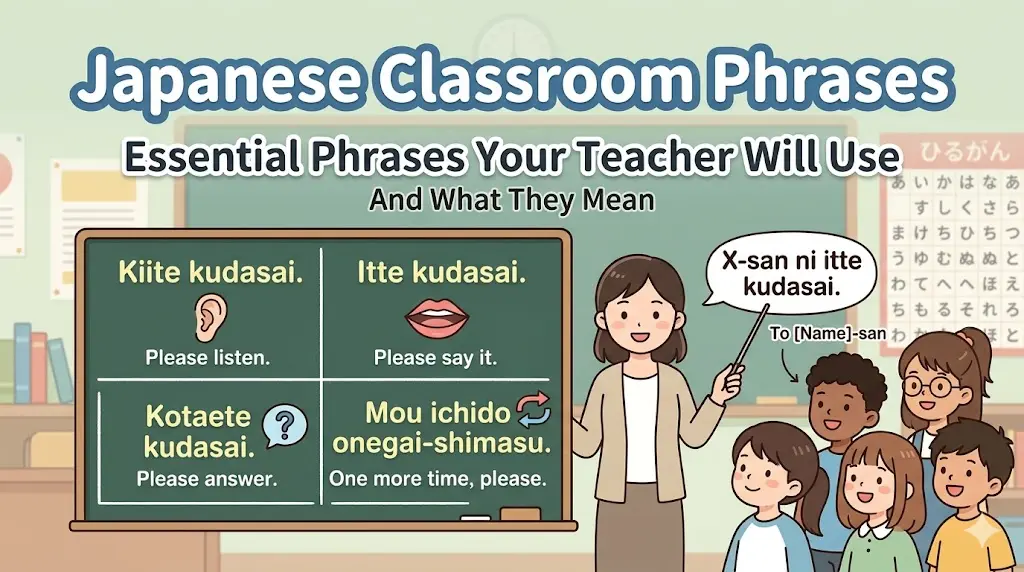
Before getting into greetings, here are some common Japanese classroom instructions. If your learning Japanese in a class or following along with a teacher-led course, you’ll hear these a lot. You don’t need to produce them yourself — just understand what action is expected when you hear them.
| Romaji | Japanese | Meaning |
|---|---|---|
| Kiite kudasai. | 聞いてください。 | Please listen. |
| Itte kudasai. | 言ってください。 | Please say it. |
| Kotaete kudasai. | 答えてください。 | Please answer. |
| Mou ichido onegai-shimasu. | もう一度お願いします。 | One more time, please. |
| X-san ni itte kudasai. | Xさんに言ってください。 | Please say it to Mr/s. X. |
The goal from the very beginning of Japanese study is to avoid using English in the classroom as much as possible. Even just understanding these five instructions helps a lot with that.
Japanese Morning Greetings – Ohayou and Ohayou Gozaimasu
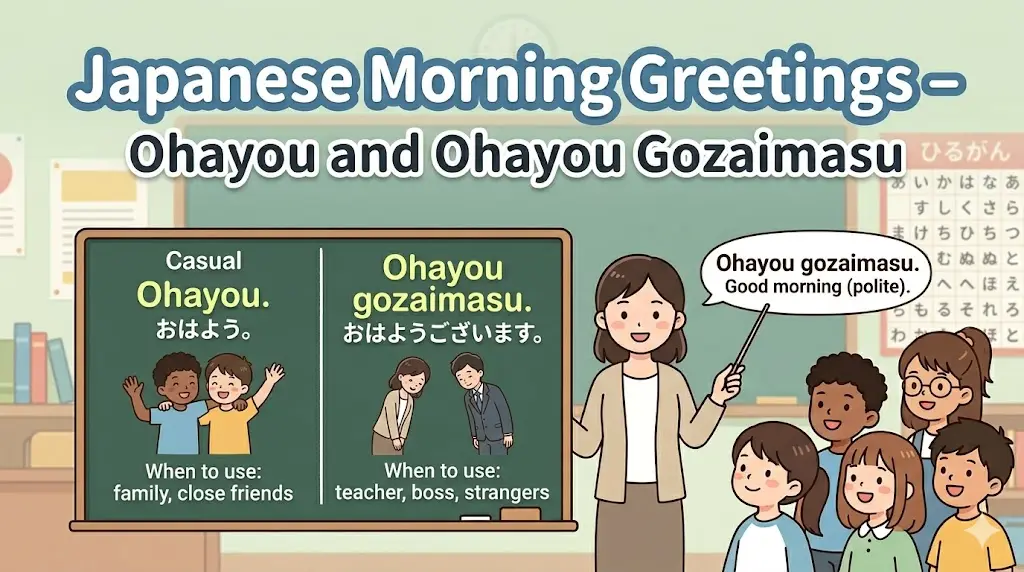
This is probably the first Japanese greeting most people learn — and for good reason. “Good morning” in Japanese has two forms depending on how formal the situation is.
A: おはよう。 — Ohayou. — Good morning.
B: おはようございます。 — Ohayou gozaimasu. — Good morning (polite).
| Expression | Japanese | When to use |
|---|---|---|
| Ohayou | おはよう | Casual — family, close friends |
| Ohayou gozaimasu | おはようございます | Polite — teacher, boss, strangers |
| Konnichiwa | こんにちは | Hello / Good afternoon (any situation) |
| Konbanwa | こんばんは | Good evening (any situation) |
⚠️ Important: Gozaimasu is the politeness marker. Never use the short form (おはよう) with your teacher, boss, or supervisor — always use the full おはようございます with them. Konnichiwa and konbanwa work in both formal and casual situations, so their safe to use with anyone.
How to Say Thank You in Japanese – Arigatou and Doumo
One of the most searched Japanese phrases online is “how do you say thank you in Japanese” — and there are actually several ways depending on the situation!
A: どうぞ。 — Douzo. — Go ahead / Please take it.
B: ああ、どうも。 — Aa, doumo. — Oh, thanks.
| Expression | Japanese | Meaning |
|---|---|---|
| Douzo | どうぞ | Go ahead / here you go / please (have some) |
| Doumo | どうも | Thanks / sorry (casual, versatile) |
| Arigatou | ありがとう | Thank you (casual) |
| Arigatou gozaimasu | ありがとうございます | Thank you (polite, present) |
| Arigatou gozaimashita | ありがとうございました | Thank you for what you did (past) |
Quick note on Doumo: this little word is surprisingly useful. It can express both gratitude and apology depending on context. You can also combine it — doumo arigatou gozaimasu means “thank you very much.” And gozaimashita (past tense) is used when the action is already completed — for example, thanking someone after they’ve done something for you.
How to Address Someone in Japanese – San and Sensei
A: 本田さん。 — Honda-san. — Mr/s. Honda.
B: はい。 — Hai. — Yes.
| Title | Japanese | Used for |
|---|---|---|
| ~san | 〜さん | Mr / Ms — attach to first name, last name, or role |
| ~sensei | 〜先生 | Teacher, professor, doctor |
| Hai | はい | Yes / present / here you are |
⚠️ Don’t attach ~san to your own name or to people in your group when talking to outsiders. And always use ~sensei (not ~san) when talking about or to your teacher — using ~san for a teacher is actually considered a bit rude in Japanese culture.
How to Apologize in Japanese – Sumimasen and Gomen Nasai
Japanese has more ways to say sorry than most languages, and each one has a slightly different feeling. This is one of the things that surprises many beginner Japanese learners!
A: あ、すみません! — A, sumimasen! — Oh, sorry!
B: いえ、いえ。 — Ie, ie. — No, no (it’s fine).
| Expression | Japanese | Meaning / When to use |
|---|---|---|
| Sumimasen | すみません | Sorry / excuse me / thank you (general) |
| Sumimasen deshita | すみませんでした | Sorry for what I’ve already done |
| Gomen | ごめん | Sorry (very casual) |
| Gomen nasai | ごめんなさい | Sorry / excuse me (casual, gentle) |
| Dou itashimashite | どういたしまして | You’re welcome / not at all |
| Ie / Iie / Iya | いいえ/いえ/いや | No / that’s wrong (formal → casual) |
Sumimasen is probably one of the most useful words in everyday Japanese. It’s used not just to apologize, but also to get someone’s attention (“excuse me”), and even to express gratitude when someone has gone out of their way to help you. You’ll hear it constantly in Japan.
Want more detail on Japanese apology culture? Check out my post on common Japanese phrases for travel — it covers sumimasen in a lot more real-life situations.
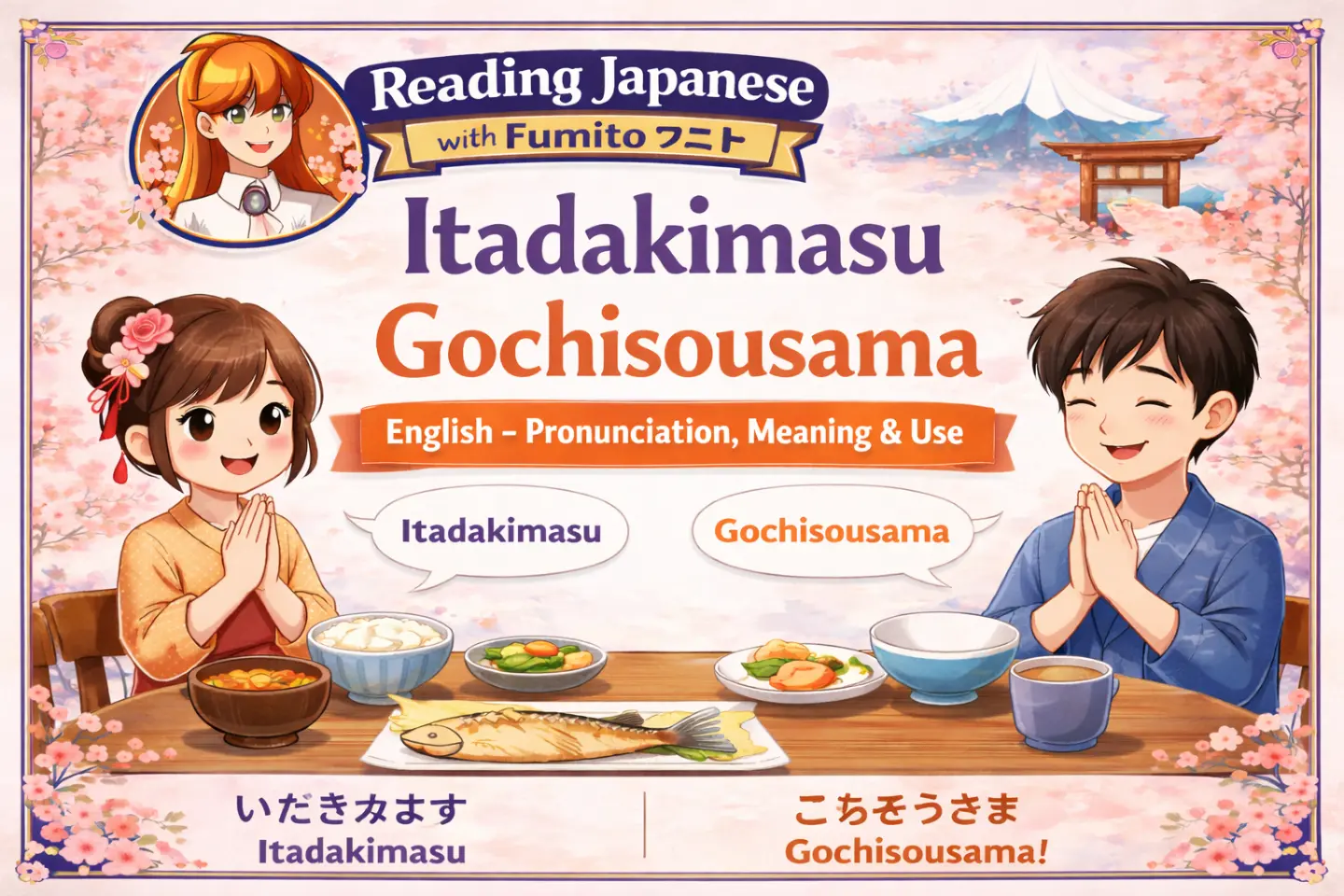
Japanese Phrases Before and After Eating – Itadakimasu and Gochisousama
This is something that really suprises people who are new to Japanese culture — Japanese people say a ritual phrase before and after every meal. Even when eating alone!
A: どうぞ。 — Douzo. — Please (have some).
B: じゃあ、いただきます。 — Jaa, itadakimasu. — Well then, I’ll have some.
B: ごちそうさまでした。 — Gochisou sama deshita. — Thank you (that was delicious).
| Expression | Japanese | Meaning |
|---|---|---|
| Jaa / Ja | じゃあ/じゃ | Well then / if so |
| Itadakimasu | いただきます | Ritual expression before eating (lit. “I humbly accept”) |
| Gochisou-sama | ごちそうさま | Ritual expression after eating |
| Gochisou-sama deshita | ごちそうさまでした | Formal / after the meal is fully finished |
Itadakimasu literally means “I will humbly receive” and shows appreciation for the food, the person who cooked it, and even the animals and plants that became the meal. It’s also used when receiving a gift. Gochisousama comes from a word that means “feast” and expresses gratitude for the food you just ate. Even when Japanese people eat alone, they tend to quietly whisper both of these — it’s deeply habitual.
How to Ask for Something in Japanese – Onegaishimasu
A: すみません。お願いします。 — Sumimasen. Onegaishimasu. — Excuse me. Can you give that to me please.
B: はい、どうぞ。 — Hai, douzo. — Sure, here you go.
| Expression | Japanese | Meaning |
|---|---|---|
| Onegai-shimasu | お願いします | Please / I’m asking you a favor |
You’ll use onegaishimasu constantly in Japan — at restaurants, shops, taxis, anywhere you need something. It’s polite and versatile. Just point at what you want and say onegaishimasu and you’re good!
Entering a Room in Japanese – Shitsurei Shimasu
A: 失礼します。 — Shitsurei-shimasu. — Excuse me. (entering)
B: はい、どうぞ。 — Hai, douzo. — Yes, come in.
| Expression | Japanese | When to use |
|---|---|---|
| Shitsurei-shimasu | 失礼します | Entering a room, interrupting, leaving |
| Shitsurei-shimashita | 失礼しました | After you’ve already done something interruptive |
📌 Tip: Always knock on the door twice before entering and saying shitsurei shimasu. This is standard etiquette in Japanese workplaces and schools.
Literally this phrase means “I’m about to do something rude” — which sounds strange in English but is a perfectly normal polite expression in Japanese. It’s used when entering a room, interrupting someone, or excusing yourself to leave.
Leaving and Coming Home in Japanese – Itte Kimasu and Tadaima
These are phrases that are deeply embedded in Japanese home life. Families say these to eachother every single day without thinking — and they carry a real sense of warmth and connection.
A: いってきます。 — Itte kimasu. — See you later. (I’m heading out)
B: いってらっしゃい。 — Itte rasshai. — See you later. (Take care)
A: ただいま。 — Tadaima. — I’m home.
B: おかえりなさい。 — Okaerinasai. — Welcome back.
| Expression | Japanese | Meaning |
|---|---|---|
| Itte kimasu | いってきます | Said when leaving home (implies you’re coming back) |
| Itte rasshai | いってらっしゃい | Response to itte kimasu (take care / see you) |
| Tadaima | ただいま | Said when arriving home (“I’m back”) |
| Okaerinasai | おかえりなさい | Response to tadaima (“welcome back”) |
Itte kimasu literally means “I’ll go and come back” — so it’s specifically for situations where you’re leaving but will return. You wouldn’t use it if you were moving out permanently! These expressions are also sometimes used between officemates when one person steps out for an errand.
How to Introduce Yourself in Japanese for the First Time
One of the most searched things by Japanese beginners — “how do I introduce myself in Japanese?” Here is exactly how it’s done.
A: はじめまして。本田です。 — Hajimemashite. Honda desu. — How do you do. I’m Honda.
B: 本田さんですか。スミスです。どうぞよろしく。 — Honda-san desu ka. Sumisu desu. Douzo yoroshiku. — You’re Mr. Honda? I’m Smith. Nice to meet you.
| Expression | Japanese | Meaning |
|---|---|---|
| Hajimemashite | はじめまして | How do you do (first time meeting) |
| ~desu | 〜です | I am / it is / you are |
| ~desu ka | 〜ですか | Are you / is it (question form) |
| Yoroshiku | よろしく | Nice to meet you (casual) |
| Yoroshiku onegai-shimasu | よろしくお願いします | Please treat me favorably (formal) |
💡 Cultural tip: After someone tells you their name, it is customary in Japanese introductions to confirm it by repeating it back as a question — “Honda-san desu ka?” It might seem unnecessary to English speakers, but this is standard Japanese etiquette. Also make sure you bow when saying hajimemashite!
Hajimemashite literally means “for the first time.” You can respond to someone else’s hajimemashite with your own, or go straight into “douzo yoroshiku onegai shimasu.”
For more on Japanese self introductions, including how to talk about yourself, your job, and your hobbies, check out my post on Japanese self-introduction phrases (jiko shoukai) for beginners.
Japanese Farewell Phrases – Sayonara, Ja Mata, and Otsukare Sama
A: じゃ、失礼します。 — Ja, shitsurei-shimasu. — Well then, I’ll go.
B: ああ、お疲れさまでした。 — Aa, otsukare-sama deshita. — Thanks for the good work.
A: じゃ、また。 — Ja, mata. — Well, see you.
B: さよなら。 — Sayonara. — Goodbye.
| Expression | Japanese | Meaning |
|---|---|---|
| Otsukare-sama | おつかれさま | Thanks for your work / you must be tired |
| Otsukare-sama desu | おつかれさまです | Formal, for ongoing work |
| Otsukare-sama deshita | おつかれさまでした | The work is finished / well done |
| Ja, mata | じゃ、また | See you later (casual) |
| Sayonara / Sayounara | さよなら/さようなら | Goodbye |
Interestingly, sayonara is often used for more permanent goodbyes in real Japanese life — like when you’re leaving a job or saying goodbye for a long time. Between close friends and coworkers, ja mata (“see you later”) or otsukare are much more common every day farewells.
How to Say Goodnight in Japanese – Oyasumi and Oyasuminasai
A: じゃ、おやすみ。 — Ja, oyasumi. — Well, goodnight.
B: ああ、おやすみなさい。 — Aa, oyasuminasai. — Ah, goodnight.
| Expression | Japanese | Meaning |
|---|---|---|
| Oyasumi | おやすみ | Goodnight (casual) |
| Oyasuminasai | おやすみなさい | Goodnight (polite) |
Just like ohayou vs ohayou gozaimasu — oyasumi is the casual version you use with family and close friends, while oyasuminasai is the more polite form. In anime you’ll hear oyasumi a lot between characters who are close!
Japanese Pronunciation Guide for Beginners – Syllables and Special Cases
One question beginners always ask is — “is Japanese pronunciation hard?” The honest answer is: not really, compared to other Asian languages. Japanese doesn’t have tones like Chinese or Vietnamese. It has a pretty consistent set of sounds, and once you learn them, reading romaji (the romanised version of Japanese) becomes quite straightforward.
Japanese syllables are built in four ways:
- A vowel alone: a, i, u, e, o
- A consonant + a vowel: ka, ki, ku, ke, ko etc.
- A consonant alone: n, and doubled consonants (tt, ss, pp, kk)
- A consonant + y + a vowel: kya, kyu, kyo etc.
The five Japanese vowels are always pronounced the same way — this is different from English where vowels change sound depending on the word:
| Vowel | Sounds like… | Example word |
|---|---|---|
| a | “ah” (as in father) | a-ri-ga-tou |
| i | “ee” (as in feet) | i-ta-da-ki-ma-su |
| u | “oo” (short, like “book”) | su-mi-ma-sen |
| e | “eh” (as in pet) | se-n-se-i |
| o | “oh” (as in go) | o-ha-you |
Complete Japanese Syllable Chart
| k | g | s | z | t | d | n | h | p | b | m | y | r | w | |
|---|---|---|---|---|---|---|---|---|---|---|---|---|---|---|
| a | ka | ga | sa | za | ta | da | na | ha | pa | ba | ma | ya | ra | wa |
| i | ki | gi | shi | ji | chi | ji | ni | hi | pi | bi | mi | — | ri | — |
| u | ku | gu | su | zu | tsu | zu | nu | fu | pu | bu | mu | yu | ru | — |
| e | ke | ge | se | ze | te | de | ne | he | pe | be | me | — | re | — |
| o | ko | go | so | zo | to | do | no | ho | po | bo | mo | yo | ro | — |
| ya | kya | gya | sha | ja | cha | — | nya | hya | pya | bya | mya | — | rya | — |
| yu | kyu | gyu | shu | ju | chu | — | nyu | hyu | pyu | byu | myu | — | ryu | — |
| yo | kyo | gyo | sho | jo | cho | — | nyo | hyo | pyo | byo | myo | — | ryo | — |
🟡 Yellow cells = special pronunciation cases (see below)
Special pronunciation rules to remember:
• s + i = shi (not “si”)
• z + i = ji (not “zi”)
• t + i = chi (not “ti”)
• t + u = tsu (not “tu”)
• d + i = ji (not “di”)
• d + u = zu (not “du”)
If you want a full audio guide to Japanese pronunciation, NHK World’s free Japanese lessons are excellent — they’re made by Japan’s public broadcaster and completely free to use. I also recommend Anki flashcards for drilling hiragana and katakana once you know the sounds. And for a beginners full course, Duolingo’s Japanese course is a good starting point alongside this material.
FAQ – Japanese Greetings and Phrases
What is the most common Japanese greeting?
The most common everyday Japanese greeting is konnichiwa (こんにちは), which means hello or good afternoon. In the morning, Japanese people say ohayou gozaimasu (good morning), and in the evening, konbanwa (good evening). Between people who know each other well, even shorter casual forms like just ohayou are used.
What does “sumimasen” mean in Japanese?
Sumimasen (すみません) can mean “excuse me,” “I’m sorry,” or even “thank you” depending on the situation. It’s used to get someone’s attention, to apologize for a small inconvenience, or to express gratitude when someone has done something for you. Its one of the most useful and frequently used words in Japanese.
What does “itadakimasu” mean?
Itadakimasu (いただきます) is a ritual expression said before eating. It literally means “I will humbly receive” and expresses gratitude for the food. Japanese people say it before every meal — even when eating alone. It can also be used when receiving a gift.
How do you say goodbye in Japanese?
The most well-known way is sayonara (さよなら), but in everyday life, Japanese people more commonly use ja mata (じゃ、また — “see you later”) between friends, or otsukare sama deshita (おつかれさまでした) between coworkers at the end of the workday. Sayonara tends to carry a feeling of a longer or more permanent goodbye.
What is the difference between “ohayou” and “ohayou gozaimasu”?
Both mean “good morning” but the difference is formality. Ohayou is casual and used with family and close friends. Ohayou gozaimasu is the polite form and should always be used with your teacher, boss, or anyone senior to you. Using the casual form with a superior is considered impolite in Japanese culture.
How do you introduce yourself in Japanese for the first time?
Start with hajimemashite (はじめまして — “how do you do”), then say your name followed by desu (e.g. “Fumito desu”). Finish with douzo yoroshiku onegai shimasu (どうぞよろしくお願いします — “nice to meet you / please treat me well”) and bow. The other person will usually mirror your introduction.
Is Japanese pronunciation hard for English speakers?
Compared to languages like Chinese, Korean or Arabic — Japanese pronunciation is actually quite accessible for English speakers. It has only 5 vowel sounds that never change, and no tones. The main challange is getting used to the rhythm of the syllables and a few special sound rules (like “shi” instead of “si” and “tsu” instead of “tu”). With regular listening practice, most people get comfortable with Japanese pronunciation within a few weeks.
What does “tadaima” mean?
Tadaima (ただいま) is said when you arrive back home. It roughly means “I’m back” or “I’m home.” The person at home responds with okaerinasai (おかえりなさい — “welcome back”). These are ritual expressions used in Japanese homes every single day and are a lovely example of how language and culture are deeply connected in Japan.
Final Thoughts
Japanese greetings are much more than just words — each one carries culture, respect, and social context. From the moment you wake up (ohayou gozaimasu) to the moment you go to sleep (oyasuminasai), these expressions are woven into the fabric of daily Japanese life.
The best way to learn them is to practice them in context — say them out loud, use them with body language, and don’t just memorize a list. Pick two or three that feel useful to you right now and start using them today.
If your ready for the next step, head over to my posts on how to learn hiragana and katakana fast, or explore common Japanese phrases for travel. And if you have questions about anything covered here, drop them in the comments — I read every single one!
頑張ってください!(Ganbatte kudasai!) — Keep going! 🎌
— Fumito フミト | reading-japanese.com
📚 You might also like:
- Itadakimasu Gochisousama English – Pronunciation, Meaning & Use
- 1000 Most Common Japanese Words for Daily Conversation [With Examples & PDF]
- 1000 Most Common Japanese Words 2026 (With Meaning, Romaji & Example Sentences)
- Hiragana Stroke Order Practice PDF (2026) – Master Perfect Writing in 7 Days!
- Hiragana Chart with Audio – Your 10-Minute Beginner Guide!